
Supreme Court Ruling On Maintenance After Divorce Calls The Bluff Of Muslim Clergy, Hindutva Activists: Zakia Soman
New
Age Islam News Bureau
14 July 2024
• Supreme Court Ruling On
Maintenance After Divorce Calls The Bluff Of Muslim Clergy, Hindutva Activists:
Zakia Soman
• Burqa-Clad Muslim Women Take Part In Khuti Puja
Rituals To Herald Durga Puja In Kolkata
• Arab, Kurdish Women: Physical Freedom Of Leader
Ocalan Must Be Achieved
• Photojournalist YaldaMoaieryDocuments Struggles,
Bravery Of Iranian Women In Sausalito Exhibit
Compiled
by New Age Islam News Bureau
URL:
-----
Supreme Court Ruling On
Maintenance After Divorce Calls The Bluff Of Muslim Clergy, Hindutva Activists:
Zakia Soman
By Ranjit Bhushan
Jul 13, 2024
 Zakia Soman, founder of the
Bharatiya Muslim Mahila Andolan, a non-governmental women's rights
organisation.(PTI file)
Zakia Soman, founder of the
Bharatiya Muslim Mahila Andolan, a non-governmental women's rights
organisation.(PTI file)
------------
Under Section 125 of the
CrPC, all women are entitled to alimony, so why leave out Muslim women, says
Zakia Soman, founder of Bharatiya Muslim Mahila Andolan.
In a landmark decision, the
Supreme Court has affirmed that a divorced Muslim woman is entitled to seek
maintenance from her former husband under Section 125 of the Criminal Procedure
Code (CrPC). This ruling, issued on June 10, has been lauded by prominent
activist Zakia Soman, founder of the Bharatiya Muslim Mahila Andolan, a
non-governmental women's rights organisation.
“I welcome the apex court
ruling. It is long overdue, but finally it has come and is a significant
incremental step in the right direction,” Soman said in an interview.
"Under Section 125
CrPC, all women are entitled to alimony, so why leave out Muslim women? Hindu
and Christian women, who’s laws are codified, can seek help, but not Muslims,
which is unfortunate,” she said.
According to Zakia, any
discrimination against Muslim women in matters of alimony under the secular
laws of the country would be regressive and against the principles of gender
justice and equality.
The apex court ruled that
all married and divorced women, including Muslim women illegally divorced by
pronouncement of `triple talaq’, are entitled to claim maintenance from their
husbands under Section 125 of the Code of Criminal Procedure (CrPC), 1973,
“irrespective of her personal law”.
In separate but concurring
judgments, a Bench of Justices BV Nagarathna and Augustine George Masih held
that the right of Muslim women to seek recourse to Section 125 will not be
eclipsed by the provisions of the Muslim Women (Protection of Rights on
Divorce) Act, 1986, enacted by the then Rajiv Gandhi government after the
landmark and controversial Shah Bano judgement of 1985.
The Shah Bano case was a
maintenance lawsuit, in which the Supreme Court delivered a judgment favouring
maintenance given to an aggrieved divorced Muslim woman.
Asked how she saw the SC
ruling vis a vis triple talaq, Zakia said that this was an issue that precedes
the BJP government coming to power.
“The fact remains that
marginalization of women has been a reality, and this SC ruling calls the bluff
of the Muslim clergy and Hindutva activists. It is truly an appropriate judgment,
and such protection offered by no less than the Supreme Court is a big shot in
the arm,” she pointed out.
The apex court said that
“the right to seek maintenance under Section 125 of CrPC, 1973, is invokable
even during the sustenance of marriage and thereby is not contingent upon
divorce.”
Zakia Soman, a university
professor from Gujarat, has been a strong advocate for the rights of Muslim
women. She has worked and written extensively on issues of peace and justice,
minority and human rights.
Hailing the emerging
consciousness among Muslim women, she said it is not just the individual alone
but their family and the ecosystem that has become conducive to change.
"Afterall, no one woman can fight the system alone. She must have the
support of her family and close ones, without which any litigation or public
action is simply not possible,” Zakia said.
The SC ruling came on an
appeal filed by Mohammad Abdul Samad, who had been ordered to pay ₹20,000 as
monthly maintenance to his ex-wife by a family court in Telangana. The woman
had moved the family court under Section 125 of CrPC stating that Samad had
given her triple talaq. The HC, on December 13, 2023, said “that several
questions are raised which need to be adjudicated” but “directed the petitioner
to pay 10,000 as interim maintenance”.
Challenging this, Samad told
the apex court that the HC had failed to appreciate that the provisions of 1986
Act, which is a Special Act, would prevail over the provisions of Section 125
CrPC, which is a general Act.
"As you can see, a lone
woman from remote Telangana has moved the courts and won justice. This should
never be underestimated,” Zakia said.
Source: Telegraph India
Please click the following
URL to read the full text of the original story:
-----
Burqa-Clad Muslim Women Take
Part In Khuti Puja Rituals To Herald Durga Puja In Kolkata
Jul 14, 2024
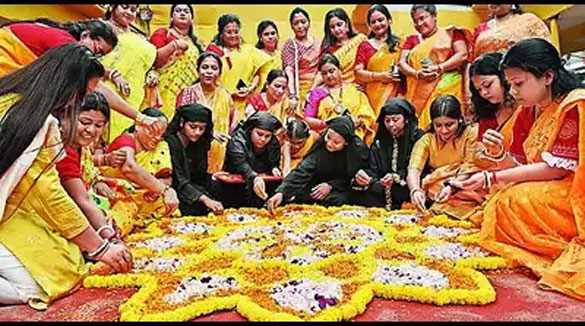 Kolkata: Durga Puja has
transcended the barriers of religion in some pockets in Kolkata, with Muslims
joining hands with their Hindu neighbours to observe Khuti Puja, marking the
beginning of preparations for Bengal’s biggest festival.
Kolkata: Durga Puja has
transcended the barriers of religion in some pockets in Kolkata, with Muslims
joining hands with their Hindu neighbours to observe Khuti Puja, marking the
beginning of preparations for Bengal’s biggest festival.
At Unnayani Sangha in
Kundghat, burqa-clad women joined hands with others to draw a huge ‘alpona’
(decorative designs made on the floor or wall) with flower petals during a
Khuti Puja ceremony on Saturday. Their nimble fingers brought the design to
life through colourful petals. Their Hindu neighbours collaborated as well in
preparing the beautiful multicoloured design successfully, which took nearly
two hours.
“I have come to participate
in this Durga Puja ritual as we like this festival so much that being a part of
it has always been a matter of happiness to us. I am a newcomer in this area. I
stayed at Belghoria earlier, where we would visit Durga Puja pandals every
year,” said Sultana Khatun.
Soniya Mondal, who also took
part in the ritual along with her two kids, said, “Like Eid, we enjoy a lot in
Durga Puja. We relish everything from new dresses to outings during those four
days.”
“Muslim women have been
coming here to participate in the ritual for the last few years. We too think
our festival remains incomplete without their participation,” said Joy
Mukherjee, secretary of the puja committee.
At Munsigunj in Kidderpore
area, 75% of the members of a Durga Puja committee are Muslim. “The nearly
five-decade-old puja is a much-awaited festival in our locality. Even our
children keep aside some of their new clothes bought during Eid intact to wear
during the four puja days,” said Md Latif, treasurer of the puja committee of
Five Star Club. A Durga Puja at Alimuddin Street is fully organized by Muslim
youths. At Bhowanipur 75 Palli Puja, an interfaith Khuti Puja will be held on
Sunday in the presence of religious leaders from different faiths.
Tripura govt to issue 10,000
job offers before Durga pujaTripura government to offer record-breaking 10,000
job opportunities before Durga puja in October. This initiative, set to be the
highest in two decades, reflects the government's focus on state development
and youth empowerment.111576999
MasikDurgashtami 2024: Date,
Shubh Muhurat, Puja Rituals and SignificanceLearn about MasikDurgashtami 2024,
falling on July 14th. This auspicious day is dedicated to worshipping Goddess
Durga, with devotees observing fasts and performing puja rituals to seek
blessings and spiritual enlightenment.111708350
AbirChatterjees first-look
motion poster for Bohurupi is out; Film to release this Durga PujaGet a sneak
peek at 'Bohurupi' with the first-look motion poster featuring Abir Chatterjee.
Directed by Nandita Roy and Shiboprosad Mukherjee, the film is based on true
events from 1998 to 2005. Don't miss the clash between 'Bohurupi' and
SrijitMukherji's 'Tekka' this Pujo season!111575068
Source: Times Of India
-----
Arab, Kurdish Women:
Physical freedom of leader Ocalan must be achieved
14 July 2024
PeymanAlloush, the member of
the Kongra Star in the Euphrates Canton, said that the philosophy of leader
Abdullah Ocalan helped woman to know their rights and freedom.
Alloush stated that Kurdish
and Arab women and women around the world will continue to struggle for the
physical freedom of leader Abdullah Ocalan.
Alloush pointed out that
women in NE Syria have organized themselves according to the thought of leader
Abdullah Ocalan. She concluded her speech by saying that women got the strength
from the struggle of leader Abdullah Ocalan.
Member of the People's
Municipality in the city of Sirin, Nisreen Sheikh Kyar, said that the isolation
imposed on the leader Abdullah Ocalan is inconsistent with the laws of
humanity.
“We have not received any
information about our leader for 4 years. Furthermore, The European Committee
against Torture colludes with the
Turkish occupation state regarding the leader situation in Imrali prison”
Nisreen Sheikh added.
Sheikh drew attention to the
global campaign for the leader’s physical freedom, and said: “We, Kurdish and
Arab women, and women of all other nations will struggle to achieve leader physical freedom."
The administrator at Kongra
Star in the city of Sirin, Yusra Ibrahim Khalil
stated that the Turkish state is tightening the isolation on the leader
Abdullah Ocalan day after day and said: “The Turkish state and its allies
imposed isolation on the leader Abdullah Ocalan in order to prevent the spread
of the leader’s ideas."
Source: Hawarnews.Com
https://hawarnews.com/en/arab-kurdish-women-physical-freedom-of-leader-ocalan-must-be-achieved
-----
Photojournalist YaldaMoaiery
documents struggles, bravery of Iranian women in Sausalito exhibit
By COLLEEN BIDWILL
July 13, 2024
In her home country, Iranian
photojournalist YaldaMoaiery would never be able to put on a show like the one
that was hung this week at the Sausalito Center for the Arts: photos that offer
“glimpses of truth” about what life is really like in Iran, especially for
women “fighting for normal rights.”
“Over the past 20 years, I
have devoted myself to documenting the struggles of Iranian women: their
defiance against government dress codes, their relentless pursuit of education,
their battles in courts for the custody of their children and their empty-handed
protests in the streets. Women’s issues and their relentless quest for freedom
have dominated my work, reflecting the pervasive oppression and discrimination
rooted in my gender and the patriarchal nature of my profession,” Moaiery
writes in her artist statement for the exhibit.
With Moaiery’s images
usually accompanying news stories over the years, this will be the first time
that her work will be shown in this way: in a large collection where people can
see a more “complete story,” she says, of what she’s captured behind the lens
all these years, including images that may seem “normal” at first glance.
“I showed one of my pictures
to a journalist recently,” she says. “And I asked her, ‘What is this picture
of?’ It was a picture of a woman singing in a private ceremony. And she said,
‘It’s a normal picture.’ I said, ‘No, it’s not a normal picture. Women cannot
sing in Iran. So if the police come to this ceremony, they’re going to arrest
all of them and put them in jail.’ The story behind these pictures are
powerful,” says Moaiery, who often shares the context of her images on social
media.
Presented by the Sausalito
Center for the Arts and Artistic Freedom Initiative, a nonprofit organization
that facilitates pro bono immigration representation and resettlement
assistance for international artists who are persecuted or censored, her
exhibit, “Standing in the Dust,” will run through July 28 at the Sausalito
gallery.
A panel discussion on “The
Power of Photography in Defying Censorship,” with Moaiery, Ashley Tucker, the
co-executive director of the Artistic Freedom Initiative, Moaiery’s friend,
Washington Post journalist Jason Rezaian, a Marin native who spent 544 days in
prison after being convicted of false espionage charges while living and working
in Tehran for the Post, and moderator Persis Karim, the director of the Center
for Iranian Diaspora Studies at San Francisco State University, is at 2 p.m.
Sunday at the Sausalito Center for the Arts. A $20 donation is suggested at the
door. For more information about the exhibit and to RSVP for the panel, go to
sausalitocenterforthearts.org.
“I think that the moment is
right,” Rezaian says. “Iran will inevitably be part of our national
conversation, and anything that we can do to give a more nuanced and human
picture of the place, as well as give a voice to the people and their
struggles, is really essential. It’s what I’ve tried to do in my reporting.
It’s what drew me to her images so long ago. Sadly, neither of us are able to
work there at this point. This show will coincide with 10 years since I was
arrested and thrown out of Iran after spending a year and a half in prison. And
our windows into that country are fewer and fewer and fewer. So Yalda’s work is
really essential and critical. It’s special to be able to do this here. I’m
hoping that Marin County gives Yalda the reception that she deserves.”
They first connected in the
2000s when Rezaian, then working as a freelance journalist out of San
Francisco, was looking for a photographer for the stories he was reporting on
in Iran.
“The stories that I was
telling were very colorful and vivid and didn’t match up with people’s
impressions of Iran,” Rezaian says. “I found Yalda on the internet. She was one
of the first Iranian photojournalists who had their own website, and her images
really matched up with my impressions of the country.”
While Moaiery says that
being a photojournalist is a job that doesn’t exist now in her country, she
hopes to continue finding places to showcase her work as well as eventually
pick back up her work as a photojournalist here.
Growing up, Moaiery didn’t
hear much about people being photojournalists. It wasn’t really on her radar
when she first started learning photography as a teenager from her father, who
did it as a hobby.
But when she started
photographing the wars in Iraq and Afghanistan and conflicts with the United
States, she decided her work could be used to “show the world the things I
think are important,” says Moaiery, who has shot conflicts, wars and natural
disasters around the world.
“(Iran) do not keep any
evidence. They can disappear everything they want suddenly. So it’s really
important to document these things with pictures or with words and tell people
what’s happening to my people,” she says.
For her work, Moaiery was
awarded the 2018 Courage in Journalism Award for her iconic image of the 2018
Iranian protests and the 2023 Wallis Annenberg Justice for Women Journalists
Award from the International Women’s Media Foundation.
She’s been imprisoned six
times throughout her career, mostly recently in 2022 while covering the
protests that erupted after the death of 22-year-old Mahsa Amini, while she
under the custody of Iran’s morality police.
“I was visiting Iran on
Sept. 16, 2022, when Mahsa Amini was killed by the hands of the Iranian
morality police,” says Pakdel, a Marin artist and the executive director of the
Sausalito Center for the Arts.
“The events that followed
were a turning point in the consciousness of Iranians. The images of bravery
from the Iranian girls, their resilience against a repressive regime, their
struggles of everyday life, their courage and their hopes and dreams were
evermore moving. I’ve always been interested in opportunities that shine a
spotlight on Iran. Yalda’s powerful photography truly impacts emotions faster
and more powerfully than words. I am proud of the Sausalito Center for the Arts
for bringing this iconic photography exhibition to the Bay Area audiences.”
Following a suspended
sentence, Moaiery, in legal jeopardy, came stateside to get her award by the
International Women’s Media Foundation. She now lives in South San Francisco
with her parents.
Recently, a collection of
her images of some of the women she met in her latest stint in prison ran in
the Washington Post. The photos were taken where they were arrested, along with
their names, ages and what they were arrested for.
“They were very happy that I
wanted to do this,” Moaiery says. “They helped me. They pushed me to do it. I
wrote a book in prison and the days that I didn’t write they started to tell
me, ‘Why did you stop it? Write our stories and show it to the people.'”
“People there do not have
connection with the world; when you are alone, the regime can put more pressure
on you to do anything they want. So they wanted to be in contact with the other
parts of the world for them to know what is going on there. The women that I
took pictures of, most of them are young women, and they are very brave. I
couldn’t even believe it. … And when I was talking to them, they said that ‘we
don’t have anything to lose. We want to fight.’ It’s important to tell these
stories for them.”
Source: Www.Marinij.Com
-----
URL: