
Pakistan Woman Seema Haider, Who Came To India, Hoists Tricolour; Indian National Anju Celebrated Pakistan's Independence Day
New
Age Islam News Bureau
15
August 2023
• Pakistan Woman Seema Haider, Who Came To India,
Hoists Tricolour; Indian National Anju Celebrated Pakistan's Independence Day
• After Anju, Yet Another Woman, identified as Deepika
Patidar, From Rajasthan Ditches Family For Boyfriend, Converts To Islam
• Egyptian Young Woman Identified As Maryam Samir
Fayez, Forced Back To Christianity After Converting To Islam
• Muslim Women With Burkini Prevented From Swimming In
Northern Italy
• Five Key Moments In The Crushing Of Afghan Women's
Rights
• Netflix and AFAC launch training program for female
filmmakers
• Afghan Women Set Up Secret Businesses To Escape
Taliban Bans
Compiled by New
Age Islam News Bureau
URL: https://newageislam.com/islam-women-feminism/pakistan-seema-tricolour-independence/d/130450
-------
Pakistan Woman Seema Haider, Who Came To India, Hoists
Tricolour; Indian National Anju Celebrated Pakistan’s Independence Day
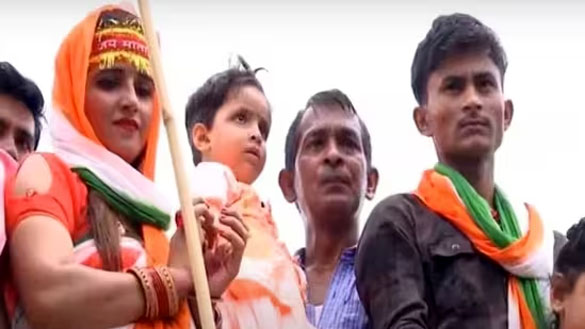
Seema Haider and Sachin
Meena join the 'Har Ghar Tiranga' celebrations at their residence in Uttar
Pradesh's Great Noida
------
by Ritu Singh
14-08-2023
Pakistani citizen Seema Haider, who illegally entered
India to live with Sachin Meena, was seen hoisting the Indian flag with her
family in Noida ahead of India's 77th Independence Day. In a video that has
surfaced on social media, Seema Haider and Sachin Meena were seen hoisting the
Tricolour on Sunday as part of the “Har Ghar Tiranga” celebrations at their
residence in Uttar Pradesh's Greater Noida. Clad in a Tricolour sari and donning
a patriotic headband, she was also heard raising the slogans of ''Jai Mata
Di,'' and chanting ''Bharat Mata ki Jai'' and ''Vande Mataram''.
During the occasion, Mrs. Haider, who had reportedly
been offered a role in a Hindi film, also clarified that she has turned down
the offer.
Meanwhile, across the border in Pakistan, Indian
national Anju was seen celebrating Pakistan's Independence Day. Pakistan marks
its independence day on August 14 every year, a day ahead of India's
Independence Day.
Notably, Anju, who hails from Rajasthan, travelled to
Pakistan on a month-long visa and married her Facebook friend Nasrullah, on
July 25 after converting to Islam. The couple has been staying at Nasrullah's
home in the Upper Dir district of Khyber Pakhtunkhwa, as per PTI reports. The
34-year-old's husband said they are not divorced yet. The couple has a
15-year-old daughter and a six-year-old son.
In a video shared on social media, Anju was seen
cutting a cake along with Nasrullah at an event. The room was decorated with
Pakistan's national flag and the people were seen singing and clapping.
Seema Haider, who hails from Sindh province in
Pakistan, says she got in touch with Mr. Meena, 22, while playing the online game PUBG in 2019-20
and eventually the two talked over WhatsApp and Instagram before falling in
love with each other. She entered India illegally along with her four children
on a bus via Pakistan on May 13 and was arrested. However, she was granted bail
by a local court on July 7.
The couple now lives in the Rabupura area of Greater
Noida, near Delhi, where he runs a provision store, according to Uttar Pradesh
Police.
Both love stories, which bear striking similarities,
have generated massive public interest, in both nations. Seema Haider's viral
videos, in particular, have opened floodgates of memes on social media.
Source: Ndtv.Com
-----
After Anju, Yet Another Woman, identified as Deepika
Patidar, From Rajasthan Ditches Family For Boyfriend, Converts To Islam
Representative Photo
-----
By Prakash Kl
August 15, 2023
In a case similar to Anju, who went to Pakistan to tie
the knot with her Facebook boyfriend, a woman and a mother-of-two eloped to
Kuwait with her boyfriend.
The woman identified as Deepika Patidar fled with her
friend Irfan Haidar. Her family came to know about it after photos of the woman
wearing a burqa were shared on social media, PTI reported citing police.
Patidar Samaj and other Hindu organisations have
demanded the action against the man with whom the woman left the country. They
have also submitted a memorandum to the collector and the superintendent of
police.
On July 15, Mukesh Patidar, the husband of the woman,
who is employed in Mumbai, filed a missing person report at Chitri police
station. According to him, they have a son and daughter.
Mukesh Patidar informed the media on Monday that
Haidar had brainwashed his wife and converted her to Islam. Haidar is a
resident of Himmat Nagar in Gujarat, the police said. The woman often visited
Khed Brahma in Gujarat's SabarKantha to meet Haidar. It was later found that he
took her to Kuwait, Chitri SHO Govind Singh said. The matter is being
investigated to ascertain how she met Haidar and secured a visa.
Pakistan Extends Visa For Indian Woman Anju After
Converting To Islam And Marrying FB Friend Pakistan Extends Visa For Indian
Woman Anju After Converting To Islam And Marrying FB Friend
Anju, who was born in Kailor village in Uttar Pradesh
and lived in the Alwar district of Rajasthan, travelled to Pakistan legally
from India via the Wagah-Attari border. She was married to Arvind, who is in
Rajasthan. They have a 15-year-old daughter and a six-year-old son.
Anju, who now goes by the name of Fatima after
converting to Islam, on July 25 married her 29-year-old friend Nasrullah. They
became friends on Facebook in 2019.
Source: Www.Oneindia.Com
-----
Egyptian Young Woman Identified As Maryam Samir Fayez,
Forced Back To Christianity After Converting To Islam
August 15, 2023
The case of an Egyptian young woman who publicly
converted to Islam then appeared a few days later with her family praying
inside a Church has stirred controversy on social media, amid reports she was
forced back to Christianity.
Local media sites identified the young woman as Maryam
Samir Fayez, a research assistant at the University of Arish.
According to the sites, the young woman’s family lost
contact with her on 30 July after she told them that she would be busy. Later,
she appeared in a video on YouTube in which she announced that she had
converted to Islam and presented a certificate of conversion to Islam
officially signed by Al-Azhar.
In the video, Maryam stressed that she had not been
kidnapped, and that her decision was of her own free will.
The young woman’s family reported that she had been
kidnapped and said the State Security has returned her to the church through a
person named Naguib Gabriel.
Gabriel appeared in a video clip, with the young woman
and her family while they were praying inside the church.
However, social media users said the young woman was
forced back to Christianity.
Over the past years, the issue of Egyptian Copts’
conversion to Islam has sparked widespread controversy, amid accusations that
the church was kidnapping those who take this step, and forcing them back to
Christianity.
Social media users have also criticised what they
described as “the silence of Al-Azhar” on such issues, and the failure to
demand the state protect the freedom of those who want to become Muslim.
Source: Middle East Monitor
-----
Muslim women with burkini prevented from swimming in
northern Italy
BurakBir
14.08.2023
A group of Muslim women in northeastern Italy were not
allowed to swim with burkini swimsuits, local media reported on Monday.
The women were prevented from swimming by another
group of women on the women-only section of the Lido Pedicin beach, Europe's
only segregated beach, in the Trieste city, according to the state-run ANSA
news agency.
Later, the Muslim group asked for clarification from
the beach management but they were told that there is no regulation on the
issue.
The incident came a month after Anna Maria Cisint, the
mayor of northern Monfalcone town, wrote an open letter to the Muslim
community, saying being fully clothed on beaches is "unacceptable."
Source: Www.aa.Com.Tr
-----
Five key moments in the crushing of Afghan women's
rights
By Yogita Limaye
15-08-2023
"We are going to allow women to study and work
within our framework. Women are going to be very active in our society,"
the Taliban announced in their first press conference shortly after seizing
power on 15 August 2021.
Two years on, these assurances have been firmly
demolished by the Taliban government's actions. The suppression of women's
rights under their rule is the harshest in the world, brought in through a
relentless series of religious decrees from the Taliban leadership, and
regional rulings that have been steadily imposed across Afghanistan.
During each of these moments, the BBC has been on the
ground speaking to Afghan girls and women - documenting grief, fear, hope and
resolve as their lives and world have shrunk.
The first indication of the Taliban's attitude to
women came a month after the takeover. Secondary schools opened for boys
following a ministry of education statement which made no mention of girls.
"Locally, we were told not to attend
classes," a 17-year-old female student told us in Kabul at the time.
"For 11 years, despite the risk of violence, I worked hard so I could
become a doctor. I'm devastated," she wept, as she waved goodbye to her
brothers heading off to school.
In the same week, female employees of the Kabul city
administration were told by the mayor to stay at home, with only those who
performed jobs which couldn't be done by men, allowed to continue.
But still, some women felt hope. "They've kept
universities open, so I think they will change their policy soon," one
university student told us.
At the time, we visited the headquarters of the
Taliban's moral police, the Ministry of the Propagation of Virtue and the
Prevention of Vice. It had been set up in the same compound where the Ministry
of Women's Affairs of the former regime once was - a government department
scrapped by the Taliban weeks after taking power.
Source: Www.Bbc.Com
https://www.bbc.com/news/world-66461711
-----
Netflix and AFAC launch training program for female
filmmakers
ARAB NEWS
August 14, 2023
LONDON: Netflix and the Arab Fund for Arts and Culture
have announced a new training program for female filmmakers in the Arab world.
The program, called “Women in Film: Introduction to
the Creative Process,” will focus on introducing the creative filmmaking
process and the different roles that women can play behind the camera.
“At Netflix, we are passionate about amplifying
women’s voices behind the camera,” said Nuha el Tayeb, director, content
director, Middle East, Africa and Turkiye at Netflix.
“AFAC has been a long-standing partner and has done
some incredible work for under-represented voices within the film fraternity in
the region. Through this partnership, we are discovering a wealth of promising
Arab talent and working to ensure that women are represented both on and off
camera.”
The program is open to emerging female filmmakers aged
21 to 27 who have graduated from film studies and are living in Egypt, Jordan,
Saudi Arabia, Kuwait or the UAE.
The 45 selected participants will receive training
from established female filmmakers from the Arab region, and they will also
have the opportunity to network with other aspiring filmmakers.
AFAC’s Director Rima Mismar said that the initiative
reflected a long-standing commitment to “supporting bold creative voices of
women and men artists, who are trying to push boundaries and challenge status-quos.”
Mismar said that the program was part of AFAC’s
efforts to favor the emergence of regional women talents and “allow for a
deeper understanding of the inequities and inequalities that women are
subjected to in the film industry.”
The program is also part of Netflix’s wider commitment
to promoting gender equality in the Arab cinema industry through its “Because
She Created” initiatives.
Last year, the streaming giant teamed with AFAC in a
scheme that gave five female Arab producers and directors a total of $250,000
via Netflix’s Fund for Creative Equity.
Applications for the program are open from Aug. 17 to
Sept. 8. Successful participants will be selected by an external jury and
notified on or before Oct. 17.
Source: Arab News
https://www.arabnews.com/node/2354996/media
-----
Afghan women set up secret businesses to escape
Taliban bans
REUTERS
August 15, 2023
LONDON: Five months after Taliban supporters smashed
up her restaurant, Afghan entrepreneur Laila Haidari opened a secret craft
center where women earn a small income stitching elaborate dresses and
fashioning jewelry from melted down bullet casings.
Her workshop is among an array of underground
businesses that women have launched since losing their jobs after the Taliban
grabbed power in 2021, ranging from gyms to beauty salons and girls’ schools.
The Taliban administration, which marks two years in
power on Aug. 15, has banned women from most jobs, barred girls from secondary
and higher education, and imposed harsh restrictions on their freedom of
movement.
But thousands of women continue to run
micro-enterprises from their homes — which officials broadly allow, while
others like Haidari oversee more clandestine businesses.
Haidari, 44, used to own a lively Kabul restaurant
that was known for its music and poetry evenings and was popular with
intellectuals, writers, journalists and foreigners.
But a few days after the Taliban seized the country,
gunmen and locals threw out the rehabilitation center’s patients, destroyed her
restaurant and looted the furniture, Haidari said.
Her handicrafts enterprise now subsidises an
underground school providing 200 girls with lessons in maths, science, and
English. Some attend in person, others online.
“I don’t want Afghan girls to forget their knowledge
and then, in a few years, we will have another illiterate generation,” she
said, referring to the women and girls deprived of education during the
Taliban’s last rule from 1996 to 2001.
The Taliban’s return to power has rapidly reversed two
decades of internationally backed efforts to boost economic opportunities for
women that saw donors pour several billion dollars into empowerment programs.
Most businesses set up by women prior to 2021 were
informal cottage industries like bakeries, but they had increasingly made
inroads into traditionally male sectors such as IT, media services, exports,
travel agencies and even construction.
Others, like Haidari, were running cafes and
restaurants – also considered a male domain in Afghanistan, given the taboos
around women interacting with men outside the home.
But many others have closed their businesses amid
Afghanistan’s severe economic crisis. The Taliban takeover triggered the
meltdown after foreign governments cut funding and froze the country’s bank
assets.
The crisis has hit all businesses hard, but the
difficulties for women are compounded by Taliban curbs on their movement
including a ban on travel without a “mahram” — a male relative to act as a
chaperone.
Dressmaker Wajiha Sekhawat, 25, used to go to Pakistan
and Iran to buy fabrics for her tailoring studio in the western city of Herat,
from where she creates outfits for clients inspired by celebrities’ social
media posts.
With her income already squeezed by the economic
crisis, she cannot afford to take a chaperone with her. But when she sent a
male family member to Pakistan in her place he returned with the wrong fabrics.
Sekhawat’s monthly income has fallen from about $600
to $200 or less. Demand for party dresses and outfits for professional women
plummeted after most lost their jobs.
The Taliban’s rules on chaperones make it difficult
for women to buy raw materials, meet people to do business with or sell their
merchandise. The restrictions also make it harder for female customers to reach
them.
The Taliban’s restrictions are particularly hard for
the country’s estimated 2 million widows, as well as single women and
divorcees. Some are their family’s sole breadwinner, but may not have anyone to
act as a mahram.
In the aftermath of the Taliban takeover, social media
was awash with images of beauty salons where posters of women’s faces had been
painted over. But rules varied between districts and many businesses — unlike
Sadaf’s — were allowed to reopen.
However, last month the authorities ordered all salons
to shut, saying they offered treatments that went against their Islamic values.
Despite erasing women from most areas of public life,
the Taliban have not banned them from running businesses, and some aid
organizations continue to oversee employment projects.
“There is so much demand because no one wants to have
to be reliant on humanitarian aid,” said Melissa Cornet, an adviser to CARE
Afghanistan.
“We’ve had to refocus more on training women in crafts
they can do from home — tailoring, embroidery or making foodstuffs like
cookies, jams, pickles etc,” Cornet said.
Although incomes are typically less than $100 a month,
Cornet said this could be life-changing for a family at a time when
unemployment is through the roof and 85 percent of the population is living
under the poverty line.
Source: Arab News
https://www.arabnews.com/node/2355401/pakistan
-----
URL: https://newageislam.com/islam-women-feminism/pakistan-seema-tricolour-independence/d/130450