
Muslim WomanThennadanSubaida's Hindu Children Inspire An Indian Film, (Yours Truly, Sreedharan)
New
Age Islam News Bureau
03
April 2023
•
Iran’s Judiciary Chief Threatens To Prosecute
Unveiled Women ‘Without Mercy’
•
Two Women Attacked With Yoghurt In Iran Arrested For Not Covering Hair
•
Women’s Radio Station Closed in Badakhshan
Compiled
by New Age Islam News Bureau
URL:
--------
Muslim
Woman ThennadanSubaida's Hindu Children Inspire An Indian Film, (Yours Truly,
Sreedharan)
April
3, 2023
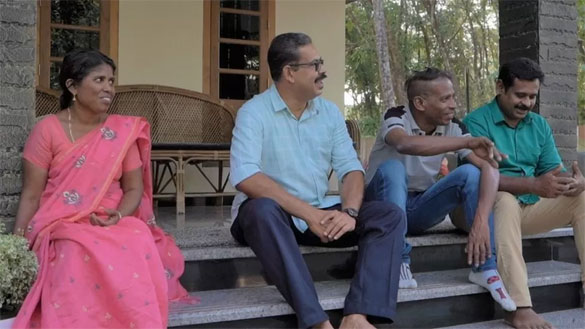 (From left) Leela, Shanawas,
Sreedharan and Jafferkhan grew up together with two other siblings
(From left) Leela, Shanawas,
Sreedharan and Jafferkhan grew up together with two other siblings
------------
A
new film on a Muslim woman from the southern Indian state of Kerala who raised
three Hindu children has brought attention to the family's unusual story. BBC
Hindi's Imran Qureshi spoke to the siblings who inspired the film.
When
Jafferkhan first watched EnnuSwantham Sreedharan (Yours Truly, Sreedharan), he
says he was moved to tears.
But
it was his brother Sreedharan, sitting next to him at the screening, who ended
up "crying uncontrollably".
Jafferkhan
and Sreedharan, both of whom use only one name and are 49 years old, are not
biologically related - Jafferkhan is a Muslim and Sreedharan is a Hindu.
But
ask Jafferkhan what Sreedharan means to him and he says: "He is a brother.
No, he is much more than that. He is always around me. I don't know who he is…
he is a saathi [companion].
The
woman who brought them together - Jafferkhan's mother, ThennadanSubaida - died
in 2019. Her story, a heart-warming reminder of humanity triumphing over
religious differences, has found resonance at a time when tales of polarisation
and communal disharmony are regularly reported in India.
Subaida
took in Mr Sreedharan and his two older sisters - Ramani and Leela - in 1976
after their mother died while giving birth to a fourth child who also didn't
survive. The children's mother, Chakki, was a domestic worker in Subaida's
house.
The
brothers say that Subaida did not legally adopt the children as the laws around
it were not as strict at the time. They add that they didn't have relatives
willing to take care of them, and that their father had given permission to
Subaida, saying he was "incapable of taking care of them".
Subaida
already had two sons - Jafferkhan and his elder brother Shanawas - at the time,
and gave birth to a daughter, Joshina, four years later. The children grew up
together in perfect harmony.
Their
story first made headlines in 2019 after Subaida's death - Sreedharan, who was
working in Oman at the time, had written an emotional tribute to his umma (as
Malayali Muslims call their mother) on Facebook, asking friends to pray for her
"grand welcome in heaven".
The
post caught the attention of many people who wondered why a man with a Hindu
name was calling his mother umma.
"They
asked, 'who are you, a Hindu or a Muslim?' It is quite understandable because
my name was Sreedharan,'' he said.
The
questions were endless and sometimes nasty. But Sreedharan answered them all
patiently even under the weight of grief.
He
also emphasised that neither Subaida nor her husband Abdul Aziz Haji had ever
asked their adopted children to convert to Islam.
"It
was painful for me. My parents always taught us that caste and religion do not
matter,'' he says.
"Goodness
is what we need. It is we humans who make changes in the belief system."
That's
the philosophy by which Subaida lived her life and raised her children.
Leela,
now 51, says her mother would take her to the temple "whenever she
wanted" - transport facilities weren't as developed at the time, so they
usually went together in a group during festivals.
"My
umma would always say it didn't matter if you practised Hinduism, Islam or
Christianity. Each religion teaches us the same thing, which is to love and
respect everyone," Sreedharan says.
His
siblings also have many stories about their childhood.
Shanawas
remembers the day his mother returned home carrying two-year-old Sreedharan.
"Leela
and Ramani were behind her. My mother said that they would live with us now
since they had no one to take care of them," he says.
After
that, they were all one family.
Shanawas
recounts stories of the children sleeping next to each other on the floor; and
the joy they felt when Joshina was born four years later.
Growing
up, the bond between Sreedharan and Jafferkhan deepened and they "were
like twins" who did everything together.
Shanawas
and Jafferkhan say the siblings rarely fought, even though "Sreedharan was
their mother's clear favourite" and often received special treatment.
"Unlike
me, Sree [Sreedharan] would run all the errands and was very honest. Maybe
that's why Umma loved him more," Jafferkhan laughs.
The
siblings say they also learnt important life lessons from their parents. For
instance, Shanawas remembers how their mother would go out of her way to help
people irrespective of their caste, class or religion.
"Anyone
could approach my mother and ask for money for education, marriage or health
reasons and she would arrange it somehow - often by taking informal loans which
she paid back by selling some of her ancestral land," he says.
These
stories form the backbone of EnnuSwantham Sreedharan, directed by Siddik
Paravoor.
Paravoor
was among the many people who were inspired by Sreedharan's facebook post about
Subaida.
"There
is so much of humanism in this story that the society needs to know,'' he says,
adding that he attempted to capture the beauty of human relationships through
the movie.
The
film had a special screening at a theatre in Kerala on 9 January. Paravoor is
now trying to raise funds for its commercial release.
The
siblings, who live in different cities now, say there couldn't be a better
tribute to their mother.
"I
have only good memories of my umma. It hurts to realise these memories were
finite, but I am happy that a film will now remember it,'' Leela says.
"It
was only when umma passed away that we realised that people saw a difference
between us," Shanawas says.
"But
we are the same even now."
Source:
BBC
https://www.bbc.com/news/world-asia-india-65108300
--------
Iran’s
Judiciary Chief Threatens To Prosecute
Unveiled Women ‘Without Mercy’
01
April ,2023
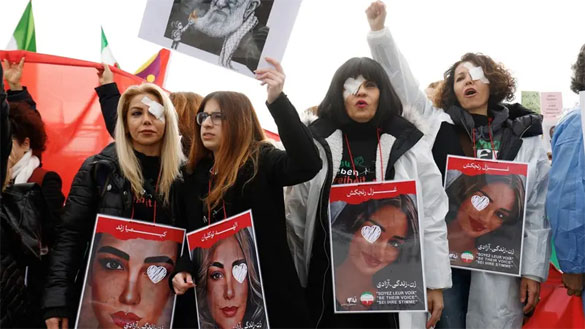 Women
flash the V-sign during an opposition rally in solidarity with Iranian people
on the 44th anniversary of the Islamic Revolution, in Paris, on February 11, 2023.
(AFP)
Women
flash the V-sign during an opposition rally in solidarity with Iranian people
on the 44th anniversary of the Islamic Revolution, in Paris, on February 11, 2023.
(AFP)
------------
Faced
with an increasing number of women defying the compulsory dress code, Iran’s
judiciary chief has threatened to prosecute “without mercy” women who appear in
public unveiled, Iranian media reported on Saturday.
Gholamhossein
Mohseni Ejei’s warning comes on the heels of an interior ministry statement on
Thursday that reinforced the government’s mandatory hijab law.
“Unveiling
is tantamount to enmity with (our) values,” Ejei was quoted as saying by
several news sites. Those “who commit such anomalous acts will be punished” and
will be “prosecuted without mercy,” he said, without saying what the punishment
entails.
Ejei,
Iran’s chief justice, said law enforcement officers were “obliged to refer
obvious crimes and any kind of abnormality that is against the religious law
and occurs in public to judicial authorities”.
A
growing number of Iranian women have been ditching their veils since the death
of a 22-year-old Kurdish woman in the custody of the morality police last
September. MahsaAmini had been detained for allegedly violating the hijab rule.
Government
forces violently put down months of nationwide revolt unleashed by her death.
Still,
risking arrest for defying the obligatory dress code, women are widely seen
unveiled in malls, restaurants, shops, and streets around the country. Videos
of unveiled women resisting the morality police have flooded social media.
Under
Iran’s Islamic Sharia law, imposed after the 1979 revolution, women are obliged
to cover their hair and wear long, loose-fitting clothes to disguise their
figures. Violators have faced public rebuke, fines, or arrest.
Describing
the veil as “one of the civilizational foundations of the Iranian nation” and
“one of the practical principles of the Islamic Republic,” the Interior
Ministry statement on Thursday said there would be no “retreat or tolerance” on
the issue.
It
urged ordinary citizens to confront unveiled women. Such directives have in past
decades emboldened hardliners to attack women without impunity.
Source:
Al Arabiya
--------
Two
women attacked with yoghurt in Iran arrested for not covering hair
Nadeem
Badshah
Sun
2 Apr 202
 Two
women attacked with yoghurt in Iran arrested for not covering hair – video
Two
women attacked with yoghurt in Iran arrested for not covering hair – video
-------------
Two
women have been arrested in Iran for not covering their hair in public after
having a tub of yoghurt thrown over them.
Video
footage that went viral on social media showed two female customers being
approached by a man who engages them in conversation.
He
then takes what appears to be yoghurt from a shelf and throws it over their
heads.
Iran’s
judiciary said the two women had subsequently been detained for allegedly
violating the country’s hijab rules.
It
added the man was also arrested for disturbing the public order.
The
arrests come as Iran’s judiciary chief threatened to prosecute “without mercy”
women who appear in public unveiled, Iranian media reported on Saturday.
Gholamhossein
Mohseni Ejei’s warning came on the heels of an interior ministry statement on
Thursday that reinforced the government’s mandatory hijab law.
“Unveiling
is tantamount to enmity with [our] values,” Ejei was quoted as saying by
several news sites. Those “who commit such anomalous acts will be punished” and
would be “prosecuted without mercy,” he said, without saying what the
punishment would entail.
Ejei,
Iran’s chief justice, said law enforcement officers were “obliged to refer
obvious crimes and any kind of abnormality that is against the religious law
and occurs in public to judicial authorities”.
A
growing number of Iranian women have been ditching their veils since the death
of a 22-year-old Kurdish woman in the custody of the “morality police” last
September. MahsaAmini had been detained for allegedly violating the hijab rule.
Government
forces violently put down months of nationwide revolt unleashed by her death.
However,
women are widely seen unveiled in malls, restaurants, shops and streets around
the country, risking arrest for defying the obligatory dress code. Videos of
unveiled women resisting the “morality police” have flooded social media.
Under
Iran’s Islamic sharia law, imposed after the 1979 revolution, women are obliged
to cover their hair and wear long, loose-fitting clothes to disguise their
figures. Violators have faced public rebuke, fines or arrest.
Describing
the veil as “one of the civilisational foundations of the Iranian nation” and
“one of the practical principles of the Islamic Republic,” the Interior
Ministry statement on Thursday said there would be no “retreat or tolerance” on
the issue.
It
urged ordinary citizens to confront unveiled women. Such directives have in
past decades emboldened hardliners to attack women with impunity.
Source:
TheGuardian
--------
Women’s
Radio Station Closed in Badakhshan
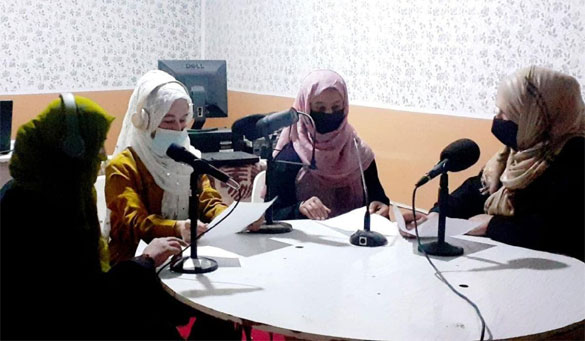 A
women's radio station was closed in Badakhshan by authorities at the Ministries
of Information and Culture and Vice and Virtue, the officials at the radio
station confirmed to TOLOnews.
A
women's radio station was closed in Badakhshan by authorities at the Ministries
of Information and Culture and Vice and Virtue, the officials at the radio
station confirmed to TOLOnews.
Moezuddin
Ahmadi, head of the provincial department of information and culture, said the
radio went off the air until further notice due to broadcasting “songs during
Ramadan."
The
head of the radio station said that they mistakenly broadcasted an Arabic Na’at
(religious poetry in praise of the prophet, Muhammad (PBUH).
“Yesterday,
our radio was closed by the department of Information and Culture. Our
broadcast has been halted and they gave the reason for it as broadcasting
music.Our colleague mistakenly broadcast the music in holy Ramadan,” said
NajiaSorosh, head of the radio station.
The
provincial officials told TOLOnews that they have given many warnings to the
radio station before.
"Radio
Banwan [Women's Radio] was closed because of broadcasting music, particularly
in Ramadan, which is also a violation of publishing policies of the Islamic
Emirate. They were informed many times but didn't pay attention, so finally we
closed it," said Hekmatullah Mohammadi, head of the provincial department
of Information and Culture.
The
local journalists in Badakhshan called on the Islamic Emirate to allow the
radio station to resume broadcasting.
"Undoubtedly,
mistakes happen in the publishing system. It has not been intentional, we call
on the government to allow the radio station to resume activities," said
MohibSaeedi, a journalist.
The
Sada- Banwan [Women's Voice] radio station started 10 years ago in Faizabad,
the capital of Badakhshan.
At
least 8 people, the majority of them women, were working at the station.
There
are 2 TV channels and 10 radio stations currently active in Badakhshan,
according to the Badakhshan Journalists Safety Committee.
Two
of the media organizations are being managed by women.
There
are 45 women and 73 men working in these private media organizations.
Source:ToloNews
https://tolonews.com/afghanistan-182762
--------
URL: https://newageislam.com/islam-women-feminism/muslim-woman-hindu-children-indian-film/d/129479
New Age Islam, Islam Online, Islamic Website, African Muslim News, Arab World News, South Asia News, Indian Muslim News, World Muslim News, Women in Islam, Islamic Feminism, Arab Women, Women In Arab, Islamophobia in America, Muslim Women in West, Islam Women and Feminism