
Little Girl In Iran Bleeds After Being Hit In The Face For Not Wearing Hijab Properly
New
Age Islam News Bureau
23
February 2023
•
Swiss Envoy Nadine Olivieri Lozano Dons Head-To-Toe ‘Chador’ & Hijab During
Visit To Shrine In Iran
•
Removal Of Shamima Begum's UK Citizenship 'Lawful,' Judges Rule
•
Two Karnataka Muslim Girls Want To Wear Hijab To PUC Exams, SC Agrees To List
Their Application Seeking Stay Of Hijab Ban
•
Afghan Women Face Further Harm If Donor Funding Is Withdrawn – Report
•
One Woman Dies Every 2 Minutes In Pregnancy, Childbirth: UN
•
Saudi Deaf Female Chess Team Aims To Make Right Moves In Debut Continental
Tournament
•
Tennis: Saudi Arabia Sends First Female Team To ITF Event Held In Colombo
Compiled
by New Age Islam News Bureau
URL: https://newageislam.com/islam-women-feminism/iran-bleeds-hijab-girl/d/129181
--------
Little Girl In Iran Bleeds After Being Hit In The Face For Not Wearing Hijab Properly
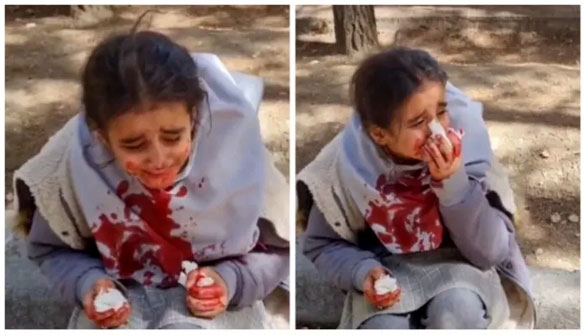
Photo
OPIndia
----
February
23, 2023
New
Delhi: A young Iranian girl was hit in the face for not wearing hijab on
Tuesday, according to a post shared on Twitter.
In
a video post shared by Twitter user Monika Verma, the girl can be seen bleeding
from her nose and blood splattered all over her clothes, as she sits on the
roadside weeping relentlessly.
“Little
girl bleeding after getting hit in Iran. Her fault? She didn’t wear Hijab.
“Hijab is a choice” is the biggest scam of our times,” wrote Verma in the post.
Warning:
Scenes of violence; viewer discretion advised
The
video also shows two women helping and consoling the girl.
The
wearing of a hijab in public is currently mandatory for women in Iran under
strict Islamic law that is enforced by the country’s so-called morality police.
The
country has witnessed five months of nationwide demonstrations triggered by the
September death of a 22-year-old Mahsa Amini in the custody of morality police.
Amini had been arrested for allegedly wearing a hijab improperly.
Young
Iranian women have been at the forefront of the demonstrations demanding
fundamental economic, social and political reforms in the country. A growing
number of them, including celebrities, have appeared in public without head
coverings or have set them on fire in public.
The
authorities have cracked down hard on the protest movement, which has morphed
into one of the most serious challenges to the theocracy installed by the 1979
Islamic Revolution.
Security
forces have killed more than 520 people and detained over 19,000 since the
demonstrations began, activists say. Following biased trials, the judiciary has
handed down stiff sentences, including the death penalty, to protesters.
Source:
Firstpost
--------
Swiss
Envoy Nadine Olivieri Lozano Dons Head-To-Toe ‘Chador’ & Hijab During Visit
To Shrine In Iran
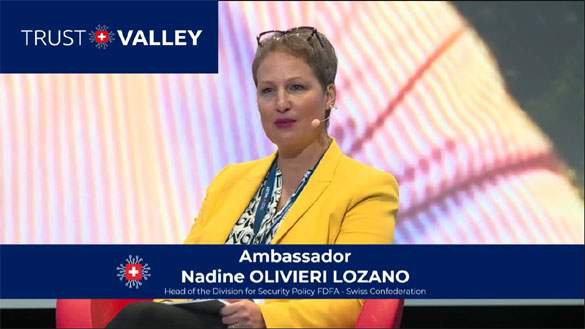
Nadine Olivieri Lozano
------
Ayndrila
Banerjee
February
23, 2023
Qom:
A Swiss envoy who was on a visit to Iran has made the headlines for all the
wrong reasons for cladding herself with a long black veil in a country that has
been fighting to reject the regime’s compulsory hijab mandate.
Pictures
of the Swiss Envoy Nadine Olivieri Lozano have gone viral on social media with
many condemning her move to wear a black veil that covered her head and whole
body during her visit to the Iranian city of Qom.
In
the photos, Lozano can also be seen posing with several Iranian clerics at a
shrine in Qom and receiving a gift and a religious book from the shrine’s
caretaker.
According
to Iran International, Lozano’s trip to Iran was marked by her interest in
Islamic culture. In the country, she travelled to Qom, a city 120 km south of
Tehran.
Protestors
outraged by envoy’s choice of attire
Lozano’s
decision to don a veil was not well received by many Iranians who have been
fighting a long war to deny Iran’s hijab mandate after a 22-year-old woman,
Mahsa Amini, died in police custody for not wearing the hijab “properly.”
Iranian
journalist, Masih Alinejad, said, “While teenagers & women are getting
beaten, jailed & killed for saying NO to forced hijab, NO to gender
apartheid regime, Swiss ambassador in Iran obeyed forced hijab. Shameful &
betrayal to Iranian women. Switzerland must respond why they took side with our
killers.”
An
international human rights lawyer named Hillel Neuer said, “Meet Nadine
Olivieri Lozano, Swiss Ambassador to Iran and star of the murderous regime’s
propaganda. While women in Iran are being beaten, blinded, tortured, raped and
killed for daring to protest the compulsory hijab laws, she is complicit in her
head-to-toe chador and hijab.”
Branding
Lozano’s move as “disgusting” a member of Belgium Parliament Darya Safai said,
“Swiss ambassador Nadine Olivieri Lozano wears a chador & goes to a mosque
with the mullahs. While millions of Iranian women are fighting for women’s
rights and knowing that thousands have been killed for it, she wears a hijab
and makes publicity for the oppressors.”
Many
have argued that the incident was an insult to both Iranian and Swiss women.
Some even demanded her resignation.
Young
girl hit for not wearing hijab
The
Swiss envoy’s visit comes amid a horrific incident where a young Iranian girl
was hit in the face for not wearing a hijab.
In
the videos shared on social media, the girl can be seen crying relentlessly
while her nose bled out.
“Little
girl bleeding after getting hit in Iran. Her fault? She didn’t wear Hijab.
‘Hijab is a choice’ is the biggest scam of our times,” wrote a user on Twitter.
Iran
protests
The
unrest in Iran that has drawn the attention of the entire world and is being
considered the most impactful and longest-running protest the country has seen
since the Islamic Revolution of 1979 has now covered more than 100 days.
The
Human Rights Activists News Agency says that around 500 protestors including 69
children have lost their lives during the demonstrations ever since they began
in September.
Since
then, two protestors have been executed and 26 others face trials that will
decide their death sentences.
Source:
Firstpost
--------
Removal
Of Shamima Begum's UK Citizenship 'Lawful,' Judges Rule
Aysu
Bicer
22.02.2023
LONDON
The
British judges ruled on Wednesday that the removal of UK citizenship of Shamima
Begum, who joined Daesh/ISIS in 2015, was "lawful."
Begum
lost her appeal against the UK government which revoked her British citizenship
when the Special Immigration Appeals Commission gave its decision.
The
commission rejected Begum's appeal on all grounds and ruled that she cannot
return to the UK.
The
23-year-old woman still remains in a refugee camp in northern Syria.
In
2021, the UK Supreme Court ruled that Begum, who lost her citizenship because
she joined Daesh/ISIS in 2015, should not be allowed to return to the country
to legally fight for her citizenship.
Dubbed
a "Daesh bride" for having left the UK to marry a member of the
terror group, Begum lost the first stage of her court appeal against the Home
Office's decision to strip her of British citizenship, which was revoked on
national security grounds after she was found in a Syrian refugee camp in 2019.
Fifteen
years old at the time of her departure from London, Begum is of Bangladeshi
origin. Before the decision, she held UK citizenship but not Bangladesh.
The
government argued that as Begum is of Bangladeshi origin, she is thus eligible
for Bangladeshi citizenship by descent under that country's law and thus cannot
be considered stateless.
She
lived in Daesh/ISIS-controlled areas for three years, marrying a Dutch foreign
fighter. She had lost two children and a third one shortly after birth.
Source:
Anadolu Agency
https://www.aa.com.tr/en/europe/removal-of-shamima-begums-uk-citizenship-lawful-judges-rule/2827892
--------
Two
Karnataka Muslim girls want to wear hijab to PUC exams, SC agrees to list their
application seeking stay of hijab ban
Feb
23, 2023
NEW
DELHI: Two petitioners - an 18 year old Muslim girl student and father of
another - on Wednesday requested the Supreme Court for urgent listing of their
applications seeking interim stay on the ban on wearing religious clothings in
Karnataka government schools and colleges to enable them wear hijabs in
accordance with their religious beliefs while appearing in board examinations
next month.
Two
Udupi residents - 18-year-old Shafa and another Muslim girl's father Abdul
Shukur - pleaded for urgent stay of the February 5, 2022 circular banning
wearing of religious clothes, including hijab and saffron shawls, by students
in government run schools and colleges, to enable Muslim girl students to take
this years' PUC board examinations.
The
application said like these two, many Muslim girls preferred not to take the
examination last year over not wearing hijab to appear in the tests. They
should not be forced to lose another academic year, which would cause
irreparable damage to their academics and future careers. They said after the
Karnataka HC upheld the validity of the state circular, many Muslim students
also lost an academic year because of the hijab ban. CJI D Y Chandrachud agreed
for an early hearing of their plea.
On
October 13 last year, a 2-J bench of Justices Hemant Gupta and Sudhanshu Dhulia
had returned a split verdict on the validity of the February 2022 circular of
the state banning students from wearing religious clothings to the schools and
PUCs. The matter was referred to a 3-J bench, which the CJI would now
constitute to decide which of the diametrically opposite views was correct.
Until such time, and unless the new bench stays circular, no student could wear
religious clothings to government-run schools and PUCs.
Interestingly,
the application attached a document which said that practical PUC board
examinations were scheduled between February 6-20. The advocate mentioning the
application informed the bench that the examinations are scheduled for next
month.
Even
the applicants said, "If the Impugned Government Order is not stayed, this
state of affairs for the appellants will continue, while another batch of hijab
adorning Muslim girls will be forced to drop out or be retained in the same
year upon failing to write PUC Board exams that are due to be conducted in
February, 2023."
They
said no State other than Karnataka has instituted any restriction, let alone a
ban, on the wearing of hijab in schools or colleges. They said the SC's split
verdict demonstrated "prima facie merit in the appellants’ contentions.
Justice Dhulia’s judgement declaring the Impugned GO as unconstitutional
reflects, at the very minimum, reasonable disagreement as to the constitutional
validity of the GO, which is sufficient to make out a prima facie case for the
grant of interim relief."
"The
purpose and object of interim relief is to protect against injuries to
fundamental rights that are not repairable once inflicted. The indignity of
being forced to choose between a secular (and affordable) education and one’s
cultural identity expressed via forms of dress is not an injury that is capable
of repair." they said.
"The
rate of dropouts among Muslim girls has steadily increased since the imposition
of the hijab, as PUCs prevent girls from writing their exams and attending
classes while wearing the hijab. After the Karnataka HC judgment, the
appellants were left with no choice but to drop out of their school. After
losing a year, they have now joined a private unaided institution (Al-Ihsan
Women’s PU College, Mulur) to be able to pursue their studies in a manner
compatible with their dignity," they said.
Source:
Times Of India
--------
Afghan
women face further harm if donor funding is withdrawn – report
Kaamil
Ahmed
Thu
23 Feb 2023
Western
countries have risked causing further harm to Afghan women by withdrawing
funding and suspending operations in protest against Taliban policies that
adversely affect women, the International Crisis Group said in a report today.
The
Brussels-based thinktank said outside powers should hold the Taliban to account
for its bans on secondary and university education for girls and women as well
as on those working for non-governmental organisations, but they should avoid
“self-defeating” policies that left women without services.
“Donors
are turning away from Afghanistan, disgusted by the Taliban’s restrictions on
women’s basic freedoms. However, cutting aid to send a message about women’s
rights will only make the situation worse for all Afghans,” said Graeme Smith,
ICG’s senior consultant on Afghanistan.
“The
most principled response to the Taliban’s misogyny would be finding ways to
mitigate the harms inflicted on women and other vulnerable groups.”
Several
leading charities suspended their operations in Afghanistan in December,
calling on the Taliban to reverse its decision to ban female humanitarian staff
working for aid agencies. About a third of the agencies’ workforce are women,
who are seen as vital in providing services in a culturally appropriate way.
Though
the Taliban has since made exceptions for women working in healthcare or
education, which has allowed NGOs to resume some operations, they say the
Taliban’s restrictions have made it difficult for them to carry out their work.
“Banning
female humanitarian workers prevents us from reaching half of the population.
Due to cultural norms in the country, male aid workers cannot register women
and girls to receive aid, it must be done by other women,” said Mélissa Cornet,
an adviser for Care Afghanistan.
Save
the Children said last week that after the ban, women had reported being
overlooked by male-only humanitarian teams if they were not accompanied by a
male family member.
According
to a survey of humanitarian workers by UN Women, the biggest issues were being
able to assess needs and provide information.
“In
Afghanistan, it is not culturally acceptable for men to do humanitarian assessments
with women and girls, so without female staff we struggle to do meaningful
assessments on the impact on women,” said Becky Roby, the Afghanistan advocacy
manager with the Norwegian Refugee Council.
Roby
said it was unsustainable for two-thirds of Afghanistan’s population to depend
on humanitarian aid and a political roadmap was needed that included direct
engagement with the Taliban.
She
said the NRC hoped the Taliban “will see sense” but until that point it does
not feel it could safely or effectively reach women and girls.
“We
are sticking to our principles on this topic, because it is these principles
that help us access the people who are most in need and the most vulnerable,”
she added.
The
ICG report said many western officials supported the idea of cutting the
Taliban off as a consequence of the policies but that the group’s record,
including when it was in power in the 1990s, showed it was unlikely to respond
to such pressure.
It
said the decisions of western powers risked doubling the impact in a society
where women bore the brunt, by taking smaller rations or through girls being
forced into early marriages.
It
called for greater funding for humanitarian campaigns, more work to be done on
infrastructure and supporting agriculture – where most women earn their
livelihood – and negotiating concessions at a local level with Taliban
officials.
Source:
The Guardian
--------
One
Woman Dies Every 2 Minutes In Pregnancy, Childbirth: UN
February
23, 2023
GENEVA:
A woman dies every two minutes due to pregnancy or childbirth complications,
despite maternal mortality rates dropping by a third in 20 years, the United
Nations said Thursday.
Rates
fell significantly between 2000 and 2015 but largely stagnated between 2016 and
2020 — and in some regions have even reversed, the UN said.
The
overall maternal mortality rate dropped by 34.3 percent over a 20-year period —
from 339 maternal deaths per 100,000 live births in 2000 to 223 maternal deaths
in 2020, according to a report by the World Health Organization and other UN
agencies.
Nonetheless,
that means nearly 800 women died per day in 2020 — or around one every two
minutes.
Belarus
recorded the biggest decline — down 95.5 percent — while Venezuela saw the
highest increase. Between 2000 and 2015, the biggest rise was in the United
States.
“While
pregnancy should be a time of immense hope and a positive experience for all
women, it is tragically still a shockingly dangerous experience for millions
around the world,” said WHO chief Tedros Adhanom Ghebreyesus.
“These
new statistics reveal the urgent need to ensure every woman and girl has access
to critical health services... and that they can fully exercise their
reproductive rights.”
The
report found that between 2016 and 2020, maternal mortality rates dropped in
only two of the eight UN regions: in Australia and New Zealand by 35 percent,
and in Central and Southern Asia by 16 percent.
The
rate went up in Europe and Northern America by 17 percent, and in Latin America
and the Caribbean by 15 percent. Elsewhere, it stagnated.
The
two European countries witnessing “significant increases” are Greece and
Cyprus, the report’s author Jenny Cresswell told journalists.
Maternal
deaths remain largely concentrated in the world’s poorest regions and in conflict-affected
countries.
Around
70 percent of those deaths recorded in 2020 were in sub-Saharan Africa, where
the rate is “136 times bigger” than in Australia and New Zealand, Cresswell
said.
In
Afghanistan, the Central African Republic, Chad, the Democratic Republic of
Congo, Somalia, South Sudan, Sudan, Syria and Yemen — all facing severe
humanitarian crises — rates were more than twice the global average.
Severe
bleeding, infections, complications from unsafe abortions and underlying
conditions such as HIV/AIDS are among the leading causes of death, the report
said — which are all largely preventable and treatable.
The
WHO said it was “critical” that women had control over their reproductive
health — particularly about if and when to have children, so that they can plan
and space childbearing to protect their health.
Natalia
Kanem, head of the UN Population Fund, said the rate of women “needlessly”
dying was “unconscionable.”
“We
can and must do better by urgently investing in family planning and filling the
global shortage of 900,000 midwives,” she said.
While
the report covers data up to 2020, the WHO’s Anshu Banerjee told journalists
that the statistics since then look bleak, due to the Covid-19 pandemic and the
economic crisis.
Source:
Arab News
https://www.arabnews.com/node/2256421/world
--------
Saudi
Deaf Female Chess Team Aims To Make Right Moves In Debut Continental Tournament
MOHAMMED
AL-KINANI
February
22, 2023
JEDDAH:
A Saudi team of deaf female chess players is hoping to make all the right moves
competing in its first major continental tournament.
Rasha
Mahfouz Abu Zaid, Fatimah Mohammed Al-Amoudi, Zahrah Abdulrahman Al-Somali, and
Wafa Ali Baghanim, are taking part in the first Asia Pacific Deaf Rapid and
Blitz Championships for Open and Women 2023.
The
competition, being staged in the Jordanian capital Amman until Feb. 28, has
been organized by the Jordanian Deaf Sports Federation and the Asia Pacific
Deaf Sports Confederation.
Registered
under the Saudi Deaf Sports Federation, the four players from the Women’s
Association for Hearing Impairment (Emkan) in Jeddah, will be among more than
100 competitors from 20 countries participating in the event.
Head
of the Saudi delegation and member of the SDSF’s board of directors, Faiza
Abbas Natto, told Arab News: “We are hopeful our players will win and show good
results for the Saudi team, despite the fact that it is the first participation
of its kind for Saudi Arabia in such a big continental championship.”
She
said the Saudi federation had struggled to find the money to fund the team’s
involvement in the tournament.
“Despite
that, the SDSF has spared no efforts in coordinating with the Jordanian side to
facilitate the participation of the team. The federation also approved the team
in its future domestic and external participations,” she added.
Natto
noted that the Emkan team members had received months of intensive training
under the supervision of chess coach Eman Fallatah.
She
said: “The players succeeded in winning the local federation’s trust to
represent their country in the events, amid great aspirations and hopes that
they will achieve good results that reflect the high levels Saudi sportspeople
have reached.
“It
is hoped they can reflect the impressive results achieved by male and female
champions with special needs in many international sporting events.”
She
pointed out that the Emkan team, the first Saudi chess squad for people with
hearing impairment, was established in September last year with the support of
board chair, Princess Nouf bint Muqrin bin Abdulaziz.
“The
team consists of five female players who have been trained and rehabilitated at
the headquarters of the Emkan by specialized chess coaches so that they can
competently participate in local and international tournaments,” Natto added.
Source:
Arab News
https://www.arabnews.com/node/2255951/saudi-arabia
--------
Tennis:
Saudi Arabia sends first female team to ITF event held in Colombo
22
February ,2023
Women’s
sport in Saudi Arabia reached a new milestone this week as the Kingdom sent
their first female team to an International Tennis Federation (ITF) event.
The
Asia/Oceania pre-qualifying event of Billie Jean King Cup Juniors, hosted this
week in Colombo, Sri Lanka, is the first time Saudi Arabia has been represented
by a female team at an ITF event.
“This
is an amazing experience, and it is so empowering,” Saudi Arabia captain Areej
Farah told ITF.
“Taking
part in this event is a big step for women’s tennis in Saudi and we are all
very proud to represent our country and do our best.
“Watching
doors open for our young Saudi female athletes is just beyond exciting. I feel
like ‘m living through them, and I honestly thank this team for trusting me and
allowing me this opportunity to guide them.”
Although
recent reforms have given women in Saudi Arabia more freedoms, many of their
rights remain restricted.
Saudi
Arabia’s women’s football team only played their first match in February 2022,
while Saudi women were banned from attending fixtures in stadiums until 2017.
“It’s
groundbreaking because Saudi Arabia has a goal of expanding the number of women
in sports, and being a part of that just makes us feel so lucky,” Dania
Alzuhair, representing Saudi Arabia at the 16-and-under team event, added.
“Billie
Jean King Cup is a huge international event, and we are so proud to take part
in it.”
The
ITF has been working with the Saudi Arabian Tennis Federation in the development
of junior initiatives over the last few years, it said.
“(The
development programs include) the Junior Tennis Initiative and educational
programs for coaches and parents,” the ITF’s Development Officer for West and
Central Asia, Amir Borghei, said.
“The
Saudi Arabian Tennis Federation’s approach of developing junior tennis has
helped them form a girls’ team, which is participating at an ITF team event for
the first time. It is wonderful to see.”
Source:
Al Arabiya
--------
URL: https://newageislam.com/islam-women-feminism/iran-bleeds-hijab-girl/d/129181
New Age Islam, Islam Online, Islamic Website, African Muslim News, Arab World News, South Asia News, Indian Muslim News, World Muslim News, Women in Islam, Islamic Feminism, Arab Women, Women In Arab, Islamophobia in America, Muslim Women in West, Islam Women and Feminism