
Indian Woman Anju Alias Fatima Praises Pakistan's Beauty
New Age
Islam News Bureau
29 July 2023
• Indian Woman Anju Alias Fatima Praises
Pakistan's Beauty
• How Women Are Reshaping Islamic
Pilgrimages as Saudis Change Rules
• "No Jihadi Conspiracy", No
Video Leak': Cops on 'Filming' of Student by Three Women Students at Udupi
College
• From Rajasthan to Pakistan, Anju’s
journey leaves a family seething
• Trinamool Congress MLA Seeks More
Funds For Muslim Women Under West Bengal’s Lakshmir Bhandar Scheme
Compiled by New Age Islam News Bureau
URL: https://newageislam.com/islam-women-feminism/indian-anju-fatima-pakistan/d/130330
----
Indian Woman Anju Alias Fatima Praises
Pakistan's Beauty
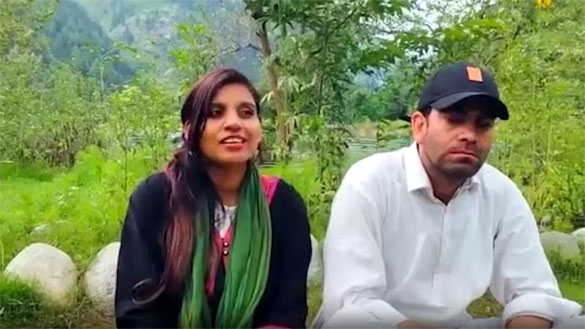
The duo, who
became friends on Facebook in 2019, reportedly tied the knot in a local court
of a district and sessions judge amid tight security.
------
India Today News Desk
New Delhi: Jul 26, 2023
An Indian woman, Anju, crossed the border to
meet her lover in Pakistan three days ago on July 23. A video of the couple,
their second since yesterday, is now circulating on social media, where they
can be seen enjoying tourist spots in Upper Dir, Khyber Pakhtunkhwa province of
Pakistan.
The 4-minute-long video, recorded by a
blogger named Numan Khan, showed Anju praising the beauty of Pakistan.
Anju, a married Indian woman from
Rajasthan’s Bhiwadi district, travelled all the way to Pakistan's northwestern
Khyber Pakhtunkhwa province to meet a man she befriended and fell in love with
on Facebook.
Anju told her husband Arvind that she
was going to Jaipur for a few days. But on Sunday, Arvind came to know via the
media that Anju had gone across the border.
Pakistani media reported that Anju had
converted to Islam and married her Pakistani lover, Nasrullah.
Source: indiatoday.in
https://www.indiatoday.in/india/story/second-video-anju-pak-friend-nasrullah-emerges-pakistan-tourist-spots-2412044-2023-07-26
-----
How Women Are Reshaping Islamic Pilgrimages
as Saudis Change Rules
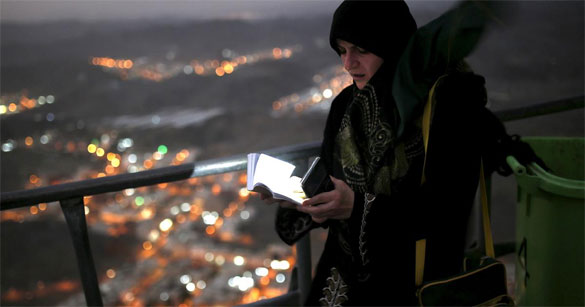
A woman
reads the Koran during the Haj pilgrimage. | Ahmad Masood/Reuters
------
Iqbal Akhtar, The Conversation
Saudi Arabia has changed its decades long
rule that mandated single women be accompanied by a male relative when
performing an Islamic pilgrimage, facilitating the participation of thousands
of single Muslim women in the Haj in 2023.
The new rules don’t apply just during
the Haj. Women can also perform the Umrah, known as the “lesser pilgrimage,” or
other routine pilgrimages such as ziyarat that can be undertaken any time of
the year to Islamic holy sites, without a “mahram,” or male guardian.
The fact that women can now travel
unaccompanied is part of a campaign by the political leadership of Saudi Arabia
to improve the rights of women in the kingdom, which Western societies view as oppressive.
My research looks at issues of identity
and “covenantal pluralism”, which refers to the mutual obligations that
different faith communities have toward one another to support the pursuit of
each one’s spiritual truth. I focus on the geographical area that encompasses
the Indian Ocean, and I argue that these changes need to be viewed within a
larger historical context and as they relate to Muslim women’s engagement with
the sacred sites of Islam.
Saudi Arabia and the West
There is no Quranic injunction against
women’s traveling alone. Nevertheless, in some patriarchal societies where
sexual harassment is common, restrictions are put on women irrespective of
religious affiliation. Currently, Islamic medieval-era injunctions are applied
in Taliban-controlled Afghanistan.
However, Saudi Arabia is an exception.
Conservative Sunni Muslim countries often see the kingdom, the birthplace of
Islam, as the bulwark against Western secularisation. Medieval Islamic laws,
such as capital punishment for apostasy, are used to give an appearance of
authoritative piety in present times.
Indeed, the cities of Mecca and Medina
are visible manifestations of piety. To enter the holy cities is to be
transported into a ritual space of sacred time based on the Muslim call to
prayer, in which pilgrims from around the world unite in the idealised
Prophetic vision of a nation of faith. It is not a world of punctual
appointments set by a work schedule. Rather, worshippers serve God through
devotion in prayer in accordance with the ancient Islamic prayer timings set by
the rhythm of the Sun and Moon.
Colonisation created a dichotomy within
the world where Islam was often seen to be the opposite of the values of the
West. Keeping women segregated from male worshippers, and viewing that
separation as an expression of piety, is part of the rejection of Western norms
while legitimising the Islamic credentials of the Saudis both domestically and
internationally.
Insider perspectives
Generally in mosques around the world,
women and men worship separately. To some it may appear to violate the norms of
Western egalitarianism, but it’s an ancient practice meant to encourage a
spiritual intimacy and fellowship.
Until now, single women who did not have
a male relative to escort them to the Two Holy Mosques – Al Masjid Al Haram in
Mecca and the Prophet’s Mosque in Medina – would join an organised tour group
of women. Their accommodations, meals, sermons and prayers would be organised
together.
Interestingly, the holiest site in Islam
– the mosque in Mecca – is circular, and historically men and women have
worshipped openly together with few, if any, barriers.
These barriers, erected for women in
Saudi Arabia in the 20th century, are being removed in accordance with the
older prophetic tradition of women’s independence. For example, the first wife
of the Prophet, Khatija, was an independent businesswoman who initially hired
the Prophet as an employee for her trading caravans.
What is also important to consider is
that whereas the Hajj is the preeminent Muslim pilgrimage, additional sacred
sites exist for Shiite pilgrimage in countries such as Iran, Iraq and Syria. In
these countries there is no mahram rule, though the threat of violence in Iraq
and Syria means that both male and female pilgrims who visit from abroad come
in groups.
Community and camaraderie
Islamic pilgrimages are global
gatherings of Muslims organized into groups, communities and families in which
the individual’s identity is a dynamic one. The ultimate truth in Islam is the unity
of God, and a Muslim pilgrimage is a manifestation of that unity through
integration and service to the community. In this integration, the individual
ego is subsumed through a communal religious experience, which can be ecstatic.
Additionally, Islam is a religion of
right action in which individuals find realisation by integrating into the
community. The communal model of pilgrimage helps them go through a physically
demanding schedule of ritual observance and creates camaraderie, that continues
beyond the pilgrimage.
The changes to the mahram rule allowed
single Muslim women to join the Hajj pilgrimage in 2023. Over 4,000 women from
India performed the Hajj without a male guardian. Nonetheless, community
participation remains important, and most women do not actually travel alone.
The majority of women join groups that share the same language, rituals and
cuisine to facilitate navigation of the foreign world of Muslim religious
tourism.
The reshaping, reinterpretation and
reconstruction of Islamic pilgrimages has been going on for centuries; this
time, women are leading it.
Source: scroll.in
https://scroll.in/article/1053408/how-women-are-reshaping-islamic-pilgrimages-as-saudis-change-rules
--------
"No Jihadi Conspiracy", No
Video Leak': Cops on 'Filming' of Student by Three Women Students at Udupi
College
Meenakshy Sasikumar
26 Jul 2023
On 20 July, three women students from a
private paramedical college in Karnataka's Udupi were suspended for allegedly
filming a fellow student using a mobile phone inside a washroom. The institute
informed the police on the same day, and an inquiry was launched.
But the incident took a rather drastic
communal turn over the next few days, with several right-wing groups alleging
that the suspended students, who were Muslims, used hidden cameras to shoot
private videos of "Hindu girls" and circulated them among Muslim men
as part of a "jihadi conspiracy."
"There are a lot of people sharing
misinformation and rumours on social media with regard to this incident.
Perhaps, they are doing this with some motive. I would like to clarify that
though there were reports that there were hidden cameras, as per our
information, no such thing was used in this case," Udupi Superintendent of
Police Hakay Akshay Machhindra told the media on Tuesday, 25 July.
Speaking to The Quint over the phone,
the director of the institute Rashmi Krishna Prasad also said that there was no
video leak, and added that the video was deleted by the three Muslim students
in front of the Hindu girl who they filmed, by her own admission.
"No video was circulated among
anyone, unlike what is being said on social media. It is all wrong. It is being
shared to tarnish the image of the institute as well as the future of the
students," she added.
So, What Exactly Happened?
On 18 July, the three students allegedly
shot the video of the other student inside the institute's washroom. They,
however, deleted the video then and there, right in front of the student.
"The student informed a female
faculty member about the issue. She just wanted her to scold the students for
doing it; she didn't want to file a complaint," the director said.
The director was informed of the
incident on the morning of 20 July – and she immediately called the police.
The Quint tried to reach out to the
students involved in the matter. We were unable to contact them. This story
will be updated if we receive their response.
"We confiscated the phone and
suspended the three students until further notice. The phone was handed over to
the police for the inquiry," Prasad added.
The director said that they decided to
suspend the three students because "no student is allowed to bring phones
to the college" and because "they also admitted to committing the
crime."
The Hindu girl also gave a statement
saying that she doesn't want to lodge any complaint, as they are her college
mates and their future is also important, the director further said.
She also clarified that there are no
"hidden cameras" anywhere in the institute.
How Did Right-Wing Groups Get Involved?
After the students were suspended, a
right-wing student organisation in Karnataka, the All College Student Power,
wrote to the Udupi SP demanding action against the three Muslim students.
They also threatened to stage a protest
if the college does not file a complaint against the students.
As per The News Minute, members of the
All College Student Power even appeared on news channels alleging that several
Hindu women were victim to this "conspiracy."
A Twitter user named Rashmi Samant,
whose tweet on the incident was circulated widely, claimed that the three
Muslim students "placed cameras in female toilets of their college to
record hundreds of unsuspecting Hindu girls. Videos and phots that were then
circulated in community WhatsApp groups by the perpetrators [sic]."
She went on to tweet that "many of
the girls who were featured in the videos are depressed and disturbed to the
extent that they are contemplating self-harm/suicide. Yet, this issue is not
being condemned with the severity it deserves."
Reportedly, a different video from Tamil
Nadu was also circulated on social media to claim that it was shot by the three
Muslim students in Udupi.
Speaking to the media, SP Machhindra
said:
He further clarified that "there
are also reports that they [the students] are circulating those videos and
blackmailing the Hindu student. So far, the police department has not found
this to be true."
The SP appealed to people not to engage
in spreading misinformation and rumours. "It is having an impact on the
students, teachers, and society at large," he said.
Right-Wing Group Issues 'Clarification'
After the Udupi Police issued its
statement, the All College Student Power took to Twitter to clarify that the
video being circulated with the claim that it is from Udupi was actually from
Tamil Nadu.
"Thank you to the police department
for investigating the case in a comprehensive way. The video is being shared by
some organisations and individuals on social media. The video is actually from
Tamil Nadu, there should be no confusion in this matter," the statement
said.
Source: thequint.com
https://www.thequint.com/gender/udupi-women-student-filmed-no-video-leak-hidden-camera-police-communal-angle#read-more
--------
From Rajasthan to Pakistan, Anju’s
journey leaves a family seething
Last week, Anju informed her family that
she is going to Jaipur, but reached Pakistan instead to be with Nasrullah, a
resident of Upper Dir district in Malakand Division of Pakistan’s Khyber
Pakhtunkhwa province
Written by Hamza Khan
July 29, 2023
The crossing of the international border
by Alwar’s 35-year-old Anju last week, to be with her Pakistani “friend”, has
left more questions than answers for her family back home.
Last week, Anju informed her family that
she is going to Jaipur, but reached Pakistan instead to be with Nasrullah, a
resident of Upper Dir district in Malakand Division of Pakistan’s Khyber
Pakhtunkhwa province.
In a video statement earlier, Anju,
sitting alongside Nasrullah, claimed she met him on Facebook. “Like other
people come and visit, I have come here in the same manner. People are making
it an issue while I’ve just come to visit my friend. Some are saying we are
getting engaged or married but there is nothing like that. I am merely visiting
and have come here legally. I have to go back and I will go back in two-three
days.”
While family claims she told them she is
going to Jaipur, she says she had told the family she is on her way to
Amritsar. “I had to come here via Amritsar and the Wagah border, so when I crossed
the border, there was a network issue and I could not talk to them. But I
eventually told the family – they had no (unusual) reaction,” she said.
However, as her ‘Nakahama’, or a
marriage certificate with Nasrullah – which also recorded her conversion from
Christianity to Islam as Fatima – went viral, back home her husband Arvind
“disowned” her and is now demanding an investigation into her documents and
even an FIR once she returns.
“She lied and got a visa and even from
there she keeps lying,” he said.
“Although she is claiming that she has
submitted divorce papers, there is nothing like that. She is still my wife,” he
told journalists. He added: “If she returns, we won’t accept her because she
left on her own, she didn’t tell me or the kids or any family member. Even the
kids are now declining to meet her if she comes back. I will not accept her. My
elder daughter is saying she won’t (accept her either).”
“I have no idea when she got a visa,” he
said.
Anju’s father Gaya Prasad too said he
has “disowned” her. “She usually talks to her mother, not with me. I didn’t
even know when she got a passport or visa made, or left. The woman who takes
such a step, leaving behind two children… She could have taken a divorce first
but now that man’s (Arvind’s) life is spoiled, and of two children as well,” he
said.
“There is no pressure of any sort from
us for anything. I don’t want to talk to her. When she has left us, it is as if
she has died for us,” he said.
Arvind added: “When it came to work, she
did get tense sometimes. But I never thought she would take such a big step.
Once she resolves that she has to do something, she will definitely do it.”
“The children are okay and know about
it. They are telling me not to take tension,” he said. “Our relations were okay.
She used to joke that she doesn’t want to live together but I didn’t think
(that she would act on it).”
In her initial statement, Anju had
spoken about Pakistan, saying, “I like the place hence I would want to visit
again and bring my kids this time … The people here are better than what I had
thought.” While her visa expires on August 20, it is not clear if she will
return to India. If she does, Arvind says, “I will first ask her how she got
her visa made. And I will get an FIR registered once she arrives.”
In a video statement, Nasrullah (29),
who works as a medical representative, said his “relationship” with Anju
started in 2019. However, Covid disrupted their plans to meet. “We had applied
for a visa back then but it didn’t go through. Then in 2022 her visa process
started and I applied for the NOC (no-objection certificate). I struggled a lot
for her. Her process was finally completed in 2023… she has come here with
legal documents. The government has provided her 24-hour security.”
Source: indianexpress.com
https://indianexpress.com/article/india/rajasthan-to-pakistan-anju-journey-8865541/
--------
Trinamool Congress MLA Seeks More Funds
ForMuslim Women Under West Bengal’s LakshmirBhandarScheme
The scheme entitles a woman to ₹500 while those from
SC/ST are entitled to ₹1,000 and, according to State Minister for Women and
Child Development Department Sashi Panja, is not based on religion
July 29, 2023
Shiv Sahay
Trinamool Congress MLA and former IPS
officer Humayun Kabir on Friday asked whether Muslim women would be given
higher benefits, like those from Scheduled Caste and Scheduled Tribes community
are, under the State Government’s ‘LakshmirBhandar’ scheme. He was speaking at
the West Bengal Legislative Assembly.
“Will Muslim women like Scheduled Caste
and Scheduled Caste women be given ₹1,000 in the Lakshmi Bhandar scheme?” Mr. Kabir asked on the
floor of the House. The MLA from the Debra Assembly
constituency referred to a report by the Pratichi Trust and said that the
financial condition of Muslim women in the State was not good.
According to the Trinamool Congress
leader, Muslim women told him during the panchayat polls campaign that they
were getting ₹500
while Scheduled Caste and Scheduled Tribe women were getting ₹1,000.
LakshmirBhandar is one of the State’s
key cash incentive schemes where every woman is entitled to ₹500 while those from
SC/ST are entitled to ₹1,000. The State’s Minister for Women and Child
Development Department Sashi Panja said the entitlements under the scheme are
not based on religion.
According to a report by Nobel Laureate
Amartya Sen’s Pratichi Trust, the socioeconomic condition of Muslims in the
State was similar to the Scheduled Caste and Scheduled Tribe communities. While
releasing the report, titled ‘Living Reality of Muslims in West Bengal’, in
2016, Prof Sen had said Muslims “constitute a very large proportion of the poor
in the State”.
After the recently concluded panchayat
polls, which were marred by violence the MLA had said, “As a Bengali, I hang my
head in shame. It is shameful that even in 2023, we could not stop this culture
of violence.”
The police officer–turned politician has
been a part of the Council of Ministers headed by Chief Minister Mamata
Banerjee.
A wrong photo accompanying this article
has been removed.
Source: thehindu.com
https://www.thehindu.com/news/national/other-states/trinamool-congress-mla-seeks-more-funds-for-muslim-women-under-west-bengals-lakshmir-bhandar-scheme/article67132617.ece
--------
URL: https://newageislam.com/islam-women-feminism/indian-anju-fatima-pakistan/d/130330