
Afghan Women-Run Radio, Sadai Banowan, Resumes Broadcasts After Shutdown For Playing Music
New Age Islam News Bureau
08 April 2023
• British Muslim Woman Detained At UK Airport ‘For
Having Similar Name To Daesh Bride Shamima Begum’
• 23 Women Fell Victim To Femicide in Türkiye Last
Month: Report
• Will Turkey’s Conservative Young Women Abandon
Erdogan And AKP?
• Mehbooba Mufti’s Daughter Iltija Mufti Slams CID For
Getting ‘Country-Specific’ Passport
• Saudi Female Gaming Market Can Soar To New Heights
• OIC Calls On Taliban To Revisit Ban On Afghan Women
US Staff From Working
Compiled by New Age Islam News Bureau
URL: https://newageislam.com/islam-women-feminism/afghan-radio-sadai-music/d/129515
--------
Afghan Women-Run Radio, Sadai Banowan, Resumes
Broadcasts After Shutdown For Playing Music
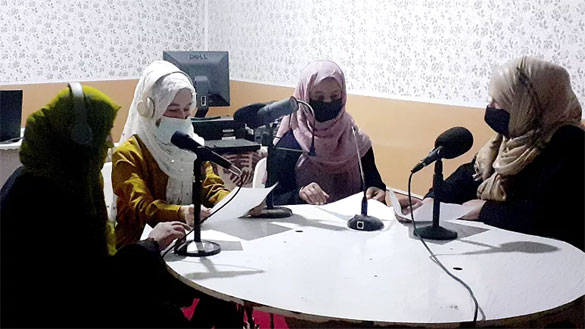
Sadai Banowan resumes
broadcasting after officials shut it down for a week for playing music during
Ramadan - Copyright
AP
------
April 07, 2023
ISLAMABAD: A women-run radio station in northeastern
Afghanistan has resumed its broadcasts, after officials shut it down for a week
for playing music during the holy month of Ramadan, a Taliban official and the
head of the station said Friday.
Sadai Banowan, which means “women’s voice” in Dari,
was launched 10 years ago in Badakhshan province and is Afghanistan’s only
women-run radio station. Six of its eight staff members are women.
Moezuddin Ahmadi, the director for Information and
Culture in Badakhshan, said the station was allowed to resume activities on
Thursday after it had obeyed the “laws and regulations of the Islamic Emirate”
and agreed to stop broadcasting any kind of music.
Station head Najia Sorosh said after the station “gave
a commitment to officials at the information and culture department, they
unlocked the door of the station,” and they started broadcasting again.
The Afghan Journalist Safety Committee, an Afghan
watchdog organization that promotes the safety of journalists and press freedom
and which was involved in mediation for the station’s reopening, welcomed the
resumption of broadcasts.
“Following AJSC’s advocacy efforts, Sadai Banowan
radio resumed its broadcasts,” it said in a tweet.
Representatives from the Ministry of Information and
Culture and the Vice and Virtue Directorate had shut down the station a week
earlier.
Many journalists lost their jobs after the Taliban
takeover in August 2021. Media outlets closed over a lack of funds or because
staff left the country, according to the Afghan Independent Journalists
Association.
The Taliban have barred women from most forms of
employment and education beyond the sixth grade, including university. There is
no official ban on music. During their previous rule in the late 1990s, the
Taliban barred most television, radio and newspapers in the country.
Source: Arab News
https://www.arabnews.com/node/2282831/media
--------
British Muslim Woman Detained At UK Airport ‘For
Having Similar Name To Daesh Bride Shamima Begum’
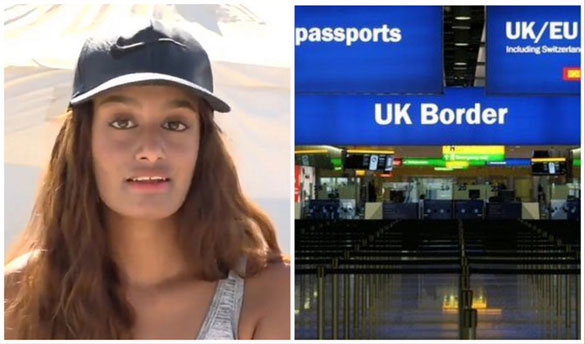
(Reuters/File Photos)
-------
April 07, 2023
LONDON: A British Muslim woman returning home to the
UK from a holiday in Turkey claimed she was detained by police because she has
a similar name as Daesh bride Shamima Begum.
Shamina Begum, who was returning to Manchester
Airport, said she was asked if she “thinks bombing is okay,” and was told to
seek assistance from UK Border Force staff because they said her name was the
same as that belonging to “someone of interest.”
Begum, who had been traveling with her partner,
alleged that five officers detained her under Schedule 7 of the Terrorism Act
2000.
She also claimed her mobile phone and handbag were
seized before having her DNA and fingerprints taken and being questioned for
three hours over her name, her Muslim faith and even her mortgage.
In what Begum called a “humiliating” ordeal, she said
she was also forced to go to an airport bathroom to relieve herself in an
unlocked cubicle with a male officer present, all while being on her period.
“I’m traumatized,” she told The Independent newspaper.
“At first I was confused — I’ve travelled to many destinations previously and
never had this problem,” she added.
Begum was eventually released with no further action
taken against her.
“After I was let go, I cried all the way from the
airport to my house and I couldn’t face the outside world for about four
weeks,” she said. “In the immediate days after this happened, I’d wake up every
day and wish I had not. I’m not a terrorist and didn’t deserve to be treated
that way. It was a dark and difficult time which still impacts me,
unfortunately.
“It was so humiliating and I could not say anything.
It’s easy for the police to hand people a leaflet about what a Schedule 7 stop
is...but what about aftercare? It’s taken me six months to talk about it
properly.”
Begum complained to Greater Manchester Police about
her treatment, who declined to comment on the case, and her complaint was not
upheld by police staff who claimed the stop was justified and handled
correctly.
She has now lodged an appeal against the decision, and
added: “If it isn’t down to my race and religion, why aren’t police stopping
every white person who walks through the airport? It’s always the brown and
Black people who are targeted.
“It wasn’t just the fact that I was stopped; it was
the kind of questions I was asked. Just because I am a Muslim with a Muslim
name and background, it doesn’t make me a terrorist.”
Shamima Begum was 15 when she left her home in London,
traveled through Turkey and into Daesh-held territory, before having her
British citizenship revoked in February 2019.
She is currently in a Syrian camp for former Daesh
brides and their families and is fighting a legal battle with the British
government over the stripping of her citizenship.
Source: Arab News
https://www.arabnews.com/node/2283051/world
--------
23 Women Fell Victim To Femicide in Türkiye Last
Month: Report
April 07 2023
Femicide and violence against women continues to be a
grave problem in Türkiye, some 23 women fell victim to femicide in March, when
International Women’s Day was marked, reveals a report published by a women’s
association.
According to the report published by “We Will Stop
Femicide Platform,” 23 women were murdered in Türkiye last month, while nine of
these women were killed by the person to whom they were married.
Eight women were killed by their spouses, with whom
they were in the process of divorcing and as they did not agree to reconcile.
The perpetrators of some of the murders of women are
their fathers, sons and ex-husbands.
Some 70 percent of the victims of femicide were killed
in their own homes.
According to another report published in January by
another womens association, nearly half of the perpetrators of femicides in
2022 were either partners or spouses.
Intimate partner violence is a form of violence that
can include physical, sexual, psychological and economic violence, as well as
digital abuse, by current or former partners in close relationships.
Intimate partner violence is one of the most common
forms of violence experienced by women worldwide and in Türkiye.
Source: Hurriyet Daily News
https://www.hurriyetdailynews.com/23-women-fell-victim-to-femicide-last-month-report-182171
--------
Will Turkey’s conservative young women abandon Erdogan
and AKP?
Nazlan Ertan
April 7, 2023
IZMIR, Turkey — Turkey’s ruling Justice and
Development Party (AKP), which faces one of the toughest electoral challenges
of its 20-year rule in the May 14 election, is losing its electoral advantage
among conservative women, which had been one of its pillars, political analysts
say.
Rasim Sisman, the chairman of the Social Democracy
Foundation, told Al-Monitor that a survey of 1,067 women found that only 68.7%
who voted for the ruling party in the 2018 elections are likely to vote for the
party again. The report was prepared in collaboration with the
German Friedrich Ebert Foundation and Panaliz Polling and Research Company
According to the poll, 7.8% of that number will go to
the main opposition Republican People’s Party (CHP), which is actively wooing
conservative women, and 2% to the nationalist Good Party, which is one of the
two political parties with a woman chair or a co-chair. CHP and the Good Party
have come together with four smaller right-wing parties for an electoral
alliance that rallies around Kemal Kilicdaroglu as their presidential
candidate, while incumbent President Recep Tayyip Erdogan has sought to broaden
his electoral base with its traditional ally, the Nationalist Movement Party
(MHP), and two small Islamist parties. The SODEV poll says 14% remain undecided
on how they will vote in the parliamentary elections, which will take place at
the same time as the first round of the presidential polls on May 14.
Sisman and Ali Suslu, the director of ALF polling and
research company, believe that the female votes up for grabs will mainly go to
larger parties such as the CHP and the Good Party. A survey carried out by ALF
in January shows that the AKP — traditionally the top party among women voters
— has become second (26.5%) to CHP (29.2%), even before AKP’s
contested alliance with two Islamist parties with misogynist agendas last
month.
In the survey, the Good Party receives 18.8% of the
women’s vote, while AKP-offshoot DEVA gets 3.8%, slightly above the patriarchal
Nationalist Movement Party (MHP) of Devlet Bahceli. The pro-Kurdish People's
Democracy Party (which has the highest number of female lawmakers in parliament
as well as a woman party co-chair) gets 7.4% of the vote. Suslu told Al-Monitor
that a second survey on women was on the way, predicting further breakaways
from the AKP and its electoral ally MHP following the alliance with
conservative Huda Par and New Welfare.
While conservative women are far from a monolithic
voting bloc, 20 years ago many regarded the AKP as the only party that
reflected their values. However, various pollsters and commentators have
pointed out a shift since 2018, and more acutely after 2020, over economic
hardships, gender pay gap and the AKP’s attitude on women’s rights,
particularly on domestic violence and early marriage.
The question of where young conservative women will
take their vote has been embodied in pop culture with the question, “How will
Nursema vote?” A character in politically charged TV series “Cranberry Sorbet,”
Nursema is presented as the embodiment of a young, bourgeois Muslim woman with
her immaculate headscarves, a thorough knowledge of Islam, a no-nonsense
manner, and a sarcastic tongue. Her dream of an international career as a calligraphy
artist is shattered when her well-to-do conservative family forces her into
marriage with the son of a “pious family,” who first attempts to rape her on
her wedding night, then throws her out the window. The series was penalized by
Turkey’s media watchdog RTUK for “encouraging violence against women” after
several conservative papers and columnists complained about the series'
depiction of Sunni believers and its glorification of “liberals,” who, in the series,
rally to help Nursema.
Nihal Bengisu Karaca, an estranged member of the
pro-AKP camp, also bitterly contested the RTUK punishment and the political
environment that made such a ban possible. “The series’ scenario challenges the
myth that a conservative family is a happy one. It shows plainly that
conservative women are not only victimized by the secular side in a polarized
society but suffer injustice at home,” Karaca wrote in her column in Haberturk.
After Ipek Maya Saygin, an academic and commentator
for Daktilo1984, held a talk show with the title “How will Nursema Vote?”
Turkish sociologists and laymen raced to hedge their bets on Twittersphere,
suggesting soft transitions, such as AKP-offshoots Deva and Gelecek, or the
right-wing Good Party; or a hard one, toward Kilicdaroglu. “One clear thing is
that Nursema will not vote for AKP anymore,” tweeted Burak Kadercan, associate
professor of strategy and policy at the US Naval War College and an ardent fan
of the series. Saygin, for her part, told Al-Monitor that she believed Nursema,
irked by the lack of impunity against abuse during the AKP’s 20-year rule,
would reject the ruling party at the ballot box and vote for Aksener, a strong
female figure.
Politicians also jumped on the wagon. “If Erdogan wins,
Nursema’s declaration that she was abused will not be enough and her madman of
a husband will get out scot-free,” tweeted Gursel Tekin, a senior member of the
CHP. “If Kılıcdaroglu wins, she will sue her husband, divorce, and start a new
life. So here is your choice.”
Sehide Zehra Keles, a gender and poverty expert, said,
“Young pious women are rapidly breaking away from the AKP. However, breaking
away from the AKP does not always lead to turning to opposition parties.”
Keles, who works closely with the Muslim feminist women’s association Havle,
wrote in her column for the left-wing Politik Yol, “Political parties will all
nominate candidates wearing a headscarf, but this is far from being convincing
or even adequate. While political parties were vying for [headscarved]
Nursema’s vote, Nursema faced violence, formed alliances with women of other
[political] camps and she no longer feels bound by narrow descriptions. What
she needs is an area of freedom and coexistence.”
Seyda Taluk, the author of “How to Win Elections,”
agreed that the AKP can no longer take conservative women’s votes for granted.
“Through its energetic work with the grassroots, AKP developed strong ties with
conservative homemakers across the country, offering them a network, opportunities
to socialize, and hope that their daughters can have a better life,” Taluk told
Al-Monitor. “But the generation changed. Young women wearing headscarves no
longer fear the headscarf ban will return if the government changes. Stories of
corruption, nepotism, and inequality dishearten devout homemakers. All women
feel the pinch of the high cost of living.”
The young Muslim women, who express their views on new
platforms such as Recel, do not subscribe to AKP’s views on family and
motherhood. They also complain that the patriarchal structure of the party used
them as “soldiers” without allowing them into the decision-making of either the
party or its cronies in business and media.
The last straw came with the AKP’s alliance with the
New Welfare Party, which was a vocal advocate of Erdogan’s overnight withdrawal
from the Istanbul Convention, a pan-European accord that urges its signatories
to monitor, prevent and penalize domestic violence against women. A leaked
document showed that the party also urged the AKP to change Article 6284, which
specifies protections for women from violence. Ozlem Zengin, a vocal AKP
lawmaker, bitterly complained before the cameras that she was “left alone” in
her defense of the article, implying that her male colleagues failed to support
her.
“Both the AKP and some of the opposition parties of
failing to grasp the true impact of Ankara’s withdrawal from the Istanbul
Convention,” Taluk said. “So many male politicians pooh-poohed the issue as an
intellectual debate that did not touch the grassroots. They were wrong. This
was a key defining moment in the AKP’s ties with its female electorate.”
Taluk warns that Erdogan still enjoys popularity among
conservative female voters even if AKP’s votes are falling in parliamentary
elections. Similarly, Istanbul-based pollster Turkiye Raporu’s March Report
says that 45.1% of women said they would vote for Erdogan and 34.5% for
Kilicdaroglu in presidential polls, as compared to 34.7 % of the male
electorate for Erdogan and 46.7% for Kilicdaroglu. The same poll places
Kilicdaroglu at 47%, 7% ahead of
Erdogan, and 5.4% undecided.
Source: Al Monitor
--------
Mehbooba Mufti’s Daughter Iltija Mufti Slams CID For
Getting ‘Country-Specific’ Passport
Muzaffar Raina
| Srinagar
08.04.23
Iltija Mufti, former Jammu and Kashmir chief minister
and erstwhile BJP ally Mehbooba Mufti’s daughter who has been issued a
“country-specific” passport that allows her to visit only the UAE for higher
studies, has accused the CID that runs the security show in the Union territory
of “persecuting” Kashmiris like the Gestapo of Nazi Germany.
The CID (Criminal Investigation Department) of Jammu
and Kashmir police is rarely criticised in public by Kashmir politicians,
largely because of the fear of retribution in a place that has not had an elected
government for nearly four years.
Iltija on Thursday received the two-year passport that
allows her to visit only one nation for higher studies after the CID reportedly
invoked the Official Secrets Act.
On Friday, Iltija suggested that the CID might as well
have pressed espionage charges against her as it had invoked the Officials
Secrets Act to deny her a normal passport.
“This Act is usually invoked for espionage,” she said.
“They (CID officers) are lying to the court....
The CID here has only one job —
that is to harass and persecute Kashmiris. There was a force called the
Gestapo in Nazi Germany, its police wing, which was persecuting and harassing
Jews. Similarly, the CID has only one work here, which is to crush Kashmiris,
persecute them, snatch their jobs and book them under UAPA (the anti-terrorism
law).”
Iltija did not mention it but the passports of Jews in
Nazi Germany were invalidated in 1938 and the document had to be stamped with a
red “J” denoting the holder’s religion to get them validated again. Such rules
marked the persecution of the Jews that eventually led to the Holocaust.
Iltija said the government wanted to make an example
out of her family “so as to stop people from raising their voice”.
“Am I a fugitive? Am I Nirav Modi, am I a terrorist,
an anti-national that I am being punished? If I talk about the central
government, is it like talking against the country?” she asked.
Iltija had approached the high court in February after
her application for a passport was denied following an “adverse report” from
the CID. Her passport had expired on January 2 last year and she had applied
for a fresh one on June 8.
Iltija said the CID last month handed over an “adverse
report” in a sealed cover (under the Official Secrets Act) to the court, citing
the reasons for denying her a normal passport.
“I am not a fugitive or a conman like Kiran Patel who
was treated as a VVIP,” she said. Gujarat resident Patel was arrested last
month after he allegedly posed as a top official from the Prime Minister’s
Office to enjoy the government’s hospitality in Kashmir during multiple trips.
Iltija said she was an “Indian citizen and a
law-abiding citizen” and had broken no laws.
She said Delhi was using the CID to “criminalise” the
right that ordinary residents looking to travel abroad for studies and jobs
have to a passport.
People from different walks of life in Kashmir,
including journalists, were routinely denied passports or were put on no-fly
lists to prevent them travelling abroad, she underlined.
In October, photojournalist Sanna Irshad Mattoo, 28,
was denied boarding at Delhi airport for a flight to the US to accept the
Pulitzer Prize at a ceremony in New York.
Iltija accused the CID of putting Kashmir on
“auto-pilot and silent mode” after the 2019 scrapping of the special status,
and of denying the “basic right to talk” to those who want to express
themselves.
“The CID is playing a very dirty role…. Why has the
CID submitted an adverse report in a sealed cover? If you are so confident
about your report, then why did you invoke the Official Secrets Act? Why do you
not want the document to come out in the public domain?” Iltija asked.
“Because there is nothing substantial in that, there
are no solid grounds (against me). So, you are misleading the court. So, I
request the court to see that it is being misled.”
Iltija had emerged as one of the leading voices
criticising the policies of the Centre in the wake of the 2019 revocation of
the special status, with most other politicians jailed.
“The deputy solicitor-general (of India, Tahir Majid)
Shamsi has asked the court to dismiss my petition as a passport has been issued
to me. But what passport is this?” Iltija asked.
She said the CID had told the court that it was not
stopping her passport and “not violating any of my fundamental rights”. She
accused both the CID and the passport officer of lying.
“This is happening to me because I am the daughter of
a former chief minister. I am not entitled to a passport because Mehbooba Mufti
is my mother. I am entitled to a passport because I am a law-abiding citizen,”
she said.
Iltija asked if there was any FIR or chargesheet
against her in any court to deny her a normal passport.
“It is a conditional passport, (the like of) which is
not given even to fugitives. The regional passport officer is flouting the
Passport Act and violating his duties because if you are giving a conditional
passport to me then you have to tell me why,” she said.
Asked if she would continue to pursue the matter in
court, Iltija alleged that there was pressure on her lawyer to “withdraw the
petition”.
“But I will not withdraw my petition because this is
not only my fight but also of others who have been deprived of such rights.
There is tremendous pressure on us to withdraw the petition, but I will continue
to fight it in the court and I have full faith in the honourable judiciary that
they will issue this passport,” she said.
CID response
The CID has denied any wrongdoing and said the claim
of pressuring litigants to withdraw their court petitions was not true.
In a statement, a CID spokesperson said that
law-enforcing agencies do not ordinarily discuss their work procedures in
public but it had become necessary to do so following “false allegations”
attributed to figures with a public profile. The agency did not name Iltija.
The CID spokesperson said the department was
approaching the aggrieved person to ascertain details about who had pressured
her. The department has promised disciplinary action if any of its officers is
found delinquent.
Source: Telegraph India
--------
Saudi female gaming market can soar to new heights
07 April ,2023
Shaun Ahmed
As Saudi Arabia advances toward the objectives of
Vision 2030, esports and the gaming industry have risen to the forefront of the
Kingdom's economic diversification strategy. With roughly 70 percent of its
population under the age of 35, the Kingdom is home to an estimated 23.5
million gamers. There are many amateur and semiprofessional esports players in
the country, with hundreds of professional esports players pursuing full-time
careers.
The gaming and esports sector will contribute more
than $13.32 billion to the Kingdom's GDP by 2030, according to Brian Ward, CEO
of Savvy Gaming Group, a Saudi gaming company launched by PIF.
However, despite the meteoric rise of esports and
gaming in Saudi Arabia, female gamers, constituting around percent of the
country's gamers, remain underrepresented within the industry. The staff at
most gaming companies in the region are male-dominated and esports teams are predominantly
male, particularly those competing for the most lucrative prizes.
Female gamers face unique challenges that impede their
full participation. During my visit to Riyadh for the Next World Forum last
September, a recurring sentiment I heard among female gamers was that there is
a lack of safe spaces for them. Supportive environments are essential for
nurturing growth and engagement within the gaming community.
Female gamers often resort to hiding or ‘anonymizing’
their identity due to the threat of online abuse and other dangers in the
male-dominated online gaming realm. Reach3, the global market research firm,
surveyed 900 women gamers in the US, China, and Germany about the issues they
face, and 59 percent reported that they hide their gender when playing video
games.
Limited opportunities for women to train and showcase
their talents, along with their inadequate awareness of existing esports and
game development programs, further contribute to the gender disparity.
To tackle these challenges and unlock the female
gaming market's potential in Saudi Arabia, the government and businesses can
adopt several strategies, including hosting female-only tournaments. Women-only
esports competitions provide a platform for female gamers to showcase their skills
and expand their presence in the gaming community.
Under this umbrella establishing female teams becomes
easier to provide safe and supportive environments for women to compete and
collaborate in the gaming industry.
Workshops and classes for game development can foster
the advancement of women in game design and development through education and
training programs. Simply, it will enable females to acquire the requisite
skills for game creation.
Establishing female-only events and teams should not be
the only objective. While this helps integrate women into the esports market,
the end goal is for them to compete on a level playing field with men and have
equal opportunities in game development.
Investing in the female gaming market makes sound
business sense and is consistent with the objectives of the Saudi government.
Businesses could experience long-term success in this market as Saudi Arabia's
user penetration is projected to reach 17.6 percent in 2023 and 19.0 percent in
2027.
The growth of the esports industry could also create
jobs for women ranging from game developers and designers to event organizers
and marketers. A team roster, for example, can include roles such as manager,
coach, analyst, mentor, and psychologist. There can also be content creators
and publishers, social media and content managers, marketing executives and so
on.
Cultivating a thriving female gaming community can
contribute to fostering a sense of identity and pride among Saudi women. As the
country progresses towards a more inclusive society, empowering women to
participate in the gaming industry will not only boost the economy but also
enhance social cohesion and national unity.
Ultimately, investing in the female gaming market will
enable the Kingdom to fully harness its young, dynamic population's potential.
By taking the necessary steps to empower and support women in gaming, Saudi
Arabia can emerge as a regional trailblazer, setting an example for other
countries to emulate.
As Vision 2030 unfolds, the esports and gaming
industries must ensure that the female gaming market is not left behind, but
rather, championed and celebrated as an integral part of the Kingdom's economic
and social transformation.
With the right investments and policies in place, the
female gaming market in Saudi Arabia can soar to new heights, contributing
significantly to the country's growth and adhering to the three themes outlined
in Vision 2030's plan: a vibrant society, a thriving economy, and an ambitious
nation.
Source: Al Arabiya
https://english.alarabiya.net/views/2023/04/07/Saudi-female-gaming-market-can-soar-to-new-heights
--------
OIC calls on Taliban to revisit ban on Afghan women US
staff from working
8 April, 2023
Kabul [Afghanistan], April 8 (ANI): The Organisation
of Islamic Cooperation (OIC) has called upon the de-facto authorities of
Afghanistan to once again revisit the ban on Afghan women staff of the UN
agencies in the country from working, TOLOnews reported.
Many nations and international organisations have
continued to respond negatively to the prohibition.
Calling the restrictive measures placed on women and
girls regressive for country’s growth, the OIC’s general secretariat said that
the barring of females from state organisations is of grave concern, the Afghan
news agency said.
Moreover, the German mission for Afghanistan on
Twitter also condemned the ban on women working for UNAMA.
“It puts millions in acute danger and blatantly
violates human rights. Women are essential to humanitarian assistance,” the
German mission said on Twitter, adding, “We are now coordinating further steps
with our international partners.”
The spokesperson for the UN Secretary-General, Stephane
Dujarric, stated that Afghan women would not be replaced with men.
“Afghan women and men are essential to all aspects of
the UN’s work in Afghanistan. As we’ve said repeatedly, Afghan women’s
meaningful participation is essential to reach safely and effectively
populations in need with principled and quality assistance,” he said, reported
TOLOnews.
Since the Taliban took control of Afghanistan in
August 2021, the situation of women in the country has only got worse. Women in
the country are prohibited from leadership posts, and not allowed to work as
well as travel unless accompanied by a male companion.
The Taliban promised to reopen all schools on March
23, this year, but, instead, on that day, they closed secondary institutions
for girls.
There is still no word on when or if these schools
will reopen or if the ban is indefinite.
As women’s education continues to suffer majorly in
Afghanistan under the Taliban regime, the Organisation of Islamic Cooperation
(OIC) in March agreed to send a team of scholars to the country to discuss
women’s right to education and work with the regime, TOLOnews reported. (ANI)
Source: The Print
--------
URL: https://newageislam.com/islam-women-feminism/afghan-radio-sadai-music/d/129515
New Age Islam, Islam Online, Islamic Website, African Muslim News, Arab World News, South Asia News, Indian Muslim News, World Muslim News, Women in Islam, Islamic Feminism, Arab Women, Women In Arab, Islamophobia in America, Muslim Women in West, Islam Women and Feminism