
World Media on Israel and Gaza - Part 4
Compiled By New Age Islam Edit Bureau
22 July, 2014
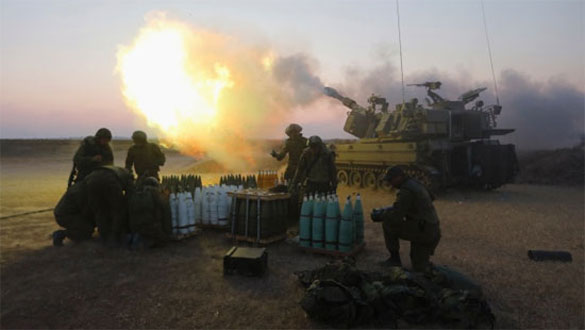 Israel intensified airstrikes and shelling on Tuesday, as two more IDF soldiers were killed and the Palestinian death toll rose to at least 570. (Nir Elias/Reuters)
-------
Articles:
• Netanyahu’s Goal Is to End Palestinian Sovereignty
By Dr. Nafeez Ahmed
• Gaza 1994-2014: The Peace That Led To War
By Marwan Bishara
• A Human Tragedy: What Is It Like To Live In Gaza Under Israeli Offensive?
By Sarah Ali
• Israel Used Ceasefire Plan to Escalate War
By Sharif Nashashibi
• Fleeing Civilians Become Targets In Shajaiya
By Asmaa Al-Ghoul
• Western Fatigue and Gaza
By Neil Berry
• Palestinians Are Victims of Miscalculation
By Semih Idiz
• Netanyahu's Renewed Legitimacy
By Mazal Mualem
• It Is Time for Serious Introspection
By Saad Dosari
• Massacre in Gaza
By Javid Husain
-----
Netanyahu’s Goal Is to End Palestinian Sovereignty
By Dr. Nafeez Ahmed
21 July 2014
Israel’s military assault on Gaza has so far killed more than 500 Palestinians and wounded more than 2000. Nearly 80% of these casualties have been civilians. Eighteen Israeli soldiers and two Israeli civilians have been killed.
So far, upwards of 1,400 Palestinian homes have been completely destroyed, damaged or left uninhabitable, including health facilities and ambulances. According to the Red Cross, the Israel Defence Force (IDF) has conducted “repeated bombings of water infrastructure” leaving “hundreds of thousands” of Palestinians in Gaza without water for days.”
On the pretext that Hamas has rejected Egypt’s proposed ceasefire; Israel is escalating “Operation Protective Edge” with plans for intensified airstrikes. Now Israel has launched its much-vaunted ground invasion, likely designed to collapse Gaza’s civilian infrastructure. On Tuesday, the IDF called on residents of eastern and northern Gaza – some 100,000 residents - to evacuate their homes.
The only conceivable objective of this total war on Gazan society, I believe, is the forced displacement and expulsion of the Palestinian people from their homes.
A hint at Israeli Prime Minister Benjamin Netanyahu’s game-plan was revealed on day four of the military operation in a press conference. Speaking in Hebrew, Netanyahu “made explicitly clear that he could never, ever, countenance a fully sovereign Palestinian state in the West Bank.” While he is known to have previously indicated he is opposed to a single bi-national Israeli state which would include Palestinians, favouring instead a unilateral “separation” from the Palestinians, he now “made explicit that this could not extend to full Palestinian sovereignty.
“There cannot be a situation, under any agreement, in which we relinquish security control of the territory west of the River Jordan,” he said.
Consolidating Control
As observed by David Horovitz, founding editor of the Times of Israel: “Not relinquishing security control west of the Jordan, it should be emphasized, means not giving a Palestinian entity full sovereignty there. It means not acceding to Mahmoud Abbas’ demands, to Barack Obama’s demands, to the international community’s demands. This is not merely demanding a demilitarized Palestine… That sentence, quite simply, spells the end to the notion of Netanyahu consenting to the establishment of a Palestinian state.”
In other words, Netanyahu’s vision is to consolidate Israel’s control over “Judae and Samaria” in the name of “security.”
Little has changed. In his 1995 book, A Place Under the Sun, Netanyahu described a Palestinian state as a danger to Zionism, and declared his belief in the Jewish right to a state that would not just incorporate the land of historic Palestine, but even potentially incorporate other Arab countries: “Jordan, for example, is part of the lands that constitute greater Israel,” he said.
“Separation” in this context does not mean a two-state solution at all. It seems it means the opposite – a greater Israel without Palestinians.
To be sure, this mentality is not isolated to the Israeli right. Earlier this year, the Knesset voted down the so-called ‘two-state solution’ bill that would have prohibited Israel from unilaterally annexing land in the West Bank and Gaza, only permitting land annexation with Palestinian approval in the context of a peace agreement leading to two states.
Israeli leaders, it seems, are neither interested in peace, nor a two-state solution. According to U.S. Middle East envoy Martin Indyk, Israel had deliberately “sabotaged” the peace talks by refusing to even consider a freeze on expanded settlement activity. Netanyahu, he said, “would not yield an inch” for peace. Although he blamed both sides for their intransigence in negotiations, he pointed out that Israel’s pro-settlement stance torpedoed negotiations on purpose.
That is why “Operation Protective Edge” has deliberately targeted civilians and civilian infrastructure. This is not simply a war on Hamas. It is a war on the very concept of an independent, sovereign Palestinian state, it seems.
Hamas: As Much an Enemy as Israel
Unfortunately, by continuing its indiscriminate rocket attacks on Israel, Hamas has continued to prove itself as much of an enemy to the Palestinian people as the IDF. Time and time again, Hamas’ rockets have served to play into the hands of Israel’s most militant factions in government, providing the pretext needed for escalation.
Indeed, U.S. intelligence officials confirmed that from the late 1970s to the 80s, Israel had “directly and indirectly” financed Hamas as a counterweight to the Palestinian Liberation Organization (PLO) “to divide and dilute support” for the secular movement for self-determination. But there was another agenda. “The thinking on the part of some of the right-wing Israeli establishment was that Hamas and the others, if they gained control, would refuse to have any part of the peace process and would torpedo any agreements put in place,” said one U.S. government official. “Israel would still be the only democracy in the region for the United States to deal with.”
In 2001, Times of Israel columnist Ellis Shuman reported for the Israel Insider that former Knesset parliamentarian Michael Kleiner, leader of the far right Herut party who has just been elected president of the Supreme Court of Netanyahu’s Likud, “suggested replacing Arafat, even if it meant the Hamas would take his place. According to Kleiner, the entire world recognises the Hamas as a terrorist organisation so Israel’s continued efforts against a radical Palestinian leadership would not be condemned.”
That year, according to Ha’aretz, Silvan Shalom – then Israeli finance minister and current minister of energy and water – told the Cabinet that: “Between Hamas and Arafat, I prefer Hamas.” None of the ministers protested, noted Ha’aretz. Shalom went on to describe Arafat as “a terrorist in a diplomat’s suit, while the Hamas can be hit unmercifully. Everyone will understand who we’re dealing with, he implied, and there won’t be any international protests.”
As former Times Editor George Szamuely observed in New York Press magazine in 2002, Israel’s support for Hamas “even continued after the 1993 Oslo accords,” as suicide bombings inside Israel continued. Hamas, he remarked, “served Israel’s purpose admirably by suggesting to the American public that the conflict in the Middle East pitted democratic Israel against all-or-nothing fanatics who wanted to drive the Jews into the sea. Israel’s refusal to surrender conquered land and its continued building of settlements in violation of innumerable U.N. resolutions could then all be justified as perfectly reasonable responses to an implacable enemy.”
I believe that Israel has leapt on Hamas’ rejection of the Egyptian-brokered ceasefire as justification to expand its war on Gaza. But the failure of the ceasefire proposal was a foregone conclusion. “We did not receive any official draft of this Egyptian proposal,” said a Hamas spokesman who complained that Cairo had not even consulted the group over the deal.
According to another senior Hamas source, Egyptian intermediaries had instead passed on secret messages to the group warning that Israel would “wipe out” one third of the Gaza Strip. The Egyptian army proceeded to aid Israel’s ensuing military attack by blowing up 29 tunnels under the country’s border with Gaza. It is therefore no surprise that Hamas believed the proposal was “not worth the ink that wrote it.”
Yet Hamas’ insistence on firing rockets into Israel plays into the hands of the Likud’s longstanding ambitions to permanently alter the facts on the ground in Gaza through extreme force. Given the vast military disparity between Hamas and the IDF – illustrated in the casualty figures – this is not a war. Rather, I view it as an attempt to expunge Palestinians from their ancestral homeland.
Dr. Nafeez Ahmed is a bestselling author, investigative journalist and international security scholar. He is executive director of the Institute for Policy Research & Development in London, and author of A User's Guide to the Crisis of Civilization among other books. His work on international terrorism was officially used by the 9/11 Commission, among other government agencies. He writes for the Guardian on the geopolitics of environmental, energy and economic crises on his Earth insight blog.
Source: http://english.alarabiya.net/en/views/news/middle-east/2014/07/21/Netanyahu-s-goal-is-to-end-Palestinian-sovereignty.html
-----
Gaza 1994-2014: The Peace That Led To War
By Marwan Bishara
20 Jul 2014
So much has changed, so little has improved two decades after Israel and the PLO signed the Gaza-Jericho Agreement that paved the way for the beginning of limited Palestinian self- rule.
I witnessed first-hand peoples' joy as the Israelis withdrew from the populated centres in the spring of 1994. The arrival in Gaza of PLO leader Yasser Arafat soon after - 20 years ago this month - seemed to open a new chapter in the modern history of Palestine and Israel. Even the sceptics and the Islamists couldn't hide their pleasure at seeing the back of their Israeli tormenters.
Alas, they didn't go far.
Israel had redeployed its military among the Palestinian camps and towns where it maintained a few illegal Jewish settlements along with their fences and swimming pools.
The signed agreement stipulated that the 5,000 or so settlers would continue to control 40 percent of the strip while more than a million Palestinians were squeezed into less than 60 percent of Gaza, home to the oldest, most impoverished refugee camp.
This lopsided vision of peace persisted in the following six years. The Palestinians signed multiple transitional agreements, only to see their freedoms and territory shrink with each internationally celebrated ceremony. The "peace of the brave" was slowly exposed as the peace of the reckless - short on peace, long on process, and culminating in ever more frustration, hostility and violence.
Hegemonic Peace
Since its inception in 1993, the Oslo Process was based on an imbalance of power. It reflected Israel's strategic superiority to dictate certain terms, but also its inability to impose its will on the defiant Palestinians who refused to surrender.
It's fundamentally unstable. Unlike peace based on defeat (US and Japan post-World War II) or balance of power (Egypt and Israel), the Israeli-Palestinian peace has been marked by conflicting expectations and disruptive ambiguity.
That's why instead of a comprehensive peace settlement, Israel insisted on phased peace accords that allowed it to dictate the pace of progress in a transitional process. Agreements were reached in phases, and implemented in stages, forcing the Palestinian Authority to prove its security-worthiness to Israel by cracking down on "extremist", Islamists and secularists alike.
Likewise, Israel expanded its illegal settlements while imposing a hermetic system of control over the Palestinian population centres.
As a result, two separate systems emerged in the Gaza strip and the West Bank; a superior one for Israel and its settlers that encompassed industrial zones, rich water resources, and modern road networks, and a second subordinate closed system for the indigenous Palestinian population living in separate Bantustans.
This worsened the precarious equilibrium characterized by instability and recurring violence between occupiers and occupied, between illegal settlers and indigenous residents.
The Palestinians, and to some degree the Israelis, became the casualties of a process that promised peace and security but produced insecurity and division. The persistent occupation led to deeper radicalisation in both societies, the people grew geographically closer and politically evermore distant.
In 2000, Israel failed to force the PLO at Camp David to accept its lopsided vision of a permanent solution. The Palestinians treated its "generous offer" as a diplomatic insult that fell short of meeting their basic historic and national rights.
And from there onwards, the situation has gone from bad to ugly.
Weakening Fatah, strengthening Hamas, and back
Israeli provocations and Palestinian despair led to a second Palestinian uprising in the midst of the diplomatic void.
The repression under Ehud Barak intensified with the advent of Ariel Sharon. The extremist leader exploited the US global war on terror after the 9-11 attacks to wage his war against "Arafistan". In no time, Israel's assault turned into a full-scale war against the Fatah-led Palestinian Authority, destroying its institutions and security forces, in an act of what Israeli sociologist Baruch Kimmerling called "politicide".
The ascendance of the more "moderate" Mahmoud Abbas to the presidency after Arafat's death didn't lead to a Fatah recovery as Israel continued to dictate its conditions on the new leader and his government. Worse, Abbas's gamble on diplomacy backfired as Israel expanded its settlements in the West Bank but withdrew its settlers from the Gaza strip under the heat of Hamas's resistance.
From then on, Fatah and Hamas have been competing, even fighting over who will rule the Palestinians in their open-air Gaza prison. But Israel has remained the occupying power in terms of its control over all of Gaza's connections to the outside world. And it has continued to use force there whenever it deemed it necessary, as it has done this month - the latest in a series of invasions, incursions, bombardments and siege.
The historic record makes clear that Hamas grows stronger not weaker with each and every Israeli aggression. Like the Lebanese Hezbollah, it's no less capable of cutting through Israel's deterrence.
Alas, none of this is registering with Israel's leaders. Their political expediency and ideological blindness are deepening Israel's insecurity and worsening its strategic standing. Their failure to subjugate Palestine into a greater Israeli control continues to backfire, and in the process do away with the two-state solution.
For their part, the strategic myopia of the Palestinian leaders has trapped them in a corner. Their hunger for power and lack of real commitment to national unity have let down their people and undermined their struggle for freedom. It's high time they rise to the level of their people's suffering and endurance.
Having said that, the onus remains on the occupying power, Israel. Much of its complaints about the Palestinians, whether real or imagined, are primarily a by-product of its occupation and dispossession of their national rights, not the opposite.
That's why a ceasefire must go beyond curtailing Israel's firepower to lift the siege on Gaza and pave the way for negotiations based on fairness not power; on legality not force.
It's high time to forego the killing and destruction in favour of a peace agreement. Unlike war, peace need not be a zero-sum game.
Marwan Bishara is the senior political analyst at Al Jazeera.
Source: http://www.aljazeera.com/indepth/opinion/2014/07/gaza-1994-2004-peace-led-war-2014720144816864760.html
-------
A Human Tragedy: What Is It Like To Live In Gaza Under Israeli Offensive?
By Sarah Ali
20 Jul 2014
Boom! It's 3:05 am. We wake up for suhour, the pre-dawn meal in Ramadan, after a long and horrifying night made worse by the thick presence of Israeli surveillance drones in Gaza's sky. Friends on my Facebook newsfeed complain of sleep deprivation and continuing Israeli air strikes around them. The radio has a bad signal, so I turn it off. My two-and-a-half-year-old niece flinches as a deafening explosion strikes a nearby area. Her forefinger pointed upwards, she exclaims, "wawa!" (a colloquial Arabic word babies use to say they are in pain).
On July 7, Palestinians found themselves in the throes of yet another Israeli aggression. Thirteen days into the Israeli onslaught on Gaza, over 400 Palestinians have been killed, most of them civilians. At least 77 children are among the dead. Thousands of people have been injured and over 50,000 displaced. Some 15,000 houses have been destroyed or severely damaged, and dozens of fishing boats have been burned, destroyed or partially damaged.
The main water line for al-Shati refugee camp in Gaza was bombed and damaged, while 50 percent of sewage pumping and treatment centres are no longer operating. A home for the disabled run by a charitable centre was destroyed, killing two women and injuring others. A kindergarten was hit and damaged. A rehabilitation hospital was targeted. The house of police chief Tayseer Al-Batsh was hit by two Israeli bombs, critically injuring him and killing 17 people of Al-Batsh family. Four children playing on the beach were slain as an Israeli gunboat targeted them in broad daylight. Another three children were killed while playing on the rooftop of their house. The list goes on and on.
In response to Israel's occupation and illegal blockade of the Gaza Strip (with Egypt's complicity), its wreaking havoc across the West Bank, its constant human rights violations and arrests, shooting at Palestinian fishermen and farmers, and frequent bombing of Gaza - Palestinian armed groups have fired a barrage of rockets into Israeli territory. Sirens go off in Jerusalem, Sderot, Tel Aviv, Isdoud, Ber Saba', and other areas, forcing Israeli citizens into shelters. So far there have been two civilian deaths in Israel and five Israeli soldiers have been killed in clashes with Palestinian fighters.
In late afternoon on July 16, the house of my deceased grandparents - home to four families and 12 people in East Gaza - was bombed. My uncles and cousins received no phone call, no messages, nothing (not that a phone call telling you "we'll bomb your house" makes it any better). The distance between their house and that of their neighbours is less than a metre. No rocket could have possibly been fired from their house into Israel. And, yet, an Israeli "targeted" strike hit them. When the first missile fell, they ran out of the house. My uncle and 70 year old aunt sustained injuries but they all miraculously survived.
Homeless, in every sense of the word, they are now split into relatives' homes. Their house has been completely destroyed. Most of their belongings remain in the street; they visit every morning, trying to find and pull out of the rubble anything still fit for use. My uncle's wife, an agriculture engineer and a lifelong embroidery enthusiast, laments, "How did I not take my embroideries? Why did I leave without them?"
We are still in the holy month of Ramadan, a time of spirituality, reflection and religious devotion, when people socialise outside and at home with family and friends. Mornings and evenings of Ramadan are no longer the same, though. Most workplaces are closed. People do not go to school or work. They are careful not to go out a lot, although many Palestinians still venture out to get food and perform Taraweeh - evening prayers. At night, most people, except for medical staff and journalists, remain indoors.
War is horror. War is our vulnerability and helplessness. It is our inability to protect family and friends. It is deciding not which area in Gaza is safer, but which one is less dangerous. It is packing official papers, a bottle of water, life savings, a mobile with a dead battery, and, above all, memories into one small "emergency bag" and forgetting the bag altogether once your house is shelled. War is having no time to say goodbye to your window, or the stickers on your wall, or a piece of embroidery, or that crack in the door you always hated. War is leaving your house barefoot. War is your grief aired live on TV. War is humiliation. War is remorse for things you have not done. War is traumatised children and traumatised adults. War is broken hearts and scars that do not heal.
War is the painful abruptness of loss. All it takes is a minute, or perhaps less than a minute. A sky lantern lights up the whole area around the "target", guiding the Israeli apache or F16 through the dark strip. A terrifying whoosh accompanies the missile as it falls upon the house. Screams and silent tears. A last declaration of faith in Allah and His messenger. A last breath. The sky lights up again. A massive explosion is heard outside. Smoke clouds the area and the air around smells of death. Flames erupt. The explosion echoes in your ear. In seconds, someone's memories are buried under the rubble of their home. Someone's loved ones are gone forever.
It is 3:30 A.M. I hear the third boom in a span of only a few minutes as a reminder of the war. War is waking up for Suhoor not by an alarm clock, but by a blast. Faces are pale and food is tasteless. Time is meaningless. Power is now off and there is no way I can make sure my friends are alive. My niece, still crying and terrified by the sounds of bombing yawns, her tears lulling her to sleep. I turn on the radio again only to hear about Western leaders staunchly asserting, from the comfort of their countries, the right of our oppressor to "defend" itself, while simultaneously denying a defenceless and besieged population that right. I smile at the irony of it all as another explosion roars in the background.
Sarah Ali is a Palestinian living in the Gaza Strip. She studied English Language and Literature and currently is working as a teacher in Gaza City.
Source: http://www.aljazeera.com/indepth/opinion/2014/07/gaza-human-tragedy-2014720114139777497.html
------
Israel Used Ceasefire Plan to Escalate War
By Sharif Nashashibi
20 Jul 2014
A week of ceasefire calls, efforts and proposals has not stopped Israel from launching a ground invasion of Gaza in tandem with its aerial and naval bombardments. Developments suggest that Israel, while accepting an Egyptian proposal, used it as a pretext to intensify and widen its offensive. Cairo, which since the ouster of President Mohamed Morsi last summer is as hostile to Hamas as Israel is, may have enabled such a plan, deliberately or otherwise.
Hamas, which has roots in Egypt's outlawed Muslim Brotherhood, said it was never consulted about Cairo's ceasefire proposal, having learned of it from media reports. It is extraordinary that a supposed mediator between two warring parties would exclude one of them from the process.
This would almost ensure that party's rejection, regardless of the proposal's content, because it would be humiliating to accept something presented as a fait accompli. As such, Hamas' rejection was hardly surprising, describing the initiative as one of "bowing and submission".
A Ceasefire Trap?
Israeli Prime Minister Benjamin Netanyahu's statement that "the Egyptian proposal gives the opportunity to address the disarmament" of Gaza was likely intended to ensure rejection by Palestinian militants there. After all, this was not stipulated in the plan, as described in media reports. Netanyahu said Hamas' rejection "leaves us no choice but to expand and intensify the campaign against it" and to do so with "international legitimacy".
Egypt contributed to this deluded sense of legitimacy by blaming Hamas - as well as Qatar and Turkey - for the failure of its proposal. The next day, Israel launched its ground invasion. This week's developments could not have been better scripted in favour of such an outcome, with Israel portraying itself as having no choice against a belligerent foe, and the traditional mediator over Gaza helping to foster that impression.
Given the regular contact between Israel and Egypt, it is not outlandish to suspect that this was a trap designed to ensnare Hamas. The latter rejected Cairo's proposal "in its current form" - not outright - and notified it of desired changes. However, there has been no attempt by Egypt to modify its plan. Indeed, Cairo had been criticised from the outset for the sluggish nature of its mediation, leading to speculation that it was happy to see Israel deal a decisive blow to Hamas.
If the Palestinian faction was uninterested in a ceasefire, it would not have subsequently floated its own proposal for a 10-year truce. This was announced on Al Jazeera and reported by Israeli media. If Netanyahu genuinely sought an end to hostilities, he would have taken Hamas' plan into consideration.
He did not even respond - nor did Egypt - despite the terms being eminently reasonable. They include lifting the siege of Gaza, economic development of the territory, UN supervision of borders, crossings, the airport and seaport, easing conditions for permits to pray at Jerusalem's Al Aqusa mosque, respect for the national reconciliation deal, and the freeing of Palestinians detained since the abduction and killing of three Israeli teenagers last month.
The problem for Hamas is that in terms of accepting the Egyptian proposal, it would have been damned if it did and damned if it did not. One of its primary objections was negotiating longer-term issues after a ceasefire was agreed, preferring instead to do both simultaneously.
This thinking was borne out of the experience of the last ceasefire agreement in 2012. The terms stipulated that after 24 hours, talks would begin on opening crossings into Gaza and allowing free movement of people and goods. That did not happen, and the two sides disagreed on what that meant. Hamas said the deal covered the opening of all Gaza's border crossings with Israel and Egypt, but Israel said it would not lift its blockade.
A repeat of this would mean Hamas not having anything tangible to show the Palestinians of Gaza for all the death and destruction Israel is inflicting on them. This could undermine its popularity and its image as an effective resister of Israeli aggression.
However, agreeing short- and longer-term issues simultaneously would provide no guarantee of Israel's abidance. Indeed, it has left behind a trail of violated deals. Within just a week of the 2012 ceasefire taking effect, Israel had killed a Gaza Palestinian civilian, injured at least 15, arrested nine fishermen at sea, and sunk several fishing boats, not to mention numerous provocations in the West Bank. No Palestinian factions responded to these clear violations.
Hamas' Defiance
A fundamental difficulty facing Hamas is that Israel feels no need for comprehensive negotiations. The latter has maintained its siege of Gaza without international repercussions, and is being aided and abetted by Egypt. International calls for a ceasefire have largely ignored the underlying issue of the blockade.
In addition, Hamas' current domestic and regional positions are weak. At home, in Gaza, it has failed to improve the lot of Palestinians or bring them any closer to statehood. It is also openly at odds with the Palestinian Authority despite the reconciliation deal, which now exists in name only. Regionally, it has lost an ally in Morsi, as well as backing from Damascus and Tehran due to its support for the Syrian revolution. It is also viewed unfavourably by certain Gulf States.
As such, it is unlikely to be able to push for better terms from Israel. Neither can Hamas indefinitely sustain an onslaught from a much more powerful enemy. For all the rockets it has fired, and their increased range, the vast majority have been intercepted, and they have only managed to kill one Israeli.
Contrast this with more than 300 Palestinian deaths and almost 2,000 injuries (the vast majority civilians), tens of thousands displaced, more than 15,000 homes partially or totally destroyed, and the water, health, sewage, electricity and education systems in ruins. Such death and destruction will skyrocket now that a ground invasion is under way.
Many Palestinians in Gaza say they refuse to go back to the status quo ante. Such sentiments are understandable given their miserable existence in what is the world's largest open-air prison. As UNRWA's Gaza director Robert Turner said: "A return to 'calm' is a return to ... confinement," with "no external access to markets, employment, or education - in short, no access to the outside world".
However, it would be highly risky for Hamas to base its defiance on that of the civilian population - given that the latter are bearing the brunt of Israel's onslaught - because it would not want to be seen as callous with Palestinian life. Meanwhile, the more iron-fisted Netanyahu's policies, the more domestic popularity he seems to gain.
Hamas may be counting on increased international condemnation putting a stop to Israel, however, by the time that happens, Gaza Palestinians' losses - and those of Hamas - may dwarf what they have already endured.
The Palestinian faction is in an unenviable, perhaps impossible, situation, and Israel is taking advantage of this. As if Netanyahu's actions are not shameful enough, regional positions and circumstances are helping him wage a war whose primary target, despite the rhetoric, is Gaza's captive civilian population. Unfortunately, it is he who will decide how long this conflict lasts and at what cost to the Palestinian people.
Sharif Nashashibi is an award-winning journalist and analyst on Arab affairs. He is a regular contributor to Al Jazeera English, Al Arabiya News, The National, The Middle East magazine and the Middle East Eye.
Source: http://www.aljazeera.com/indepth/opinion/2014/07/israel-ceasefire-escalate-war-2014719173840867406.html
------
Fleeing Civilians Become Targets in Shajaiya
By Asmaa Al-Ghoul
July 21, 2014
A two-hour humanitarian truce was declared to evacuate the dead and wounded from the Shajaiya neighborhood. It was scheduled from 1:30 to 3:30 p.m. Sunday, July 20, after a long night of heavy shelling by Israeli tanks. Israeli occupation forces have been randomly and continuously shelling the neighborhood, leaving at the time of this writing 400 wounded and 72 dead, according to the Ministry of Health. The search for other civilian casualties is continuing.
Hardly an hour passed before the truce collapsed and we heard the Israeli shelling start up all over again. It seems that the truce means nothing to the Israeli forces, and neither does the bloodshed.
We managed to enter the neighborhood along with reporters and ambulances during the truce. The rescue crews were able to pull some bodies out from under the rubble of houses. The people, who were holding bags filled with their belongings, had been trying to hide, but the shells took their lives anyway.
We entered Beltagy Street in Shajaiya. The houses were empty, most of them shelled or burned. We saw one faraway resistance fighter, walking alone, dressed in black and coming from the front line. The few people still alive were coming out of their homes, while others returned to their houses during the truce to collect their belongings.
A father returning home in search of his missing child told Al-Monitor, “I did not find my child in any of the places where the residents of Shajaiya sought refuge. There are no hospitals here — I believe he remained here.”
We helped him pull up a tree that had been struck down by a shell, to see if perhaps his son was beneath it. We found nothing; except for electrical wires spread everywhere.
Mohammed Rabih, exiting the burned area, told Al-Monitor, “They have been shelling randomly all night long. Some of the neighbourhood’s residents managed to leave, while others were stuck under the bombardment.”
We tried to walk further into the neighborhood. Civil defence vehicles were extinguishing a fire while paramedics were searching for injured and dead people. We saw the ambulance near which journalist Khaled Hamad and ambulance worker Fouad Jaber had been killed. The vehicle was also shelled.
We moved a little further and came upon a house with smoke billowing out of it. At that very moment, the truce was suspended, and the thud of Israeli shells echoed nearby. A few seconds later came the sound of another shell. We tried to hide in the corners of a house and then we ran to the car. Al-Jazeera reporter Wael Dahdouh remained in place, broadcasting live.
The car took us swiftly out of the neighborhood. On our way, we saw people trying to go back to check their houses. Amar al-Zaeem, who was wearing prayer clothes, told us, “We returned home to collect clothes. We could not enter the neighborhood. We miraculously survived the shelling.”
News of the Shajaiya massacre began to reach the locals in the early morning, as hospitals were filled with injured people. In the emergency department of al-Shifa hospital, 15-year-old Mohammed Rahmeh's blood was squirting out of his face. He pressed his hand against his face to try to stop the bleeding. His cousin, Amjad al-Yaziji, also 15, held a hand to his own eye. The nurse placed a bandage on Rahmeh’s face, trying to stop the bleeding.
“He is suffering from shrapnel wounds. I am afraid an artery has ruptured,” the nurse said.
Another nurse took Yaziji away and covered his eye with a bandage. But he soon returned to remain near his cousin. Yaziji was not able to talk to Al-Monitor, but his brother Mohamed al-Yaziji, 24, said, “Mohammed came with his family to find refuge in our house. We were sitting at home when the tank shell hit us and both of them were injured.”
On another bed, Iman al-Atwi lay embracing her 3-year-old niece Nawal, who was crying from her shrapnel wounds and screaming the name "Tala."
Atwi told Al-Monitor, “Tala is Nawal’s sister. I saw her head on the floor after the fighter jets bombed us. We did not leave the house all night, despite the random tank shells. We did not know where to go. However, when the F-16 jets were shelling around the house, the walls started crumbling down while we were sleeping. My family and I fled in the car to our neighbours’. My five nieces, Tala, Assil, Nawal, Kinda and Diana, were all wounded and I knew that Tala was dead.”
Al-Shifa hospital seemed to have turned into a large shelter, as thousands of civilians from the Shajaiya neighborhood preferred to stay in the hospital’s yard or in the surrounding streets instead of returning to likely death.
The Misbah family sat in front of the hospital. The mother, Abla, who was surrounded by her sons and grandsons, said, “We live on the border of the Shajaiya neighborhood near the Karni crossing. We have been receiving threats from the Israeli army for over a week and none of us have left yet. However, the shelling intensified at night and we fled to Shajaiya, where the bombardment was not any better. So we left once again.”
She pointed to her 3-year-old grandson’s feet, which were all black, saying, “He came here barefoot. We walked through the destruction and under the shelling barefoot to save our lives.”
The United Nations Relief and Works Agency for Palestine Refugees (UNRWA) tweeted that 85,000 people were seeking assistance in 67 UNRWA shelters.
In front of the gate of the emergency department, where the Misbah family had made their temporary home, an ambulance was parked. When three paramedics came out of the vehicle, one, Ahmed Sabah, told Al-Monitor. “We just buried a fellow paramedic of ours, Fouad Jaber. He was in an ambulance with a reporter near one of the houses in the Shajaiya neighborhood. The hospital administration has decided to hand over the bodies to their relatives to be buried, instead of keeping them in the hospital, as there is no more room for more bodies,” he said.
Nabil Saker, a volunteer and Sabah’s colleague, added, “Since last night [July 19], we have been trying to reach the wounded, but it is a difficult task. We have been informed by international institutions that Israel has declared the area a closed military zone. The majority of the people we managed to pull out from Shajaiya in the past few hours were either dead or seriously injured, as most of the injuries were in the head and chest.”
According to the Ministry of Health, by Sunday night, July 20, the death toll had risen to 97 in the Gaza Strip. People gathered in the hospital morgue to learn the fate of their relatives.
There was not enough room in the morgue for all the bodies, which were spread on the ground covered with white sheets. The director of the forensic department, Ihab Khail, told Al-Monitor, “Some of the dead, including women, are unidentified. They were brought here in ambulances during the truce.”
Elderly Saeed al-Qunfud was there searching for a relative, Marwan al-Qunfud. He told Khail, “I don’t remember what he was wearing, but his leg was severed.” Khail answered, “This is a body of a young man whose leg is severed but it is decapitated. How will you recognize him?”
Source: http://www.al-monitor.com/pulse/originals/2014/07/israel-massacre-shujaiya-civilians-fled.html#ixzz387nvKMWk
------
Western Fatigue and Gaza
By Neil Berry
20 July 2014
Lack of correct thinking is bringing a bad name to independent media
ISRAEL’S LATEST maniacal rampage in Gaza has unfolded not just against the background of the abortive US-led peace talks but also of an egregious outpouring of Zionist self-congratulation.
As the ‘Arab Spring’ gave way to baleful developments across much of the Middle East, Zionist commentators indulged in an orgy of gloating. Their barely disguised racist message to the West was: ‘Now you see what our neighbours are really like. How did anybody ever imagine that solving the Palestine-Israel conflict was the key to bringing peace and stability to the wider region?’
Some critics of the Jewish state have always maintained that to see the Arab world plunged in internecine conflict was the cherished goal of the Zionist establishment. Their belief is that ideologues in Tel Aviv and Washington lobbied hard for the 2003 invasion of Iraq with precisely this objective in mind. However this may be, the current disarray of the Middle East is plainly not altogether displeasing to the sort of smug, myopic Zionists who boast that Israel is the ‘villa in the jungle’.
If Western media reaction to the current Gaza offensive has been muted, it is partly because this self-serving Zionist narrative chimes with public fatigue, a prevailing reluctance to think about foreign affairs. Certainly there is a growing Western conviction following the debacles of the interventions in Afghanistan and Iraq that the problems of the Arab and Muslim worlds defy understanding, let alone solution. At the same time, the news media are palpably struggling to muster the resources to cover a geopolitical scene seething with crisis to an extent not seen in many decades.
Concerning Gaza, you could be forgiven for thinking that the London-based media have been only too ready to reflect the present isolationist mood — thereby also gratifying sentiment. On the weekend of July 12, 2014, with Palestinian casualties escalating rapidly, the front page of the Guardian newspaper was devoid of any reference to Gaza – though of course there was coverage inside. Meanwhile, BBC news bulletins were leading with former Archbishop of Canterbury George Carey’s endorsement of ‘assisted dying’. Whether terminally ill Britons should enjoy the right to die was apparently more newsworthy than the plight of Gazan children who were being robbed of the right to live.
Even when the Palestine-Israel conflict is discussed on the BBC, it is often in terms as stale as they are discredited. In a radio discussion with the American diplomat, Dennis Ross, the veteran BBC broadcaster, John Humphrys, remarked that everybody acknowledges that in the end there is no alternative to a ‘two state solution’. Humphrys spoke as if unaware that even among inveterate supporters of the ‘two state solution’ there are now grave doubts, thanks to endless illegal settlement-building by Israel in the West Bank, as to its viability.
Though the BBC may be more culpable than most, the mainstream media in the UK and US operate as though the debate about Palestine-Israel raging in alternative Anglophone media is not happening. Last week, in an online polemic, the American Jewish peace activist and writer, Jeff Halper, made a compelling case that Israel’s agenda in Gaza is to communicate to all its inhabitants, not just Hamas, the stark message: ‘submit, leave, or die’. His verdict was echoed by the heroically heretical Israeli columnist Gideon Levy. It is indefensible that these distinguished commentators – whose opinions are informed by years of observation and reflection – are shunned by leading print and broadcast media.
The cynical Zionist calculation is perhaps that so long as such voices seldom reach the wider public they are effectively irrelevant. Yet albeit imperceptibly, the denial of access by the BBC and other news organisations to the likes of Jeff Halper is compromising their credibility. Increasingly, politically engaged persons resort to new online forums of debate, while millions more, jaded about the Middle East though they may be, behold the latest grisly images from Gaza and form their own views about the legitimacy of Israel’s actions.
Forever smearing those who are ‘de-legitimising’ Israel, Zionists fail to notice how their vaunted ‘villa in the jungle’ is de-legitimising itself.
Neil Berry is a London-based writer
Source: http://www.khaleejtimes.com/kt-article-display-1.asp?xfile=data/opinion/2014/July/opinion_July26.xml§ion=opinion
-----
Palestinians Are Victims of Miscalculation
By Semih Idiz
July/22/2014
Listening to Hamas’s political leader Khaled Meshal on Al-Jazeera the other day, I got the impression that he wants the Israeli operation on Gaza to continue. It looked to me like he is calculating that Israel’s grossly disproportionate response to the al-Qassam Brigade’s rockets, and the images of Palestinian women and children being cut down in retaliation, will activate the world against Israel.
In other words, the fact that Turkish Prime Minister Recep Tayyip Erdogan is insisting that these rockets are not killing anyone and thus implying they should be discounted in condemning Israel’s response, is misguided. The rockets are clearly calculated to have the effect they are having, which is inviting Israeli retaliation.
Otherwise no responsible Hamas leader would allow them to be continually used, seeing as the only result they are having is the death of innocent Palestinians. If my impression is correct, Hamas’ position amounts to gambling with Palestinian lives.
Israel has, of course, long since lost the image war and its reputation is in shreds. The fact that its actions are being compared to those of Nazi Germany’s in many parts of the world does not appear to disturb the Israeli conscience either.
To the contrary, Israelis are sitting on hills with beer and Coca Cola cans in hand cheering on the Israeli military as it rains indiscriminate death and destruction on the people of Gaza. Meanwhile, Prime Minister Benyamin Netanyahu has powerful western leaders saying Israel has the right to self-defence.
He actually has it even better this time, seeing the indifference to the plight of the Palestinians on the part of Arab governments, which is also driving Erdogan to infuriation. So it appears that Hamas is miscalculating if it thinks the increasing number of Palestinian women and children killed will turn the tide against Israel.
There is, however, a miscalculation on Israel’s part too, if it thinks raining death and destruction on Gaza will turn the enclave’s residents against Hamas. Just as Israelis have rallied around Netanyahu, the people of Gaza have rallied around the Hamas leadership again. It would be naïve to expect otherwise in a time of war.
It seems, therefore, that all the killing, much of it amounting to war crimes, being perpetrated by Israel, is ultimately not going to produce the result that Netanyahu and his generals want.
There is a saturation point that Israel will reach in terms of death and destruction, after which it will have to halt. Meanwhile, the rising death toll among Israeli soldiers will also increase pressure on Netanyahu. Israel will therefore have achieved little, as was the case with its previous Gaza operations.
To all this we have to add Erdogan’s miscalculations, especially his unwavering support for Hamas. His railing at the west and the Islamic world for their passivity against Israel cannot overshadow the fact that Hamas is unloved, unsupported and unwanted, even in the Arab world.
Egging Hamas on, if indeed this is what Ankara is doing as Egypt and Israel claim, will therefore bear no results. Another of Erdogan’s miscalculations is blasting Egypt, saying it is run by a tyrant and trying to block Cairo’s diplomatic efforts concerning Gaza.
Egypt was a key regional player, even under its ruthless dictator Hosni Mubarak, and will remain so whether Erdogan likes it or not. Its current president Abdel Fatah el-Sisi has more regional and international support than Erdogan. To try and isolate Egypt in the Palestinian issue amounts to flogging a dead horse.
The bottom line is Ankara continues to row against the tide in the Middle East and its position on Gaza merely provides the latest example. Otherwise, just as any and every objective analyst is pointing out, Turkey under Erdogan has no influence left in the region that is worth the mention.
It is not difficult to see who the victims of all these miscalculations are.
Source: http://www.hurriyetdailynews.com/palestinians-are-victims-of-miscalculation.aspx?pageID=449&nID=69426&NewsCatID=416
------
Netanyahu's Renewed Legitimacy
By Mazal Mualem
July 21, 2014
On July 20, the Israel Defense Forces (IDF) released the heavy cost that Israel had paid at the beginning of the land operation in the Gaza Strip: 13 soldiers had been killed and dozens more were wounded. Shortly after, Prime Minister Benjamin Netanyahu and Defense Minister Moshe Ya’alon held a news conference at the Defense Ministry in Tel Aviv. In the shadow of that bitter announcement, the event was a reminder of the fickleness in attitudes toward the conflict in Gaza, among the Israeli public at large but also among the political leadership.
Just two days earlier, politicians from the Likud Party and other right-wing parties were still tongue-lashing at the prime minister, accusing him of reluctance and cowardice, and of abandoning the residents of the south. At the time, political pundits explained that Netanyahu would pay a high electoral price among his right-wing voters for showing moderation in the use of military force. The situation was exacerbated by calls from Netanyahu’s main rivals in the nationalist camp, Foreign Minister Avigdor Liberman and Economy and Trade Minister Naftali Bennett, for a significant ground operation.
Over the past few days, Netanyahu has become a punching bag of sorts for the Likud. Deputy Defense Minister Danny Danon, whom Netanyahu has since fired, accused him of abandoning the residents of southern Israel and of exhibiting “left-wing slackness.” Liberman, who dismantled the alliance between the Likud and his own Yisrael Beitenu faction on July 7, toured the towns of the south that were targeted by rockets, giving interviews to the media in which he challenged the prime minister’s decisions.
On the evening of July 20, however, with the country plunged into mourning, Netanyahu stood behind the podium at the Defense Ministry and gave the impression that he was assuming the role of the responsible adult. What created this impression was not only the ground operation, which came after almost two weeks of relative restraint, but mostly it was the popular belief that this was a war of “no choice.” It was a justifiable war, which led the country to stand united behind its leaders. Netanyahu proved to the public that military restraint paid off diplomatically. He could take pride in the support he received from the United States, France, Great Britain, Germany and Canada. For him especially, this support was nothing short of remarkable, after spending years contending with international isolation in so many diplomatic situations.
The war that was forced upon him in Gaza earned Netanyahu a surprising amount of international credit. From the president of the United States to the prime minister of the United Kingdom, and from Egypt to Jordan, Netanyahu has succeeded in reviving Israel’s international legitimacy. For five years, Western leaders had mostly targeted Netanyahu for criticism because of his diplomatic refusal. They did not even believe him when he renewed negotiations with the Palestinians, viewing him as a prime minister restrained by his political right wing, which continues to build in the settlements.
During those years, Israel’s international isolation went from bad to worse. This was especially apparent in the Palestinian Authority’s diplomatic victories in various international institutions. The more Netanyahu, Liberman and other ministers from the right argued that Palestinian President Mahmoud Abbas was irrelevant, the more the Palestinian president’s status improved in the international arena. At the same time, the agreement reached by the superpowers with Iran over its nuclear program made Netanyahu’s long-standing agenda irrelevant.
Considering all of that, what happened to Netanyahu in the international arena over the past few days is a significant achievement. He received an unexpected opportunity to become a major player in a new regional coalition opposed to Hamas, together with Egypt, Jordan, the Palestinian Authority, Saudi Arabia and the United States, and with the support of Europe. Netanyahu spoke with US President Barack Obama on July 18 and again July 20, and Obama before the cameras declared his support for Israel’s right to self-defense. A phone call also took place between Obama and British Prime Minister David Cameron, which led to them declaring their support for Israel’s right to “proportionate action'' to defend itself from the barrage of rocket attacks from Gaza.
Netanyahu received a positive outcome when he decided to accept the Egyptian outline for a cease-fire, regardless of whether he did so for tactical, diplomatic reasons, or to avoid a comprehensive military action in Gaza. He acted like a reasonable leader, one not eager to go to war, and in so doing he turned Israel — at least during the current operation — from an aggressive occupying force into a country defending itself.
Internally too, Netanyahu shows that the experience he accumulated during his years in the prime minister’s office enhanced his leadership ability. The Israeli public in general and the right in particular can now see the steep toll that the IDF is paying for a ground offensive in Gaza, and realizes that Netanyahu’s reluctance was justified. Thus, he now finds himself in an excellent situation.
On the other hand, this could all change in a matter of days, when the international support he has mustered is replaced by pressure to end the operation. All it took was to hear the phone call between US Secretary of State John Kerry with one of his advisers to realize how delicate the situation really is, and how fickle Washington’s position is, too. Shortly before he was about to give an interview to Fox News, Kerry was recorded saying, “It's a hell of a pinpoint operation. … We’ve got to get over there. I think we ought to go tonight. I think it’s crazy to be sitting around.” Kerry then left for Cairo and Jerusalem. He will be arriving in the region right after UN Secretary-General Ban Ki-moon leaves, and it is not unlikely that international pressure to end the operation will then be renewed.
Netanyahu began a limited operation with quantifiable objectives. Based on what he said at the news conference, he has clearly defined for himself military objectives, namely, “restoring quiet to Israel's citizens for a prolonged period while inflicting a significant blow on the infrastructures of Hamas and the other terrorist organizations in Gaza.” He also spoke about the tunnels that Hamas dug between Gaza and Israel and their potential to be used to launch bloody terrorist attacks [and abduction operations]: “We found handcuffs and sedatives. There is no question here. This was a strategic network for Hamas.” Netanyahu also set forth diplomatic targets in support of his operational targets, when he said, “In the days before we commenced ground action, we were engaged in building the diplomatic and military infrastructure for it and we did this in several areas simultaneously. First of all, we acceded to the Egyptian proposal for a cease-fire. …These measures, along with the personal talks we held with many world leaders, built the diplomatic infrastructure thanks to which we are currently receiving international credit for the operation.”
This is Netanyahu’s time of grace. He can now reinvent himself as a key player in the regional coalition against Hamas, supported by the superpowers. On the other hand, if he is to have this support for any length of time, he must return to the diplomatic negotiating table and resuscitate the collapsed talks. It looks like Netanyahu and Abbas just got a second chance to get their relationship back on the dialogue track. The prime minister must think about the day after the current confrontation in Gaza. Otherwise, all of his achievements will dissipate, internationally and in Israel.
Source: http://www.al-monitor.com/pulse/originals/2014/07/protective-edge-netanyahu-yaalon-gaza-kerry-abbas.html#ixzz387nmn9qB
------
It Is Time for Serious Introspection
By Saad Dosari
21 July 2014
When the sun comes up, it is normal for kids to go out and play on the beach. Building castles, playing footballs, running after each other, falling and helping each other out, screaming and laughing and opening their arms to embrace life … till the sound of bullets cover the sound of laughter and the jumping small bodies fall stone dead on the sand.
The happy and full life scene happens anywhere in the world, the followed dark and bloody one perhaps only happens in Gaza.
It is sad, and scary what is happening in Gaza these days; sad due the loss of innocent lives, and scary because it is once again a demonstration of how barbarian a human being can become, killing without mercy, unleashing excessive power on helpless farmers and fishermen.
And if you are still a believer in the “global conscience,” you may want to think again. The whole world seems to be crippled, unable to do anything of merit to stop the bloodshed. The world we are living in is a world of tangled interests, greed and power. There is no space for mercy and peace to grow and flourish. It is the world run by politicians and sometimes it seems to me that for politicians, the world is nothing but a video game. This world will come to an end one day, and these politicians will only expedite the process, I guess!
Although the horror in Gaza, the strip of land that became known as the largest open-air prison in the world, is not new, the horror this time seems to be having kids and teenagers caught in the crossfire. The chronicles of events that led to the current situation had begun by the abduction of teenagers from this group, and met by another abduction, beating and burning alive a teenager by the other group. A game of horror played by the two parties to pave the road for rockets and blood.
Trying to analyze the situation in Gaza in anyway is a dangerous task. Using logic and deduction won’t help, you either cheer for the group in Gaza, or you are most probably a traitor. That basically sums up the discussions taking place about Gaza these days on the Arab streets. You can witness it on social media websites, on news channels, and on most of the Arabic media; people fighting and expropriating each other’s rights of being Arabs or Muslims just because they have different opinions. I can only imagine how does it feel be to a political analyst in the Arab world. It is nothing less than a minefield where a wrong step could open the gates of hell.
However, this is not a political article, I am not here to discuss who is right and who is wrong, it is an article about the humans who usually fall victims because of political stands and political wrangling. The case of Palestine is undeniable. The people of Palestine are the last on earth who live under a direct occupation in modern history. The level of injustice and hardship they have to live up with and face on daily basis is unmistakable.
Nevertheless, solving the situation would never come through incidental adventures, shiny emblems and enthusiastic speeches. We are losing ground not only because the strength of the enemy, but because we are getting weaker. There is hardly any advancement in the Palestinian case in the past 60 years or so. That, per se, is an indication enough that we are doing something wrong!
We just need to wake up, to focus on building our future instead of feeding on our past. Nations are not built by delivering fiery speeches, but through hard work and turning ambitions and dreams into reality. There is a long journey that we have to take on the road of civilization in order to be able to take back what is ours. When we negotiate, we better negotiate while holding the winning cards, and when there is no other way than playing the game of politics, we better play it strategically, smartly. How many more kids should we lose more before realizing that we are on the wrong bus?
Source: http://www.arabnews.com/news/605086
------
Massacre in Gaza
By Javid Husain
July 22, 2014
Israel is on a rampage again in Gaza. As a result of Israel’s air and naval bombardment which commenced on 8th July followed by the launch of an Israeli ground offensive on 18th July in Gaza, 438 Palestinians, mostly civilians, had been killed and another 2600 had been wounded by last Sunday. The casualties on the Israeli side were much lower including 18 soldiers and two civilians. As Israel continued its air and ground offensive and Hamas continued its rocket attacks on Israel, there were no signs of an early cease-fire. Meanwhile, a humanitarian disaster of huge proportions was in the making with the people in Gaza living under siege subjected as they were to land and naval blockades. The short five-hour cease-fire brokered by the UN to allow humanitarian assistance to enter Gaza was only of marginal help in alleviating the misery of its 1.8 million people, crammed into a narrow 41km long coastal strip.
The UN Security Council unfortunately has not been able to take any effective action so far to stop Israel’s brutal offensive against Gaza despite a number of meetings, the last being late in the evening of 20th July. This was not surprising considering the unsympathetic stance of the US towards Hamas which controls Gaza. Arab governments, most of them mired in internal strife or beholden to the US, Israel’s benefactor and protector-in-chief, merely paid lip service to the misery of the people of Gaza. An example was the cease-fire proposal made by Egypt, which, according to the Economist, “amounted virtually to a surrender by Hamas”. Unsurprisingly, the proposal, which would have kept in place the siege of Gaza, was accepted by Israel and rejected by Hamas. The Muslim world, barring some voices of protest here and there, remained either indifferent or incapable of taking any effective action to stop Israel’s outrageous onslaught against Gaza. As for the rest of the world, few dared to link the crisis in Gaza to the urgent need for a comprehensive settlement in Palestine based on a two-state formula endorsed by the UN.
The immediate cause of the latest crisis in Gaza can be traced to the kidnapping and killing of three Israeli teenagers last month. Israel blamed Hamas for the killing and, despite the rejection of the charge by Hamas, arrested over 500 of its members including 50 who had been freed from prison by Israel earlier in return for the release of an Israeli soldier Gilad Shalit from Hamas custody. In protest against these arrests and the continued blockade of Gaza in violation of the November 2012 cease-fire agreement, Hamas launched rocket attacks on Israel on 28th June. The Israeli response to those rocket attacks gradually escalated into a full-fledged air and ground attack on Gaza with the aim of destroying and incapacitating as much of the Hamas human and physical infrastructure in the territory as possible.
The latest crisis in Gaza, therefore, is partly the result of the deep frustration that its people feel because of the blockade of the territory and the continued closure of the crossings into Israel and Egypt. This state of siege has turned Gaza into an open-air prison. Israel’s objective in the continuation of the blockade of Gaza has been to undermine the authority and popularity of Hamas whom it considers a terrorist organization. However, as the saying goes, one man’s terrorist is the other man’s freedom fighter. The Palestinian view of Hamas is that of a resistance movement against the Israeli occupation. What is particularly lamentable is that Egypt under its new President, Abdel Fattah al-Sisi, who overthrew the elected government of Muhammad Morsi last year, is also hostile towards Hamas. For this reason or perhaps to please the US, Egypt has maintained its own blockade of Gaza’s crossing into Egypt, thereby, strangulating the life in the territory.
A deeper look into the situation in Gaza reveals that the latest crisis is closely linked with the over-all Palestinian question. Israel has been vehemently opposed to the formation of the Palestinian unity government by the Fatah party and Hamas on 2 June this year after the failure of the US-brokered peace talks between Mahmoud Abbas, the Palestinian President, and Benjamin Netanyahu, the Israeli Prime Minister. Israel’s attack on Gaza may be partly aimed at undermining the authority and the prestige of the unity government whom Israel considers as a threat to its interests. Obviously Israel finds it advantageous to deal with a Palestinian movement divided into opposing factions rather dealing with a united Palestinian front. It may, therefore, prefer to see Gaza under the control of an enfeebled Hamas rather than a strong Palestinian unity government which may be more effective in pleading the Palestinian case internationally. Israel may also not go all the way towards the total destruction of Hamas because of its apprehension that such a step would create a political vacuum to be filled up by an even more extremist Palestinian party.
Last week Hamas issued its own ten-point plan for cease-fire, which called for the lifting of the siege of Gaza, the release of Palestinian prisoners, and the reopening of Gaza’s seaport and airport. It also suggested that a cease-fire could be followed by a ten-year truce. Apparently, Hamas has also been in touch with Turkey and Qatar to broker a cease-fire with Israel. These efforts are obviously opposed by Egypt, which is not in favour of giving room for mediation to either Turkey or Qatar for the cease-fire. It should be recalled that Egypt’s relations with both have been frosty since the overthrow of Morsi’s elected government by the Egyptian military headed by al-Sisi.
Hopefully, the current visit of the UN Secretary General to the region in search of a formula for a cease-fire between Israel and Hamas and the efforts of the international community would help in putting an end to the ongoing hostilities in the near future. But as past experience shows, this would be just a temporary pause waiting for another crisis to disturb peace in the region. In the ultimate analysis, durable peace in Gaza and the rest of Palestine would remain elusive as long as Israel maintains its illegal occupation of Palestinian territories in violation of the relevant UN Security Council resolutions. Only a comprehensive settlement based on the two-state formula would help in the restoration of durable peace in the region. The essential ingredients of such a settlement would be Israel’s withdrawal from occupied territories in accordance with the relevant UN Security Council resolutions, establishment of an independent and sovereign Palestinian state on the Palestinian territories to be vacated by Israel, and a just solution of the Palestinian refugee issue in return for recognition of and peace with Israel. Till this goal of a comprehensive settlement is achieved, the region will remain prone to armed conflicts and instability.
Javid Husain is a retired ambassador and the president of the Lahore Council for World Affairs.
Source: http://www.nation.com.pk/columns/22-Jul-2014/massacre-in-gaza
URL: https://newageislam.com/islam-west/world-media-israel-gaza-part-4/d/98230