
How Maktaba Shamila Helped Me See Islamic Heritage Anew
By New Age Islam Special Correspondent
09 May 2026
Looking back, I can honestly say that Maktaba Shamila changed my intellectual life. It showed me the depth and diversity of Islamic heritage. It taught me that Islam isn't just one fixed interpretation but a living conversation that has been going on for centuries. It showed me that reinterpretation has always been a part of the tradition.
Major points:
· Most importantly, it convinced me that Islamic heritage has a lot to offer when it comes to progressive interpretation.
· The future of Islam can't depend entirely on repeating answers from the Middle Ages to modern questions. But it also can't depend on completely rejecting tradition. The challenge is to engage with that heritage in a way that's intelligent, ethical, and aware of the context.
· Digital libraries like Maktaba Shamila make that kind of engagement possible.
· For me, it became more than just software. It became a bridge connecting the past and the present, tradition and modernity, and faith and critical inquiry. It transformed my understanding of Islam from a narrow identity into a vast intellectual civilisation.
· In a world dominated by polarisation, shallow religious debates, and outrage fuelled by algorithms, the simple act of reading deeply can be a revolutionary act in itself. And for many people like me, that revolution begins quietly, with a digital library opening the doors of history.
My personal exploration of Islamic heritage didn't start in some prestigious university or traditional madrasa. It began with simple curiosity mixed with confusion, using the search bar within Maktaba Shamila. I can still recall the first time I launched the software and realised thousands of Islamic books were right there at my fingertips. It didn't feel so much like opening a programme, but more like uncovering a lost civilisation.
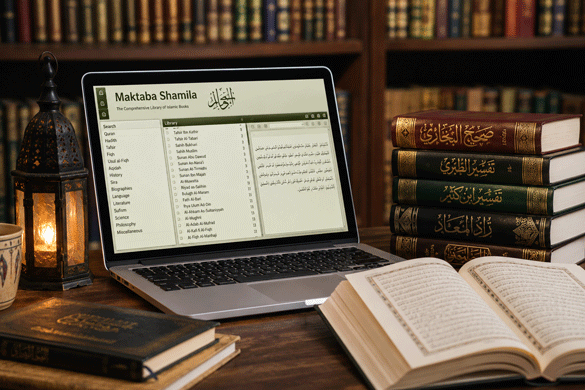
Maktaba Shamila is one of the most important digital libraries for Islamic studies, giving students, scholars, and ordinary readers access to thousands of classical and modern Islamic books in Arabic. It has transformed the way Muslims engage with Islamic heritage by making religious texts easily searchable and accessible through computers and mobile devices. The software allows users to explore Quranic commentaries, hadith collections, jurisprudence, history, theology, philosophy, and Sufi literature without depending only on physical libraries or institutions. For many young Muslims, Maktaba Shamila has opened the doors to deeper learning, critical thinking, and a broader understanding of the diversity within Islamic intellectual tradition.
Before I found Maktaba Shamila, my understanding of Islam was mainly formed from bits and pieces. I'd listen to Friday sermons, check out lectures on YouTube, follow online religious debates, and read translated Islamic books from the local stores. But there was always a sense that something was missing. The religious discussions often felt repetitive and limited. Every group insisted they had the only real version of Islam. Every preacher acted like their interpretation was the only correct one. Questions were frowned upon. Complex ideas were dumbed down into simple slogans.
I knew Islam had a rich intellectual history, but I couldn't quite grasp it. I'd heard of great thinkers like Imam Ghazali, Ibn Rushd, Ibn Khaldun, Shah Waliullah Dehlawi, and Muhammad Abduh, but they seemed like distant figures. Their actual writings were out of reach for regular people like me. Islamic heritage seemed locked away behind language barriers, geographical challenges, institutional red tape, and expensive libraries.
Maktaba Shamila completely changed that.
Suddenly, I had direct access to classical commentaries, hadith collections, theological discussions, historical accounts, legal arguments, philosophical works, and Sufi writings right on my computer. I could instantly search through texts, compare different viewpoints, and trace ideas across centuries. It was intellectually overwhelming but also incredibly freeing.
I slowly came to understand that Islam wasn't some rigid, unchanging ideology. It was a vast and dynamic intellectual tradition filled with debates, disagreements, fresh interpretations, ethical struggles, and real human experiences.
Accessibility and Bridging the Intellectual Gap
One of the most groundbreaking things about Maktaba Shamila is how accessible it is. Historically, knowledge wasn't equally available to everyone. Books were costly. Manuscripts were rare. Religious learning depended heavily on institutions, travel, and social status. Only a select few could attend the major centres of learning.
For most Muslims, religion was filtered through local scholars or passed down through customs. Access to original sources was limited. In many places, intellectual authority became concentrated in the hands of a few. Digital libraries changed all of that.
Maktaba Shamila made access to Islamic texts incredibly easy, in a way that previous generations couldn't have even imagined. A student in a small village in India could now access the same books as someone at a top university in Cairo or Medina. The barriers between regular readers and classical scholarship started to break down.
For me personally, this accessibility boosted my confidence. Before, if someone quoted a scholar or claimed that a certain religious view was universally accepted, I couldn't easily check it. I had to rely on trust. But, with digital access, I could go straight to the sources myself.
This changed my whole approach to religion. Islam no longer felt distant or controlled by intermediaries. Instead of passively absorbing information, I could actively explore the tradition.
Accessibility also changed the emotional connection between Muslims and their intellectual heritage. Before, classical scholarship often seemed intimidating. Thick Arabic books looked impossible for ordinary people to understand. But digital search tools made it simpler to engage with the material. They made exploring the texts feel easier and less daunting.
I realised that Islamic civilisation wasn't just for institutions and clerics; it also belonged to anyone who wanted to learn.
Discovering the Variety Within Islam
Perhaps the most significant lesson I learned from Maktaba Shamila was that Islamic civilisation has always had a wide range of intellectual viewpoints.
Modern religious discourse often portrays Islam as uniform and monolithic, with many groups claiming to have the only correct interpretation. But once I began reading deeply, I discovered a very different picture. Muslim scholars were constantly disagreeing.
Jurists debated legal rulings with incredible detail. Theologians argued about reason, ethics, divine attributes, and human free will. Philosophers explored logic and metaphysics. Mystics emphasised spirituality and inner transformation. Historians criticised rulers and documented political failures. Reformers challenged stagnation within Muslim societies.
This diversity came as a shock to me, because it contradicted the strict narratives that dominate religious discussions today.
I realised that Islamic intellectual history wasn't built on everyone agreeing; it was built on people arguing and debating. Disagreement was actually a part of the tradition itself.
Reading scholars from different eras helped me see that interpretation has always been a part of Islam. Every scholar approached the texts with their own historical context, cultural background, and intellectual methods.
For instance, scholars who lived under empires had different perspectives on governance than those who lived under colonialism. Jurists in commercial societies had different views on economic issues than those in tribal societies. Thinkers who were influenced by Greek philosophy developed different intellectual traditions than those who were mainly shaped by legal scholarship.
This historical diversity made me more humble in my thinking. I stopped believing that any modern group could honestly claim to have the only true understanding of Islam.
Reinterpretation as a Part of Islamic Tradition
One of the biggest misunderstandings in many Muslim communities is that reinterpretation is somehow dangerous or foreign to Islam. But my experience with Maktaba Shamila revealed that reinterpretation has always been a part of Islamic history.
Muslim scholars have consistently reinterpreted religious teachings to fit changing times. New social situations led to new legal questions. Political shifts sparked theological debates. Scientific advancements influenced philosophical discussions. Colonialism reshaped Muslim political thought.
Islamic civilisation was able to adapt because Muslim scholars approached religion with a dynamic, rather than a rigid, interpretation.
This realization changed how I viewed faith. I used to see religion in very black and white terms. Something was either completely Islamic or completely un-Islamic. But reading about history made me question those assumptions.
I started to notice how scholars balanced tradition with the need for change. They respected the past while also addressing current issues. Islamic law, in particular, had clever ways of adapting. Ideas like "maslaha," or public welfare, and "maqasid al-shariah," or the higher goals of Islamic law, showed that ethics and social realities were important in Islamic thought.
Looking at these discussions through Maktaba Shamila helped me move away from a purely literal understanding to a more contextual one.
I realised that many strict interpretations come about when texts are taken out of their historical context. Without that context, religion can become mechanical. With context, it becomes ethical and humane.
The Search for a Progressive Understanding of Islam
As I kept exploring Islamic history, I became more and more interested in the idea of progressive interpretation. The word "progressive" is often misunderstood in discussions about Islam. Some people think it means abandoning religion or just copying Western liberalism. But my reading convinced me that progressive interpretation can naturally arise from within Islamic intellectual history itself.
I found scholars who emphasised justice, dignity, compassion, reason, and public welfare. I discovered traditions that supported intellectual inquiry and social reform. I came across thinkers who criticised authoritarianism, sectarianism, and blindly following tradition.
This challenged the notion that progressive values are completely foreign to Islam.
For example, when I studied Islamic legal theory, I noticed that many scholars valued ethical goals over strict literalism. Justice was always a priority. Human welfare was important. Context mattered. The public interest mattered.
Similarly, reading Sufi texts revealed a deeply humane and spiritual side of Islam that focused on humility, compassion, and inner growth rather than political power.
These discoveries helped me imagine a different future for Muslim societies.
I started to believe that Islam could contribute positively to conversations about democracy, pluralism, women's rights, education, poverty, and social justice without losing its spiritual core.
Maktaba Shamila played a big role in shaping this belief because it allowed me to directly engage with the vastness of Islamic history, instead of being limited to narrow, ideological interpretations.
Knowledge Production in the Digital Age
Digital libraries are changing not only how we access knowledge but also how it is created.
In the past, religious interpretation was mainly controlled by institutions and established authorities. Today, digital technology has created a more open and decentralised intellectual environment. Students, researchers, journalists, activists, and everyday readers can now directly engage with texts. This shift has huge implications.
For me, Maktaba Shamila became a tool that empowered me intellectually. I could examine primary sources myself, instead of relying on summaries or carefully chosen quotes. I could compare arguments from different schools of thought. I could see how scholars responded differently to similar issues. This process changed how I think about authority.
I realised that religious authority is often influenced by politics and social power. Certain interpretations become dominant not necessarily because they are intellectually superior but because they have institutional support.
Digital access weakens some of those monopolies. It creates opportunities for alternative voices and forgotten traditions to be heard again. This is particularly important for progressive Muslims, women scholars, minority communities, and independent researchers. In the past, many voices were marginalised because they lacked institutional backing. But digital archives make intellectual participation more accessible.
However, this democratisation also has its dangers. Untrained readers might misunderstand texts. Extremist groups can misuse historical writings. Social media can encourage selective reading and emotional polarisation. Therefore, simply having access is not enough. Critical thinking and an understanding of history are equally important.
Reading Islamic History Contextually
One of the most important lessons I learned through Maktaba Shamila was the importance of historical context. At first, I approached texts very literally. If I came across a harsh legal opinion or a controversial statement, I would react emotionally. But over time, I realised that texts cannot be properly understood without understanding the worlds in which they were created.
A mediaeval scholar living during a time of war, empire, or political collapse would write differently from a modern thinker living in a democratic society. Many legal rulings were addressing specific historical situations rather than universal principles. This realisation completely changed my approach.
For example, discussions about slavery, warfare, governance, or gender roles seemed very different once I considered their historical context. I realised that many scholars were responding pragmatically to the social realities around them, rather than describing timeless ideals.
This grasp of context helped me stand firm against extremist and overly rigid interpretations. Extremist groups often take texts out of their historical setting and present them as if they're timeless commands. But when you read more deeply, you find complexity, disagreements, and changes over time.
Maktaba Shamila showed me that to understand Islam responsibly, you need to be aware of its history.
Maktaba Shamila also had a profound effect on me emotionally, not just intellectually.
These days, when people talk about Islam, it's often all about politics, conflicts over identity, and debates between different groups. Religion gets boiled down to slogans and ideological battles. But reading deeply within the Islamic tradition revealed a much richer human experience.
I came across poetry full of longing and beauty. I read philosophical reflections on ethics and the meaning of life. I explored mystical writings that focused on love, humility, and the struggle to grow spiritually. These texts reminded me that Islamic civilisation wasn't just about law or politics. It was also about morality and art.
Sometimes, late at night, as I was reading classical scholars on my screen, I felt connected to centuries of human searching. The digital interface would fade away, and history would come alive. That emotional connection strengthened my faith. Islam stopped feeling like a defensive identity trapped in the middle of modern political conflicts. It became a living intellectual and spiritual tradition.
Challenges of the Digital Religious World
As much as I admire Maktaba Shamila, I also see the problems that come with a digital religious culture.
Just because you can access information doesn't mean you automatically become wise. In fact, having unlimited access can be confusing. People might jump from text to text without really understanding the methods or historical background.
Social media has made this worse. Religious discussions online are often driven by anger, overconfidence, and trying to show off how religious you are, rather than by careful study.
Another big issue is reading selectively. People often use digital libraries just to find support for what they already believe. Extremists, those who promote division, and propagandists selectively use classical texts to justify their agendas. That's why engaging responsibly is so important.
Being digitally literate needs to include being ethically literate. Muslims need to know how to read texts in context, analyse them critically, and be intellectually humble. Scholars and educators should guide people toward a deeper understanding instead of just criticising digital access. The future of Islamic learning will probably depend on finding a balance between making information accessible and encouraging responsible engagement.
Maybe the biggest change Maktaba Shamila brought about in me was the removal of fear.
Many Muslims are afraid to ask tough questions. They worry that intellectual inquiry might weaken their faith. But for me, it was the opposite. The more I explored Islamic heritage, the stronger and more mature my faith became.
I realised that Islamic civilisation has historically encouraged intellectual exploration. Muslim scholars engaged with philosophy, science, ethics, and cultural exchange because they believed that truth could withstand questioning.
This realisation freed me from feeling like I had to defend my religion all the time.
Instead of seeing Islam as fragile, I started to see it as intellectually expansive. A civilisation that produced philosophers, scientists, legal experts, poets, historians, and mystics can't be reduced to narrow ideological slogans. Maktaba Shamila helped me rediscover Islam as a tradition that's capable of renewal, self-criticism, and ethical growth.
Conclusion: A Digital Library That Became an Intellectual Companion
Looking back, I can honestly say that Maktaba Shamila changed my intellectual life.
It showed me the depth and diversity of Islamic heritage. It taught me that Islam isn't just one fixed interpretation but a living conversation that has been going on for centuries. It showed me that reinterpretation has always been a part of the tradition. It helped me approach religion critically without losing my faith.
Most importantly, it convinced me that Islamic heritage has a lot to offer when it comes to progressive interpretation.
The future of Islam can't depend entirely on repeating answers from the Middle Ages to modern questions. But it also can't depend on completely rejecting tradition. The challenge is to engage with that heritage in a way that's intelligent, ethical, and aware of the context.
Digital libraries like Maktaba Shamila make that kind of engagement possible.
For me, it became more than just software. It became a bridge connecting the past and the present, tradition and modernity, and faith and critical inquiry. It transformed my understanding of Islam from a narrow identity into a vast intellectual civilisation.
In a world dominated by polarisation, shallow religious debates, and outrage fuelled by algorithms, the simple act of reading deeply can be a revolutionary act in itself. And for many people like me, that revolution begins quietly, with a digital library opening the doors of history.
URL: https://newageislam.com/islam-spiritualism/maktaba-shamila-islamic-heritage-anew-/d/139963
New Age Islam, Islam Online, Islamic Website, African Muslim News, Arab World News, South Asia News, Indian Muslim News, World Muslim News, Women in Islam, Islamic Feminism, Arab Women, Women In Arab, Islamophobia in America, Muslim Women in West, Islam Women and Feminism