
Reflection on Night of The Strangers!
By Mohammed Khaku, New Age Islam
30 June 2026
Commentary of Supplication of Alqaamah (Safwan) and Surah Al-Fajr -expression of devotion, & love for the Prophet and his family (Ahulul Bayt) especially Imam Husayn grandson of Prophet Muhammad.
The tears that roll down our cheeks are for the oppressed and each droplet being challenged to the tyrant be it ZI or American exceptionalism. We are not the “Nation of Weepers”, but this weeping has protected the Mostaz’afin (downtrodden), and the oppressed. Every day is the Ashura, and every Land is Karbala and every pulpit (Mimbar) and every Merab is a battleground of Imam Hussein (AS).
Thoughts on the Day of Ashura and the Night of Shame-e-Ghariban, also referred to as the Night of the Strangers.
As my visit at the Hussaini Islamic Center (HIC) in Orlando comes to a close, I’ll be sharing my reflections on Muharram at HIC and my impressions of the community in my upcoming blog.
I was deeply touched and moved by the young participants with their sweet, melodic recitations of the Quran, Marsiya, Nohas, and Matam, complemented by the insightful lectures of Dr. Mithani.
The recitations were outstanding high quality carried out with impeccable timing and discipline by the reciters.
Watching children as young as three to ten years old perform Matam (lamenting) and sa’ef (beating the chest in a circle) was deeply touching and brought tears to my eyes.
I truly hope and pray my grandchildren, and future generation will carry on these lamentations (Azadari) for Hussayn, a tradition that has lasted for more than 1,400 years.
Alongside the warm hospitality of many brothers and sisters who welcomed us into their homes and sent lunch.
I reflected on the TV translation at HIC of two recitations – Dua e Alqaamah (Safwan) and Surah Al-Fajr.
I felt it was my duty to share the synopsis, even though the HIC presenter had already done a great job presenting it.
Sham-e-Ghariban, or the Night of the Strangers (شام غریبان), is an important Shia Muslim mourning tradition observed on the evening of Ashura, the 11th of Muharram.
It marks the sorrowful aftermath of the Battle of Karbala in 680 CE, when Imam Husayn ibn Ali and his companions were tragically martyred.
Meaning and Etymology: The term comes from Persian and Arabic—Sham (شام) meaning evening or nightfall, and Gharībān (غریبان) meaning strangers, the oppressed, or the destitute.
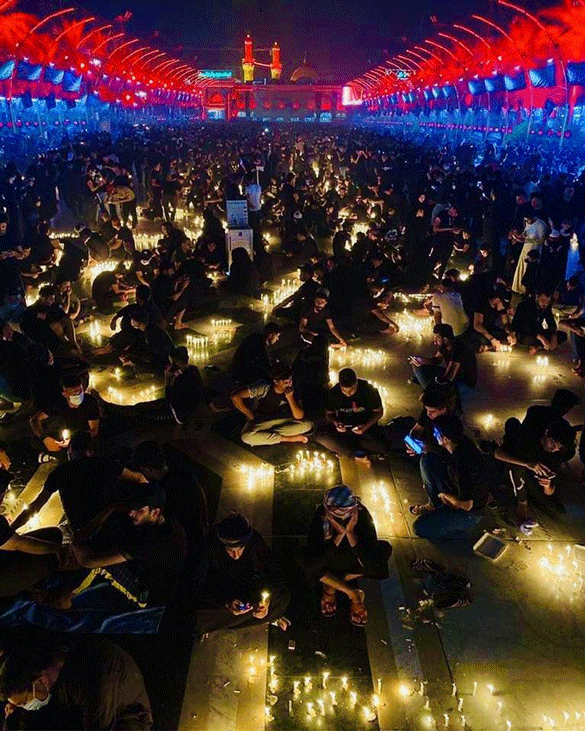
It’s often translated as “Night of the Strangers” or “Night of the Oppressed,” capturing the feeling of isolation and grief experienced by the surviving members of Imam Hussayn.
On Ashura, Imam Husayn and his companions endured a brutal martyrdom, deprived of food and water, and trampled under horses’ hooves, reminiscent of tanks crushing children in Gaza and the carpet bombing of Lebanon.
That night, the tents of the women, children, and surviving family members were raided and set ablaze by the Umayyad forces, leaving them chained, exiled, and destitute—a haunting reflection of the genocide in Gaza.
It became a symbol of feeling like “strangers” in their own land, much like the plight of Palestinians in Gaza.
The twelve days may have passed, but the memory of Imam Husayn and his companions’ sacrifice will always endure.
It’s a time to reflect on themes like loss, resilience, and standing up to tyranny, drawing lasting lessons about justice and the fight against oppression.
Commentary & Synopsis of Supplication of Alqaamah (Safwan) and Surah Al-Fajr.
Dua e Alqaamah, also called Dua Safwan, is a heartfelt prayer often recited after Ziyarat Ashura.
It’s attributed to Imam Ja’far al-Sadiq (peace be upon him) during a moment with his companion Safwan and is documented in Mafatih al-Jinan by Shaykh Abbas.
This supplication (dua) is recited as a warm and genuine expression of devotion, love, and hope for the Ahlulbayt, the family of Prophet Muhammad, especially Imam Husayn (as).
It is observed during Ashura, a day dedicated to mourning and reflecting on the martyrdom of Imam Husayn and his companions.
Supplication serves as a heartfelt connection between the believer, the Lord, the Most Merciful, and the Prophet’s family, seeking their intercession and Allah’s mercy.
The supplication opens with heartfelt calls to Allah, praising His oneness, greatness, and countless qualities: O Allah! O Allah! O Allah! — a powerful emphasis on His majesty… O He who answers the prayers of the distressed — seeking relief in difficulty… O He who eases the pain of the suffering — a plea for comfort… O Helper of those who cry out — an appeal for aid… O He who is closer than one’s own life vein — expressing intimacy and closeness… O He who intervenes between a person and their heart — asking for guidance and reconciliation… O He in the Highest and Clear Horizon — a reminder of His omnipresence and authority… O Most Merciful, Most Compassionate — highlighting His mercy… O Knower of hidden thoughts and intentions — recognizing His all-knowing nature… O He who is never confused by voices, never overwhelmed by needs, never bothered by persistent pleas — trusting in His ability to respond to all… O He who catches every escape and gathers all that is scattered — hoping for resolution and unity… O He who revives souls after death — remembering the afterlife. It also includes intercession, calling upon the Prophet Muhammad (pbuh) and his family to advocate before Allah. Reciting with understanding deepens the connection with Allah and the Ahlulbayt, brings comfort in hardship, inspires resilience, and renews hope and trust in divine mercy.
Synopsis of Surah Al-Fajr
Surah Al-Fajr (سورة الفجر), the 89th chapter of the Qur’an, contains 30 verses and was revealed during the Makan period (around 615–618 CE).
Its name comes from the word Fajr, meaning “the dawn,” found in the opening verse, where it serves as an oath rather than the main theme.
Revealed early in Prophet Muhammad’s mission in Makkah, it addressed a time when Muslims faced persecution, social pressure, and economic boycotts from the Quraysh.
It brought spiritual encouragement to the oppressed, reminding them of divine justice and the inevitability of accountability. The imagery of dawn symbolizes new beginnings and the triumph of truth over oppression.
The surah is split into four main sections, each centered on the theme of oppression: Oath, Lessons, Blessing, Misfortune, and the Last Day.
Oath In Verses 1–5, is symbolic references open with solemn vows by the dawn, ten nights, the even and odd, and the fading night. These are thought to emphasize sacred moments in worship, like the dawn prayer (Fajr) or the Night of Power (Laylat al-Qadr).
Lessons from Previous Nations (Verses 6–14) highlight how past peoples like ‘Ad, Thamud, and Pharaoh faced destruction because of their arrogance and defiance.
Human Attitude Toward Blessings and Misfortune (Verses 15–20) It reminds us that prosperity doesn’t always signify divine favor, and poverty doesn’t necessarily indicate divine disgrace.
It highlights the struggles endured by the poor and orphans الدرر السنية. Wealth and the material world are like the fleeting shadow of a cloud, appearing briefly before fading away.
The Last Day (Verses 21–30) It portrays the Day of Resurrection as a time of judgment, when the earth is “pounded and crushed,” the Lord appears with angels in perfect formation, and while many are filled with regret, the righteous rejoice with joy.
Surah Al-Fajr’s: The unifying theme centers on the certainty of Divine Justice and the Day of Reckoning.
It offers reassurance to the faithful, warns the disbelievers, and challenges human pride, ego, and ingratitude.
It’s a reminder to think about how temporary worldly status is and the importance of getting ready for the eternal accountability that comes after الدرر السنية.
May Allah protect us from the trials at the time of death, grant ease in our journey through Barzakh (the torment of the grave), and safeguard us from the fire of hell. Ameen!
Karbala lives on wherever oppression reigns and voices are silenced. It exists in every society where tyrants & hypocrites rule in the name of God. It lives in every institution where religion is used to shield injustice. It lingers in the silence of scholars who should speak but choose comfort. And it lives in the cry of every soul that whispers, “Is there anyone to help me?” Husayn is not only buried in Karbala, but in every heart of Muslims everywhere. He walks with every seeker of justice, stands beside every oppressed, and lives in the conscience of every believer who has the courage to say “No” to falsehood…If the religion of Muhammad cannot stand except by my death — then O swords, take me… every flicker of resistance tracing its lineage back to Ashura.
…
Mohammed Khaku of Allentown, PA, USA. Born in Mombasa, Kenya, and currently residing in the United States.
URL: https://newageislam.com/islam-spiritualism/reflection-on-night-strangers/d/140603
New Age Islam, Islam Online, Islamic Website, African Muslim News, Arab World News, South Asia News, Indian Muslim News, World Muslim News, Women in Islam, Islamic Feminism, Arab Women, Women In Arab, Islamophobia in America, Muslim Women in West, Islam Women and Feminism