
Khaled Abou El Fadl's Religious Humanism: A Qur'anic Call to Love and Unity in a Divided World

By Adis Duderija, New Age Islam
1 April 2026
In an era marked by rising polarization, religious extremism, and global conflicts, the essence of faith often gets lost in the noise of dogma and division. Yet, buried within the teachings of Islam lies a profound vision of religious humanism that could serve as a beacon for our troubled times. Drawing from the insights of scholar Khaled Abou El Fadl in one of his seminal works The Great Theft, I argue that true religious devotion is not about isolation or supremacy, but about actively pursuing goodness, beauty, and love on earth as a reflection of the Divine. This perspective transforms faith from a rigid set of rules into a luminous force for compassion, urging believers to create the conditions where humanity can truly know and love one another. As we navigate the challenges of the 21st century—from interfaith tensions to social injustices—embracing this religious humanism is not just an option; it’s an ethical imperative rooted in the Qur’an itself.
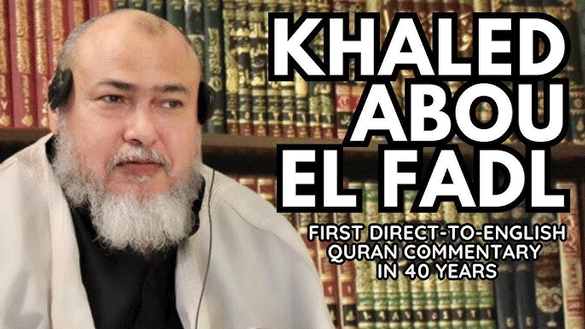
At its core, religious humanism in Islam posits that the pursuit of goodness in our earthly lives is intrinsically linked to realizing the goodness of God. El Fadl eloquently captures this by stating that “the pursuit of goodness on earth is part of realizing the goodness of God, and seeking beauty in life is part and parcel of reflecting the beauty of God.” This isn’t mere poetry; it’s a theological framework that elevates human actions to divine significance. In a world where religion is often weaponized to justify harm—think of the atrocities committed in the name of faith, from terrorist attacks to discriminatory policies—this humanism reminds us that God’s attributes are not distant abstractions but qualities we are called to embody. Goodness isn’t confined to prayer mats or mosques; it’s manifested in acts of justice, environmental stewardship, and community building. For instance, when Muslims engage in charitable works like feeding the hungry or advocating for refugees, they aren’t just fulfilling a religious duty—they are mirroring the divine mercy (rahma) that the Qur’an describes as encompassing all things.
Central to this humanism is the generation and spread of love, which El Fadl ties directly to the Qur’anic instruction in Surah Al-Hujurat (49:13): “O mankind, indeed We have created you from male and female and made you peoples and tribes that you may know one another (ta’arufu).” Here, “knowing one another” isn’t a superficial acquaintance; it’s a profound invitation to mutual understanding and affection. El Fadl extends this to argue that “generating and spreading love is inseparable from the Qur’anic instruction to come to know one another.” In practice, this means transcending tribalism and prejudice. Imagine a society where Muslims, Christians, Jews, atheists, and others actively seek to “know” each other not through suspicion or conversion efforts, but through shared dialogues, collaborative projects, and empathetic listening. This is religious humanism in action: faith as a bridge, not a barrier.
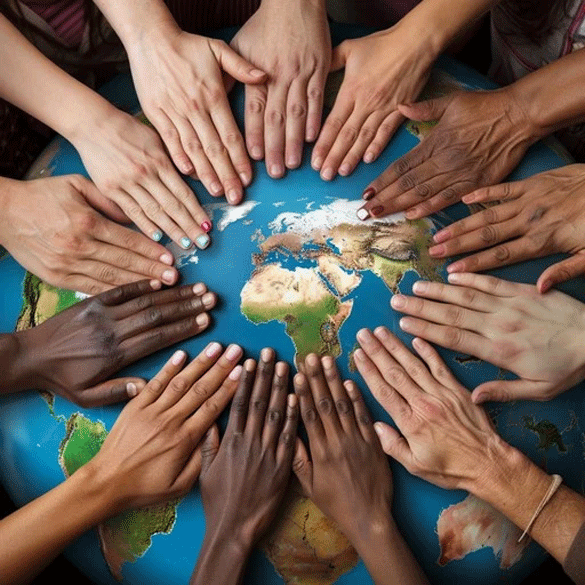
El Fadl draws on early Islamic theologians like Ibn Abi al-Dunya to deepen this idea, describing love as “a luminous state” where the believer “glows with compassion and mercy toward all of creation.” This imagery is powerful—love isn’t an emotion; it’s a transformative energy that radiates outward. When a believer loves God, that love doesn’t stop at personal piety; it spills over into compassion for every living being, from fellow humans to animals and the environment. In today’s context, this luminous compassion could address pressing issues like climate change. If loving God means caring for His creation, then religious humanists must advocate for sustainable practices, seeing environmental degradation not as a secular problem but as a failure to reflect divine beauty.
Yet, the true genius of El Fadl’s articulation lies in how it elevates “ta’aruf” from a mere suggestion to an ethical imperative. He writes that “the act of loving God transforms the Divine command to ‘come to know the other’ (ta’aruf) into an ethical imperative to strive to create the necessary moral and material conditions in which people can come to love one another.” This is where religious humanism becomes revolutionary. It’s not enough to wish for peace; believers must actively build the structures that enable it. Morally, this means fostering education that promotes empathy and critical thinking, countering the puritanical interpretations that El Fadl critiques in The Great Theft as “theft” of Islam’s humane essence by extremists. Materially, it involves addressing inequalities—poverty, discrimination, and access to resources—that breed resentment and hinder genuine knowing. As El Fadl notes, puritanical movements have “stolen” the religion’s humanistic spirit, reducing it to legalistic rituals while ignoring its call to ethical action.
Importantly, religious humanism isn’t exclusive to Islam; it’s a thread running through many faiths. Christianity’s emphasis on loving thy neighbour, Judaism’s tikkun olam (repairing the world), and secular humanism’s focus on ethical living all align with this vision. By embracing it, Muslims can lead a global movement toward unity, showing that faith enhances rather than diminishes our shared humanity.
In conclusion, as El Fadl illuminates, religious humanism transforms loving God into a radiant force for compassion, turning the Qur’anic call to ta’aruf into a blueprint for a just world. It’s time we reclaim this luminous state, creating moral and material conditions where love can flourish. For believers and non-believers alike, this isn’t just theology—it’s a practical path to healing our divided planet. Let us pursue goodness on earth, seek beauty in life, and glow with mercy toward all creation. In doing so, we don’t just honour God; we build a world where humanity truly knows and loves one another.
…
Adis Duderija is an Associate Professor in Islam and Society and Griffith University and a book series editor of a new book series on Islam and Process-Relational Thought (Routledge).
New Age Islam, Islam Online, Islamic Website, African Muslim News, Arab World News, South Asia News, Indian Muslim News, World Muslim News, Women in Islam, Islamic Feminism, Arab Women, Women In Arab, Islamophobia in America, Muslim Women in West, Islam Women and Feminism