
Hajj: A Journey of Faith

By Moin Qazi, New Age Islam
23 May 2026
Intention, Ihram, and the Levelling of the Self
The Hajj occupies a unique and exalted place in Islam's spiritual imagination. It is not simply a religious obligation fulfilled through ritual movement; it is a civilizational drama of faith, memory, surrender, and moral awakening enacted upon a sacred landscape layered with revelation and history. As the Fifth Pillar of Islam, the pilgrimage gathers within itself theology, ethics, symbolism, and collective human experience. Yet its deepest significance lies beyond formal obligation. Hajj is, above all, a journey of return: a return to God, to the primordial dignity of the human being, and to the moral clarity obscured by the noise of worldly life.
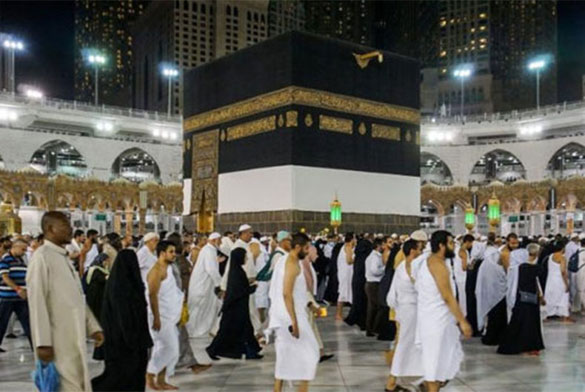
Every pilgrimage begins not with movement of the body but with movement of the soul. The foundation of Hajj is intention—niyyah—the inward act that transforms travel into worship and ritual into spiritual striving. In Islam, intention is not a procedural formality; it is the moral axis upon which all action turns. Before the pilgrim crosses geographical boundaries, he must cross an inner threshold: from distraction to consciousness, from habit to devotion, from self-possession to surrender.
This inward transition is made visible through ihram, the sacred state that inaugurates the pilgrimage. Men remove the garments of ordinary life and wrap themselves in two simple pieces of unstitched white cloth. Women adopt attire marked by modesty, restraint, and dignity. The transformation appears external, yet its meaning is profoundly metaphysical. In the state of ihram, the architecture of social distinction begins to dissolve. Wealth, profession, nationality, rank, and prestige lose their symbolic authority. The banker and the labourer, the ruler and the refugee, the scholar and the peasant stand clothed in the same simplicity before the same Creator.
Few rituals in human civilisation enact equality with such immediacy and force. Ihram is not merely a dress code; it is a moral and existential stripping away. It dismantles the hierarchies through which human beings ordinarily define themselves and others. The pilgrim enters a condition in which identity is no longer anchored in possession, achievement, or status, but in vulnerability before God. In this sacred uniformity, the illusion of superiority is quietly but decisively broken.
The white garments of ihram also carry an unsettling eschatological resonance. They resemble the burial shroud in which every human being will eventually be wrapped. The pilgrim is thus confronted with a stark spiritual reminder: that beneath the elaborate structures of worldly identity lies the fragile reality of mortality. Hajj begins, therefore, not with triumph but with humility. It compels the believer to encounter the truth that all human distinctions ultimately collapse before death and divine judgement.
Yet ihram is not a negation of individuality; it is a purification of it. By suspending external markers of status it creates the possibility of recovering a more essential self, one no longer fragmented by vanity, competition, or social performance. The pilgrim is invited into a different moral grammar, where worth is measured not by visibility or power but by sincerity, restraint, and God-consciousness.
The restrictions associated with ihram deepen this transformation further. Pilgrims are prohibited from acts associated with aggression, vanity, argumentation, and excess. Hunting, quarrelling, ostentation, and even certain ordinary comforts are suspended. The human being is disciplined into attentiveness. One learns that spirituality is not merely emotional elevation but ethical containment: the capacity to regulate desire, temper the ego, and inhabit the world with humility and care.
What emerges through this discipline is a rare form of collective consciousness. Millions converge upon the same sacred space, reciting the same invocations, clothed in the same simplicity, moving toward the same spiritual centre. The pilgrimage becomes an extraordinary enactment of human equality—not as abstract political rhetoric, but as embodied religious experience. In a world fractured by race, wealth, nationalism, and exclusion, Hajj offers a radically different vision of humanity: one in which dignity is universal because dependence upon God is universal.
The pilgrim who enters ihram does not merely prepare for ritual performance. He enters a state of moral exposure. The self is stripped of its protective narratives and returned to its elemental condition. This is why the opening moments of Hajj possess such transformative power. Before the pilgrim circles the Kaaba, stands at Arafat, or walks between Safa and Marwah, something more fundamental has already begun: the slow dismantling of illusion.
Hajj, at its deepest level, is an education in proportion. It teaches human beings how small they are in the face of eternity, yet how immeasurably dignified they become through surrender. And it begins with the simplest of acts: an intention sincerely formed, and a human being clothed not in the symbols of the world, but in the humility of the soul.
Tawaf, Sa'i, and the Re-enactment of Sacred History
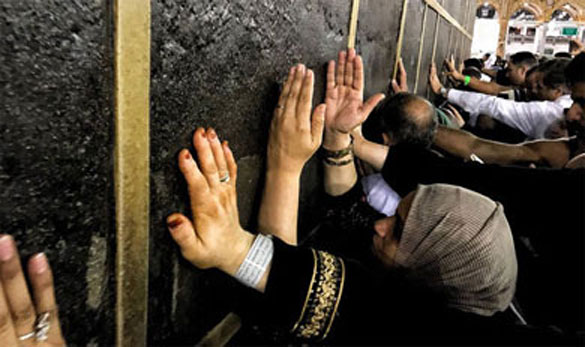
The first major rite, the circumambulation of the Ka'bah (tawaf), embodies this idea of unity in motion. Pilgrims move in counterclockwise circles around the central sanctuary, the Ka'bah, seven times, mirroring a cosmic choreography of devotion. The Ka'bah itself is not worshipped; it is the focal point that organises collective orientation. In this movement, the individual dissolves into a larger rhythm, experiencing unity not as abstraction but as physical participation. The repetition of movement reinforces a deeper metaphysical truth: faith is not static affirmation but continuous return.
The circular motion itself carries symbolic weight. It disrupts linear notions of hierarchy and replaces them with a geometry of equality, where every point on the circle is simultaneously central and peripheral. Each pilgrim moves, yet none advances above another. The self is decentered, not erased, but placed within a shared orbit of devotion. This embodied synchrony generates a rare form of collective consciousness, where individuality is retained but harmonised within a shared spiritual direction.
From here, the pilgrimage transitions into the ritual of sa'i, the walking and running between the hills of Safa and Marwah. This act recalls the struggle of Hagar, who searched desperately for water for her infant son in an unforgiving desert landscape. Her movement between the two points is commemorated not as myth alone but as a paradigmatic expression of endurance, maternal struggle, and trust in divine providence. The emergence of water from the well of Zamzam symbolises unexpected grace arising from human perseverance. In this sense, the Hajj does not merely commemorate sacred history; it re-enacts it, allowing past and present to converge in lived time.
Sa'i also introduces a different rhythm from tawaf. Where tawaf is circular and unbroken, sa'i is directional, oscillating between two points. It reflects human existence more closely: movement shaped by effort, uncertainty, and search. The pilgrim does not move in perfect harmony but in repeated striving. The ritual thus encodes a theology of effort—meaning is not simply received but pursued through persistence.
Arafat, Muzdalifah, and the Ethics of Struggle
The pilgrimage then moves toward Arafat, widely regarded as its spiritual climax. Here, gathered in vast multitudes on an open plain, pilgrims stand in collective supplication. The ritual is stripped of architectural structure and reduced to exposure—human beings in a landscape of silence, prayer, and introspection. Arafat is often described as a rehearsal of final return, a moment in which worldly distinctions lose relevance. It is here that the ethical core of the Hajj becomes most visible: the recognition of shared vulnerability and shared accountability.
Arafat represents a moment of radical moral transparency. Without enclosure or hierarchy, the human being is confronted with the simplicity of existence before God. This exposure produces a distinctive form of ethical clarity: life is no longer mediated through social performance but through inward reckoning. In this sense, Arafat functions as both culmination and reset, a symbolic condensation of life's ultimate questions.
Following Arafat, pilgrims proceed to Muzdalifah, where they gather pebbles for the symbolic stoning ritual performed in Mina. This act represents resistance to moral deviation, recalling the narrative of Abraham's rejection of temptation. The ritual is not about physical violence but about internal discipline: a dramatisation of the struggle against distraction, ego, and moral inertia. In throwing stones, the pilgrim externalises an internal ethical confrontation, giving form to an invisible struggle.
Muzdalifah itself, often marked by simplicity and exhaustion, reinforces the pedagogy of humility. Rest is minimal, movement is collective, and the environment is deliberately unadorned. This transitional space between Arafat and Mina functions as a liminal zone—neither culmination nor completion, but preparation for moral action. It is here that reflection is translated into readiness.
Sacrifice, Completion, and Transformative Return
The sacrifice that follows Eid al-Adha completes this sequence of remembrance. It commemorates Abraham's willingness to sacrifice what he held most dear, and the divine substitution that follows in the narrative tradition. The act of sacrifice is distributed socially through the sharing of meat, embedding ethical responsibility within communal practice. It is a reminder that devotion is not merely inward withdrawal but also outward generosity.
The logic of sacrifice extends beyond ritual slaughter. It symbolises the reordering of priorities—where attachment to possession, comfort, and ego is subordinated to a higher moral command. In this sense, sacrifice is not loss but recalibration. It teaches that value is not located in accumulation but in the willingness to surrender what binds the self to limitation.
The final circumambulation of the Ka'bah, performed as a farewell, closes the cycle of rites. Yet it is less an ending than a return transformed by experience. The pilgrim departs physically from Mecca, but ideally carries forward a recalibrated sense of selfhood—one shaped by equality, discipline, and heightened moral awareness.
What distinguishes the Hajj from other forms of worship is its convergence of physical exertion, symbolic meaning, and collective experience. It is simultaneously demanding and unifying, deeply personal yet profoundly communal. Millions of individuals from diverse linguistic, cultural, and economic backgrounds converge in one space, temporarily dissolving boundaries that elsewhere define human interaction. In this convergence lies one of its most powerful messages: that unity is not achieved by erasing difference, but by recognising a shared origin and shared destiny.
At the same time, the Hajj is not without complexity. The logistical scale of the pilgrimage, the pressures of modern infrastructure, and the challenges of crowd management introduce layers of contemporary difficulty. The sheer density of participants, the physical demands of movement, and the vulnerability of mass gathering create moments of strain alongside moments of transcendence. Yet even these challenges become part of the lived reality of the pilgrimage, reinforcing its character as a journey that tests both body and spirit.
Equally significant is the deeply interior dimension of the experience. For many pilgrims, the most enduring aspect of the Hajj is not any single ritual act but the cumulative effect of sustained devotion. It is the experience of time reorganised around prayer, of identity reframed through humility, and of perception sharpened by repetition of sacred action. In this sense, the Hajj functions as a temporary restructuring of consciousness, in which ordinary rhythms are suspended and replaced by a rhythm oriented toward remembrance.
Upon return, the pilgrim re-enters ordinary life, but not unchanged. The Hajj leaves behind not a visible transformation in all cases, but often a subtle reorientation: a heightened awareness of moral responsibility, a diminished attachment to status, and a renewed sense of belonging to a wider human community. Its significance lies not only in the completion of ritual obligations but in the possibility, it opens—the possibility of beginning again with greater clarity.
Ultimately, the Hajj stands as one of the most comprehensive expressions of Islamic spiritual life. It integrates history, ritual, ethics, and embodiment into a single unfolding experience. It is at once a journey outward and a return inward, a movement through space that paradoxically leads to deeper stillness. In its rhythm of walking, circling, standing, and sacrificing, it offers a vision of faith not as abstract belief but as lived transformation.
…
Moin Qazi is an Indian author and development leader who advanced dignity-centred, community-led change. A pioneer of microfinance and grassroots institutions, he fused ethics with social innovation. With deep interdisciplinary scholarship, he bridged policy, justice, and lived realities. His legacy affirms ethical leadership and people’s agency as drivers of India’s progress….
URL: https://newageislam.com/islam-spiritualism/hajj-journey-of-faith/d/140135
New Age Islam, Islam Online, Islamic Website, African Muslim News, Arab World News, South Asia News, Indian Muslim News, World Muslim News, Women in Islam, Islamic Feminism, Arab Women, Women In Arab, Islamophobia in America, Muslim Women in West, Islam Women and Feminism