
Teach Mahmud Ghaznavi, But Also Teach Hazrat Nizamuddin Auliya, Amir Khusrau, Dara Shikoh, Sir Syed, And Maulana Azad
By Ghulam Rasool Dehlvi, New Age Islam
13 April 2026
Main Points:
· Organised by the India History Forum at the India Islamic Cultural Centre, the National History Conference 2026 brought together parliamentarians, historians, scholars, writers, and public intellectuals who spoke with unusual clarity on a question that lies at the heart of India’s democratic future: Can India truly understand itself by erasing or diminishing the role of one of its most formative civilizational communities?
· Shashi Tharoor stressed that India’s civilizational journey cannot be reduced to “a single thread.” Its identity has evolved through Vedic, Islamic, Bhakti, colonial, constitutional, and modern influences. He underlined that textbooks, educators, politicians, and public institutions play a decisive role in shaping how society remembers the past and understands itself in the present.
· The expanded Class VII chapter on the Ghaznavid invasions highlights violent episodes, but this article argues that without equal emphasis on Muslim contributions to culture, education, language, and nation-building, the narrative becomes historically disproportionate.
· While conferences defend pluralism, the deeper struggle lies in what children learn in schools. Curriculum politics has become the key site where India’s historical memory is being shaped.
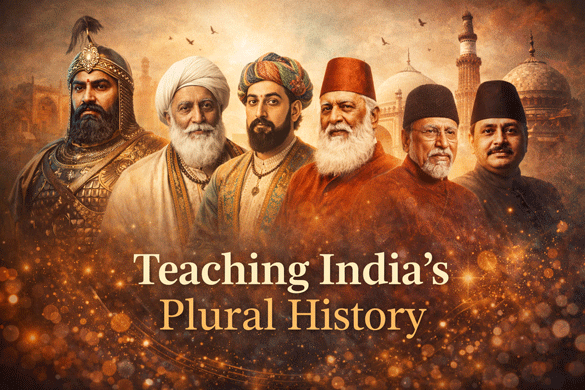
· Difficult episodes like Mahmud of Ghazni’s invasions must be taught, but alongside the contributions of Amir Khusrau, Nizamuddin Auliya, Sir Syed, Maulana Azad, and others, so that Muslims are seen as co-authors of India’s civilisation, not outsiders.
When children first encounter Muslim presence in India primarily through the image of Mahmud of Ghazni as invader, plunderer, and destroyer, while the civilizational roles of Amir Khusrau, Hazrat Nizamuddin Auliya, Dara Shikoh, Sir Syed Ahmad Khan, Maulana Azad, and countless Muslim freedom fighters remain under-emphasised, the result is not neutral pedagogy. It is historical asymmetry.
This is the crux of the current debate over curriculum of India history. The issue is not the inclusion of painful chapters. It is the absence of civilizational proportion.
In this backdrop, Shashi Tharoor’s call for a pluralistic view of ‘many-threaded’ Indian history is timely—but the deeper challenge lies in moving beyond elite rhetoric toward epistemic justice.
At the National History Conference 2026 held in Delhi, Congress MP Shashi Tharoor offered what may be one of the most important intellectual and rational interventions in India’s current battle over memory. Delivered under the theme “Revisiting the Muslim Contribution to Indian History, Society and Civilisation,” he averred in his speech:
“India’s story cannot be reduced to a single thread.”
This is more than an eloquent defence of pluralism. Tharoor’s core argument is historically unassailable. India’s strength has always lain in its ability to absorb, adapt, reinterpret, and integrate multiple influences over millennia—Vedic, Buddhist, Jain, Bhakti, Islamic, Sikh, colonial, constitutional, and modern scientific.
More to the point, the timing of Tharoor’s remarks could not be more significant. They come amid the debate over the revised NCERT Class VII Social Science textbook, Exploring Societies: India and Beyond, which now devotes a six-page section to the Ghaznavid invasions and Mahmud of Ghazni’s 17 campaigns, with a far more graphic emphasis on plunder, temple destruction, and slaughter than older editions.
No honest scholar would argue that these episodes should be omitted. They are undeniably part of the historical record. But history is not merely about what is included.
Tharoor is right to insist that India’s civilizational story is a confluence of influences—Vedic, Buddhist, Islamic, colonial, constitutional, and modern scientific. But the challenge before India is no longer simply conceptual. The real struggle lies in institutional power. The question is: who controls textbooks, archives, universities, museums, public commemorations, and digital discourse?
Pluralism cannot remain an eloquent parliamentary phrase if state-sponsored memory systems increasingly privilege one civilizational narrative over others.
The newly expanded NCERT treatment of the Ghaznavids, for instance, may be historically relevant, but when such episodes are foregrounded without equal emphasis on centuries of cultural synthesis, shared institutions, linguistic fusion, trade networks, Sufi ethics, and constitutional participation, the result is not history but selective pedagogy. The critique, therefore, is not of teaching difficult history. It is about teaching difficult history without a civilizational proportion.
A civilisation cannot be understood only through its wounds; it must also be understood through its healings. This is where the discourse often fails even within liberal spaces.
Even conferences that speak of Muslim contributions frequently remain trapped within dynastic and monumental frameworks—Mughals, monuments, courts, emperors. While these are important, they are not the whole story. The deeper Muslim contribution to India lies equally in the Sufi khanqahs, vernacular literary cultures, artisan guilds, urban mercantile ethics, interfaith shrine cultures, educational networks, and everyday social negotiations that produced India’s Ganga-Jamuni ethos.
Without foregrounding this lived civilizational syncretism, pluralism risks becoming merely decorative. There is another critique that must be voiced honestly.
The defence of plural history cannot come only from opposition politicians and occasional intellectual gatherings. If the commitment to historical plurality is genuine, it must translate into curricular interventions, public scholarship, translation projects, digitisation of neglected archives, regional history recovery, and serious engagement with madrasa, khanqah, and vernacular knowledge traditions.
Otherwise, the discourse remains performative.
In that sense, Tharoor’s speech is persuasive as a diagnosis, but the republic now needs a programme of historical reconstruction, not just a critique of monolithic narratives.
This is particularly urgent because the battle over history in India today is not merely academic. It is about citizenship, belonging, and moral legitimacy.
When Muslims appear in textbooks only as invaders or rulers, and not as poets, philosophers, jurists, weavers, freedom fighters, reformers, women scholars, Sufi saints, and co-authors of the republic, a dangerous civic message is sent that they are incidental to the nation rather than constitutive of it. That is the real danger of selective memory.
A student must indeed learn about Ghazni’s invasion of India. But the same student must also learn how Muslims shaped India’s languages, urban institutions, trade routes, legal cultures, Sufi ethics, architecture, music, anti-colonial thought, and constitutional nationalism.
Without this balance, a community begins to appear not as a co-author of the nation, but as a recurring external interruption in it.
It is about what is foregrounded, how it is sequenced, and what emotional impression it leaves on the young mind.
Teach the Ghaznavids, certainly. But teach them beside the Chishti khanqahs, Khusrau’s Hindavi cosmopolitanism, the Deccan’s Indo-Persian exchanges, Muslim women scholars, Urdu’s evolution, and the Muslim role in building India’s democratic republic.
Only then does the many-threaded metaphor become a method of nation-building rather than a rhetorical flourish. In this context, Tharoor’s speech matters because it reminds India that plural memory is not sentimental liberalism—it is historical honesty.
The Delhi conference thus reminded the country that India’s story is plural. But the harder truth is that pluralism itself now requires institutional courage, not just eloquent speeches.
The real test is whether such conferences can generate a sustained intellectual movement capable of resisting historical reductionism at the level where it matters most: schools, universities, media ecosystems, and popular consciousness.
India’s civilisation has always been strongest when it embraced multiplicity not as tolerance, but as self-definition.
Only then can the phrase “India’s story cannot be reduced to a single thread” become more than a noble sentiment—it can become a democratic method.
…
Contributing author at New Age Islam, Ghulam Rasool Dehlvi is writer and scholar of Indian Sufism, interfaith ethics, and the spiritual history of Islam in South Asia. His latest book is "Ishq Sufiyana: Untold Stories of Divine Love".
New Age Islam, Islam Online, Islamic Website, African Muslim News, Arab World News, South Asia News, Indian Muslim News, World Muslim News, Women in Islam, Islamic Feminism, Arab Women, Women In Arab, Islamophobia in America, Muslim Women in West, Islam Women and Feminism