
Moderation In the Holy Qur'an

By Dr. Zafar Darik Qasmi, New Age Islam
11 April 2026
Abstract:
This article explains that the Qur’an teaches moderation and balance in all areas of life. It presents Islam as a complete way of life that guides personal, social, moral and economic matters. The Qur’an commands justice, kindness and care for relatives, while it forbids immorality, wrongdoing and oppression. Justice means fairness and balance in all actions, even towards enemies, while excellence means showing kindness and going beyond basic duties. The concept of a “middle nation” highlights that Muslims should avoid extremes in beliefs, worship and daily life. Islam promotes a balanced approach between worldly and spiritual needs. By following moderation, individuals can achieve harmony, fairness and peace in both personal life and society as a whole.
Main Points:
· The Qur’an teaches balance and moderation in beliefs, actions, emotions and daily life of humans.
· Justice means fairness and balance, while excellence means kindness, forgiveness and doing more good always.
· Islam forbids immorality, wrongdoing and oppression, which arise from uncontrolled desires, anger and wrong thinking.
· Muslims are called a middle nation, avoiding extremes in beliefs, worship, social and economic matters.
· A balanced life in Islam ensures peace, justice, harmony and success in personal and social life.
—-
The Qur’an is the final book of guidance revealed by Allah. It is not only a source of spiritual direction but also a complete code of life. It provides guidance for every human being in personal, social, moral and legal matters. That is why the Qur’an repeatedly teaches people to adopt moderation and balance in all aspects of life.
Allah says in the Qur’an:
“Indeed, Allah commands justice, excellence, and giving to relatives, and He forbids immorality, wrongdoing, and oppression. He advises you so that you may take heed.” (Surah An-Nahl: 90)
In explaining this verse, Maulana Shabbir Ahmad Usmani writes that “justice” means maintaining balance and fairness in beliefs, actions, character, dealings and emotions. A person should avoid all forms of excess and deficiency. Even when dealing with enemies, one should not leave justice. One’s inner and outer life should be the same, and one should like for others what one likes for oneself.

“Excellence (ihsan)” means going beyond justice. It means being kind, forgiving, gentle and compassionate. A person should not only fulfil obligations but also do extra good deeds. He should treat others with generosity and believe that Allah is always watching him, and that every good deed will be rewarded.
After mentioning justice and excellence, the Qur’an specifically highlights giving to relatives. This shows that while justice applies equally to all, kindness and generosity should be greater towards close relatives. Maintaining family ties is a special virtue in Islam.
The verse also forbids three things: immorality, evil actions, and oppression. These are linked to human weaknesses. Immorality comes from uncontrolled desires, evil actions from misguided thinking, and oppression from uncontrolled anger and aggression. A person can only become truly refined when he controls these forces and lets reason and moral awareness guide him.
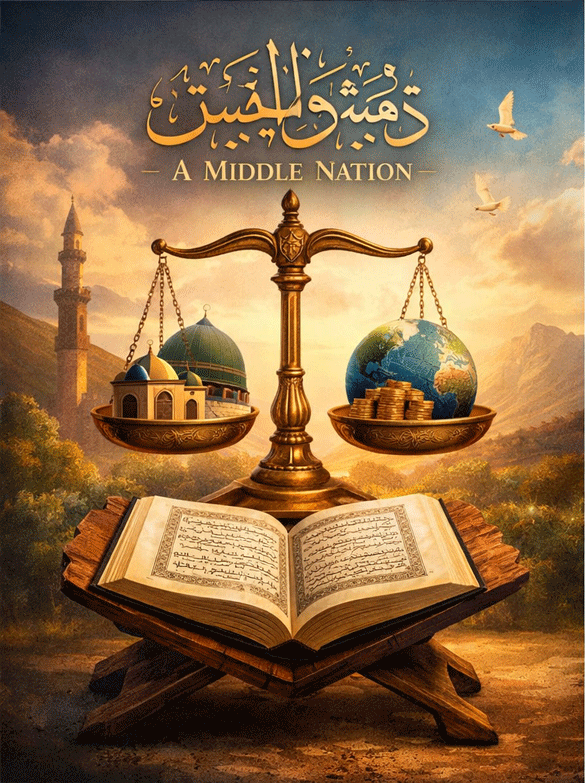
The importance of moderation is also clear from another verse where Allah calls the Muslim community a “middle nation” (Ummat Wasat):
“And thus We have made you a balanced community so that you may be witnesses over humanity, and the Messenger may be a witness over you.” (Surah Al-Baqarah: 143)
Scholars explain that being a “middle nation” means being moderate in all areas of life. This includes beliefs, worship, social life and economic matters.
In beliefs, previous nations sometimes went to extremes. Some raised their prophets to the level of divinity, while others disrespected and rejected them. The Muslim community, however, maintains balance by loving and respecting the Prophet while recognising that he is a servant and messenger of Allah, not divine.
In worship, some people neglected religious duties, while others went to extremes by adopting monastic lifestyles and abandoning worldly life. Islam teaches a balanced approach: fulfil religious duties sincerely while also living a normal, responsible life in society.
In social matters, some societies ignored human rights and committed ظلم and injustice, while others went to unnecessary extremes in showing compassion. Islam establishes balance by giving clear rights and responsibilities, protecting human dignity, and teaching fairness even in difficult situations such as war.
In economic life, some systems promote unlimited accumulation of wealth without moral limits, while others deny personal ownership altogether. Islam adopts a middle path. It allows personal property but sets ethical rules, encourages charity, and ensures that wealth is not concentrated in the hands of a few while others remain deprived.
The Holy Qur’an presents moderation as a central principle of life. It teaches balance in beliefs, actions, relationships and economic matters. This balanced approach ensures harmony, justice and well-being in both individual and collective life.
—
Dr. Zafar Darik Qasmi is an Islamic Scholar, author and Regular Columnist for a New Age Islam.
URL: https://newageislam.com/islam-spiritualism/moderation-in-the-holy-quran/d/139626
New Age Islam, Islam Online, Islamic Website, African Muslim News, Arab World News, South Asia News, Indian Muslim News, World Muslim News, Women in Islam, Islamic Feminism, Arab Women, Women In Arab, Islamophobia in America, Muslim Women in West, Islam Women and Feminism