
Hazaras of Pakistan Are Being Killed Because They Oppose the Taliban Version of Islam
June 29,
2012
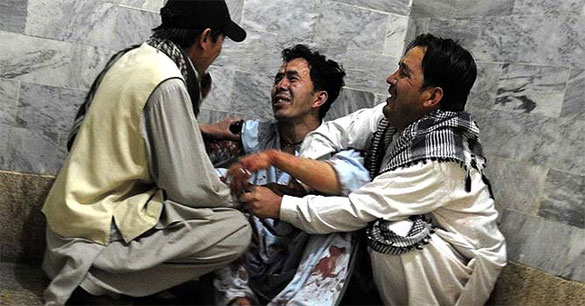
Men belonging to the Hazara community mourn the killing of their
relatives at a hospital in Quetta on April 9, 2012, following an attack by
gunmen. — File photo by AFP
------
“At least
60 people belonging to Hazara community living in Quetta have been killed in
targeted attacks, including suicide, remote-controlled and timer device
bombings and firing,” says a report published in this newspaper, following a
brutal attack on Shia pilgrims belonging to the Hazara community.
Thursday’s
bomb attack in the Hazarganji area on the outskirts of the provincial capital
of Balochistan was not the first such attack of the year. Not even the first of
the month. The Hazara community has been targeted, with great impunity, by
outlawed militant organisations on at least six occasions in the current year.
While all attacks have claimed precious lives, one of worst attacks against the
community came last September, when a bus carrying Hazara passengers was
stopped by assailants heavily armed with rocket launchers and Kalashnikovs.
They identified Hazara men, took them off the bus and slaughtered them one by
one within half a kilometre from a security check post. A similar incident was
repeated a few days later in Akhtarabad area of Quetta. Some unconfirmed reports say “over 800
Hazaras have been killed in 24 incidents of mass-murder and 131 targeted ambushes
since 2001.”
Murderous
motives Responsibility for most of these attacks has been claimed by outlawed
group Lashkar-i-Jhangvi, who have gone as far in their hate preach as declaring
the community “wajib-ul-qatl” or deserving of death in their edicts handed out
in the Balochistan province. Moreover, the community has been warned that its
settlements in Hazara Town and on Alamdar Road will be transformed into
graveyards as the war against them continues, according to a column published
in this newspaper.
The
killings have received mixed reactions and analyses from government officials,
politicians and Hazara community leaders. Some blame security forces and
intelligence agencies for the killings. Others point the fingers at the
sectarian fanatics, Taliban and land mafia while some people even suggest a
complex amalgam of all the aforementioned factors.
Role of
security forces While there is little doubt that all the attacks have been
unprovoked and unidirectional without any apprehensions for many years, for
Hazaras, the failure of security forces to protect their community remains an
unanswered question.
“They have
not failed. They have rather no intentions to protect us from the terrorists”
explains Sardar Saadat Ali Hazara, a community leader.
Members of
the community allege that Hazara killings are designed as a counterinsurgency
campaign to divert attention away from the activities of security forces in
Balochistan.
“The
Hazaras are being systematically killed because they are anti-Taliban and
because they do not agree with the policy of strategic depth towards
Afghanistan,” says Tahir Khan Hazara, a political activist.
“They
consider the Hazaras as pro-Northern Alliance and suspect our patriotism,” says
Zaman Dehqanzada of the Hazara Democratic Party (HDP).
Dehqanzada
alleges that his community’s ‘refusal to fight the Baloch’ has led them to
become targets of unabated violence. “We are not going to destroy our relations
with our brothers in Balochistan,” he adds.
Meanwhile,
a former chief sectary Balochistan revealed on the condition of anonymity that
the state policy towards the Hazaras has dramatically changed since 2001. “They
are kept away from sensitive administrative posts both in the armed forces and
civil bureaucracy as they are considered, albeit falsely, pro-Iran and
Pro-Northern Alliance just because they are Farsi-speaking Shias,” the official
said.
According
to a recent report on the killings of Hazaras, the Frontier Corps (FC) believes
that “the Hazaras are receiving funding from Iran to incite Shia revolution in
Pakistan,” a statement refuted by the community. How can a small community,
they say, surrounded by military cantonment bring about Shia revolution in
Pakistan?
While the
FC also blames the Balochistan Liberation Army (BLA) for the Hazara killings.
Hazara leader Sardar Saadat strongly disagrees. “BLA has no issues with the
Hazaras. It is, in fact, Lashkar-i-Jhangvi operatives who kill the members of
my community and roam freely all around. Everybody knows that they are being
trained and protected in Qubo area of Mastung,” he says.
Chairman of
HDP Abdul Khalique Hazara is of the same view. “We have repeatedly demanded
targeted actions against Lashkar-i-Jhangvi, who are a handful of terrorists but
the government and security forces have given us a cold shoulder. Balochistan
Home Minister Zafarullah Zehri has said on the floor of the provincial assembly
that he had clues about those involved in the target killings but he was
helpless. So we were forced to call international protests against Hazara
genocide in order to pressurise the government to take actions”
Religious
radicalisation All the secular nationalist parties of Balochistan are of the
view that religious extremism is thriving in the province in order to counter
the activism of the Baloch nationalists. The nature of killings, they say, also
indicates the same. Almost all the attacks on Hazaras have either taken place
in the vicinity or in between two FC check posts – raising questions over the
ability of heavily armed men to cross the check-posts, kill innocent civilians
and escape on their pick-up vehicles without being caught or chased after.
“If you
look at the videos of the Mastung and Akhtarabad massacres released by the
terrorists on YouTube, you will find out that all these incidents have taken
place on an international highway, bustling with traffic but the terrorists
seem in no haste as they slaughter our people. It takes them almost half an
hour to accomplish their mission and not a single vehicle passes the site of
the attack. How was the traffic blocked on both sides?” asks a Hazara activist,
who wishes to remain anonymous for security reasons.
Asian Human
Rights Commission (AHRC) issued a statement on its website a day after the
Mastung massacre under the title of “Members of Shia community were under
attack while the military forces look on” questioning the role of military
establishment in such attacks. According to AHRC “more than 500 Shias have been
killed in terrorist attacks during the past three years after the FC received
the powers of the police”
It further
adds: “These campaigns against the Shia religious community is very well known
to police, FC, the army and its intelligence services but no action has been
taken against the Lashkar-i-Jhangvi.”
According
to columnist, Aziz-ud-Din Ahmad, “Attacks on the Hazara community started only
two years after former president and army chief General Pervez Musharraf’s
coup. These coincided with the period when agencies were directed under a
master plan to give religious parties and militant groups a free hand.”
Talibanisation
of Balochistan The Taliban had massacred tens of thousands of Hazaras in
Afghanistan during their reign in Afghanistan and had warned them to leave the
country. The Hazaras of Afghanistan were part of the so-called Northern
Alliance which resisted Taliban's rule and later on allied with the
international forces to overturn the radicals. To avenge their defeat the
Taliban pointed their guns towards the Hazaras of Baochistan by allying with
LeJ and Al-Qaeda operatives.
In an open
threat letter distributed at Hazara localities in Quetta Lashkar-i-Jhangvi
warned the Hazaras to leave Pakistan by 2012 and in another, they vowed to
continue targeting the community in Pakistan, particularly in Quetta.
For the community,
being targeted repeatedly and labelled as conspirators is heartrending as they
take pride in their role as servants of the country ever since its creation.
History of
Hazaras in Pakistan The Hazaras are believed to be the descendants of Kushans who,
in the sixth century, built giant Bhuddas of Bamiyan in Hazarajat of central
Afghanistan. The Buddhas were dynamited and destroyed by the Taliban in 2001.
The native language of Hazaras is Dari (Farsi) and they mostly adhere to Shia
Islam. The very first group of Hazaras migrated from Hazarajat of Afghanistan
to British India and served in “Broadfoot's Sappers” from 1839–1840.
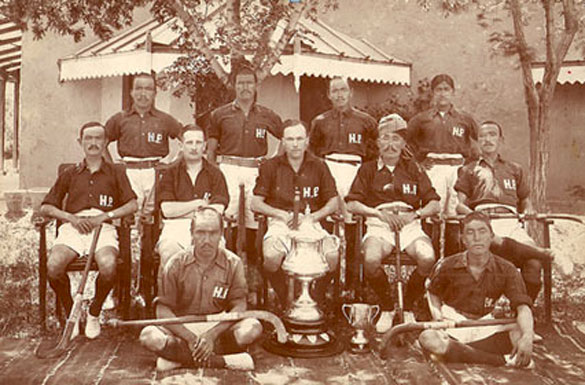
The
106th Hazara Pioneers – Photo courtesy author
------
In 1904,
Lord Kitcherner the Commander-in-Chief in India directed Major C. W. Jacob to
raise a battalion of Hazara Pioneers, which led to the birth of the 106th
Hazara Pioneers with drafts from the 124th Duchess of Connaught's Own
Baluchistan Infantry and from Major Jacob’s own regiment.
The 106th
Hazara Pioneers were renamed “The Hazara Pioneers” in 1929. As a result of the
financial crisis in 1933, all Pioneer Regiments in the Indian Army, including
the Hazara Pioneers, were disbanded. According to Brigadier N. L. St. Pierre
Bunbury, “the Hazara Pioneers was the best shooting regiment in the Indian
Army.”
Military
services Inspired by The Hazara Pioneers and because they had no land in
Balochistan, the Hazaras either joined the Indian army or established small
businesses in Quetta city. One of them,
General Musa Khan Hazara (Hilal-e-Jurat), joined the Indian army as a jawan
(soldier) who later served as the Commander-in-Chief of Pakistan army from 1958
to 1966. He also served as governor of West Pakistan and Governor of
Balochistan from 1985-91.
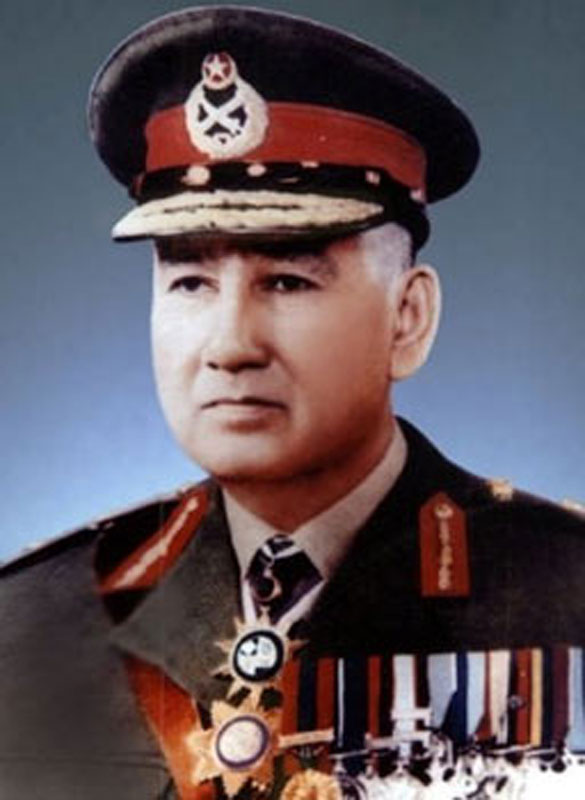
General
Musa Khan Hazara (HJ) – Photo courtesy author
------
The trend
of seeking commission in the armed forces did not cease and another Hazara, Air
Vice Marshal Sharbat Ali Changezi, also reached the upper echelons of Pakistan
Air Force. Hazara women, too, followed suit. A Hazara girl, Saira Batool, is
among the first female pilots in Pakistan Air Force.
Civil
services and politics Hazaras also played an important role in the formation of
Pakistan. A Hazara politician, Qazi Mohammad Essa (his son, Faiz Essa, is the
present Chief Justice of Balochistan High court ), was the founder of
Balochistan Muslim League who represented Balochistan in Lahore Resolution in
1940. In spite of having a population of only about half a million, the Hazaras
have been prominent in provincial and national politics. The community's
political party, Hazara Democratic Party (HDP), founded in 2003 describes
itself as a secular, liberal and nationalist party whose founding chairman,
Hussain Ali Yousufi was assassinated by Lashkar-e-Jhangvi on January, 26, 2009
on Jinnah road, Quetta. A Pakistan People’s Party MNA from Quetta, Syed Nasir
Ali Shah, is also a Hazara.
The Hazara
community has given birth to some of the best national sportsmen such as
legendary footballer, Qayyum Changezi, three-time Olympian boxer Syed Ibrar
Hussain Shah, who was assassinated on June 16, 2011.
While the
community continues to reiterate its support for the country and refutes all
claims of the presence of anti-state elements, it remains unclear why the
government and security forces have been unable to curtail the hate crimes and
broad-day-light massacres of Hazaras.
“All around
the world, it is always the smallest, most peace-loving, least politically
connected groups that are selected as targets by those seeking to scare the
populations they seek to control,” Rafia Zakaria opined in her column on
violence against Hazaras. Indeed, if her words are to be understood, the signs
are ominous for the already scarred
province of Balochistan.
----
Dr
Saleem Javed is a freelance journalist and human rights activist based in
Quetta.
Original
Headline: Hope fades away for Hazaras of Pakistan
Source: The Dawn, Pakistan
URL: https://newageislam.com/islam-sectarianism/hazaras-pakistan-being-killed-they/d/124282
New Age Islam, Islam Online, Islamic Website, African Muslim News, Arab World News, South Asia News, Indian Muslim News, World Muslim News, Women in Islam, Islamic Feminism, Arab Women, Women In Arab, Islamophobia in America, Muslim Women in West, Islam Women and Feminism