
The Politics of Posthumous Defamation: Reassessing the Campaign Against Syed Salman Hussaini Nadwi

By Mushtaq Ul Haq Ahmad Sikander, New Age Islam
03 July 2026
A critical examination of how posthumous accusations against Syed Salman Hussaini Nadwi reflect ideological conflict, selective history, and the misuse of religious sentiment.
Main Points Covered:
· It argues that the campaign against Nadwi after his death was not a sincere theological concern but an organized effort to settle ideological scores and defame him.
· It explains that the accusation of being “Ghustaakh-e-Sahaba” is presented as a weaponized label used to silence dissent, not as a fair scholarly judgment.
· It emphasizes that Islamic history distinguishes among different groups of the Companions, and that flattening all of them into one undifferentiated category is historically misleading.
· It highlights Nadwi’s critical comments on figures such as Muawiya and related historical controversies as rooted in classical sources, not in abuse of the Sahaba.
· It also condemns selective quotation, decontextualization, and ignoring Nadwi’s praise of key Islamic figures, arguing that the controversy reveals a broader problem of ideological control over religious discourse.
…
The death of Syed Salman Hussaini Nadwi should have marked a moment of solemn reflection—a pause in the relentless churn of polemics that defines much of contemporary Muslim discourse. Death, in the Islamic moral imagination, is not merely an end but a reminder: of accountability, of humility, and of the shared destiny that binds all human beings. Yet, instead of introspection, his passing has triggered an aggressive and calculated campaign of vilification. What has unfolded is not a spontaneous expression of theological concern but a deliberate attempt to settle ideological scores under the cover of religious sentiment.
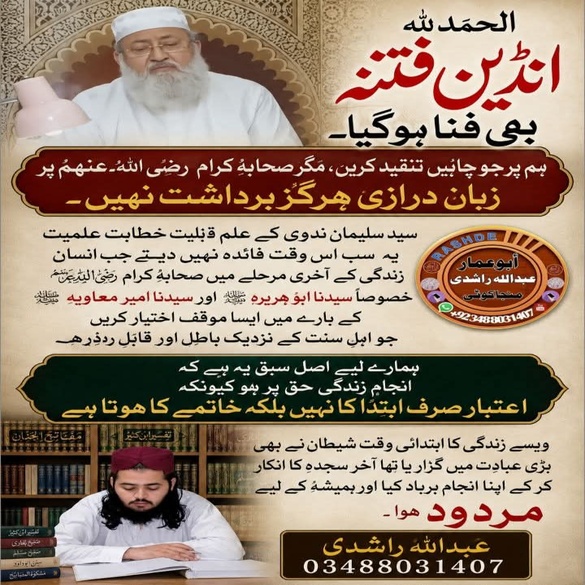
Particularly striking is the role played by Saudi-sponsored Ahle Hadith factions and their ideological affiliates, who have seized this moment to intensify their longstanding hostility toward Nadwi. Their response has not been one of scholarly disagreement but of denunciation, distortion, and defamation. This reaction reveals a deeper anxiety—an unease with voices that challenge hegemonic interpretations of Islamic history and authority.
At the centre of this campaign lies the deeply charged accusation that Nadwi was “Ghustaakh-e-Sahaba. (enemy of companions of Prophet Muhammad pbuh)” This label is not an innocent theological descriptor; it is a weaponized category designed to delegitimize, isolate, and, in some contexts, endanger. In societies where religious sentiment can be easily mobilized, such accusations carry potentially lethal consequences. They are often deployed not to protect the sanctity of religion but to silence dissent and enforce conformity.
The troubling reality is that this accusation collapses under even minimal scrutiny. Nadwi did not engage in abuse of the Companions of the Prophet (peace be upon him). What he did, rather, was revisit historical narratives, drawing upon established hadith literature and classical historiography—to critically examine certain political actions. This distinction is crucial, yet it is precisely this nuance that his opponents seek to erase.
The insistence on portraying the Sahaba as a monolithic and undifferentiated group is itself historically and theologically untenable. Classical Islamic scholarship recognizes clear gradations among the Companions. There are those uniquely honoured, such as the ten promised Paradise. There are the early Meccan converts who bore the brunt of persecution, the migrants to Abyssinia and Medina who sacrificed their homes and livelihoods, the participants of Badr whose status is unparalleled, and those present at Bay‘at al-Ridwan who earned divine commendation. At the other end are the Tulaqaa—those who accepted Islam after the conquest of Mecca, often in circumstances shaped by political necessity rather than early conviction, as they had the option of being slayed or accepting Islam.
To ignore these distinctions is not an act of piety; it is an act of historical erasure. Yet, certain groups, particularly those aligned with rigid ideological frameworks—insist on flattening these hierarchies. This flattening serves a purpose: it allows for the uncritical elevation of figures whose political actions have long been subjects of scholarly debate.
The most glaring example in this regard is Mu‘awiya ibn Abi Sufyan. The disproportionate energy expended by these factions in defending him raises legitimate questions about their priorities. Why is the defence of a politically contentious figure elevated to the level of doctrinal necessity? Why is any critical engagement with his actions treated as an attack on the entirety of the Sahaba? Abu Sufiyan, Mawiya and Yazeed, all are defended by Nasibi elements among the Sunnis despite all their crimes, but the defence of first two is very vocal and third one is not so vocal given his crimes against the family of Prophet (Ahle Bayt). Mawiya is being labelled as the maternal uncle of the Ummah by Nasibis forgetting Abdul Rahman and Muhammad bin Abu Bakr (RA), because his sister Umme Habiba (RA) is the wife of Prophet Muhammad (saw) and mother of believers. However, Abu Sufiyan and Mawiya did a lot to dissuade her from leaving Islam, but she stood firm.
Maulana informed the audiences about these facts, after the Nasibis started praising a rebel and oppressive ruler who was the killer of Suhaba. Most Sunnis used to maintain silence about the tussle of Siffin but as Nasibis started praising Mawiya, real history has to be exposed,
Nadwi’s so-called “crime” was to bring to public attention what is already documented in the classical sources: that Mu‘awiya’s political career involved actions that were contested, criticized, and debated by early Muslim scholars. Figures such as ‘Amr ibn al-‘As and al-Mughira ibn Shu‘ba, who aligned with him against the fourth Caliph, Imam ‘Ali (peace be upon him), have also been subject to scrutiny within the tradition. The events of Siffin, including the controversial tactic of raising Qur’ans on spears, are not inventions of modern polemicists but part of the historical record.
What Nadwi did was to refuse silence in the face of selective glorification. As certain Nasibi-leaning elements began openly praising Mu‘awiya, often ignoring or downplaying the ethical and political controversies surrounding his rule, Nadwi responded by reintroducing a more complete historical narrative. This was not an act of provocation but of correction.
.jpeg)
The pattern here is neither new nor isolated. When Mahmood Ahmad Abbasi and others attempted to rehabilitate figures like Mu‘awiya and Yazid through apologetic writings, it prompted a response from scholars such as Abul A‘la Mawdudi, whose Khilafat wa Mulukiyat sought to critically examine the transformation of Islamic governance. Mawdudi, like Nadwi, was met with fierce opposition, not because his arguments lacked basis, but because they challenged entrenched narratives.
It is telling that Nadwi’s critics have largely avoided engaging with his arguments at the level of evidence. Instead, they have resorted to tactics that are intellectually indefensible: selective quotation, decontextualization, and character assassination. Short clips of his speeches are circulated without context, stripped of their argumentative framework, and presented as proof of hostility toward the Sahaba. This is not scholarship; it is propaganda.
Equally revealing is what is omitted. Nadwi’s extensive praise of the first three Caliphs, his defence of Sayyida ‘Aisha (may Allah be pleased with her), and his critique of Rafidite excesses are systematically ignored. His broader intellectual project, one that sought to balance reverence with critical inquiry is reduced to a caricature. This selective representation is not accidental; it is strategic.
The Qur’anic injunctions against such practices are explicit. In Surah al-Hujurat (49:6), believers are commanded to verify information before acting upon it. This verse establishes a foundational principle of epistemic responsibility, one that is flagrantly violated in the campaign against Nadwi. Similarly, Surah al-Ma’idah (5:8) warns against allowing hatred to compromise justice. The persistent misrepresentation of Nadwi’s views is a clear example of how these principles are being ignored.
The invocation of ijma‘ (consensus) against Nadwi is another example of rhetorical overreach. The concept of consensus, while important, is neither monolithic nor immune to contestation. Islamic intellectual history is replete with disagreements among scholars on a wide range of issues. Moreover, when primary sources, particularly hadith, present narratives that complicate the reputations of certain historical figures, the appeal to consensus cannot be used to silence inquiry.
What emerges from this controversy is a troubling picture of how religious authority is exercised? For some, the authority to interpret religion has become a means of enforcing ideological conformity rather than fostering understanding. Labels such as “Ghustaakh-e-Sahaba” are deployed not as tools of theological clarification but as instruments of exclusion.
The geopolitical dimension of this campaign cannot be ignored. Nadwi’s criticism of Saudi Arabia and certain Gulf regimes appears to have intensified opposition from groups aligned with these powers. In a context where religious discourse is often intertwined with political interests, such reactions are hardly surprising. The defence of particular historical narratives becomes, in effect, a defence of contemporary alignments.
His growing popularity further unsettled these dynamics. As his lectures and writings reached wider audiences, they challenged established hierarchies of authority. For those invested in maintaining control over religious discourse, this posed a significant threat. The response, therefore, was not to engage but to discredit.
It is also necessary to confront the deeper implications of this episode. If every attempt at critical historical engagement is met with accusations of heresy or disrespect, the space for meaningful scholarship will inevitably shrink. The result will not be a more unified community but a more intellectually impoverished one, where difficult questions are suppressed rather than addressed.
Nadwi’s legacy, therefore, cannot be reduced to the caricatures constructed by his opponents. It must be understood in the context of a broader intellectual tradition that values both reverence and inquiry. His willingness to revisit contested aspects of Islamic history was not an act of defiance but an affirmation of this tradition.
The campaign against him ultimately reveals more about his critics than about his scholarship. It exposes a mode of engagement that prioritizes polemics over evidence, loyalty over truth, and control over understanding. It reflects an anxiety about losing narrative dominance in an age where access to information is increasingly democratized.
In the final analysis, the treatment of Salman Hussaini Nadwi after his death raises fundamental questions about the ethics of disagreement in the Muslim community. Will disagreement be governed by principles of justice, verification, and intellectual honesty, as mandated by the Qur’an? Or will it continue to be shaped by polemical excess, selective outrage, and ideological insecurity?
To answer these questions is to determine not only how Nadwi will be remembered but also what kind of intellectual and moral future the community seeks to build. For if scholarship is to remain meaningful, it must be protected from precisely the kind of distortion and defamation that has marked this episode. And if truth is to retain its value, it must be defended—even, and especially, when it unsettles those who have grown comfortable with unchallenged narratives.
….
M. H. A. Sikander is Writer-Activist based in Srinagar, Kashmir.
New Age Islam, Islam Online, Islamic Website, African Muslim News, Arab World News, South Asia News, Indian Muslim News, World Muslim News, Women in Islam, Islamic Feminism, Arab Women, Women In Arab, Islamophobia in America, Muslim Women in West, Islam Women and Feminism