
Al-Zahrawi: A Pioneer of Modern Surgery
By M. Basheer Ahmed M.D, New Age Islam
27 March 2026
Medieval Years: The Cradle of Civilization
Western historians frequently acknowledge the achievements of Greek and Roman scholars up until around 300 AD, but then jump to the 16th century and the Renaissance, overlooking the 1,300 years in between, commonly called "The Dark Ages of Europe." This perspective fails to recognize the vital contributions of Muslim scientists and scholars during this period. In fields such as mathematics, science, physics, chemistry, medicine, social sciences, astronomy, and philosophy, Muslim scholars made significant advances that greatly influenced the progress of human knowledge and illuminated the world with their discoveries and innovations.
The Quran highlights the importance of both faith and the pursuit of knowledge. This principle led to the creation of major institutions, such as Bait ul-Hikma (House of Wisdom) and universities from Baghdad to Cordoba, Spain. Renowned Muslim scholars such as Ibn Haitham, Ibn Sina, Al-Razi, Al-Zahrawi, Ibn Rushd, Al-Farabi, Ibn Khaldun, and Ibn Nafis made remarkable contributions across various scientific and intellectual disciplines. Their achievements, driven by Quranic teachings, laid the foundation for the European Renaissance in the 16th century.
From Baghdad and Muslim Spain (Al-Andalus), the modern era of civilization spread throughout Europe. Cordoba, the capital of the ninth century, was a leading global center of learning, filled with libraries, universities, and intellectual activity. It housed the world’s largest collection of books, including the invaluable works of Aristotle and other ancient scholars. Europeans seeking knowledge traveled to the universities of Baghdad and Cordoba, returning home to share what they learned and spark the Renaissance.
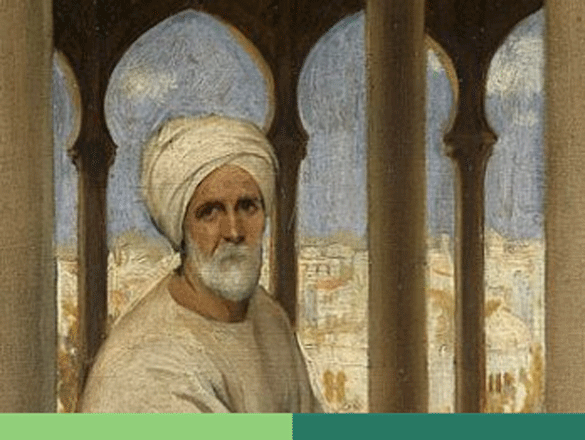
In this rich environment of inquiry and innovation, Abu Qasim Khalaf ibn al-Abbas Al-Zahrawi was born in 936 CE in Al-Zahra, near Cordoba. Known in the West as Albucasis, he became not only the court physician to Caliph Al-Hakam II but also the greatest surgeon of the Middle Ages, earning the title "the father of surgery."
Al Zahrawi’s Magnum Opus
Al-Zahrawi was known to be god-fearing, humble, and pious. His residence and the street where he lived in Cordoba (Calle Albucasis) have been preserved by the Spanish government, quietly honoring his legacy. His education was deeply rooted in Cordoba’s academic traditions, and he spent over 50 years teaching, practicing, and transforming medicine and surgery.
Alongside his expertise in medicine and surgery, Al-Zahrawi was skilled in preparing both simple and compound remedies, earning the nickname “Pharmacist Surgeon.” The translation of his work "Liber Servitor " provides information on how to prepare various drugs commonly used at the time.
His most significant achievement was the Kitab al-Tasrif li-man 'Ajiza 'an al-Ta'lif ("The Arrangement of Medical Knowledge for One Who is Unable to Compile It"), a thirty-volume encyclopedia completed in 1000 CE. Based on a lifetime of careful observation and experience, Al-Tasrif covered the entire scope of medical science, including pharmacology, dentistry, childbirth, and surgery. Its section on surgery was especially influential, raising the field to new heights.
The surgical volumes of Al-Tasrif were translated into Latin in the 12th century and became the primary reference for surgery in European universities, particularly in Italy and France, throughout the Middle Ages. For more than 500 years, they served as the standard textbook for surgical education in Europe. Through this text, Al-Zahrawi introduced innovative surgical methods and a wide range of instruments, many of which were used until the 16th century. The 10th-century European surgeon Pietro Argallata proclaimed, "Without doubt, he was the chief of all surgeons." These translated works are preserved in major libraries worldwide, demonstrating their global impact. Al-Zahrawi’s contributions established surgery as a distinct medical discipline, integrating it into scientific medicine and elevating its status beyond barbers or untrained practitioners.
A Pioneer of Modern Surgery
Al-Zahrawi was an outstanding clinician, surgeon, pharmacist, educator, inventor, and illustrator. He recognized that the advancement of surgery depended on a thorough understanding of anatomy and the use of specialized tools. He wrote, "He who devoted himself to surgery must be versed in the science of anatomy." This belief was groundbreaking at a time when anatomical dissection was discouraged. Nevertheless, Al-Zahrawi and his peers fostered an intellectual environment that encouraged evidence-based inquiry, debate, and the study of animal and human anatomy.
His surgical inventions, described in the final volume of Al-Tasrif, included over 200 instruments. These were not mere adaptations but original designs: scalpels, retractors, specula, hooks, and bone saws, each tailored for specific procedures. His innovative techniques brought lasting changes to surgical practice.
He was the first to use catgut (from animal intestines) for internal sutures, a material that is still valued for its ability to dissolve naturally. He introduced cotton as a surgical dressing and wax to control cranial bleeding.
Al-Zahrawi pioneered the use of ink to mark incision sites, a practice still used today. He described the lithotrite (forceps) for crushing bladder stones, developed fine drills for urethral stones, and invented Al-Mirwed, a metallic probe for detecting stones before surgery, paving the way for modern cystoscopy.
His approach to varicose vein stripping closely resembles modern methods. He documented tonsillectomies, tracheotomies, and cataract surgeries. He described the "Walcher" position in obstetrics, discussed ectopic pregnancy, and performed patellectomy (kneecap removal) centuries before the procedure was "rediscovered" in 1937.
He was the first to identify hemophilia, describe its uncontrollable bleeding, and understand its hereditary nature. He was cautioned against amputation above the knee and elbow.
Al-Zahrawi is regarded as a pioneer of plastic and reconstructive surgery and was also an accomplished dental surgeon, devising techniques for tooth alignment and replacement.
Al Zahrawi the Healer: Education, Ethics, and Humanity
Al-Zahrawi’s legacy extends beyond surgery, shaping the core of medical practice. He founded one of the earliest large medical schools in Cordoba, insisting on high standards of education and ethics. He stressed
the importance of the doctor–patient relationship and advocated for patient safety and dignity, regardless of social status.
Al-Zahrawi was among the first Islamic scholars to support nursing and encourage women to become midwives. His progressive initiatives led to major improvements in hospital and maternal care in Andalusia. By promoting the training of women as midwives, he enhanced the quality of care and ensured that female Muslim patients felt comfortable receiving treatment, especially from male physicians. Consequently, hospitals and nursing care flourished in Andalusia.
Above all, Al-Zahrawi was a humble seeker of knowledge. His words in Al-Tasrif reflect his humility: “Whatever I know, I owe solely to my assiduous reading of the books of the ancients, to my desire to understand them and to appropriate this science; then I have added the observation and experience of my whole life.” He viewed himself as a link in a chain—a student of the past and a teacher for the future.
Al Zahrawi left a Legacy for the New Generation
For centuries, Al-Zahrawi’s work, together with those of Ibn Sina, Al-Razi, and Ibn al-Nafis, formed the core of world medicine. However, a decline in the Muslim world after the 14th century led to their neglect. Their works were preserved and studied in the West, while fading from memory in Muslim countries. Latin translations kept his groundbreaking work alive, influencing figures such as Guy de Chauliac, who quoted him extensively in the 14th century.
Today, with renewed hope for scientific progress in the Muslim world, Al-Zahrawi’s legacy offers not only historical pride but also a powerful blueprint for the future.
The young Muslim generation, heirs to a rich legacy, should follow Al-Zahrawi’s example by exploring the unknown with curiosity and confidence. His story is more than a relic to admire; it is a timeless guide and a source of inspiration. He showed that true greatness comes from the union of faith and reason, in which piety drives perseverance, and spirituality finds its highest expression in serving humanity.
Al-Zahrawi showed intellectual courage—exploring, dissecting, designing, and documenting in an era with limited tools, motivated by the belief that seeking knowledge is an act of worship. He faced challenges and opposition, responding with innovation instead of resignation. His life demonstrates that perseverance defines human potential.
Al-Zahrawi was a visionary surgeon, author, illustrator, teacher, and founder of a school. His impact was broad and deep. He placed the dignity of the patient at the center of his science. Whatever field you choose—medicine, engineering, art, or governance—you can bring this same ethic of service. Aim for significance, not just success.
A lesson to be learned
Civilizations that neglect the pursuit of knowledge forfeit their future. It is your duty to revive the spirit of inquiry. Remember the example of the great Muslim scholars of Baghdad and Cordoba. The frontiers have changed—quantum computing, genetic engineering, climate science, and artificial intelligence —but the spirit needed remains the same: bold inquiry, ethical rigor, and a commitment to serving humanity and improving the world.
Let Al-Zahrawi’s humility inspire you. He credited his wisdom to his teachers and diligent experiences. Being a lifelong student of the universe. His legacy proves that dedicating one’s skills to relieve human suffering and dispel ignorance creates a form of immortality.
You are the descendants of civilization builders—children of pioneers who mapped the stars, named them, and healed bodies with extraordinary skill. The world needs both your intellect and your faith. Honor Al-Zahrawi’s legacy through study, innovation, and service, so you can inspire and guide future generations.
Religious Tolerance and Collaboration in Medieval Spain
During the period of Spanish history from the Muslim era in the 700s to the reconquest of Spain in 1492 by Catholic Monarchs, Muslims, Christians, and Jews lived together in relative peace. This era was characterized by religious tolerance and cooperation among different communities. They jointly conducted research to advance knowledge for the benefit of humanity, producing more scientific approaches that were better equipped to solve human problems
Bibliography
1.Levey M. (1973), Early Arabic Pharmacology, E. J. Brill,Leiden.
2. Jones, PM. "Medieval medical miniatures." London: The British Library, in association with The Wellcome Institute for the History of Medicine; 1984 - Page 27-29
3. Savage-Smith E. "Attitude toward dissection in medieval Islam." J Hist Med Allied Sci. 1995550: 67-110
4. Hehmeyer, I. & Khan, A. "Islam's Forgotten Contribution to Medical Science" Canadian Medical Association Journal 176. 2007.
5-Gimovsky, M.L., Soo Han, J "Reducing the medico legal risk of vacuum extraction" OBG management Volume 19 No. 6, June 2007, page 84.
6.Lunde, Paul. "Science in Al Andalus" Published in Science: The Islamic Legacy. Aramco-Washington D.C. 1988,page 21-26.
7-Azmi, A.A., "Contribution of Muslim Physicians in the Middle Ages", Hamdard Vol. XXIX 1-2 igSS-Hamdard Publications, Karachi, Pakistan.
8-Ashoor, A.Z. "Muslim Medical Scholars and their Work"Islamic World Medical Journal. January 1984, Pages 49-50.
9-Al Ghazal S. K. "Zahrawi and Plastic Surgery", ArabMed Journal, Issue 2(12); 2002.
10 Hayek, Simon. "How Al- Zahrawi Reached the Occident" Islamic World Medical Journal. February 1984, Page49-52.
11Hamarneh, Sami K. "Vistas of Arabic Healing Arts in Theory and Practice", Hamdard XXXII No. 3 September1989 Page 3-54 16-18
12 Huff, T.E. (2003). The Rise of Early Modern Science: Islam, China, and the West.
Al Zahrawi’s illustrations of surgical instruments he invented in his book Al-Tasrif
…
Dr. Basheer Ahmed is a physician, humanitarian, and advocate for interfaith understanding and global peace. He is a former Professor of Psychiatry, UT, Southwestern Medical School Dallas, President Emeritus of Institute of Medieval and Post- Medieval Studies (IMPMS), and Chairman Emeritus of the Muslim Community Centre for Human Service.
URL: https://newageislam.com/islam-science/al-zahrawi-pioneer-modern-surgery-/d/139425
New Age Islam, Islam Online, Islamic Website, African Muslim News, Arab World News, South Asia News, Indian Muslim News, World Muslim News, Women in Islam, Islamic Feminism, Arab Women, Women In Arab, Islamophobia in America, Muslim Women in West, Islam Women and Feminism