
When Children Meet Artificial Intelligence: Opportunities, Challenges, and Responsibilities
By Kaniz Fatma, New Age Islam
04 July 2026
There was a time when children learned about the world by listening to stories from their grandparents, asking questions in the classroom, browsing library shelves, and discovering life's lessons through experience. Today's child is growing up in a very different world. With just a few taps on a screen, they can access answers to almost any question, generate essays, create images and videos, write computer code, compose music, and explore an ocean of knowledge. That world is powered by Artificial Intelligence (AI).
Artificial Intelligence is not a substitute for human intelligence, but its speed, reach, and convenience have made it an integral part of modern life. Its contributions to education, healthcare, agriculture, industry, scientific research, and public administration are undeniable. Yet, like every transformative invention in history, AI has raised important questions that cannot be answered by technology alone. They also require ethical reflection, sound education, responsible legislation, and social awareness.
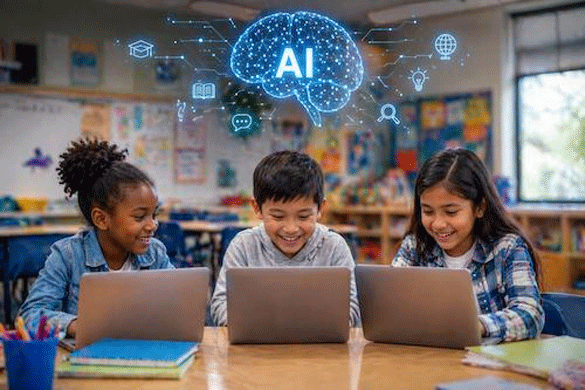
Perhaps the most pressing question is this: When Artificial Intelligence falls into the hands of children, will it become a gateway to learning and innovation, or will it expose them to risks that we are only beginning to understand?
This question is especially important because today's children are the first generation to grow up with AI from an early age. Earlier technological revolutions from personal computers to the internet and smartphones spread gradually. AI, however, has entered homes, classrooms, and mobile devices at remarkable speed. In many families, children are already more comfortable using AI tools than their parents, while adults are still trying to understand how these systems work.
This has created a new digital generation gap. Children are moving ahead with technology, but families, schools, and sometimes even governments are struggling to keep pace.
It is important to remember that Artificial Intelligence is neither inherently good nor inherently bad. It is simply a powerful tool, and like every tool, its value depends on how it is used. A kitchen knife prepares meals in the hands of a chef but becomes a weapon in the hands of a criminal. The same principle applies to AI.
Used wisely, AI can become one of the greatest educational companions of our time. It can help children conduct research, learn new languages, solve mathematical problems, understand science, develop programming skills, nurture creativity, and inspire innovation. But without guidance, ethical values, and appropriate supervision, the same technology may create challenges that cannot be ignored.
One of the most immediate concerns is privacy. Young children often do not understand what information should never be shared online. They may unknowingly enter their names, addresses, school details, family information, photographs, passwords, or other sensitive data into AI platforms. Such information could later be exploited for identity theft, cyber fraud, or other forms of digital crime. Teaching children how to protect their digital identity is now just as important as teaching them how to use a computer.
Another growing concern is psychological and emotional dependence. AI is available around the clock. It never gets tired, rarely refuses to answer, and can sometimes appear sympathetic and understanding. Young minds may gradually begin to view AI as a genuine companion. If that happens, their social skills, emotional resilience, and real human relationships may suffer. No machine, however intelligent, can replace the love, guidance, and emotional support provided by parents, teachers, and family members.
A third concern relates to ethical development. If students begin relying on AI for every homework assignment, essay, or examination, they may gradually lose the habit of independent thinking, creativity, and hard work. AI should make learning easier, but it should never replace the thinking process itself. Children must understand that AI can serve as an excellent learning assistant, but it should never become a substitute for teachers, critical thinking, or personal effort.
There is also the risk of exposure to harmful or inappropriate content. Like the internet, AI can be misused to search for violent, explicit, or extremist material. Responsible AI developers continue to strengthen safeguards against such misuse, but no technological system is perfect. This is why parental guidance, responsible teaching, and continuous digital awareness remain indispensable.
The landscape of cybercrime is also evolving rapidly. AI can make fraud, impersonation, fake images, deceptive messages, and other forms of online crime more sophisticated than ever before. While only a very small minority of children may attempt to misuse AI in this way, a far greater concern is that children themselves may become victims of AI-enabled scams and cybercrime. Digital safety and cybersecurity awareness should therefore become an essential part of school education.
These challenges remind us that protecting children cannot be the responsibility of parents alone. No individual or institution can shield children from every potential AI-related risk. Protecting young people in the age of Artificial Intelligence requires shared responsibility.
Parents should maintain open communication with their children, neither placing blind trust in them nor resorting to excessive surveillance. Schools should teach responsible AI use and integrate digital ethics, online privacy, and critical thinking into their curricula. Governments should establish effective child protection laws and regulatory standards. AI developers and technology companies must design systems that take children's age, emotional maturity, and developmental needs into account, making safety an integral part of innovation rather than an afterthought.
Ultimately, the success of Artificial Intelligence should not be measured solely by its speed, intelligence, or impressive capabilities. It should also be judged by a more fundamental question: Is this technology helping to protect the moral development, mental well-being, character, and future of our children?
History teaches us that every major technological breakthrough has required new rules and new responsibilities. The invention of automobiles led to traffic laws. Modern medicines required safety regulations. The internet gave rise to cybersecurity laws and digital rights. Artificial Intelligence is another revolution of similar magnitude. Technological advancement alone is not enough; it must be accompanied by ethical wisdom, educational reform, and collective social responsibility.
The real question is no longer whether AI will become part of our children's lives. That has already happened. The question now is how we prepare children to live with AI responsibly.
If we combine quality education, ethical values, parental guidance, responsible innovation, and effective public policy, Artificial Intelligence can help today's children become tomorrow's innovators, scientists, and responsible global citizens. But if we fail to provide that guidance, the same technology may become one of the greatest challenges facing the next generation.
Progress is inevitable. Wisdom lies not in resisting technology but in ensuring that our children learn to use it with knowledge, integrity, responsibility, and compassion. That is the foundation upon which a safe, enlightened, and humane digital future can be built.
---
Kaniz Fatma is an Islamic scholar (Alimah and Fazilah) and a regular columnist for New Age Islam.
URL: https://newageislam.com/islam-science/children-meet-ai-challenges-responsibilities/d/140673
New Age Islam, Islam Online, Islamic Website, African Muslim News, Arab World News, South Asia News, Indian Muslim News, World Muslim News, Women in Islam, Islamic Feminism, Arab Women, Women In Arab, Islamophobia in America, Muslim Women in West, Islam Women and Feminism