
Desperately Seeking Paradise: My Personal Experience with Indian Islam
BY New Age Islam special correspondent
30 May 2026
I’m still on a quest. A quest for respect without animosity. A quest for faith without being extreme. A quest for a sense of belonging without shutting out the world. A quest for spirituality in a world that’s driven by technology and divided opinions. And maybe that’s the real takeaway I got from both Indian Islam and "Desperately Seeking Paradise": paradise isn't some lost kingdom waiting to be rediscovered. It's a moral battle we face in our everyday lives. It's found in fairness, kindness, humility, getting along with each other, and having the guts to embrace our differences.
Major points:
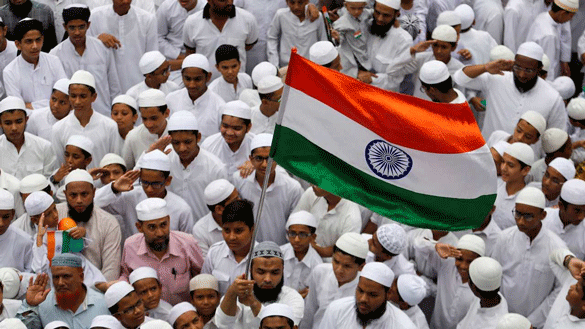
· So, my connection with Indian Islam is still a work in progress. Sometimes I feel optimistic when I see educated young Muslims, women getting involved in politics, forward-thinking scholars, unity between different faiths, and people participating in democracy.
· Other times, I get worried seeing the rise of communal hatred, online extremism, division, and closed-minded thinking around us. But maybe this tension is just part of what it means to be a Muslim in modern times.
· I’m still on a quest. A quest for respect without animosity. A quest for faith without being extreme. A quest for a sense of belonging without shutting out the world.
A quest for spirituality in a world that’s driven by technology and divided opinions. And maybe that’s the real takeaway I got from both Indian Islam and "Desperately Seeking Paradise": paradise isn't some lost kingdom waiting to be rediscovered. It's a moral battle we face in our everyday lives. It's found in fairness, kindness, humility, getting along with each other, and having the guts to embrace our differences.
My journey with Indian Islam hasn't made me less religious. Instead, it's made me think more deeply about religion itself. I still feel a strong emotional bond with Islam. I still value prayer, fasting, spirituality, and my Muslim identity. But I also strongly believe in democracy, moral principles, the importance of women's rights, diversity, open-mindedness, and living in harmony. This tension doesn't feel like a weakness to me anymore. It's what defines my Indian Islam.
I was born into Indian Islam, and as the years have passed, I've come to understand that it's more than just a religion. It's a whole way of life, a way of remembering, negotiating, and just trying to make it through. My experience with Islam wasn't just about the theology or the rituals. It was woven into my family, my village, the local mosques, those Ramadan evenings, Eid gatherings, classrooms in the madrasa, political chats, and all those memories that tug at your heart. Islam wasn't separate from the world around me. It was right there inside Indian culture, the different languages, the push and pull of democracy, the local history, and the everyday realities of life. Growing up, I slowly realised that being a Muslim in India meant constantly trying to find a balance between faith, who I am, being a citizen, being modern, and just getting along with everyone else.
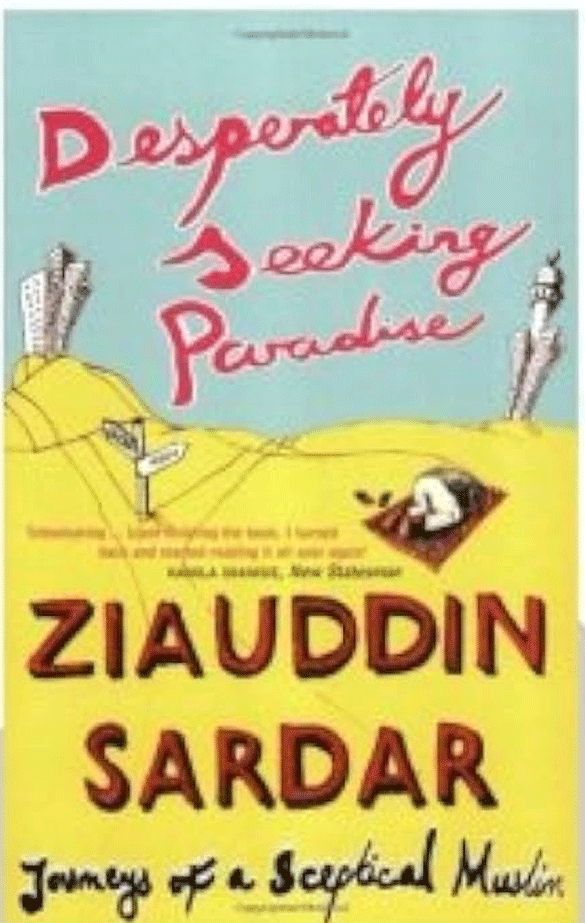
When I read Desperately Seeking Paradise, it felt like the book was putting into words so many of the emotional battles I'd been quietly fighting for years. The book talks about how modern Muslims all over the world are looking for a sense of dignity, certainty, purity, and this idea of paradise that feels lost in today's chaotic world. I really connected with that because I've seen that search happening within the Indian Muslim community too. I've seen people searching for this perfect Islamic past while grappling with the confusion of the present. I've seen ordinary Muslims trying to hold onto their faith while also trying to navigate communal politics, economic worries, social biases, and the rapid changes in technology.
Childhood Memories and Community Life
My first understanding of Islam came from the people around me. I remember the soft sound of prayers being recited at home. I remember the older men sitting outside the mosques, talking more about politics, morality, and what's happening in the community than actual theology. I remember the teachers at the madrasa, teaching with everything they had even if they hadn't seen much of the modern world. When I was a kid, Islam felt more about emotions and community than any kind of ideology. It was tied to food, relationships, festivals, giving to charity, and the local culture. At first, I didn't see any conflict between being Muslim and being Indian. The Islam I knew spoke Malayalam, carried on local traditions, and just naturally absorbed the cultural influences of where I lived.
As I got older, I started to notice how diverse Indian Islam really was. There were Sunnis, Mujahids, Jamaat activists, Sufi traditions, reform movements, and all sorts of different schools of thought. There were constant arguments about theology, politics, reform, and what it means to be modern. But even those disagreements happened in a democratic way. Tea shops, campuses, mosques, auditoriums, and student groups became places to debate. Looking back, I realize now that Indian Islam was never quiet or unthinking. It was argumentative, all over the place, emotional, and very much alive.
The Internet and the Crisis of Faith
The internet changed everything for my generation. Suddenly, Islamic knowledge was available from all over the world. A young Muslim in Kerala could listen to scholars from Egypt, Saudi Arabia, Pakistan, Britain, or America in seconds. At first, it felt like a revolution. Online Islamic libraries, digital archives, lectures, and searchable texts gave us access to centuries of Islamic scholarship. I saw firsthand how digital access opened up new intellectual worlds for me. I could compare different interpretations, read old texts, and explore theological debates without having to rely only on the religious leaders in my area.
But as time went on, I also saw the dangers of online religion. The internet didn't just make knowledge more accessible. It also oversimplified religion in a dangerous way. Complex historical debates became short, emotional videos. Nuanced Islamic jurisprudence got turned into slogans. Getting angry became a way to participate. Online religious spaces often valued certainty more than wisdom. I saw how emotionally vulnerable young Muslims could get stuck inside ideological bubbles. A genuine search for spirituality could slowly turn into an attraction to extremism or intolerance. It scared me because I realised how technology was turning religion into something you perform and a reason to get outraged.
Living as a Muslim in Democratic India
Living as a Muslim in India has really shaped the way I think. I wasn't living in an Islamic state. I was living in a big, complicated, democratic, secular society with all sorts of religions, castes, languages, and identities. This forced Muslims like me to constantly figure out how to coexist. We couldn't just shut ourselves off from the world around us. We had to engage with constitutional values, elections, the education system, the reality of different faiths living side by side, and democratic institutions. Over time, I started to feel like Indian Islam survives not by being dominant but by adapting and finding common ground.
I also saw the rise of tensions between communities over identity, food, clothing, and public religious practices. Muslims became more politically visible and more emotionally defensive. Even ordinary religious practices started to become controversial. I realised that Muslims in India needed more than just a strong emotional connection to their faith; they also needed to be responsible citizens. Religious freedom also meant being ethical towards your neighbours, taking care of public spaces, being hygienic, and living together peacefully. This changed how I understood religion itself. Islam couldn't survive in India on anger alone. It needed democratic ethics and social wisdom.
Searching for Reform and Reinterpretation
As my intellectual interests grew, I became drawn to Muslim thinkers who were pushing for reform. I got interested in ideas like collective ijtihad, reinterpretation, ethical Islam, maqasid al-shariah, and democratic pluralism. I was inspired by scholars who were trying to reconcile Islam with modern ideas, science, women's participation, constitutionalism, and human rights without giving up their faith. This journey wasn't always easy because a lot of Muslim spaces are suspicious of reform. Reform is often seen as giving in to the West or betraying tradition. However, I gradually came to see that resisting change can also negatively impact communities, both intellectually and socially.
I observed that many Muslims held onto a romanticised view of the past while being disconnected from present-day realities such as education, scientific inquiry, economic advancement, gender equality, and democratic involvement. Discussions about Islam sometimes became fixated on symbolic identity, overshadowing the need for social development. My desire was for an Islam that could effectively address real human issues—one that could meaningfully engage with ethics, democracy, women’s rights, pluralism, and social justice.
Muslim Women and Social Change
One of the most significant shifts I witnessed within Indian Muslim society was the growing prominence of Muslim women in education and public life. Particularly in Kerala, Muslim women were increasingly entering universities, politics, journalism, activism, and various professional fields with a sense of confidence. This transformation reshaped my understanding of Muslim progress. Earlier discussions within the community had largely focused on protection and preservation, but now, conversations about dignity, opportunity, leadership, and participation were gaining traction.
It became clear to me that the future of Indian Islam would largely depend on how Muslim women are regarded—not just as symbols of morality but as equal contributors to knowledge and public life. Muslim women were not only changing their own lives; they were also gradually reshaping the community's mindset.
Sufism and India’s Syncretic Traditions
My interest in Sufism and the syncretic traditions within Indian Islam also grew. As a child, I had taken these traditions for granted, but later, I observed that many ideological movements dismissed them as un-Islamic or impure. This bothered me because I believed that syncretic Islam represented one of India’s greatest strengths. Historically, Indian Islam had absorbed local cultures while preserving its faith. Sufi traditions, in particular, emphasised compassion, spirituality, coexistence, poetry, and ethical humility.
These traditions felt particularly vital at a time when society was becoming increasingly polarised and aggressive. I felt strongly that India’s Muslim heritage could not be reduced to inflexible ideological frameworks alone and that there was undeniable beauty in diversity, local culture, and shared traditions.
Global Muslim Suffering and Identity Anxiety
At the same time, my generation was deeply affected by the suffering of Muslims worldwide. Events in Palestine, Iraq, Syria, and Afghanistan; instances of communal violence; and anti-Muslim sentiment shaped Muslim consciousness everywhere. Through social media, we were constantly exposed to images of violence, humiliation, and political turmoil. I noticed that many young Muslims were developing a profound sense of frustration. While some became politically engaged and embraced democratic values, others were drawn to absolutist ideologies that promised dignity through confrontation and the pursuit of purity.
Reading *Desperately Seeking Paradise* helped me realise that many Islamist movements arise not only from theological underpinnings but also from emotional crises, feelings of humiliation, and identity anxieties, with many Muslims searching for certainty in an unpredictable world.
Campus Life and Intellectual Transformation
University life also significantly influenced my understanding of Islam. Campuses exposed me to a wide range of ideologies, political theories, and social realities. I encountered Marxists, liberals, Ambedkarites, feminists, secular activists, Islamists, and conservatives. These intellectual encounters compelled me to re-evaluate simplistic notions about religion and politics. Fields like sociology, anthropology, political theory, and postcolonial studies helped me grasp how religion interacts with power, history, colonialism, caste, and nationalism.
I realised that Indian Islam itself had been shaped by historical trauma, partition, educational disadvantages, democratic participation, and social insecurity. Religion wasn't separate from society; it was deeply intertwined with politics, economics, and identity.
Technology, AI, and Radicalization
One of my foremost concerns today is the potential for digitally accelerated radicalisation. Technology is fundamentally changing how religion is consumed. In the past, religious learning required patience, formal institutions, teachers, and community engagement. Now, individuals in isolation consume religious content through algorithms designed to maximise emotional engagement, where extreme content often appears more appealing than nuanced scholarship. Artificial intelligence may intensify this trend further in the future.
I increasingly believe that Muslim societies need ethical digital literacy in addition to religious literacy and that young Muslims need to understand not only their faith but also how algorithms can manipulate anger, identity, and emotional vulnerability.
Why Democracy Still Matters to Me
Despite all the challenges, I remain a firm believer in democracy and pluralism. Democracy may be flawed, and at times corrupt and frustrating, yet it allows for coexistence and negotiation, preventing complete social breakdown. I don’t believe that Muslims in India can thrive through isolation or reactionary politics; rather, their survival depends on education, active participation, alliances, constitutional morality, and ethical engagement with society.
My hope is to see Muslims avoid being caught between majoritarian nationalism on one side and rigid Islamism on the other. I envision a future where Muslims can be both devout and democratic, intellectually curious, socially engaged, and pluralistic.
Over time, I've stopped searching for an idealised Islamic utopia. I no longer believe that paradise can be politically restored through nostalgia or empty slogans. Communities evolve gradually, and traditions endure through reinterpretation and ethical adaptation. I strive for an Islam that prioritises compassion over dominance, ethics over control, and coexistence over isolation. I long for an Islam that can grapple with tough questions instead of running from them.
Conclusion: My Indian Islam
So, my connection with Indian Islam is still a work in progress. Sometimes I feel optimistic when I see educated young Muslims, women getting involved in politics, forward-thinking scholars, unity between different faiths, and people participating in democracy. Other times, I get worried seeing the rise of communal hatred, online extremism, division, and closed-minded thinking around us. But maybe this tension is just part of what it means to be a Muslim in modern times.
I’m still on a quest. A quest for respect without animosity. A quest for faith without being extreme. A quest for a sense of belonging without shutting out the world. A quest for spirituality in a world that’s driven by technology and divided opinions. And maybe that’s the real takeaway I got from both Indian Islam and "Desperately Seeking Paradise": paradise isn't some lost kingdom waiting to be rediscovered. It's a moral battle we face in our everyday lives. It's found in fairness, kindness, humility, getting along with each other, and having the guts to embrace our differences.
My journey with Indian Islam hasn't made me less religious. Instead, it's made me think more deeply about religion itself. I still feel a strong emotional bond with Islam. I still value prayer, fasting, spirituality, and my Muslim identity. But I also strongly believe in democracy, moral principles, the importance of women's rights, diversity, open-mindedness, and living in harmony. This tension doesn't feel like a weakness to me anymore. It's what defines my Indian Islam.
…
URL: https://newageislam.com/islam-politics/seeking-paradise-experience-with-indian-islam-/d/140206
New Age Islam, Islam Online, Islamic Website, African Muslim News, Arab World News, South Asia News, Indian Muslim News, World Muslim News, Women in Islam, Islamic Feminism, Arab Women, Women In Arab, Islamophobia in America, Muslim Women in West, Islam Women and Feminism