
Secularism and Islam: Reimagining the Relationship Between Religion and State in the Light of the Quran
By V.A. Mohamad Ashrof, New Age Islam
04 May 2026
The relationship between religion and state has generated some of the most consequential debates in modern Islamic thought. Two positions have dominated the discourse. On one side, Islamist movements insist that Islam mandates the fusion of religious authority with political power, that the ideal polity is one governed by divine law and administered by those committed to its enforcement. On the other side, secularists—both within and outside Muslim societies—argue that religion must be wholly removed from public life if democratic governance, individual freedom, and equal citizenship are to be secured. Between these poles lies a third possibility, inadequately explored and frequently mischaracterised, which this paper calls Islamic secularism.
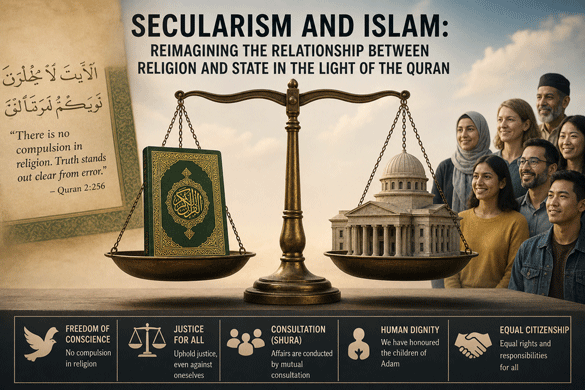
The term demands immediate clarification. Secularism, as encountered in Western political philosophy, encompasses a broad spectrum of positions. In its militant or comprehensive form, it regards religion as inherently irrational, treats faith as a private matter incapable of informing public reason, and seeks the progressive marginalisation of religious authority from collective life. This version of secularism is indeed incompatible with the Quranic worldview, which regards justice, mercy, and the moral guidance of revelation as indispensable to collective life. However, there is a second, institutional sense of secularism—sometimes called political secularism—that means simply that the state maintains neutrality among religious communities. In this sense, the state neither privileges one faith over others nor suppresses the free exercise of religion. It treats all citizens as equal bearers of rights and responsibilities regardless of their religious commitments, and it does not deploy its coercive power to enforce theological conformity. It is this institutional secularism that informs the concept developed here.
The argument of this paper is that the Quran does not mandate a theocratic state. It provides ethical principles—justice, freedom of conscience, consultation, human dignity, accountability, and mercy—that are more faithfully realised by a politically neutral, pluralistic democratic order than by a coercive confessional state. When secularism is understood as institutional neutrality rather than as anti-religious ideology, Islamic secularism ceases to be a contradiction and becomes a coherent political theology grounded in the Quran's deepest moral commitments.
This argument proceeds through several stages. The paper begins by examining the Quran's political vision, demonstrating that it provides ethical principles without prescribing a fixed institutional form of governance. It then analyses specific Quranic principles—freedom of conscience, justice, consultation, and human dignity—and shows how they align with the values of pluralistic democracy rather than theocratic governance. The discussion then turns to the influential modern doctrine of hakimiyyah (divine sovereignty), arguing that this doctrine, as developed by thinkers such as Abul Ala Maududi and Sayyid Qutb, misreads the Quran by conflating divine moral authority with direct political rule. The paper then examines the classical dhimma system and the institution of jizya, arguing that these are historically contextualised juristic constructions rather than eternal Quranic prescriptions, and that the Quran's moral objectives are better realised through equal citizenship in the modern context. It then reassesses the classical apostasy ruling in the light of the Quran's commitment to freedom of conscience. The paper concludes by articulating a constructive vision of Islamic secularism as a political theology that harmonises Quranic ethics with pluralistic democratic governance.
This inquiry is not merely academic. As Muslim-majority societies navigate complex political transitions, and as questions of religion, law, and democratic governance become increasingly urgent in a plural and interconnected world, the need for a Quranically grounded political theology that transcends the false choice between theocracy and hostile secularism has never been greater. The purpose of Islamic secularism, as articulated here, is not to marginalise Islam but to recover the Quran's deepest moral vision for the governance of human communities.
The intellectual landscape of Islamic political thought is diverse and contested. Classical juristic traditions developed extensive theories of governance within frameworks shaped by the political realities of imperial rule. The modern period has introduced new challenges: the collapse of the Ottoman Caliphate, the imposition of colonial political structures, the emergence of the nation-state, and the development of universal human rights norms have all required Islamic political thought to engage with categories and problems that had no precise equivalent in the pre-modern tradition. Revivalist movements responded in various ways—some by seeking to restore idealised pre-modern forms, others by developing new ideologies such as the Islamic state, and still others by attempting creative reinterpretation of classical sources in light of contemporary values.
This paper belongs to the third of these intellectual strands. It draws on the work of scholars such as Abdullahi Ahmed An-Na'im, Khaled Abou El Fadl, Fazlur Rahman, Wael B. Hallaq, and Mohammad Hashim Kamali, whose contributions have enriched the field of Islamic political theology immeasurably. A note on method is also in order: this paper engages primarily with the Quran as the foundational source for Islamic political ethics, acknowledging the importance of the hadith tradition but insisting, consistent with classical Islamic epistemology, that hadith must be read in the light of the Quran rather than against it. Where classical juristic constructions appear to conflict with Quranic principles, the Quran is treated as the higher authority.
The Quran's Ethical Vision: Principles Without Political Prescription
Any serious engagement with Islamic political thought must begin with an honest reading of what the Quran actually says about governance, rather than with later juristic constructions or modern ideological slogans. The fundamental observation that emerges from such a reading is that the Quran does not prescribe a specific political system. It provides no constitutional blueprint, defines no governmental structure, establishes no clerical hierarchy empowered to rule in God's name, and mandates no particular institutional arrangement for political authority.
This absence of institutional prescription is not accidental or a product of historical limitation. It reflects the Quran's characteristic approach to human social life: the text provides enduring ethical principles and leaves their institutional realisation to human deliberation and historical circumstance. The Quran commands justice (16:90), demands that authority be exercised as a trust (4:58), urges consultation (42:38), insists on freedom of conscience (2:256), and affirms universal human dignity (17:70), but it does not specify whether these principles must be realised through a monarchy, a republic, a caliphate, or any other particular form of government.
This openness is theologically significant. Wael B. Hallaq has argued extensively that the modern concept of an 'Islamic state' is an essentially modern ideological construction that misreads the pre-modern relationship between Islamic law and political authority (Hallaq, The Impossible State, p.1-19). The Quran's silence on political form supports this view. No single political model can claim exclusive Quranic legitimacy, because the Quran does not confer that legitimacy on any institutional arrangement. What the Quran does confer legitimacy on is the ethical quality of governance.
Prophet Muhammad's community at Madinah is often invoked as the paradigmatic model of an Islamic state. Yet a careful examination of the historical record reveals that the Madinan polity was a pluralistic covenant community rather than a theocracy in the modern ideological sense. The Constitution of Madinah, a document widely regarded as authentic, recognised Muslims, Jews, and other groups as members of a single political community with mutual rights and obligations. Non-Muslim communities retained their own religious laws and communal institutions. This arrangement more closely resembles a confederal pluralistic polity than a centralised theocratic state enforcing religious uniformity.
The Prophet's authority in Madinah derived from his unique role as a messenger of God, not from an institutional office that could be perpetuated. After his death, no one inherited prophetic authority. The Quran does not establish a succession mechanism, does not define the caliphate as a required institution, and does not grant any human office the authority to rule in God's name. The diversity of political forms that emerged in Muslim history—caliphates, sultanates, monarchies, emirates—demonstrates that Muslim societies themselves understood political institutions as historically contingent rather than divinely mandated (An-Na'im, Islam and the Secular State, p.45-78).
This insight liberates Islamic political thought from the false necessity of any single political form. The question is not whether the state is formally labelled 'Islamic,' but whether it embodies the ethical values the Quran demands. As Mohammad Hashim Kamali has argued, the Quran's political teaching is fundamentally ethical rather than institutional; its concern is the moral quality of governance rather than the formal characteristics of governmental structures (Kamali, Citizenship and Accountability, p.3-22). The Quran's ethical political principles cluster around four core commitments: justice (adl), consultation (shura), freedom of conscience, and human dignity (karama). Together, these commitments constitute a Quranic political ethic that is both demanding in its moral requirements and flexible in its institutional implications.
It is also important to note the diversity of political experience within Muslim history as evidence for the Quran's institutional flexibility. The Rashidun caliphate, the Umayyad dynasty, the Abbasid empire, the Fatimid caliphate, the Ottoman sultanate, and numerous regional kingdoms and principalities all operated under different constitutional arrangements, different legal frameworks, and different relationships between religious scholars and political authority. None of these systems was regarded at the time as the uniquely Quranic form of governance. Muslim scholars and rulers experimented, adapted, and innovated. This historical diversity is itself a Quranic vindication: it demonstrates that the ethical principles of the Quran can be realised across a wide range of institutional forms, and that no single form has a monopoly on Quranic legitimacy.
The Quran's silence on political form should also be understood in light of its characteristic approach to human life more broadly. The Quran does not prescribe a detailed code for every dimension of human existence; it establishes moral principles and trusts human beings to apply them with wisdom and contextual sensitivity. This approach reflects a deep respect for human intelligence and moral agency—an affirmation that the vicegerents God has placed on earth are capable of reasoning their way towards just institutions if they are guided by sound ethical principles. Political governance is one domain among others in which this reasoning is required. The Quran provides the moral compass; human deliberation supplies the institutional map.
Freedom of Conscience and the Principle of Institutional Neutrality:
The most politically significant of the Quran's foundational principles for the purposes of this discussion is its affirmation of freedom of conscience. The verse 'there is no compulsion in religion' (2:256) is among the most widely cited in the Quran, and its implications for political governance are profound. The verse does not merely prohibit physical coercion in matters of religious practice. It establishes a deeper principle: that faith is, by its very nature, a matter of free moral choice.
This principle is reinforced by several other Quranic passages. In 18:29, the Quran declares: 'The truth is from your Lord; let whoever wills believe, and whoever wills disbelieve.' In 10:99, the rhetorical question is posed: 'Would you compel people until they become believers?' The question expects the answer no. In 88:21-22, the Prophet is reminded that his role is that of a reminder, not a controller over human conscience. These passages collectively establish that genuine faith presupposes freedom. A person compelled to profess belief does not thereby believe; they merely comply outwardly. The Quran's concern is with sincere conviction, not outward conformity, and sincere conviction cannot be manufactured through coercion.
The political implications of this principle are significant. If the state privileges one religion in its laws and public institutions, citizens of minority faiths face structural pressure towards conformity even without explicit coercion. The institutional weight of state power bears against their free exercise of conscience. Such pressure constitutes a form of indirect compulsion that violates the spirit of Quranic non-compulsion even when it falls short of outright coercion. A state that remains institutionally neutral among religious communities—that grants equal legal standing to citizens regardless of their faith—better protects freedom of conscience than a confessional state.
Institutional neutrality does not mean indifference to religion; it means that the power of the state is not deployed in favour of any particular religious community or interpretation. This undergirds the concept of Islamic secularism as developed in this paper. Institutional neutrality is not hostility to religion; it is the structural precondition for genuine freedom of religion. A state that protects freedom of conscience without privileging any particular faith allows all religious communities to flourish on the basis of their own moral authority rather than state power.
The Quran's affirmation of religious pluralism as part of the divine order strengthens this argument. In 10:99, the Quran observes that had God willed, all human beings would have believed. The diversity of belief is therefore not an accident to be corrected but part of the divinely ordered human condition. This recognition does not imply that all beliefs are equally valid; the Quran clearly regards monotheism as true and associates idolatry with moral error. But it does mean that the state is not the instrument through which theological correctness is to be enforced.
The Quran further affirms in 5:48 that different communities have been given different laws and ways, suggesting that religious diversity has a positive function in divine wisdom: 'Had God willed, He would have made you one community, but He willed to test you through what He has given you, so race to do good.' This verse endorses a kind of competitive moral pluralism in which diverse religious communities demonstrate their commitments through ethical excellence rather than political domination. Institutional neutrality among religious communities is therefore not a secular imposition on Islamic political thought but a practical expression of the Quranic recognition of divinely ordered religious diversity.
Abdullahi Ahmed An-Na'im has argued persuasively that the separation of Islam and state is itself an Islamic imperative, precisely because only a state that maintains institutional neutrality can guarantee the freedom of conscience that Islam requires (An-Na'im, Islam and the Secular State, p.1-30). The state must be neutral not despite Islamic values but because of them. Freedom of conscience, as a Quranic principle, requires institutional structures that protect it, and institutional neutrality is the most effective such structure in the modern context. Religious communities, including the Muslim community, remain free to advocate for policies inspired by their values and to participate actively in civic life. But they must do so through persuasion and democratic deliberation rather than through the coercive power of the state.
It is worth reflecting on what institutional neutrality would look like in practice. In a state committed to Islamic secularism in the sense articulated here, mosques, churches, synagogues, and temples would all operate freely without state interference or state support. Muslim citizens would have the same civic rights as Christians, Jews, Hindus, and atheists. No religious community would be entitled to use state law to impose its practices on others. Religious courts might operate as voluntary arbitration mechanisms for those who choose them, but they would not have coercive jurisdiction over those who do not. Islamic values could and would inform public policy advocacy—Muslims might argue for policies promoting social justice, economic fairness, or family welfare on Quranic grounds—but these arguments would be made in the common forum of democratic deliberation, competing on their merits with arguments from other ethical traditions.
This vision may seem unfamiliar within certain strands of Islamic political thought, but it is deeply familiar within others. Many Muslim scholars throughout history have argued that the moral authority of religion is actually enhanced, not diminished, when it is not backed by state coercion. A community that practises Islam freely and sincerely demonstrates the moral power of its tradition far more effectively than one whose conformity is maintained by legal compulsion. The Prophet himself, as the Quran repeatedly emphasises, was not sent to compel but to persuade. Islamic secularism recovers this prophetic model of moral authority: authority grounded in the quality of the ethical vision offered rather than in the power of the state behind it.
Justice as the Supreme Political Value
Justice occupies the central position in the Quran's political ethic. The command 'God commands justice' (16:90) is unequivocal, and the Quran returns to the theme of justice repeatedly, in different contexts and with different emphases, to demonstrate that it is not merely one virtue among others but the foundational principle of legitimate social order. The Quran's conception of justice is notably universal. In 4:135, believers are commanded to 'stand firmly for justice, as witnesses to God, even against yourselves, your parents, or your kin.' Justice cannot be partial; it must override even the most powerful natural loyalties.
In 5:8, this universality is made explicit in political terms: 'Do not let hatred of a people cause you to swerve from justice. Be just; that is nearer to righteousness.' Justice must govern relations with adversaries as much as with allies. This universalism has profound implications for political order. If justice must be impartial—if it cannot be conditioned by communal identity, religious affiliation, or political loyalty—then a political system that grants differential rights on the basis of religion faces a serious challenge to its Quranic legitimacy. A system in which Muslims and non-Muslims enjoy different legal standing, different rights of participation, or different protections under law does not embody the Quranic demand for impartial justice.
Justice in the Quran encompasses several dimensions that are directly relevant to political governance. First, it includes legal equality: all parties before the law should be treated according to the same standards, without discrimination based on identity. Second, it includes distributive fairness: resources and opportunities should be allocated in ways that serve the welfare of all members of society, with particular attention to the vulnerable and the marginalised. Third, it includes procedural accountability: those who exercise authority must answer for their use of power.
Political authority in the Quran is conceptualised as a trust (amanah), not a divine gift to rulers for their personal benefit. In 4:58, God commands: 'Render trusts to whom they are due, and when you judge between people, judge with justice.' Authority is a responsibility entrusted to human agents for the sake of the community. This conception fundamentally undermines political absolutism: rulers hold power in trust, not as an absolute right, and they are accountable for how they exercise it. The Quran's condemnation of Pharaoh in 28:4 is instructive precisely on this point—his sin was not merely personal cruelty but the exercise of unchecked power, the claim to absolute authority that belongs to God alone.
This Quranic framework of justice has important implications for evaluating different forms of governance. A political system's legitimacy depends not on its formal religious identity but on its capacity to realise justice. A government that calls itself Islamic but rules unjustly, privileges some communities over others, and exempts itself from accountability fails the Quranic standard regardless of its religious claims. Conversely, a government that establishes equal citizenship, protects the rights of all, and maintains accountability may embody Quranic justice even without a formal religious label. Khaled Abou El Fadl has emphasised that the Quran's moral orientation is fundamentally ethical rather than legalistic; its concern is not with formal compliance but with the realisation of moral values in human life (Abou El Fadl, p.45-78).
The concept of maqasid al-shariah—the higher objectives of Islamic law—reinforces this point. Classical jurists identified the objectives of Islamic law as the preservation and promotion of life, intellect, dignity, religion, and welfare. These objectives are ethical ends, not institutional forms. They provide a framework for evaluating legal and political arrangements by their moral outcomes rather than their formal characteristics. From the perspective of maqasid, a political system is Islamic in the morally relevant sense if it protects life, upholds dignity, ensures welfare, and promotes justice—regardless of whether it carries an Islamic label (Kamali, Shari'ah Law, p.123-155). Pluralistic democracy, with its commitments to equal citizenship, legal accountability, and protection of rights, provides institutional mechanisms for realising this justice. It does not guarantee justice—democratic systems can be unjust and corrupt—but it creates the structural conditions conducive to just governance.
The Quranic concept of justice also has important implications for economic governance. The Quran condemns the concentration of wealth in the hands of a few (59:7), commands that property circulate among all members of society, and establishes strong obligations of charity (zakat) and care for the poor. These economic teachings are part of the broader Quranic commitment to justice and constitute an important dimension of what just governance must secure. A political system that protects formal political equality while permitting extreme economic inequality fails to realise the Quran's full vision of justice. This means that Islamic secularism is not merely political liberalism; it is animated by a substantive vision of justice that includes social and economic dimensions. Democratic governance, to be faithful to Quranic ethics, must attend not only to formal equality but to the substantive conditions that allow all citizens to live with dignity.
The trust (amanah) concept, which the Quran applies to political authority, also extends to the stewardship of natural resources and the environment. The concept of humans as vicegerents (khulafa) on earth implies responsibility for the created world, not merely for human social arrangements. While this dimension of Quranic political ethics is beyond the main scope of this paper, it is worth noting that the Quranic vision of just governance is comprehensive, encompassing the governance of the natural world as well as human society. An Islamic political theology worthy of the Quran must ultimately engage with these broader dimensions of stewardship, even if the present argument focuses on the more immediate questions of religious freedom, equal citizenship, and democratic governance.
Shura and the Democratic Imperative:
The Quranic principle of shura provides the most direct scriptural foundation for democratic governance. The verse describing believers as those 'whose affairs are conducted by consultation among them' (42:38) places participatory governance at the heart of the Muslim community's moral identity. Consultation is listed here alongside prayer and generosity as a defining characteristic of the community of believers—not as an administrative convenience but as a moral obligation. The command to the Prophet in 3:159—'consult them in affairs'—is equally significant. The Prophet received divine revelation; his judgement was guided in ways that no ordinary political leaders can be. Yet even he was commanded to consult his community in affairs of governance. If a prophet required consultation, the argument for participatory governance in all subsequent political life is considerably stronger.
The Quran does not specify the institutional form through which consultation must be conducted. This silence is deliberate: consultation is a principle, not a procedure. The Quran articulates the norm that governance should be participatory and accountable without prescribing the specific mechanisms through which participation and accountability are achieved. This leaves room for historical development and institutional creativity. In the modern world, democratic institutions—free elections, representative assemblies, separation of powers, an independent judiciary, free media, and civil society organisations—provide the most developed and tested mechanisms for institutionalising participatory governance on a large scale.
Understanding democracy as institutionalised shura allows Muslims to engage with democratic governance not as a foreign imposition but as a contemporary expression of a foundational Quranic value. Rather than treating democracy with suspicion as a Western secular concept alien to Islamic tradition, Muslims can participate in and shape democratic institutions as a natural extension of their Quranic commitment to participatory governance. This reframing has important practical implications for how Muslim communities relate to democratic political systems.
Human dignity, as affirmed in 17:70, provides additional support for democratic participation. If God has honoured all human beings, then all members of society have an equal stake in governance. Political participation is not merely a right granted by the state; it is an expression of the dignity that every person possesses as a created being. Democracy institutionalises this dignity by recognising each citizen as an equal participant in the political community, regardless of faith, ethnicity, or social status. The Quran's affirmation in 49:13 that all people are created from a single pair, and that the most honoured in God's sight are the most righteous, further supports the democratic principle that all citizens possess equal political worth.
Accountability is another dimension of shura that aligns with democratic governance. Democratic systems limit and distribute power, requiring rulers to answer for their actions to the community they serve. Elections, public oversight, and the rule of law create structural mechanisms for accountability that make it difficult for rulers to exercise power without scrutiny. This accountability embodies the Quranic understanding of authority as a trust rather than an entitlement. The compatibility of shura and democracy does not require that every feature of existing democratic systems be accepted uncritically—democratic systems can and do fail to realise the values they proclaim. But these failures are arguments for better democracy, not for abandoning the democratic principle. The Quran provides ethical standards by which democratic institutions must be evaluated and reformed.
There is also an important relationship between democracy and social learning. Democratic processes, by forcing advocates of different positions to make their cases publicly and to respond to criticism, create conditions for collective moral deliberation over time. Bad policies can be identified and corrected; unjust laws can be challenged and changed; the experience of governance produces feedback that informs future decision-making. This iterative quality of democratic governance reflects the Quranic recognition that human beings are fallible creatures who must seek guidance and correct their errors. No human institution is infallible; all require the possibility of correction. Democratic governance, by building in mechanisms for accountability and revision, acknowledges this human fallibility in a way that authoritarian systems, with their claims to divine legitimacy, fundamentally cannot.
Hakimiyyah Reconsidered: Sovereignty, Agency, and Democratic Ethics:
The doctrine of hakimiyyah, or divine sovereignty, has been among the most influential and consequential concepts in modern Islamist political thought. Associated principally with the Pakistani scholar Abul Ala Maududi and the Egyptian ideologue Sayyid Qutb, it holds that sovereignty belongs exclusively to God (Maududi, p.55-78; Qutb, p.47-93). From this premise, its proponents argue that human legislation is illegitimate and that democratic governance, which vests authority in the people rather than in God, constitutes a form of idolatry. The Quranic basis for the doctrine is real: several verses affirm that 'the judgement belongs to God alone' (6:57; 12:40). God is described throughout the Quran as the ultimate sovereign. These affirmations are central to Islamic theology.
The critical question, however, is what these affirmations imply for human political life. The modern doctrine of hakimiyyah makes a leap that the Quran does not explicitly authorise: from the theological claim that God is the ultimate sovereign to the political claim that human legislative institutions are illegitimate. This leap conflates two distinct kinds of sovereignty: moral sovereignty and political sovereignty. Moral sovereignty means that God is the ultimate source of ethical truth and the final judge of human action. God's commands—to be just, to be compassionate, to avoid oppression—carry unconditional moral authority. No human decision or consensus can override these obligations. Political sovereignty, by contrast, concerns the practical question of how human communities organise their collective life, make binding decisions, and resolve disputes. The Quran does not prescribe a specific answer to this question.
The Quran's affirmation of human vicegerency (khilafa) is directly relevant here. In 2:30, God announces the creation of a vicegerent on earth. Human beings are created as God's stewards, entrusted with the responsibility of ordering the earth according to divine moral principles. This vicegerency presupposes moral agency: humans must reason, deliberate, and act in the world. Political governance is part of this vicegerency; it is not a usurpation of divine authority but an exercise of the stewardship God has entrusted to humanity. The Quranic principle of shura reinforces this point: if God's sovereignty excluded human deliberation, the command to conduct affairs through consultation would be meaningless. Consultation presupposes that human beings exercise genuine moral agency in collective decision-making.
Properly understood, divine sovereignty functions primarily as a limit on human absolutism rather than as a prohibition on human political agency. Because only God is absolute, no ruler, state, or majority can claim unlimited authority. Divine sovereignty is the theological basis for constitutional limits, the rule of law, and the protection of rights. It underwrites rather than undermines democratic accountability. An-Na'im argues that the Quran's affirmation of divine sovereignty is compatible with human self-governance because sovereignty in the political sense is a human construct that the Quran does not specifically address (An-Na'im, Islam and the Secular State, p.35-68). Abou El Fadl contends that the doctrine of hakimiyyah, as formulated by Qutb, represents a political ideology that instrumentalises Quranic language rather than a faithful reading of the text (Abou El Fadl, p.145-178).
From the perspective of Islamic secularism, divine moral sovereignty and popular political sovereignty are not rivals but complements. The people exercise political authority through consultation and democratic participation, subject to the moral authority of God's ethical principles. Justice, dignity, and accountability—the values the Quran affirms—serve as ethical constraints on popular sovereignty. Democracy is not unlimited; it operates within a moral framework defined by transcendent ethical norms. This understanding allows Muslims to affirm democratic governance without theological compromise. The people do not usurp God's authority by deliberating and legislating; they exercise the stewardship God has given them, guided by the moral principles God has revealed. Democratic institutions become a means of collective moral responsibility rather than a rejection of divine authority.
The distinction between moral and political sovereignty also illuminates the proper relationship between Islamic ethics and democratic legislation. In a democratic system committed to Islamic secularism, Islamic moral values do not disappear from the legislative process; they are present as one voice among others in public deliberation. Muslim citizens bring their Quranic ethical commitments to bear on debates about social policy, economic justice, the treatment of the vulnerable, and the moral quality of public life. These commitments are influential through their moral force rather than through legal coercion. This is precisely how moral authority should operate in a free society: through persuasion, example, and democratic engagement, not through the coercive imposition of one community's values on all others.
The Modern 'Islamic State': Ideological Construction and Quranic Ethics
The modern slogan of the 'Islamic state' emerged not from the Quran but from specific historical and political circumstances. The collapse of the Ottoman Empire, European colonial penetration of Muslim societies, and the political fragmentation of the Muslim world in the twentieth century created conditions in which Islamic identity became a rallying point for political resistance and recovery. Thinkers such as Maududi in South Asia and Qutb in Egypt articulated visions of an Islamic state as the vehicle for this recovery. While their concerns about colonial domination and cultural alienation were understandable, the resulting ideology often treated the state as the primary instrument of religious revival, a significant departure from the Quran's focus on the ethical quality of the moral community.
The Quran itself never commands the establishment of an 'Islamic state.' The phrase does not appear in the Quran, nor does the text define a specific governmental structure. By prioritising political form over moral substance, the modern Islamic state project risks reducing Islam to a state ideology—a set of institutional arrangements and legal codes rather than the living ethical orientation that the Quran describes. As Hallaq has argued, the modern Islamic state as theorised by Islamist movements is in important respects an impossibility, precisely because it attempts to restore a form of governance that never existed in the idealised form its proponents imagine, while simultaneously adopting the instruments of the modern nation-state that are fundamentally at odds with classical Islamic governance (Hallaq, The Impossible State, p.28-64).
Muslim history offers instructive lessons about the dangers of sacralising political authority. When rulers claim divine legitimacy, political power becomes insulated from accountability. Dissent can be framed as rebellion against God, minorities can be marginalised as threats to the religious order, and the machinery of state can be deployed to enforce religious conformity rather than to serve the common good. Regimes claiming Islamic legitimacy have frequently violated the Quranic principles they invoked: rulers used the language of divine sovereignty to justify authoritarian rule, suppress political opposition, and marginalise minorities. Religion became an instrument of domination rather than a source of ethical guidance.
When religion is captured by the state, its moral authority is compromised. The prophetic tradition of speaking truth to power—what the Islamic tradition describes as commanding the right and forbidding the wrong—becomes structurally problematic when the state and the religious establishment are fused. The clearest voices for justice throughout Muslim history have often been those who maintained independence from political authority, precisely because they were not implicated in its compromises. A secular political framework, in the institutional sense—that is, a state that does not fuse religious and political authority—helps safeguard the autonomy of religion. It enables religion to act as a moral critic of power rather than as a tool for legitimising it. This arrangement should not be seen as a concession to Western modernity; rather, it represents a recovery of religion’s prophetic role: an independent moral voice that speaks truth to power.
The protection of religion from state capture is a theme that recurs across diverse intellectual traditions within Islam. The classical insistence on the independence of the ulama from political pressure, the Sufi emphasis on inner spiritual authenticity over outward legal conformity, and the reformist tradition's concern with the integrity of Islamic moral teaching all point in the same direction: religion's authority depends on its independence. When the state monopolises religious interpretation and backs one version of Islam with coercive power, it produces not authentic Islamic community but a kind of religiosity shaped by political utility. The Quran's vision of a community of believers united by sincere conviction and moral commitment is incompatible with a system in which religious conformity is enforced by state power. Islamic secularism, by separating institutional political authority from religious authority, protects the integrity of both.
From Dhimma to Equal Citizenship: Pluralism and Legal Equality:
One of the most significant tests of Islamic secularism's claim to be grounded in Quranic ethics is its treatment of religious minorities. The classical Islamic legal tradition developed the dhimma system as a framework for governing non-Muslim communities under Muslim rule. While this system provided structured protection and communal autonomy in its historical context, it also institutionalised hierarchical citizenship: non-Muslims occupied a legally subordinate status, paid special taxes (jizya), and were excluded from certain public roles. The critical question is whether this hierarchical arrangement reflects an enduring Quranic requirement or a historically contingent adaptation to imperial governance.
The Quran's affirmation of universal human dignity (17:70) provides the foundational argument for equal citizenship. Dignity belongs to all human beings, not only to Muslims. If God has honoured all the children of Adam, then political arrangements that permanently subordinate one group of human beings to another on the basis of religion require very strong justification. The burden of proof lies with those who would defend hierarchical citizenship against the Quran's universal affirmation of dignity. The Quran's command to uphold justice impartially (4:135; 5:8) further challenges the dhimma framework. Justice that is conditioned on religious identity is not the impartial justice the Quran demands.
The historical context of the dhimma system is important for evaluating its continued relevance. The dhimma framework developed in the context of pre-modern empire, where differential communal statuses were the norm throughout the world. The concept of equal citizenship, as a universal norm applying to all members of a political community regardless of religion, was not part of the political vocabulary of premodern governance anywhere—not in Europe, not in Asia, not in the Islamic world. The fact that classical jurists did not articulate equal citizenship does not mean that it contradicts Islamic principles; it means that the concept had not yet been developed as a political norm. Hallaq has shown that Islamic jurisprudence has always involved the adaptation of legal principles to changing historical circumstances (Hallaq, Sharia, p.1-28). The adaptation from dhimma to equal citizenship is a continuation of this tradition, not a departure from it.
The Quran's recognition of divinely ordered religious diversity further supports equal citizenship. In 5:48, the Quran affirms that different communities have been given different laws and ways. In 49:13, it celebrates the diversity of human nations and tribes as a basis for mutual acquaintance. These verses suggest that plurality of religious communities is not a problem to be solved through political domination but a feature of the divine order to be managed through justice and mutual respect. Equal citizenship in a pluralistic democracy fulfils this recognition by ensuring that all members of the political community—regardless of religious affiliation—participate on an equal footing in the common life of society.
From the perspective of maqasid al-shariah, the question is not whether the classical dhimma arrangements should be preserved in their historical form but what arrangements best realise the underlying objectives of justice, dignity, and social peace in the modern context. Kamali notes that the application of maqasid requires attentiveness to changing circumstances and the willingness to adapt legal forms to serve enduring values (Kamali, Shari'ah Law, p.45-78). The Quran's higher objectives—justice, dignity, and peaceful coexistence among diverse communities—are better realised in the modern context through equal citizenship than through the preservation of hierarchical communal arrangements designed for a different political world.
The transition from dhimma to equal citizenship also requires a rethinking of the concept of the umma, or Muslim community. In classical thought, the umma was often conceived as a religio-political community in which membership was defined by religious affiliation. Non-Muslims were members of the polity but in a different and subordinate sense. Equal citizenship in a democratic state requires a different conception of political community: one in which the political bond of citizenship is distinct from the religious bond of faith. Muslims and non-Muslims share the political community of citizenship without sharing the religious community of faith. This distinction does not weaken Islamic community; it clarifies its nature. The umma as a community of faith remains vital and important—it is the community of shared religious practice, moral support, and spiritual belonging. But it does not need to be coextensive with political community to remain meaningful.
The Quran's vision of mutual recognition among diverse communities further supports this separation. In 49:13, the Quran declares that the diversity of human nations and tribes exists so that people may know one another. This mutual acquaintance—the encounter with difference that produces understanding and enriches human life—is better served by a pluralistic political community in which citizens of different faiths interact as equals than by a hierarchical system in which one community is permanently superior to others. Democratic equal citizenship creates the conditions for the kind of mutual knowledge and respect that the Quran envisions as the fruit of human diversity.
Jizya, Imperial Jurisprudence, and the Modern State:
Related to the question of dhimma is the specific institution of jizya, the poll tax paid by non-Muslim subjects in classical Islamic governance. Quran 9:29 provides the scriptural basis for this institution, commanding that the People of the Book be fought 'until they pay the jizya with willing submission.' This verse has been central to classical juristic discussions of the legal status of non-Muslims under Muslim rule. Understanding it requires attention to its historical context.
Surat al-Tawbah, in which verse 9:29 appears, was revealed in connection with a period of intense military conflict between the early Muslim polity and hostile powers, including Byzantine-allied tribes in the Arabian Peninsula and frontier regions. The verse addresses relations between rival political communities in a state of active conflict, not the everyday governance of peaceful religious minorities within a settled and integrated society. Classical jurists, reading this and related verses in the context of imperial governance, developed the jizya into a standing fiscal institution. Yet this juristic development should be understood as a historically contextualised interpretation rather than an eternal divine command (An-Na'im, Toward an Islamic Reformation, p.52-89).
In the pre-modern imperial context, jizya served an administrative function: it marked the political incorporation of non-Muslim communities into the Muslim polity under conditions of protection and communal autonomy. Muslim citizens paid zakat, a religious obligation, and were subject to military service. Non-Muslims paid jizya instead and were exempt from military duty. This differential arrangement had a certain internal logic within the pre-modern framework. However, when interpreters moved from acknowledging the historical logic of this arrangement to treating it as a permanent and universally applicable divine decree, they elevated a contextually rational practice into a timeless theological norm. This elevation misconstrues both the nature of juristic reasoning in Islam and the Quran's own ethical orientation.
The ethical concern is not with taxation as such but with the legal inequality that the classical jizya system symbolised. When non-Muslims pay a tax that Muslims do not, connected to a subordinate legal status, the arrangement conflicts with the Quranic demand for impartial justice. In the modern nation-state, the principle of equal citizenship applies a different framework to the question of fiscal and civic obligations. All citizens, regardless of religion, contribute to the common good through common taxation and share equal rights. This arrangement realises the underlying Quranic values of fairness and civic contribution more effectively than the hierarchical jizya system in the contemporary context. The phrase in 9:29 often rendered as 'while they are subdued' has historically been used to justify humiliating treatment of non-Muslims—an interpretation that contradicts the Quranic ethic of dignity affirmed in 17:70 and the command of respectful dialogue affirmed in 29:46.
A further dimension of Quran 9:29 that rewards attention is the phrase often translated as 'accept political authority' or 'feel themselves subdued.' Classical exegetes sometimes rendered this phrase in ways that implied humiliation or degradation of non-Muslims. Yet such interpretations sit uneasily with other Quranic passages that command respectful and dignified engagement with the People of the Book (29:46) and that affirm the universal dignity of human beings (17:70). A more defensible interpretation reads the submission required in 9:29 as political submission to the legal authority of the Muslim polity—the recognition of its governance—rather than as personal humiliation. This reading removes the element of degradation while preserving the political meaning of the verse. Even so, the deeper point remains: a verse addressing military conflict and political relations between rival powers in seventh-century Arabia cannot serve as a timeless template for civil relations among equal citizens in a modern nation-state.
Apostasy, Religious Liberty, and the Limits of State Authority:
Perhaps the most direct challenge to the claim that Islam upholds freedom of conscience is posed by the classical legal ruling on apostasy. The traditional juristic position held by most classical schools of law was that a Muslim who abandons Islam is guilty of a capital offence. Critics argue that this ruling directly contradicts the Quranic principle of non-compulsion and represents an irreconcilable tension between Islamic law and religious freedom. A careful reading of the Quran, however, reveals that it does not prescribe any worldly punishment for apostasy. The Quran acknowledges apostasy, condemns it as a spiritual failing, and warns of divine punishment in the Hereafter—but it consistently treats apostasy as a matter between the individual and God rather than as a crime to be punished by the state.
Several Quranic passages address apostasy directly. In 2:217, those who abandon the faith are warned that their deeds become worthless and they face divine punishment—but the punishment described is eschatological, not judicial. In 3:86-91, apostates are described as facing divine condemnation, without any mention of earthly penalty. Most significantly, 4:137 describes those who 'believe, then disbelieve, then believe again, then disbelieve again'—a pattern of repeated apostasy that would be impossible if apostasy carried a mandatory death penalty. The verse presumes the continued earthly existence of apostates, subject to divine rather than human judgement. These verses collectively establish that the Quran treats apostasy as a serious spiritual matter but reserves judgement for God rather than the state.
The classical death penalty for apostasy derives primarily from certain hadith reports rather than from the Quran itself. The most commonly cited report—'whoever changes his religion, kill him'—appears in hadith collections but does not appear in the Quran. Several contemporary scholars have argued that this report, even if authentic, addressed the specific context of political treason rather than private religious disbelief. In the early Muslim polity, apostasy was often associated with abandoning the political community, joining its enemies, and actively working against the Muslim state. The punishment for such political betrayal was comparable to the punishment for treason in other pre-modern political systems (Hallaq, Sharia, p.319-350). The Ridda Wars after the Prophet's death illustrate this: the tribes fought by Abu Bakr were not merely private apostates but rebels refusing political allegiance and threatening the survival of the Muslim community.
An-Na'im has been among the most influential scholars to argue for the reinterpretation of the apostasy ruling on Quranic grounds. He contends that the classical ruling violates the Quran's principle of freedom of conscience and that a reformed Islamic jurisprudence must recognise the right to change religion as a fundamental human right consistent with Islamic values (An-Na'im, Toward an Islamic Reformation, p.52-89). Fazlur Rahman similarly argued that the Quran's emphasis on sincere conviction makes coercive apostasy laws theologically incoherent, because outward conformity maintained by fear of death is precisely the kind of spiritually empty compliance that the Quran consistently condemns (Rahman, p.30-46).
From the perspective of Islamic secularism, the state has no legitimate authority to punish private religious disbelief. The state's role is to protect freedom of conscience, ensure justice, and promote the common good—not to enforce theological conformity. Spiritual accountability for apostasy belongs to God; it is not a matter for human courts or state punishment. The Quran's portrayal of the Prophet as a reminder rather than a controller (88:21-22) reinforces this point: if even the Prophet's role was to persuade rather than compel, then the state's authority over religious conscience is still more limited. Recognising the limits of state authority in matters of religion is essential to Islamic secularism. A state that punishes private apostasy exercises coercive power over conscience in a way that directly contradicts 2:256. A state that protects freedom of conscience—including the freedom to change religious affiliation—embodies the Quranic principle and creates the conditions for genuine rather than merely formal religious commitment.
The reassessment of the apostasy ruling also illuminates the broader question of the relationship between Islamic law and human rights. Critics of Islamic law sometimes argue that its classical formulations are fundamentally incompatible with international human rights norms, pointing to the apostasy ruling as a prime example. This paper suggests a different conclusion: the classical apostasy ruling is not a Quranic requirement but a juristic construction that can and should be revised in the light of the Quran's own principles. This process of revision is not an external imposition of secular values on Islamic law; it is an internal Islamic argument drawing on the Quran's foundational commitment to freedom of conscience. The result is a form of Islamic law that is both authentically Quranic and compatible with universal human rights—not because human rights are imported from outside Islam but because the Quran's ethical vision and universal human rights norms share deep moral commitments to dignity, freedom, and justice.
Islamic Secularism as Political Theology:
The foregoing analysis makes possible a more precise articulation of Islamic secularism as a political theology. It is important to distinguish this concept carefully from other positions with which it might be confused. Islamic secularism is not the same as the militant secularism that characterises some Western intellectual traditions, which regards religion as inherently irrational and seeks to exclude it entirely from public life. That form of secularism is itself a political ideology with its own metaphysical commitments, and it is deeply opposed to the Quranic worldview. Nor is Islamic secularism the same as the position—common in some Muslim liberal circles—that reduces Islam to private spirituality and severs it from any connection to public ethics. The Quran is deeply concerned with justice, collective life, and the moral quality of governance. Islamic secularism does not retreat from this public concern.
Islamic secularism, as articulated here, means institutional neutrality: the state does not privilege any religious community over others in law, does not deploy its coercive power to enforce religious conformity, and does not merge its authority with that of any religious establishment. Within this framework of institutional neutrality, religious communities are free to participate fully in public life—to advocate for policies grounded in their values, to shape public moral culture through their teaching and example, and to engage in democratic deliberation about the common good. The state's neutrality protects this participation without deciding its outcome. Religious voices, including Muslim voices, are welcome in the public square; they simply cannot claim the coercive power of the state to enforce their positions on others.
This concept has precedents within Islamic intellectual tradition. The classical distinction between religious authority (din) and political authority (dawla), while never fully institutionalised as a constitutional principle, represents an acknowledgement that these are distinct domains that should not simply be collapsed into one another. The insistence of many classical jurists on the independence of the ulama from political power reflects a recognition that religion's moral authority depends on its independence from state coercion. Islamic secularism gives institutional form to these intuitions by establishing state neutrality as a constitutional principle.
The concept also finds support in contemporary Islamic scholarship. An-Na'im has argued that a secular state is a necessary condition for genuine Islamic practice, because only under conditions of institutional neutrality can Muslims and others make free moral choices (An-Na'im, Islam and the Secular State, p.1-30). Abou El Fadl has emphasised the importance of preserving the independence of Islamic moral authority from political power, arguing that the sacralisation of state power degrades both politics and religion (Abou El Fadl, p.200-234). These arguments converge on the vision of Islamic secularism developed in this paper.
Islamic secularism is a political theology in that it draws on Quranic values to articulate a vision of the proper relationship between religion and political authority. It is Islamic in that it is grounded in Quranic principles—justice, freedom of conscience, human dignity, consultation, and recognition of divinely ordered diversity. It is secular in that it affirms institutional neutrality as the political form most consistent with these principles in a modern plural society. Muslim citizens in a liberal democratic state can participate fully in political life as Muslims, bringing their Quranic commitments to bear on public deliberation, without requiring the state to privilege Islam over other communities. They advocate for just policies through democratic means, persuading their fellow citizens through argument rather than imposing their views through state coercion. They hold the state accountable to standards of justice that the Quran affirms. And they protect the freedom of conscience of all citizens—including non-Muslims—as an expression of the Quranic principle that faith must be free.
Islamic secularism, finally, is not a static doctrine but a dynamic political theology that must continue to develop in dialogue with changing circumstances and new challenges. The principles articulated here—institutional neutrality, equal citizenship, democratic participation, freedom of conscience, and justice—provide a framework rather than a blueprint. Their application to specific contexts requires the kind of contextual wisdom (ijtihad) that the Islamic tradition has always recognised as essential to faithful governance. New questions—about digital rights, environmental justice, artificial intelligence, and global governance—will require new applications of these enduring principles. Islamic secularism, as a political theology rooted in the Quran's moral vision, is equipped for this ongoing task precisely because it does not confuse any particular historical institutional arrangement with divine mandate, but insists instead on the permanent relevance of the Quran's ethical imperatives in changing historical circumstances.
The vision of Islamic secularism articulated in this paper also has implications for the global conversation about religion and democracy. Much of the policy and academic discussion about Islam and politics has been shaped by an assumed incompatibility between Islamic values and democratic governance—an assumption that is empirically questionable and theologically unfounded. The Quran's ethical principles—justice, consultation, human dignity, freedom of conscience, and accountability—are not the exclusive property of any particular civilisation; they are universal moral values that resonate across cultural and religious traditions. When Muslim political thinkers articulate a form of democratic governance grounded in these Quranic principles, they are not adopting a foreign model; they are contributing an indigenous ethical vision to a global conversation about how human beings can govern themselves justly. Islamic secularism is therefore not only a proposal for Muslim-majority societies; it is a contribution to universal political philosophy, enriching global discourse about the relationship between moral values and democratic institutions. The Quran's insistence that diversity is divinely ordered, that justice must be universal, and that power must be held accountable are insights of relevance to every society. The encounter between Quranic ethics and democratic political philosophy, when conducted honestly and constructively, has the potential to enrich both traditions and to advance the shared human project of building institutions that honour the dignity of every person and the demands of justice.
From Theocracy to Ethical Governance:
This paper has argued that Islamic secularism—understood as institutional neutrality among religious communities, grounded in Quranic ethical principles—represents a coherent and faithful political theology. The argument has proceeded through examination of the Quran's political vision, analysis of specific Quranic principles, critique of the modern doctrine of hakimiyyah, and reassessment of classical juristic institutions including dhimma, jizya, and the apostasy ruling.
The central finding is that the Quran does not mandate a theocratic state. It provides ethical principles—justice, freedom of conscience, consultation, human dignity, and mercy—without prescribing a fixed institutional form of governance. These principles are more faithfully realised by a pluralistic democratic state that maintains institutional neutrality among religious communities than by a coercive confessional state that claims divine legitimacy for its political authority. Freedom of conscience, as affirmed in Quran 2:256, requires that genuine faith arise from free moral choice rather than state coercion. Institutional neutrality protects this freedom by ensuring that the state's power is not deployed in favour of any particular religious community or interpretation.
Justice, as commanded throughout the Quran, requires equal legal standing for all members of the political community. Equal citizenship in a pluralistic democracy embodies this justice more fully than hierarchical systems of communal status. Consultation, as affirmed in Quran 42:38, requires participatory governance. Democratic institutions provide the most developed contemporary mechanisms for institutionalising consultation at scale. Human dignity, as affirmed in Quran 17:70, applies universally. Political arrangements that permanently subordinate one community to another on the basis of religion contradict this universal dignity.
The doctrine of hakimiyyah, properly understood, affirms God's moral sovereignty rather than prohibiting human political agency. Divine moral sovereignty and popular political sovereignty are complements rather than rivals: the people exercise political authority through consultation and democratic participation, guided by the transcendent ethical norms that God has revealed. Democratic accountability is itself a reflection of the Quranic insistence that authority is a trust rather than a divine entitlement. Historical juristic institutions, including dhimma and jizya, are best understood as contextualised adaptations to pre-modern imperial governance rather than eternal Quranic prescriptions. The Quran's higher objectives—justice, dignity, and social peace—are better realised in the modern context through equal citizenship. The classical apostasy ruling, which lacks direct Quranic support, should be reassessed in light of the Quran's consistent affirmation of freedom of conscience; the state has no legitimate authority to punish private religious disbelief.
Islamic secularism, as articulated in this paper, is not a surrender to Western liberal modernity. It is a faithful application of Quranic principles to the political challenges of contemporary plural societies. Its claim is not that democracy is sacred or beyond criticism, nor that Islamic values are irrelevant to public life. Its claim is that institutional neutrality, equal citizenship, and participatory governance provide the political conditions most consistent with the Quran's moral vision—conditions under which justice, freedom, dignity, and genuine faith can flourish.
The challenge for Islamic political thought in the twenty-first century is to move beyond the false choice between theocracy and hostile secularism. Neither the sacralisation of state power in the name of Islam nor the exclusion of religion from public life in the name of secularism serves the Quran's deepest commitments. What the Quran calls for is governance grounded in justice, guided by ethical principles, accountable to the community, and respectful of the conscience of every person. In that vision, pluralistic democratic governance—secular in its institutional form, but ethically inspired by the Quran's moral imperatives—represents not the enemy of Islamic political thought but one of its most promising contemporary expressions. The future of Islamic political theology lies not in restoring sacralised state power but in recovering the Quran's enduring moral vision: a vision of justice, freedom, dignity, and the recognition of God's sovereignty in the ethical quality of our common life together.
The Quran, properly read, does not ask Muslims to choose between their faith and their commitment to justice, freedom, and equal dignity for all persons. It asks them to pursue justice and freedom and dignity as expressions of their faith, as practical embodiments of the moral vision that revelation has given them. Islamic secularism is the political form most consonant with this pursuit in the modern world: a form that maintains the independence of religious authority, protects the freedom of all citizens, upholds the equal dignity of every person, and holds political power accountable to transcendent moral norms. In building such a political order, Muslims are not abandoning their Quranic heritage; they are fulfilling its deepest intention. That is the argument of this paper, and it is an argument that the Quran itself, read honestly and in its full ethical scope, supports.
Two further reflections are worth adding by way of conclusion. The first concerns the relationship between Islamic secularism and Islamic spirituality. Some critics may fear that the separation of institutional religious authority from state power will diminish the place of Islam in public culture, reducing it to a merely private affair. This fear misunderstands the nature of religious authority. Religion's deepest influence on society comes not through legal coercion but through moral example, spiritual formation, and the cultivation of conscience. The mosques, schools, charitable organisations, and intellectual institutions of Muslim civil society are far more powerful shapers of public culture than any state apparatus. A secular state that leaves these institutions free to operate according to their own internal standards—to teach, to serve, to witness—enables Islam to exercise its authentic moral authority without the distortions that accompany state capture. Islamic secularism thus liberates religion to be itself: a living moral tradition rather than a state ideology.
The second reflection concerns the relationship between Islamic secularism and global solidarity. One of the great challenges of the twenty-first century is the construction of a shared framework of norms and institutions that can manage the conflicts and co-operation of a deeply plural world. Human rights, democratic governance, and the rule of law provide the most developed such framework currently available. Islamic secularism enables Muslim societies and Muslim communities around the world to participate constructively in this framework, not as reluctant adopters of alien values but as contributors who recognise deep convergences between their own moral tradition and the values the framework embodies. Justice, human dignity, accountability, and freedom are not Western values; they are values to which the Quran gives its own powerful and distinctive testimony. By recovering the Quranic foundations of these values, Islamic secularism enables Muslims to engage the contemporary world from a position of moral confidence rather than defensive anxiety, contributing their tradition's insights to the shared task of building a more just and peaceful world.
Bibliography
Abou El Fadl, Khaled. The Search for Beauty in Islam: A Conference of the Books. Lanham: University Press of America, 2001.
An-Na'im, Abdullahi Ahmed. Islam and the Secular State: Negotiating the Future of Sharia. Cambridge, MA: Harvard University Press, 2008.
An-Na'im, Abdullahi Ahmed. Toward an Islamic Reformation: Civil Liberties, Human Rights, and International Law. Syracuse, NY: Syracuse University Press, 1990.
Hallaq, Wael B. The Impossible State: Islam, Politics, and Modernity's Moral Predicament. New York: Columbia University Press, 2013.
Hallaq, Wael B. Sharia: Theory, Practice, Transformations. Cambridge: Cambridge University Press, 2009.
Kamali, Mohammad Hashim. Citizenship and Accountability of Government: An Islamic Perspective. Cambridge: Islamic Texts Society, 2011.
Kamali, Mohammad Hashim. Shari'ah Law: An Introduction. Oxford: Oneworld, 2008.
Maududi, Abul Ala. Towards Understanding Islam. Lahore: Islamic Publications, 1960.
Qutb, Sayyid. Milestones. Indianapolis, IN: Kazi Publications, 2006.
Rahman, Fazlur. Major Themes of the Quran. Chicago: University of Chicago Press, 2009.
…
V.A. Mohamad Ashrof is an independent Indian scholar specializing in Islamic humanism. With a deep commitment to advancing Quranic hermeneutics that prioritize human well-being, peace, and progress, his work aims to foster a just society, encourage critical thinking, and promote inclusive discourse and peaceful coexistence. He is dedicated to creating pathways for meaningful social change and intellectual growth through his scholarship.
New Age Islam, Islam Online, Islamic Website, African Muslim News, Arab World News, South Asia News, Indian Muslim News, World Muslim News, Women in Islam, Islamic Feminism, Arab Women, Women In Arab, Islamophobia in America, Muslim Women in West, Islam Women and Feminism