
Kerala Sunni Leader Abubakr Musliyar Visiting PM Modi: Sunni Scholars' Approach to Politics
By New Age Islam Special Correspondent
21 February 2026
Sunni political ideas demand constant political engagement through constructive activism, not alienation. Rather than dreaming foolproof Islamic state, it asks to ensure justice and freedom is achieved at optimal levels.
Major points:
Across the world, after decolonization, Sunni Ulama havevbecome politically quietists, focusing on religious revival while leaving politics to rulers.
They are against using religion as political tool but instead believe in politics as tool to ensure dignified lives for citizens. This trend is evident to the present day.
Their engagement with the government has to be understood in wider Sunni attitude to politics.
Indian constitution and system still offers much freedom and rights for all including Muslims. Muslims are free to follow their faith and practice it subject to general public law and order.
This is not to say everything is completely alright. As we all know there are sometimes violations of this cardinal principle. We have to understand these are violations and not the norms.The country’s law still protects Muslim citizens. And in case violation, there are avenues to redeem injustice.
…
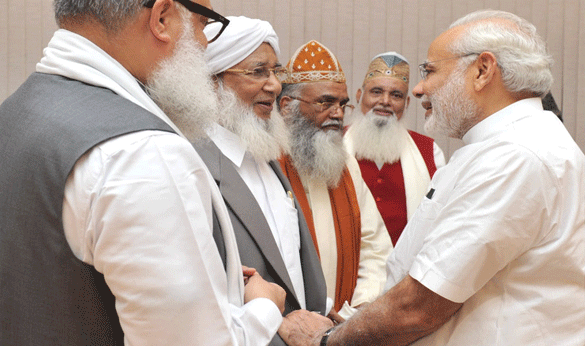
This week, Indian Muslim public space was dominated by Kerala’s Sunni Leader Kanthapuram AP Abubakr Musliyar visiting prime minister Narendra Modi. The discussions on the political and religious aspects of this meet still continues. While detractors rue this meeting as sacrifice of Muslim reality in contemporary India, this meeting provides enough context to explain global Sunni leadership attitude to politics, as opposed to Islamists. While radical Islamist scholars disapprove of any politics without sovereignty, Sunni politics is totally different and practical.
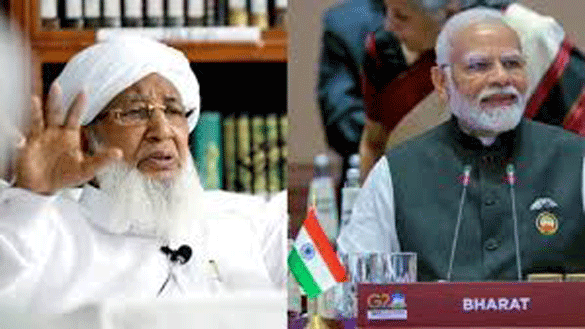
Who is Sheikh Kanthapuram
Kanthapuram AP Abubakr Musliyar leads one of the prominent Sunni factions in Kerala. Samastha Kerala Jamiyathul Ulama, led by Kanthapuram celebrates hundred years of formation next year in Kerala. His meetings with prime ministers comes against this backdrop.
In Kerala, his organization is politically relevant and keeps equi-distance with political parties while extracting maximum benefits for the community. He is stationed in opposition with Indian Union Muslim League and congress-led political front, he is not explicitly aligned with CPIM led coalition. Instead he navigates his politics with neutrality and aiming for ensuring democratic benefits reach the community.
A leader of international stature, he is said to have invited prime minister Modi to the centenary conference being held next month. Although the meeting come prior to election season in Kerala, we have our stakes in Sunni scholar’s approach to politics.
Major political attitudes of Sunni Ulama
Across the world, after decolonization, Sunni Ulama has become politically quietists, focusing on religious revival while leaving politics to rulers. They are against using religion as political tool but instead believe in politics as tool to ensure dignified lives for citizens. This trend is evident to the present day.
Al-Azhar scholars of Egypt is a classic example for this attitude. They side with rulers and ensure justice is delivered and no violation of Islamic principles are done. Famously when Napoleon conquered Egypt in 1798 and sought the support of Azhar for his regime, the response of the then chief of Islam is illuminating. Rather than declaring war against French colonialism, they engaged in correspondence asking specifically about the programs they are going to implement. When French colonialism rejected the request for financial independence, Azhar scholars issued Fatwa not to rebel but to end the conflict through talks.
In recent times, when Syria was erupted in protest against the dictator president Bashar al-Asad in 2011, Muhammad Said Ramadan Al-Bouti, Syrian Sunni leader of that time, stood against “Thawra”, calling it “fitna”(violence). He was pragmatic. He viewed the uprising as part of international politics to tear the country apart and he called for political solutions. He was assimilated in 2013 for his support of government. Still today Syria is an island of disturbance.
The major political ideas of Sunni Ulama are as follows:
Presence for stability over revolution
Unless rulers are openly hostile and ban fundamental Islamic principles, quietude is preferred. Law and order and harmony is fundamental to governance. Fitna, loosely translated as violence. Is to be abjured only in extreme cases.
This does no mean supporting the unjust, violent regime. This regime has to be opposed ideologically and morally and not through violence that brings total destruction in its wake.
Gradual reform, not Islamist politics
They believe that government is the reflection of society. This what is needed the nurturing of a society with Islamic values. This society will bring positive changes without subversion.
Moral education, family reform and spiritual purification will lead to positive changes and focus should be on internal reforms.
Accept if nation-states within Islamic ideology
Opposed to Islamists, who reject concept of nation, Sunni Ulama argue that there is no specific form of government stipulated by Islam. Any government that protects religious freedom and individual rights is compatible with Islam. Rather than structure, the performance has to be analyzed.
All these principles reject the political ideas of Islamists and try to create last peace in Islamic lands. Rather than the political structure, basic ideas of citizenship and sovereignty matter to Sunni leaders. Violence, even to establish ideal Islamic state has to be avoided, as long people are not organically demanding it. Rather than running state and implementing Islamic ideals, reforming the system through engagement is important.
These major principles follow the political ideas of classical Islamic political philosophy of staying away from anarchy. Modern Sunni politics is the continuation of this classical understanding.
Conclusion: in Indian context
The scholar had to face severe backlash against the meeting within the community. The criticism targeted his comments saying Muslims are safe in India. His engagement with the government has to be understood in wider Sunni attitude to politics.
Indian constitution and system still offers much freedom and rights for all including Muslims. Muslims are free to follow their faith and practice it subject to general public law and order.
This is not to say everything is completely alright. As we all know there are sometimes violations of this cardinal principle. We have to understand these are violations and not the norms.The country’s law still protects Muslim citizens. And in case violation, there are avenues to redeem injustice.
Sunni political ideas demand constant political engagement through constructive activism, not alienation. Rather than dreaming foolproof Islamic state, it asks to ensure justice and freedom is achieved at optimal levels.
…
New Age Islam, Islam Online, Islamic Website, African Muslim News, Arab World News, South Asia News, Indian Muslim News, World Muslim News, Women in Islam, Islamic Feminism, Arab Women, Women In Arab, Islamophobia in America, Muslim Women in West, Islam Women and Feminism