
The Manufactured Schism: Wahhabism, Sectarian Politics, and the Struggle for Islamic Leadership

By Mushtaq Ul Haq Ahmad Sikander, New Age Islam
01 April 2026
The sectarian divisions in the Muslim world are politically manufactured to preserve power, weaken unity, and divert attention from oppression and imperial domination.
Main points:
· The attack over Iran has exposed both Muslim solidarity and renewed sectarian propaganda.
· It criticizes Saudi-backed Wahhabi, Madkhali, and Ahli Hadith groups for portraying Shias as outside Islam.
· It presents the Saudi-Iran rivalry as a struggle over Islamic leadership and ideological influence.
· The sectarian narratives are used to distract Muslims from real issues like occupation, tyranny, and foreign intervention.
· The true unity in the Muslim world must be based on justice, compassion, and rejection of sectarian exclusion.
The imposed war on Iran, while ostensibly a geopolitical conflict, has exposed deeper theological fissures within the Muslim world. On one hand, it has momentarily brought Sunni and Shia masses together in shared outrage against aggression and martyrdom; on the other, it has revitalized old sectarian narratives, especially those orchestrated by Saudi-sponsored Wahhabi and Madkhali elements. These groups, nurtured within a narrow theological framework and politically aligned with the House of Saud, have launched insidious campaigns to vilify Iran by resurrecting derogatory labels like Rafidi, a term meant to brand Shia Muslims as heretics who have, according to their distorted logic, consistently betrayed the cause of Islam—meaning Sunni Islam as they narrowly define it.
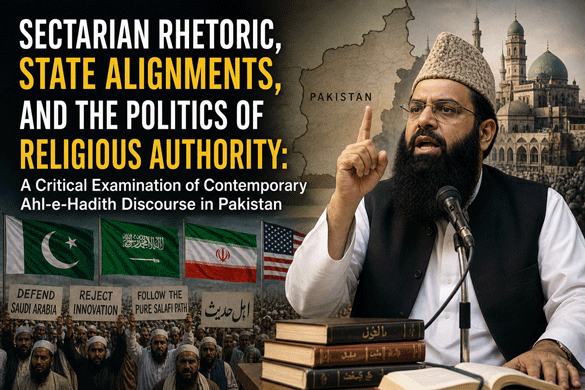
In the wake of the assassination and martyrdom of Iran’s Supreme Leader, Ayatollah Syed Ali Khamenei, and others in the ongoing conflict, the global Muslim community has largely expressed condemnation and grief. The tragedy was perceived not merely as an attack on a nation, but as an assault on a major Muslim leadership that has long resisted hegemonic interventions. Yet conspicuously silent have been the adherents of the Ahli Hadith movement, a sectarian current backed by Saudi ideological and financial resources. Their silence is not born of ignorance or neutrality but of deliberate exclusion, they do not consider Shias to be truly Muslim. However, political constraints prevent them from declaring this openly, given Saudi Arabia’s official tolerance of Shias within the framework of Islamic unity, particularly for the annual Hajj.
Instead, these sectarian preachers and their social media extensions engage in doublespeak. On public platforms, they maintain a veneer of orthodoxy and unity; on anonymous digital accounts, they spew hate, labeling the Iranian defenders as Rawafid and portraying resistance as hostility towards Islam. Cloaked in religious rhetoric, they attempt to legitimize violence by presenting it as a purification of faith, an ironic inversion in which killing fellow Muslims is seen as a service to Islam. Their hypocrisy deepens when one recalls that the same scholars who accuse Shias of taqiyyah (religious dissimulation) are themselves its most ardent practitioners, concealing their sectarian malice under the guise of piety and unity.
The roots of this hypocrisy lie in the enduring rivalry between Saudi Arabia and Iran for the mantle of Islamic leadership. Since the emergence of modern nation-states in the Muslim world, this mantle has been hotly contested but rarely responsibly borne. For the Saudis, legitimacy is derived from their custodianship of Islam’s two holiest mosques—a sacred title used not simply as spiritual stewardship but as a political instrument. The Saudi monarchy seeks to define orthodoxy according to the Wahhabi interpretation, thereby ensuring its dominance over the global Muslim narrative. Conversely, after the 1979 Islamic Revolution, Iran redefined its governance as a sacred trust anchored in resistance to tyranny, self-reliance, and justice. The revolution electrified Muslim masses across regions—Sunni and Shia alike—and threatened the autocracies of the Middle East. For monarchies that depended on Western backing, Iran’s example was combustible.
Thus, the Baathist assault on post-revolutionary Iran, led by Saddam Hussein but sustained by vast external support, was no accident. It was a coordinated attempt to choke this revolutionary fervor before it spread beyond Iran’s borders. The United States, locked in Cold War rivalries, and regional monarchs saw in Saddam a convenient enforcer. The war that ensued was not simply Iraq versus Iran—it was the world’s elite versus a newly awakened Islamic consciousness. By painting Iran’s revolution as a sectarian (Shia) phenomenon rather than a pan-Islamic movement, they sought to contain it within theological boundaries and deny it global appeal. This sectarian framing was crucial to the West’s “divide and rule” strategy and was eagerly adopted by Saudi Arabia’s religious establishment.
In this climate, Wahhabi-oriented clerics assumed a central role in shaping narratives. They tirelessly worked to associate Iran with historical deviations, accusing its leaders of betrayal towards Islam since the earliest days of the Caliphate. Such rhetoric was not new; it had lain dormant in polemical literature but was now rejuvenated as an instrument of political warfare. The Ahli Hadith networks, inspired by the Wahhabi creed, became Saudi Arabia’s ideological export. Under the pretext of purifying Islam from innovation and idolatry, they advanced a form of exclusivism that divided the community along theological lines. While the Saudi monarchy maintained formal diplomatic restraint, these proxies did what the regime could not: they demonized and alienated Iran in the hearts and minds of ordinary believers.
The desire for Islamic leadership has never lacked claimants. In the postcolonial era, each power sought to dress its ambitions in religious legitimacy. Pakistan, for instance, emerged in 1947 as an ostensibly Islamic state, though it was crafted by secular elites. Its founding figure, Muhammad Ali Jinnah, envisioned a homeland for Muslims, not necessarily a theocracy. Yet, the ideological vacuum that followed independence allowed successive regimes to claim an Islamic mission. Pakistan’s early attempts to act as a vanguard of the Muslim world provoked ridicule, as seen in the sarcastic quip from Egypt’s King Faruq that “Islam was born in 1947.” Through its role in the Organization of Islamic Cooperation (OIC), Pakistan sought to consolidate its claim, but its entanglement in the Kashmir conflict and later in the Afghan jihad under American patronage left it weakened and dependent. Fighting the very radicals it had helped create during the Cold War, Pakistan today struggles to articulate a coherent Islamic vision beyond its borders.
Iran, in contrast, invested in self-reliance, intellectual revival, and strategic patience. Despite the suffocating sanctions and isolation campaigns, it nurtured a model of resistance that appealed not just to Shias but to all oppressed groups in the region. This independence alarms the Saudis, whose political and military strength, though lavishly funded, remains brittle and dependent on external powers. Unable to confront Iran directly, Saudi Arabia channels its aggression through ideological surrogates—the Ahli Hadith movements and their global offshoots. Their mission is simple: dilute Muslim unity by portraying Iran as an existential enemy, a heretical entity masquerading as Islamic.
This narrative manipulation is sustained through systematic disinformation campaigns. Online armies of pseudo-scholars and anonymous propagandists issue fatwas of exclusion, twist Quranic verses, and vilify anyone sympathizing with Iran’s cause. By calling Shias Rawafid, they seek to erase centuries of coexistence and theological diversity that enriched Islamic civilization. The underlying objective is to redirect Muslim frustration away from imperial domination and internal corruption towards an imagined sectarian adversary. The pattern is familiar: every time a Muslim country resists Western exploitation, Wahhabi spokesmen emerge to declare its leaders deviants or apostates. Thus, the spiritual front of Islam becomes a battlefield where truth is obscured by propaganda masquerading as orthodoxy.
It is noteworthy that Saudi-backed clerics rarely, if ever, challenge the complicity of their rulers in alliances with Western powers that occupy Muslim lands and exploit Islamic resources. Their selectivity is revealing; while they weep over doctrinal purity, they remain silent on justice and oppression. No Wahhabi preacher of repute dared condemn the devastating wars in Yemen or Gaza in unequivocal terms. Their loyalty lies not with the ummah but with the Saudi throne, which bankrolls their institutions and publications. The hypocrisy reaches surreal levels when these preachers accuse others of hypocrisy. They lament taqiyyah among Shias while themselves practicing it under a polished religious mask, serving political masters for worldly gain.
The idea that Wahhabism represents the “real Islam” is itself a historical fallacy. Emerging in the 18th century in alliance with the House of Saud, Wahhabism was less a spiritual awakening than a political compact. Its founder, Muhammad ibn Abd al-Wahhab, provided religious legitimacy to the ambitions of local rulers who sought to consolidate territory under the banner of tawhid. The puritanical tone of his message had appeal, but its implementation led to persecution and demolition of centuries-old Islamic heritage. What was once an internal reform movement mutated into an ideology of exclusion, later magnified by oil wealth and Western endorsement. Today, its global machinery thrives on divisive literature, satellite preaching, and well-funded mosque networks—all geared towards moulding a pliant religious conscience that aligns with Saudi strategic interests.
The result is a fragmented Muslim world. While the injustices against Muslims in Palestine or Yemen cry out for solidarity, sectarian preachers redirect attention to doctrinal disputes. This perpetual distraction serves imperial interests well. It prevents the formation of a united political consciousness that could challenge both internal despotism and external domination. Historically, Islam’s greatest strength lay in its pluralism, in the coexistence of diverse schools, from Hanafi jurists to Jafari theologians, from Sufi mystics to philosophers. Reducing this civilizational mosaic to a single interpretation is intellectual violence; enforcing it through state power is political tyranny.
The ongoing war on Iran thus becomes a microcosm of a larger struggle within Islam—between those who seek unity through justice and those who preserve division through dogma. The martyrdom of leaders like Syed Ali Khamenei, regardless of sectarian identity, represents a moral resistance against the forces that exploit religion for power. The grief expressed across much of the Muslim world reflects a yearning for authenticity, a desire for leadership that stands for dignity rather than dominance. Yet, amidst this collective empathy, the silence of Ahli Hadith circles is deafening, exposing the limits of an ideology that equates righteousness with allegiance to rulers.
The hypocrisy of Wahhabism lies not only in its actions but in its theological claim to possess the exclusive truth of Islam. Such a claim usurps a divine prerogative, deciding who is a believer and who is a disbeliever. The Qur’an itself warns against this arrogance, leaving judgment solely to God. But official Wahhabism has long appropriated this divine authority to serve political ends. Its clerics perform intellectual gymnastics to justify alliances with imperialists while denouncing fellow Muslims as enemies. Their mission, since inception, has been to ridicule, demean, divide, and decimate Muslim unity in the name of purity. They remain ever loyal to their paymasters, executing with precision the task of diverting Muslim minds from real injustices—economic exploitation, occupation, and despotism, towards fruitless debates on doctrinal identity.
If history offers any lesson, it is that imposed unity through coercion cannot endure, but unity born of justice and humility can. The Wahhabi strategy of exclusion might still command wealth and media, but it cannot command hearts. Across the Muslim world, the silent majority recognizes that the enemy is not Shia or Sunni, but tyranny itself, whether it wears the mask of monarchy, dictatorship, or empire. The survival of the ummah depends not on uniformity but on compassion, not on slogans but on moral conviction. To reclaim that spirit is the true challenge of our time, and in meeting it, Muslims must rise above the poisonous sectarianism bred by those who mistake power for piety.
M. H. A. Sikander is Writer-Activist based in Srinagar, Kashmir.
…
New Age Islam, Islam Online, Islamic Website, African Muslim News, Arab World News, South Asia News, Indian Muslim News, World Muslim News, Women in Islam, Islamic Feminism, Arab Women, Women In Arab, Islamophobia in America, Muslim Women in West, Islam Women and Feminism