
Pakistan Administered Kashmir: Evolution of a Crisis

By Mushtaq Ul Haq Ahmad Sikander, New Age Islam
13 June 2026
A political and historical crisis shaped by contested representation, migrant seats, economic hardship, and growing public anger in Pakistan-administered Kashmir.
Main Points:
· It argues that today’s unrest in Pakistan-administered Kashmir is rooted in the unresolved political legacy of partition and incomplete self-determination.
· It explains how early tensions between local leaders and migrant political groups created lasting problems of representation and legitimacy.
· It shows how recent protests over electricity bills, wheat, subsidies, and administrative neglect have expanded into demands for deeper political change.
· It emphasizes that the issue of reserved migrant seats, state repression, and limited local authority has turned the crisis into a broader question of who has the right to govern.
…
Pakistan administered Kashmir (PaK) stands today at a dangerous historical crossroads. What appears on the surface as a wave of protest over subsidies, legislative seats, and administrative neglect is in fact the latest expression of a much older crisis: the crisis of unresolved political identity, incomplete representation, and a state structure that has long promised autonomy while practicing control. The turmoil in the region is therefore not an isolated disturbance. It is the visible symptom of a political order that has carried its contradictions for decades and is now struggling to contain them.
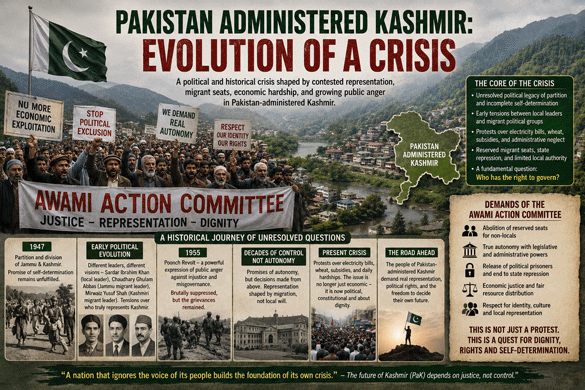
To understand this crisis properly, one must begin with the partition of the Indian subcontinent and the division of the princely state of Jammu and Kashmir. That partition did not settle the destiny of the region. Instead, it produced a prolonged dispute, grounded in the promise that the people would one day be allowed to determine their political future. Yet that promise, while powerful in theory, was never translated into a stable and democratic settlement. The territory that came under Pakistan’s control was organized in a way that preserved strategic interests, historical claims, and political ambiguity, but not genuine popular sovereignty. From that moment onward, Pakistan administered Kashmir became a place where statehood was incomplete, representation was contested, and political legitimacy remained fragile.
The early political evolution of the region was shaped by competing groups and rival claims to authority. There were local inhabitants led by Sardar Ibrahim Khan, a prominent figure in the region’s political beginnings. There were also Jammu migrants led by Chaudhary Ghulam Abbas, who served as president of the Muslim Conference and represented an influential migrant political current. Alongside them stood Mirwaiz Yusuf Shah, who spoke for Kashmiri-speaking migrants from the Kashmir Valley. These were not merely different personalities; they embodied different historical experiences, different political interests, and different visions of who should speak for Kashmir. The result was inevitable tension, particularly between migrant groups and local inhabitants, each of whom believed that it had a rightful claim over the political destiny of the region.
This early tension is important because it reveals a structural fault line that continues to shape the present. Pakistan administered Kashmir was never allowed to evolve into a political order in which local voices could alone define the future. Instead, it became a space where exile, migration, and external political calculations were built into the very structure of representation. Liaqat Ali Khan’s support for Chaudhary Ghulam Abbas strengthened the position of migrant leadership, but it also deepened the sense among local inhabitants that the region’s political institutions were being shaped from above rather than from within. This pattern created resentment, and resentment, once institutionalized, becomes a lasting political force.
The Poonch revolt of 1955 remains one of the clearest early signs that the crisis of legitimacy was not merely rhetorical. It was a rebellion born out of frustration, and its brutal suppression demonstrated how the state responded when political impatience turned into collective resistance. Such episodes should not be treated as minor historical footnotes. They are part of the political memory of the region. They show that public anger in Pakistan administered Kashmir has a long genealogy and that coercive responses have never erased the grievances that produced it. They merely postpone them.
The present crisis must therefore be read as a continuation of this history, not as a sudden rupture. The immediate spark of the current unrest lies in economic and administrative grievances. People have protested against inflated electricity bills, poor access to basic necessities, and the perception that the state extracts more from them than it gives in return. But these grievances are only the surface layer of a deeper discontent. Beneath them lies a widespread belief that the political structure itself is unjust. The state may offer subsidies, but it cannot buy legitimacy if people feel excluded from real power.
This is why the agitation led by the Jammu Kashmir Awami Action Committee (JKAAC) has gained such force. The movement has drawn energy from everyday suffering, but it has also transformed that suffering into a constitutional and political critique. In October 2025, negotiations between the committee and the government produced concessions on electricity and wheat subsidies. Instead of ending the agitation, however, those concessions encouraged the movement to widen its demands. That development was predictable. Once people realize that protest can extract results, they begin to question the entire structure that made the protest necessary in the first place.
The committee’s demands have therefore become much broader than a struggle for lower prices. They include the abolition of the twelve reserved seats for Kashmiri migrants in the Legislative Assembly, the ending of special quotas in jobs and education, and the establishment of an airport. These demands may appear separate, but they are connected by a single logic: the demand for a political order that reflects the people who live in the territory rather than those who claim authority over it from outside. In that sense, the movement has shifted from reform to redistribution of political power. It is no longer asking simply for relief. It is asking who has the right to govern.
The issue of the twelve reserved seats has become the most volatile point of the crisis. The arrangement reserves six seats each for Jammu migrants and Kashmiri migrants, and this structure has long been defended as a historical necessity. Yet many people in the region now see it as an obstacle to genuine representation. Their argument is straightforward: if a legislative assembly is meant to represent the residents of a territory, then why should a significant bloc of seats be reserved for people living outside it? From their perspective, the arrangement keeps the region politically tethered to historical displacement rather than present citizenship.
This is why the demand for abolition has acquired such intensity. It is not merely a fight over numbers in an assembly. It is a challenge to the logic of the political system itself. Reserved migrant seats symbolize the enduring influence of exile in the region’s constitutional framework. They reflect the idea that the history of displacement should continue to shape present governance. For many protestors, however, this no longer seems democratic. It seems like an inherited mechanism through which outside interests continue to exercise influence over the territory. The legal and moral dispute surrounding these seats has therefore become central to the crisis.
The government’s position has been complicated by the fact that the issue is not easy to resolve politically. The Pakistan Peoples Party government in AJK, including Prime Minister Faisal Mumtaz Rathore, has shown signs of willingness to engage with protestors and address some of their demands. But the broader state in Pakistan does not appear equally willing to loosen its grip on the existing arrangement. That tension between the local government and the central establishment lies at the heart of the current stalemate. The AJK administration may want accommodation, but it does not possess the full authority to deliver it. The result is paralysis, and paralysis in a crisis only deepens public anger.
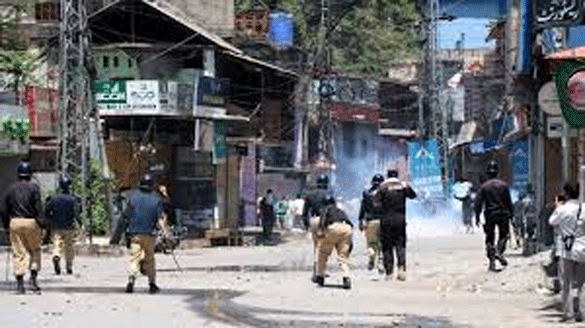
The security response has made matters worse. Rather than treating the agitation as a political warning, the state has treated it as a threat to be contained. The banning of the Awami Action Committee, the naming of its leaders as fugitives, and the deployment of harsh measures against protestors have all intensified the sense of humiliation. When the state tries to criminalize mass anger, it does not extinguish that anger. It radicalizes it. The deaths of protestors, the crackdowns, and the atmosphere of fear all reinforce the belief that the state is more interested in asserting dominance than listening to grievances.
This is what gives the crisis its dangerous moral edge. The crowds are not merely demanding economic relief. They are increasingly expressing hostility toward Pakistan itself. That does not emerge from nowhere. It is the product of long frustration, repeated disappointment, and the experience of being governed through force rather than consent. Once that emotional break occurs, restoring trust becomes extremely difficult. The wall between Pakistan and Pakistan administered Kashmir grows stronger because each act of repression confirms the public’s worst suspicions.
The tragedy of the present moment is that the region is repeating patterns it has never fully escaped. The older leaderships that once spoke in the name of Kashmiri liberation were themselves marked by division. Local leadership, migrant leadership, and refugee politics all entered the constitutional fabric of the region and helped create a structure in which no single group could claim to represent the whole without dispute. That ambiguity may have served political manoeuvring in the past, but it is now becoming a source of instability. People want clarity, not inherited confusion.
The historical reflection attributed to Mirwaiz Yusuf Shah is relevant here because it captures the psychological reversal now unfolding. Mirwaiz Yusuf Shah used to tell Kashmiris, that if Plebiscite happens in J&K, the Pak people will opt for India and Indian Administered Kashmir (IAK) will opt for Pakistan, because we have experienced Pakistan and they have experienced India.
The idea that Kashmiris on each side of the divide might eventually support the other side because they have experienced the other’s rule is not a simple prediction. It is a political warning. It suggests that lived experience can reshape allegiance more forcefully than ideology. If people come to feel that Pakistan has failed them, then the old emotional certainties begin to weaken. And once that happens, the state can no longer depend on symbolic appeals alone.
The present unrest therefore reveals a profound contradiction at the heart of Pakistan’s Kashmir policy. On the one hand, the region is presented as politically special, historically important, and morally central to Pakistan’s national narrative. On the other hand, its people are often denied full self-determination in practice. This contradiction weakens every institution in the territory. The assembly appears representative, but not fully sovereign. The government appears local, but not fully empowered. The law appears protective, but not fully responsive. Such a political arrangement may survive for years, but it cannot produce durable peace.
What makes the present crisis especially serious is that it combines old grievances with new expectations. Earlier generations may have tolerated structural ambiguity in the hope that history would eventually resolve it. The current generation is less willing to wait. It sees economic hardship directly, organizes rapidly, and demands change with greater confidence. That shift matters. It means that what was once a problem of elite political negotiation has become a public question of justice and dignity. The streets are now asking what the institutions have long avoided answering.
The people of Pakistan administered Kashmir are therefore confronting a future that feels increasingly uncertain. Those who migrated there in hope of refuge now face insecurity. Those who believed that the region could stand as a symbol of political freedom now see its institutions harden into instruments of control. Those who trusted that concessions would build confidence now watch those same concessions become the starting point for new demands. This is the irony of unmanaged crisis: every attempt at partial relief only reveals the breadth of the underlying problem.
The current state of affairs should not be understood as a temporary flare-up around a few technical disputes. It is a structural crisis of representation, historical memory, and political legitimacy. The demands for the abolition of migrant seats, the establishment of an airport, the reduction of economic burdens, and the ending of quotas are all linked by a deeper desire: to recover a sense of agency. People want to believe that the territory belongs to those who live in it, suffer in it, and build their lives in it. That is the real issue beneath the slogans and the barricades.
Pakistan administered Kashmir is now paying the price for a political model that delayed resolution and normalized contradiction. The region cannot be governed forever through inherited formulas, symbolic loyalty, and selective concessions. If its people are to regain confidence in the political order, they will need more than subsidies or administrative promises. They will need a structure that recognizes them not as passive recipients of policy, but as the true authors of their own future.
The crisis is therefore not merely about unrest. It is about the limits of a political system that has too long postponed the question of genuine representation. It is about the failure to transform historical promises into present rights. And it is about the growing realization among the people that no state can indefinitely govern a population that no longer believes in the legitimacy of its rule. The crisis also informs us that Kashmiris who were exiled, forced to migrate or willingly went to AJK, in the hope of it being a refuge for them, are now looking at bleak futures.
…
M. H. A. Sikander is Writer-Activist based in Srinagar, Kashmir.
URL: https://newageislam.com/islam-politics/pakistan-administered-kashmir-crisis/d/140370
New Age Islam, Islam Online, Islamic Website, African Muslim News, Arab World News, South Asia News, Indian Muslim News, World Muslim News, Women in Islam, Islamic Feminism, Arab Women, Women In Arab, Islamophobia in America, Muslim Women in West, Islam Women and Feminism