
Nasibi Hypocrisy and The Assassination of Imam Ali Khamenei: A Mirror of Muslim Moral Decay

By Mushtaq Ul Haq Ahmad Sikander, New Age Islam
06 March 2026
Imam Khamenei’s Assassination: Nasibi Sectarian Glee, Western Hypocrisy, and the Struggle to Rescue Muslim Politics from Moral Decay and Restore Unity through Resistance, Justice, and the Legacy of Karbala
Main Points:
· Nasibi celebration of Imam Khamenei’s killing is a disgraceful symptom of sectarian hatred and spiritual corruption within parts of the Sunni world.
· Western liberal and human-rights discourse is exposed as selectively moral, loud on Iranian “oppression” yet silent on U.S.–Israeli massacres and sanctions.
· Imam Khamenei is a unifying, Palestine-focused leader whose stance on companions and Ahl al‑Bayt refutes sectarian accusations against him.
· The real Muslim divide is between truth and power, urging a revival of courageous, justice‑centred Islamic resistance beyond sect label.
…
The tragic assassination of Imam Ali Khamenei, along with his family, marks one of the darkest episodes in recent Muslim history. It is not merely the killing of a political leader; it is the elimination of a symbol of resistance, dignity, and steadfast faith in an age consumed by treachery and hypocrisy. Yet more shocking than the act itself is the unholy spectacle that followed—the open celebration of his murder by certain so-called Nasibi Sunnis, the same groups that for decades have turned their religious identity into a political tool aligned with the interests of imperial powers. As Iran mourns the loss of its supreme leader, a section of the Muslim world, instead of grieving, rejoices. The moral decay that allows one to celebrate the blood of a Muslim leader rather than condemn the crime reflects a profound sickness in parts of the ummah today.
Equally disturbing is the choking silence of those who parade themselves as champions of human rights, women’s liberation, and peace. The same self-proclaimed liberals and feminists who fill the airwaves when a celebrity faces online trolling, or when hijab-wearing women are demonized in Europe, have now turned invisible. When the United States and Israel bombed a girls’ school in Iran, killing more than 160 innocent children, these voices suddenly lost their passion for justice. They reserved no outrage, no candlelight vigils, no hashtags. But when women in Iran remove their scarves, every Western-funded NGO celebrates it as the dawn of liberation. The duplicity is transparent. The selective empathy of the liberal elite is guided not by humanity but by the interests of empire. Condemn the victims of American aggression, and your career is over; criticize Israel, and you’re labelled antisemitic. On the other hand, ridicule the leaders of resistance in the Muslim world, and you’re promoted, invited to television studios, given grants, and perhaps even nominated for a Nobel Peace Prize.
Where are voices like Malala Yousafzai, who claim to speak for oppressed women and children? Why does her moral conscience desert her when bombs funded by U.S. taxpayers turn Iranian and Palestinian girls into corpses? Her silence is not neutrality—it is complicity. Condemning the U.S. and its European allies does not fetch NGO awards or Western invitations; it isolates you. Therefore, silence becomes a career choice. The hypocrisy of U.S. and European moral posturing is not new. It has been rehearsed and perfected since the Second World War. Behind every war for “freedom,” the West has hidden imperial ambition. From Iraq 2003 to Libya, from Afghanistan to Syria, every aggression has been baptized in the language of democracy and human rights. The world was told Saddam had weapons of mass destruction—there were none. Gaddafi was supposedly a tyrant—the country collapsed into chaos after his assassination. Now they repeat the same story with Iran. The Western media paints Iran as an oppressive theocracy while hiding the truth that the same powers have armed Saudi Arabia, the United Arab Emirates, and Israel to conduct wars that have starved and bombed millions in Yemen and Gaza. Imam Khamenei’s Iran stood as the last fortress of defiance against this unholy alliance—and that alone made him a target.
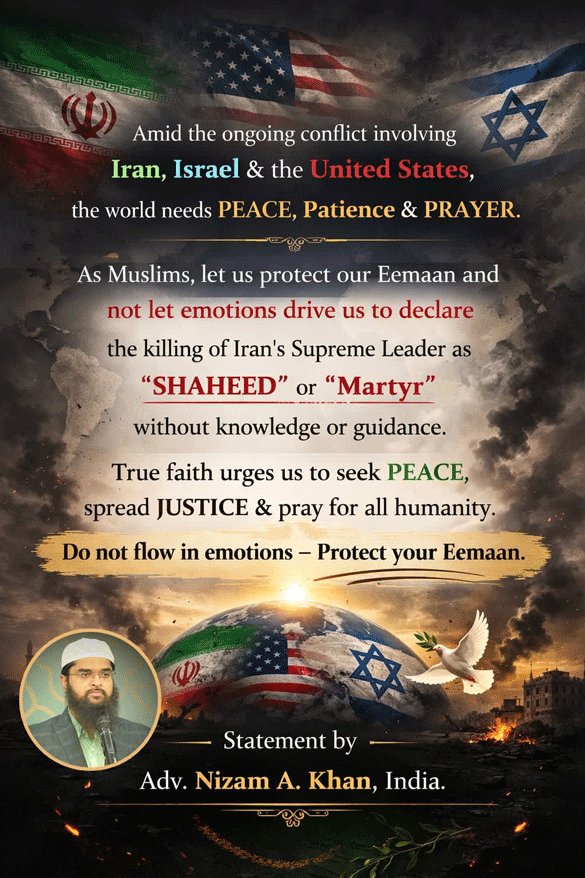
That Imam Khamenei was assassinated is a tragedy, some Muslims who publicly celebrate it is a disgrace. The jubilation of Nasibis, Madhkhalis, and the Wahhabi clergy over his death exposes their inner corruption. These are not ordinary believers misled by propaganda; these are ideological agents whose loyalty lies not with Islam but with the Family of Saud—the kingdom that has long bartered away Islamic honour for American protection. When a few clerics and social media preachers claim that Imam Khamenei cannot be called a shaheed because he insulted the Prophet’s companions or wives, their argument collapses instantly when examined. There exists not a single authentic record, speech, writing, or statement where Khamenei disrespected any companion or the Prophet’s noble wives. On the contrary, he explicitly condemned anyone who curses the first three Caliphs or Aisha (RA), declaring such acts un-Islamic and contrary to Shia belief. Imam Khamenei’s official stance was crystal clear: those who insult revered figures of Islam are not true followers of Ahl al-Bayt. Yet Nasibis spread lies. They take isolated misdeeds of fringe groups, brand all Shias as Rafidis, and then use this to rationalize their hatred for the entire Shia community. Their hypocrisy mirrors the Rafidis they despise—those who curse the revered caliphs. Both groups are two sides of the same coin: extremists blinded by sectarian hatred, divorced from the Qur’an’s command to maintain brotherhood within the ummah.
To understand the psychological roots of Nasibi behaviour, we must revisit early Islamic history. The institutionalization of cursing Imam Ali (AS) and his descendants did not begin accidentally, it was a state policy formalized under Muawiya ibn Abu Sufyan. Every Friday sermon across the expanding empire was ordered to include insults against the cousin and son-in-law of the Prophet (pbuh). This marked the birth of political Islamagen—where the power of the state rewrote religious virtue. Muawiya’s motives were clear: consolidating dynastic power by demonizing those who opposed tyranny. The Umayyad regime’s propaganda machine went so far as to fabricate hadiths in his favour, painting Ali (AS) as divisive and Muawiya as the Prophet’s loyal companion. The tragedy of Karbala was but a culmination of this distortion, a political rivalry wrapped in pious justification. Ironically, the very same mentality thrives today in Saudi-funded seminaries and pulpits. The salaried religious class of Riyadh continues Muawiya’s tradition of vilifying the true heirs of Islamic resistance. When they lack leaders of moral stature, they resort to doctrinal accusation. If you cannot be a hero, vilify the hero, that is their creed.
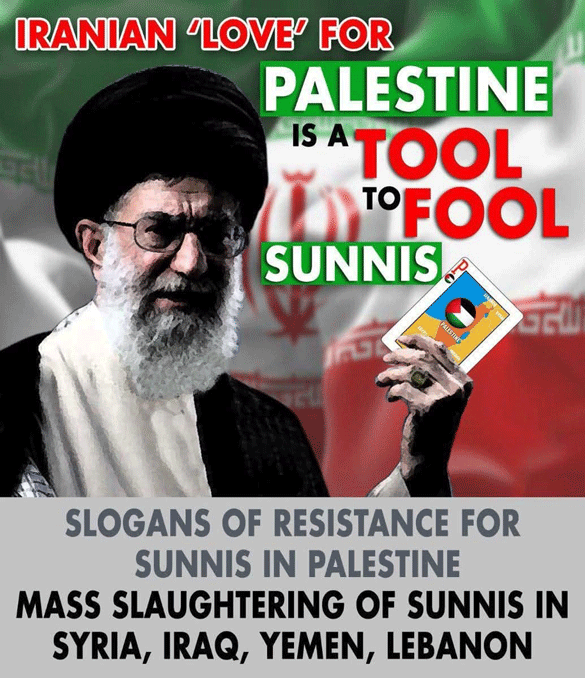
It is undeniable that Iran has its political faults. The Alawite regime in Syria, for instance, committed grave crimes against Sunni populations during its civil war. Those were acts of political brutality, not theological vengeance. Yet Western-funded commentators turn such complexities into simple headlines—“Shias kill Sunnis.” This erases the reality that Sunnis themselves are killing Sunnis across Muslim lands: in Egypt’s prisons, Pakistan’s mosques, Afghanistan’s markets, and even in Libya’s deserts. Sectarian blame becomes a convenient shield against introspection. Those who accuse Iran of hypocrisy for supporting Palestine while being involved in Syria ignore the larger truth—Iran, despite all its contradictions, remains the only major Muslim state that has consistently supported the Palestinian cause materially and diplomatically, while Arab monarchies normalize with Israel. Saudi Arabia, custodian of the two holy mosques, opened its airspace and intelligence networks to Tel Aviv, all while preaching unity in Islam. The comparison speaks for itself.
Every global moral discourse today is filtered through Western selective morality. A leader’s worth is not measured by his service to the oppressed but by his compliance with Washington’s moral script. Khamenei’s crime was not in ideology but in independence. He challenged U.S. supremacy, stood with Palestine, armed resistance groups, and refused to privatize his nation’s resources. Therefore, he had to be demonized, his image recast as a tyrant, his death dismissed as deserved. Those Muslims who echo the Western line—claiming that resistance is extremism—have internalized the colonizer’s vocabulary. Their condemnation of all forms of violence sounds noble until you notice they never condemn the structural violence of sanctions, starvation, and military occupation. Their calls for peace are empty when peace means only the survival of Western interests.
The deliberate division of Muslims into neat sectarian boxes, Sunni, Shia, Wahhabi, Deobandi, Barelvi, etc. is the oldest colonial strategy still in use. From the British Empire’s policy of divide and rule to the CIA’s modern psychological operations, the objective has remained consistent, a fractured Muslim world is easier to dominate and exploit. The agents of this division have simply changed costumes. Where once there were colonial governors, now there are clerics on payrolls, influencers with petrodollar sponsorships, and media personalities echoing Riyadh’s propaganda. They preach a purified Islam that conveniently omits justice, courage, and defiance, the very traits symbolized by Imam Ali (AS) and Imam Husayn (AS). Imam Khamenei, in his life and teachings, revitalized those traits in the 21st century. His leadership turned Iran into a voice for the voiceless from Yemen to Gaza. He dared to define Islam as a revolutionary moral project, not a pacified ritual system. That challenge was intolerable to both Washington and Riyadh alike.
One of the greatest tragedies of the modern Muslim condition is the outsourcing of theology to state paid clerics. Across the Muslim world, seminaries and fatwa councils are compromised. Religious discourse is shaped not by sincerity but by political loyalty. Every palace has its mufti, every regime its chaplain. Such muftis have long abandoned the prophetic duty of speaking truth to power. Instead, they manufacture religious verdicts that justify state violence and suppress dissent. In this corrupt architecture, truth becomes subservient to survival. A system that blesses kings while silencing scholars cannot represent Islam, but it dominates much of our religious space today. The Nasibis celebrating Imam Khamenei’s death are the natural outcome of this decay. Their spirituality is reduced to sectarian identity; their religion is performative orthodoxy devoid of moral substance. They mistake Riyadh’s wealth for divine approval and Iran’s martyrdom for divine wrath. But as history proves, the Quranic criterion of victory lies not in material power but in perseverance for justice.
Islam was never meant to be a sectarian project. The Prophet Muhammad (pbuh) did not leave behind Sunni or Shia, but a single ummah bound by justice, compassion, and remembrance of God. It was politics dynastic and colonial that splintered this unity. Ironically, many of those who shout “unity of Muslims” today are the same who abuse its symbols by dividing believers into “true” and “false” Muslims. To condemn Imam Khamenei or to doubt his martyrdom because he belonged to the Shia school is to insult the universality of Islam itself. Leadership and sacrifice in defence of the ummah transcend sect. The same Quranic command that honours the companions also enjoins believers to stand against injustice. Khamenei’s defence of Palestine, his defiance against American hegemony, and his moral restraint toward internal dissent all reflect that Quranic ethos.
The Saudi regime and its ideological extensions—Madhkhalis, Wahhabis, and other loyalist groups thrive on delegitimizing any Islamic leadership beyond their own orbit. They have made obedience to rulers a theological dogma, no matter how oppressive those rulers are. Their funding networks and madrassah systems exist to sanitize tyranny under the name of piety. Every time a Muslim nation stands for independence or resistance, these clerics rush to label it as deviation. In doing so, they serve as soft power tools for Western imperial strategy, sterilizing Islam’s revolutionary energy. The present celebration of Imam Khamenei’s death among these circles is thus not a spontaneous reaction, it is part of a long pattern of manufactured consent inside the Muslim world.
Digital propaganda has replaced old colonial reports, but its effect is the same. The rise of social media has not democratized truth it has industrialized lies. Paid influencers masquerading as preachers spread half-facts and doctored videos to turn impressionable Muslims against one another. A so-called page “Shia-ism is Not Islam,” which called Khamenei “a butcher of the people,” is one among thousands engineered to create distrust and resentment. The irony is bitter, these propagandists call others tools of the Dajjal while they themselves perform the Dajjalic function of spreading deceit. Their hate mongering ensures that Muslims never unite against the real enemy the global system of exploitation and occupation.
Whether Imam Khamenei is called shaheed or not is irrelevant to his spiritual legacy. Martyrdom in Islam is not certified by Nasibi fatwas; it is earned by the purity of intention and sacrifice in the cause of Allah. The Qur’an reminds us: “Do not say of those who are slain in the way of Allah that they are dead; they are alive, but you perceive not.” By that divine measure, Khamenei lives if not in body, then in the continuing spirit of resistance he inspired. Across the Middle East and beyond, millions mourn him not as a political leader but as a spiritual symbol. His life embodied the Quranic struggle to enjoin good and forbid wrong, even at the cost of worldly comfort. That is the measure of leadership Muslims must reclaim.
For the Muslim world to heal, it must reclaim its intellectual independence first. Both Western liberalism and sectarian dogmatism have transformed us into mental slaves. Liberals mimic colonial narratives of progress, while Nasibi clerics echo outdated dynastic loyalties. The solution lies neither in blind modernism nor blind traditionalism, but in reviving Islam’s moral reason a balance of faith and justice. Khamenei’s life and death remind us that resistance is not merely a military act; it is an intellectual duty. To think freely, resist collectively, and speak courageously these are acts of jihad in an age that rewards silence. The Muslim who refuses to condemn tyranny be it Western or local has already surrendered his dignity.
The greatest challenge now is not external aggression but internal cowardice. The Prophet (pbuh) warned that a time would come when people would fear to speak the truth lest they lose their wealth or status. That time is here. The assassination of Imam Khamenei has exposed who stands with justice and who stands with comfort. Muslims must remember: silence in the face of oppression is complicity. To remain neutral when the oppressed bleed is to bless the oppressor by absence of protest. Whether one agrees with Iran’s political system or not, to celebrate the death of its leader is to desecrate the sanctity of Muslim blood. The Quran declares that killing a single believer unjustly is like killing all of humanity. Those Nasibis who rejoiced at the sight of blood have symbolically slaughtered their own humanity.
Muslim unity cannot be built on sectarian erasure or submission to tyrants. It can only emerge through moral clarity and shared resistance to injustice. Iran’s struggle, rooted in the legacy of Karbala, represents that moral axis. To deny it is to deny Islam’s revolutionary spirit. The real divide in the ummah is not between Sunni and Shia, but between those who serve truth and those who serve power. Every era produces its Husayn and Yazid, and every believer must decide where to stand. The Shia label is merely a vehicle; the essence is commitment to divine justice. When Imam Khamenei’s assassins pulled the trigger, they may have ended a life, but they renewed a legacy. Just as the martyrdom of Imam Husayn awakened countless souls, the death of Khamenei exposes the moral bankruptcy of those who cheered.
Imam Ali Khamenei will be remembered not as a politician but as a seer of resistance, a descendant of a moral tradition stretching from Najaf to Qom, from Karbala to Gaza. Those who deride his faith or deny his martyrdom only confirm their own distance from prophetic ethics. The dustbin of history, where corrupt rulers and their clerical sycophants are already buried, awaits their spiritual progeny. They follow the path of Muawiya, Marwan, and Yazid, but as history has shown, they will be rejected again. The face of hypocrisy changes with centuries, but its essence remains timeless—greed disguised as piety, submission disguised as faith. In this unfolding saga, truth does not die with its bearers; it reincarnates in every act of defiance, every voice that refuses silence. Imam Khamenei’s death reminds the world that resistance is immortal and that every drop of innocent blood becomes a seed for future awakening.
…
M. H. A. Sikander is Writer-Activist based in Srinagar, Kashmir.
New Age Islam, Islam Online, Islamic Website, African Muslim News, Arab World News, South Asia News, Indian Muslim News, World Muslim News, Women in Islam, Islamic Feminism, Arab Women, Women In Arab, Islamophobia in America, Muslim Women in West, Islam Women and Feminism