
The Delusion of Victory: Power, Memory, And the Making of Conflict

By Moin Qazi, New Age Islam
04 May 2026
The Illusion of Strength
The current standoff between Iran and the United States is often framed as a familiar internal struggle—hard-liners versus pragmatists within Tehran. But this interpretation misses the deeper reality. The impasse persists not because one faction is obstructing another, but because both sides believe they are negotiating from a position of strength—each convinced, in different ways, that it has already prevailed. The latest exchanges illustrate this dynamic with striking clarity. Iran proposed reopening the Strait of Hormuz—a critical artery of global energy trade—in return for the lifting of the blockade while nuclear negotiations continued. The offer was swiftly rejected, with Washington instead doubling down on pressure, insisting that sanctions would remain until Iran fully conceded to its demands. This posture was not merely rhetorical; it revealed a deeper strategic orientation—one that prioritises coercion over compromise, capitulation over calibration.
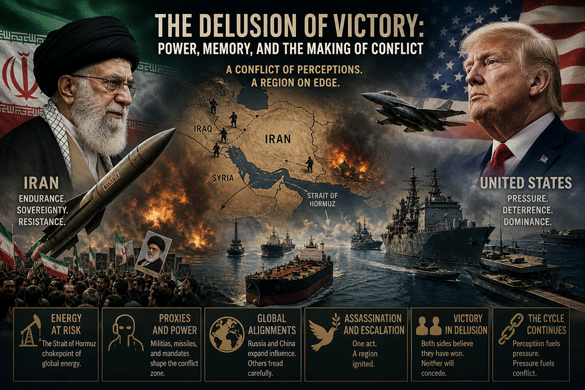
The deadlock has often been attributed to internal fractures within Iran’s leadership. It is argued that hard-liners dominate decision-making, particularly under an opaque and evolving leadership structure. This framing suggests that diplomacy is not failing at the level of interstate negotiation, but is instead being derailed from within Tehran itself. Yet this explanation, while politically convenient, risks obscuring the more fundamental reality. It externalises the failure of negotiations, shifting responsibility onto internal dysfunction within Iran, rather than confronting a deeper strategic misalignment between the two sides—one rooted not in division, but in symmetry.
In reality, Tehran’s posture reflects not fragmentation but calculation. Its leadership appears to believe that it has endured sustained economic and military pressure, preserved its core strategic capabilities, and retained sufficient leverage to negotiate without making existential concessions. Washington, for its part, operates under a parallel conviction. The sustained economic squeeze, reinforced by military positioning and diplomatic isolation, is interpreted as evidence that Iran is cornered—that time, pressure, and persistence will eventually compel submission. This mutual confidence produces not movement, but paralysis. Reports suggesting that calibrated military escalation—including targeted strikes—remains under consideration only reinforce the extent to which coercion is now treated as an extension of negotiation.
The Geography of Conflict
Yet the abstraction of “pressure” becomes tangible when viewed through the geography of the conflict zone itself. The arc stretching from the Persian Gulf—where tankers navigate the narrow Strait of Hormuz—through southern Iraq’s militia-dominated corridors, across the fractured battlegrounds of Syria, and onward to the tense littorals of the Eastern Mediterranean, has effectively become a continuous theatre of contestation. Here, proxy networks intersect with state militaries; missile ranges overlap with shipping lanes; and fragile borders dissolve into zones of influence.
Ports, pipelines, and choke points—from Basra’s terminals to Levantine coastlines—are not merely economic assets but strategic pressure points. It is within this volatile corridor that the consequences of miscalculation are most acutely felt. Energy flows are disrupted, airspaces contested, militias mobilised, and civilian populations drawn into recurring cycles of insecurity. The conflict, therefore, is no longer confined to diplomatic chambers or economic instruments; it is spatially diffused across a region where every point of friction risks ignition
Assassination and Escalation
This fragile equilibrium was violently disrupted by a singular event: the assassination of Iran’s Supreme Leader, Ayatollah Ali Khamenei. Killed in a coordinated strike, his death marked not merely the elimination of a political figure, but the rupture of a central pillar of the Iranian state. The consequences were immediate and far-reaching. Iran’s retaliatory actions reverberated across the conflict zone, targeting military and energy infrastructure and intensifying the already fragile security environment surrounding the Strait of Hormuz. What had been a tense standoff now acquired the immediacy of open confrontation.
Far from weakening Iran into submission, the assassination appears to have hardened its internal structure. Power has shifted decisively toward the military-security apparatus, particularly the Islamic Revolutionary Guard Corps, consolidating authority in actors less inclined toward compromise and more oriented toward strategic defiance. The psychological impact has been equally profound. The killing transformed an already tense geopolitical standoff into a civilisational affront, reinforcing narratives of resistance and martyrdom deeply embedded within Iran’s political consciousness. Across the Shiite world, the reaction has been one of anger and mobilisation, extending the conflict beyond state actors into transnational identities and loyalties that map directly onto the broader conflict zone.
Regional and Global Alignments
The international response has further entrenched divisions within this same geography. Russia and China have both condemned the assassination as a destabilising provocation, positioning themselves as defenders of state sovereignty while carefully expanding their strategic foothold in the region. Their engagement reflects not only diplomatic alignment with Iran, but a longer-term interest in reshaping the balance of influence across this critical corridor of global energy and trade. Yet their involvement remains calibrated—seeking advantage without direct entanglement in a conflict that could spiral beyond control.
Pakistan occupies a more precarious position along the periphery of this conflict zone. Bound by geographic proximity, sectarian sensitivities, and strategic ties to both Iran and Saudi Arabia, it has attempted to act as an intermediary while managing domestic reverberations triggered by the escalation. The spillover effects—political, social, and ideological—underscore how the conflict radiates outward, destabilising not only its core theatre but also the states that border it.
Saudi Arabia, meanwhile, finds itself at the heart of this volatile landscape. Long positioned in opposition to Iran, it now confronts the destabilising consequences of escalation within its immediate strategic environment. Threats to energy infrastructure and maritime security have forced a recalibration—from confrontation toward cautious containment—reflecting an awareness that any further intensification within the conflict zone could engulf the broader Gulf region.
Memory, Power, and the Persistence of Conflict
This is where the deeper danger lies. When both sides believe they hold the upper hand, compromise becomes indistinguishable from defeat. Concessions are no longer tactical adjustments; they are perceived as strategic surrenders. Diplomacy stalls not because it is structurally impossible, but because it becomes psychologically unacceptable. What emerges is a paradoxical equilibrium: a prolonged standoff sustained not by uncertainty, but by mutual conviction. Neither side feels compelled to yield because neither believes it has lost.
Yet this moment cannot be understood in isolation from the longer historical arc within which it is embedded. The Islamic world has, for decades, been shaped by a persistent and evolving anti-colonial impulse—one that continues to erode the influence and legitimacy of external powers across the Middle East, the Near East, and North Africa. The intensity of this upheaval is not merely theoretical; it has repeatedly manifested in acts of political violence, including the assassination of key figures perceived to be aligned with foreign interests. The killing of King Abdullah of Trans-Jordan remains one of the most emblematic examples, but it is far from an isolated case. Across the region, authority has often been contested not only through institutions and movements, but through targeted eliminations that redefine the boundaries of power.
This climate of intrigue, conspiracy, and political volatility has persisted—at varying levels of intensity—since the collapse of the Ottoman Empire in 1918. That collapse created not just a geopolitical vacuum, but a structural dislocation in which emerging states struggled to define sovereignty amidst competing internal and external pressures. Efforts to impose order—whether through mandates, alliances, or military interventions—often deepened rather than resolved these tensions, embedding a legacy of mistrust that continues to shape political behaviour.
In this context, contemporary conflicts are not merely disputes over policy or territory; they are layered expressions of historical memory unfolding within a defined and deeply contested space. The language of resistance, sovereignty, and dignity carries with it the weight of past humiliations and unfinished struggles. For Iran, the narrative of endurance against external coercion is not simply strategic—it is civilisational. For the United States, the assertion of credibility and deterrence is equally bound to its global role as a guarantor of order. Each side is thus constrained not only by present calculations, but by inherited narratives that limit the space for compromise—narratives continually reinforced by events unfolding across the conflict zone itself.
The result is a self-reinforcing cycle. Actions taken in the name of strength confirm the other side’s fears, which in turn justify further escalation. Sanctions validate resistance; resistance validates sanctions. Military posturing invites counter-posturing. In such an environment, even gestures of de-escalation are viewed with suspicion, interpreted not as openings for dialogue but as signs of weakness or deception.
What makes this cycle particularly difficult to break is the role of perception. Power, in international politics, is not merely a function of material capability; it is also a matter of belief. When actors become convinced of their own advantage, they begin to interpret reality through that conviction, filtering out signals that might otherwise encourage restraint. The delusion of victory, therefore, is not simply a misreading of strength; it is a condition that sustains conflict by rendering compromise psychologically and politically unattainable.
…
Moin Qazi is an Indian author and development leader who advanced dignity-centred, community-led change. A pioneer of microfinance and grassroots institutions, he fused ethics with social innovation. With deep interdisciplinary scholarship, he bridged policy, justice, and lived realities. His legacy affirms ethical leadership and people’s agency as drivers of India’s progress…
URL: https://newageislam.com/islam-politics/delusion-victory-power-memory-making-conflict/d/139889
New Age Islam, Islam Online, Islamic Website, African Muslim News, Arab World News, South Asia News, Indian Muslim News, World Muslim News, Women in Islam, Islamic Feminism, Arab Women, Women In Arab, Islamophobia in America, Muslim Women in West, Islam Women and Feminism