
Faith, Law, and Public Space: Reimagining Religious Responsibility in India

By Maulana Javed Haider Zaidi, New Age Islam
04 May 2026
In recent weeks, public discourse around religious practices in shared spaces has once again come into focus, particularly following observations by the Allahabad High Court regarding the offering of prayers in public places. While the legal dimension of this issue is being widely debated, it is equally important to reflect on its ethical and social implications.
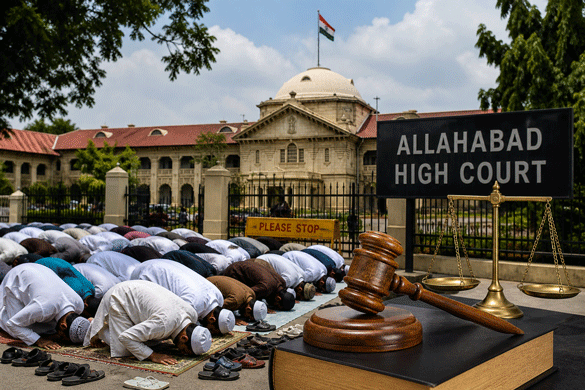
Religion, at its core, is a means to cultivate discipline, compassion, and a sense of responsibility toward others. In Islam, acts of worship such as namaz are undeniably central to a believer’s life. However, Islamic teachings also emphasize the importance of maintaining social harmony, respecting the rights of others, and upholding order in society.
It is in this balance that the current conversation must be situated. The right to practice one’s faith is constitutionally guaranteed, yet it exists within a broader framework of law and civic responsibility. When acts of devotion extend into public spaces in ways that may cause inconvenience or disruption, it becomes necessary to reassess not the value of the worship itself, but the manner in which it is performed.
Islam does not advocate for confrontation with the law of the land. On the contrary, it encourages believers to act with wisdom (hikmah), patience (sabr), and good conduct (akhlaq). The Prophet Muhammad (peace be upon him and his family) consistently demonstrated that faith is best represented through character and consideration for others.
At a time when social divisions can easily be amplified, it is crucial for communities to act with foresight and sensitivity. Religious expression should never become a source of discomfort or discord. Instead, it should serve as a bridge for mutual respect and coexistence.
This moment also calls for responsibility in public discourse. The use of religious identities in political narratives, especially in ways that may reinforce stereotypes or create divisions, must be approached with caution. Language has the power to shape perceptions, and therefore, it must be used to heal rather than to harm.
India’s strength lies in its diversity and its long-standing tradition of coexistence. Preserving this fabric requires not only legal adherence but also moral introspection. Communities must lead by example, demonstrating that faith and civic responsibility are not opposing forces but complementary values.
In conclusion, the path forward is not one of conflict, but of balance. By aligning religious practice with the principles of law, empathy, and mutual respect, we can ensure that faith continues to be a source of peace and unity in our society.
…
New Age Islam, Islam Online, Islamic Website, African Muslim News, Arab World News, South Asia News, Indian Muslim News, World Muslim News, Women in Islam, Islamic Feminism, Arab Women, Women In Arab, Islamophobia in America, Muslim Women in West, Islam Women and Feminism