
Tipu Sultan and the Modernisation of Kerala

By
Grace Mubashir, New Age Islam
30 June
2023
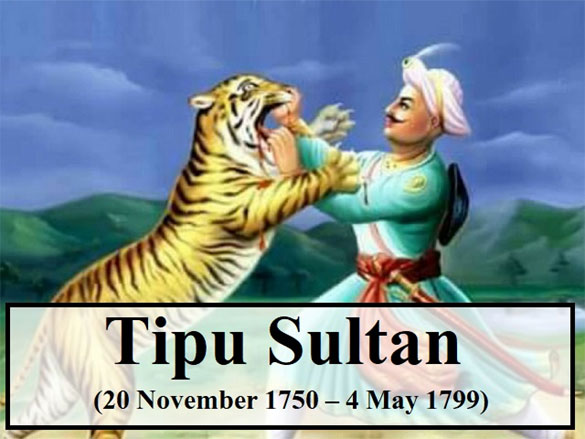
Tipu Sultan
was an important ruler of the Mysore Kingdom that grew in southern India in the
late 1700s. It was his and his father Hyder Ali's hard work and efficiency that
made Mysore an kingdom that stretched from the Krishna River in the north to
Kerala in the south, although he had no claim to royal succession or a distinct
family legacy. Through his reign that lasted from 1782 to 1799, he was able to
not only lead southern India to progress but also mount strong challenges against
European invasion.
The 18th
century for India was a time of disintegration of Mughal rule and clear signs
of British dominance. To lead a society firmly entrenched in patriarchy and in
the grip of foreign tyranny to freedom is not a heavy responsibility but one
that is met with fierce resistance and counter-attacks.
The Mysore
invasion of 1766 caused a change in Kerala's socio-political environment. The
territory of the Zamorin of Calicut and neighbouring regional kingdoms was
invaded by Hider Ali Khan, the monarch of the Mysore kingdom, for the second
time. Ali Raja of the Cannanoare Arakkal kingdom made the appeal to delay Hider
Ali Khan's second invasion. The King of Palghat, a long-time enemy of the
Zamorin troops, requested the first invasion, which took place in 1756–1757.
Hyder was at that time working for the Wodeyars of Mysore as the Faujdar of
Dindigul.
The Kingdom
of Cochin, which is located close by and to the south of Malabar, became a
subordinate kingdom of Mysore after the takeover of Zamorin territory. In 1767,
Hider Ali's first attempt to overthrow the British ally state of Travancore
failed, and his son Tipu Sultan's second attempt, made in 1789 and 1790, fell
short. However, Tipu Sultan instigated the Third Anglo-Mysore War, which led to
the British invasion, by assaulting the Kingdom of Travancore. Thus, Travancore
was the only region of the modern state of Kerala that was independent of
Mysore rule.
Kerala
during the Mysore invasion
In Kerala,
the Mysore sultans ran into a cultural and economic environment riddled with
caste hierarchies and subaltern hegemony after the arrival of the Aryans
(Namboothiris). It was a society where anarchy and immorality were rampant. In
Namboothiri families only the eldest son had the legal right to marry from his
own caste. The stipulation was that the younger sons should have convenient
relations with young women of the Nair community. For this, legal marriages in
the Nair community were banned due to caste laws. "Shudra women are not to
observe half-fasting and are to devote themselves to the fulfilment of the
wishes of the Namboothiris; The Brahmins dealing with these suggest that they
were commanded by Parasuraman, who gave the code of conduct to the Malayalees''
(C. Achyutamenon, Cochin State Manual 1910 Ernakulam, 193) This was the general
attitude of the Kerala people at that time. It was also the practice of women
here to take more than one husband. Therefore, the responsibility of looking
after the family has become that of the uncles, as the father being
unrecognizable. It became a practice that prevailed throughout Kerala under the
name Marumakkathayam (Matriliny).
Life has
become difficult for the lower class and other people by the Namboothiri
community's monopoly in agriculture, dominance in the power sector, dominance
in the financial sector, leadership in the spiritual domain and material
comforts. Increased use of intoxicating substances, depravity and moral decay
spread among the Kerala people. While describing the situation in 1800, Dr.
Buchanan says, "The renters are the dogs here." Except for the
Namboothiri women, the freedom to cover was denied. For women belonging to the
lower castes to cover up was considered grossly indecent and a violation of the
law.
Most of the
countries were ruled by Hindu kings. Muslims remained second-class citizens
under these local rulers. Although they emerged as economic powers because they
were important links in the trade chain, they had to get special permission
from the village to build a mosque. Even if a Muslim was as wealthy as he was,
it was obligatory to stand up and perform the ritual at the sight of the Hindu
Pramani (feudal lord). Isolated objections to this did not fail to arise in the
early seventeenth century. The invasion of Malabar by Hyderali and Tipu Sultan
took place at a time when the opposition of the Mappilas against Hindu
supremacy was at its peak.
Tipu was
able to implement many progressive schemes in the country within a short period
of time. Important among them are the social, cultural and economic reforms in
the Malabar region. Timely, progressive and anti-foreign, his style of
governance impressed even his enemies.
Social
Reforms
Tipu mainly
tried to eliminate the prevailing customs in the society. He firmly believed
that women's social life has to be improved. That is why he insisted that caste
culture should be abandoned. Polygamy was banned and extreme caution was
exercised in radically reorganizing the Kerala social structure. In a
proclamation issued from Kuttipuram in Kattanadu in 1788 advising the people of
Malabar, he presented a new outline of social reform. Tipu exhorted them to
stop all the previous riots and adopt the path of peace, pay taxes on time and
live as good subjects. Tipu's proclamation emphasized the need to live like a
civilized man, abandoning polygamy, which the Sultan described as uncivilized,
immoral, and more shameful than among animals. He also warns that if they
violate his orders and return to their old ways, he will take steps to bring
their leaders under the government's rule.
Realizing
that the hill tribes in Malabar's Wayanad region and other hilly areas were
living completely naked, the Sultan summoned the elders and promised to arrange
the distribution of free clothes if poverty was the cause. But they ridiculed
his action and begged to be relieved of this obligation. Threatened to flee
into a violent storm if they were forced to dress, the Sultan let them go with
a good word.
Socio-cultural
revival was Tipu's passion and idea. Therefore, he strictly prohibited the use
of alcohol and intoxicating substances, which are the main causes of moral
decay. A letter written by the Amir of Bangalore on 4th January 1787 says thus.
"Besides prohibiting the manufacture and marketing of intoxicating
substances, it is said to make written agreements with those who produce them
not to manufacture and sell them anymore, and to get an agreement that they
will engage in some other occupation. Their lives should be secured by giving
them other jobs. The practice of putting young women to domestic work was
discouraged. He found out that his Kozhikode Faujdar was having an affair with
a Nair woman and ordered it to stop. He was also willing to provide her with
new means of livelihood while enforcing prohibition laws. Trusts and
institutions to help the needy and helpless were established in all the
important places of the country. Professor Mohibbul Hassan Khan in his book
quotes from the Mackenzie records about a trust set up to marry off the
children of destitute and poor people of marriageable age. The tax system
implemented in Tipu's country and the State Training Corporation were good
enough to uplift the underprivileged.
Mysore rule
in Malabar ushered in the decline of the clan system and the introduction of
innovative and progressive ideas for state administration. Along with
introducing a centralized administrative system, the taxation system was
modernized to benefit the commoners. The amount of land was determined
according to the yield of the land. A second land survey was conducted in
1788-89, confiscation of unjustly held lands and new taxes were assessed. He
issued special orders and implemented many reforms in the field of agriculture.
This led to the Janmi system, the zamindari system that existed in Malabar for centuries,
to decline. The revolution initiated by Tipu Sultan in the agricultural land
was strongly opposed by the natives of Malabar.
Some of the
agrarian reforms included giving annual loans to farmers, fixing taxes on crop
yields, fixing land ownership, providing tax relief in case of disaster, and
allowing a small percentage of net profits to be paid as taxes.
The Sultan
tried to experiment with foreign farming systems. More attention was paid to
wheat, barley, millets, sugarcane and fruit crops. New laws were enacted to
conserve forest resources and the planting of good types of wood for
shipbuilding was encouraged. Trade in pepper, cardamom and sandalwood became a
government monopoly. Government godowns were opened in many parts of North
Kerala to collect these. Vadakara, Koyilandi, Kozhikode and Mayyazhi were
selected for this purpose. These goods were stored in these godowns and sold to
foreign traders at a fixed price. This helped the farmers to get fair price for
their produce. British historian Edward Moore records the economic progress in
Malabar during this period. In Kochi and Malabar, EMS records in his book
‘Keralam’ that there was no land tax until recently, and Tipu Sultan was the
first person to impose a tax.
Trade and
industry flourished in Malabar during the reign of Tipu Sultan. Tipu was the
only Indian ruler who understood that industrial growth and trade development
were necessary for the country to have prosperity. Muhibbul Hassan Khan
narrates: ‘A keen observer of international movements, Tipu was in touch with
the major European nations that were enjoying the benefits of the industrial
revolution. He was able to establish a systematic and exemplary administration
through the industrial policy implemented with a view to its success. Agriculture
and trade flourished. Sultan was associated with foreign countries for their
advancement.’ "The farmers in his country are safe. Their efforts are
encouraged,” John Shore wrote. Tipu's administration was concerned with
planting trees and beautifying the country by constructing irrigation schemes
and dams for agriculture. Science and art literature also flourished then.
Trading
posts were opened in Muscat, Jeddah, Darmuz and Peru (Burma) to promote foreign
trade. Sultan also set up a trading company selling shares to interested
parties. A mechanism was created to ensure 50% dividend to the shareholders. An
oyster hatchery was also established on the Malabar coast. Divers were also
imported from Muscat for this purpose. This was the beginning of industrialisation
of Kerala economy.
As part of
the industrial revolution, public works were carried out on a large-scale
during Tipu's reign. It was his way to always be doing something new. It
included new towns, new roads, new irrigation schemes, ever-changing place
names, currency systems, administrative department reorganizations, provincial
reorganizations, and many necessary and unnecessary reforms.
History
records that Tipu was the first to open navigable roads on demand in the
Malabar region. Before his time wheeled carts were not seen in the district. It
was only after the arrival of Tipu's big guns that the need for lines began to
be seen. It was during the Sultan's time that most parts of Malabar were
connected and there were many roads that made it possible to walk through the
jungles of the country.
Tipu's
implementation of the concept of the road ushered in the education of the
people, mutual cooperation, familiarity, exchange of visions and a new
closeness of human relations. A separate department was working for the
development of roads and canals in Malabar. All the long travellers used to
travel through them. For the convenience of travellers, inns were occasionally
established on the main roads. A colony was established by bringing some Hindu
families from outside to provide hotel facilities for Hindu travellers from
Tritala near Ponnani. Hindus were brought in from outside because the local
Hindus considered it a disgrace to work in hotels. These projects were
implemented with the revenue from Malabar.
A military
college in Mangalore was appointed to train the navy. This navy was at the fore
in arresting pirates. Two large weaving mills were established at Kannur and
Kasaragod to make clothes for soldiers and to solve unemployment in Malabar.
English historians have also commended him for his laudable work in reviving
the declining weaving industry in South India. Factories for the manufacture of
daily use goods, a company for the procurement and trading of forest products,
a dyeing business, and small-scale enterprises for the manufacture of hats are
examples of his business interest and financial acumen.
Tipu curbed
the extravagance shown in spending money on celebrations. Buchanan records in
his book that the custom of Malabar is to spend all that is in one's own hands
and then borrow and spend as much as one can get. Tipu ordered that no village
in his country should spend more than one percent of its total income on
celebrations. (Mappila Community - History Culture - T Muhammad). The people
were allowed to visit the Sultan at any time and express their grief. The
Sultan had instructed that Hindus should live by their creed just as Muslims
practice Sharia law. Expensive gifts were given to Hindu monks. The Sultan
directly gave gifts to those who were interested in agricultural development
and new inventions. (Kerala Muslim History. P.A. Zaid Muhammad)
Tipu's
conquest of Malabar led to economic and social transformations. It helped to
wipe out the prevailing Namboothiri supremacy and eradicated customs and vices.
Many Mappilas were appointed to important posts in the administration and the
army. With the relaxation of birth right, the Mappilas became the owners of
land. (Malabar Struggle M.P. Narayana Menon) The Mysore administration helped
the lower castes to understand that they had the right to question the upper
castes and to develop a sense of their dignity and power. With this, the Nayars
had their right cut down among the lower castes. The excessive socio-political
importance of the Nair community disappeared and the lower castes gained social
acceptance. (Kerala Muslim Directory)
Under
Mysore rule, Kerala Muslims could build mosques without anyone's permission. It
was also possible to rest in graves without paying taxes. Muslims gained glory.
But being Muslims did not exempt them from tax liability. But they became a
protected people.
Social
Consequences of Reforms
The Malabar
region were viewed with suspicion and considered an unjust encroachment on the
caste system. Therefore, strong objections were raised against it. They assumed
that Tipu Sultan, a Muslim, was carrying out conversion schemes. Tipu's failure
was that he could not convince them for who’s good he was doing this.
The Mysore
army put up a strong defence against the British who encroached on the
country's sovereignty. Therefore, Tipu became a bitter enemy of the British.
When they got the chance, they broke all bounds of politeness and clashed with
the Sultan. The British portrayed Tipu Sultan as a religious fanatic and a
temple destroyer in order to overthrow Tipu who strongly resisted and to gain
support for their political conquest.
The heavy
blow to the caste system also fuelled the protest against Tipu. So upper caste
Hinduism and the British wrote Tipu Sultan in history like this. "The
cruelties committed here by Hyder Khan and his son Tipu Sultan were inhumane:
no complaint, no indignation. But it is useless to turn a blind eye to the fact
that the fate of weapons has resulted in a crash in the customs, deeds,
actions, beliefs, ideals and theories that the Malayali people have taken care
of for centuries. Many were sad. It was so brutal that I couldn't even remember
it except with shock. It was terrible." (Kerala in the 19th century. P.
Bhaskaranunni)
But if we
look at the facts, we can understand that Tipu Sultan was very cautious in
showing respect and dignity to the people of other religions. The temple in
front of the Palakkad fort is proof of this. Many Hindus worked in his army.
Tipu's army chief himself was a non-Muslim named Apparao. After Tipu, Dewan
Purnaiya was the most powerful in the country. Shyama Iyer was in charge of the
police department. How can a ruler who shows broad-mindedness only to produce
non-religious people even in administrative matters, be a bigot and a fanatical
religious thinker?
Many
incidents can be found in the history books which support Tipu's religious
harmony stance. Some historical accounts paint Tipu as more of a religious
fanatic and a poisoner of communalism. The results of Tipu's social reforms are
still present in Kerala in the form of abolition of caste supremacy, roads and
progress in agriculture.
-----
A
regular columnist for NewAgeIslam.com, Mubashir V.P is a PhD scholar in Islamic
Studies at Jamia Millia Islamia and freelance journalist.
URL: https://newageislam.com/islam-politics/tipu-sultan-modernisation-kerala/d/130106
New Age Islam, Islam Online, Islamic Website, African Muslim News, Arab World News, South Asia News, Indian Muslim News, World Muslim News, Women in Islam, Islamic Feminism, Arab Women, Women In Arab, Islamophobia in America, Muslim Women in West, Islam Women and Feminism