
Kayalpattinam: South Indian Cosmopolis Of Islamic Heritage, Its Exquisite Ancient Mosques And Erudite Scholars

By
Grace Mubashir, New Age Islam
1 April
2023
The city is considered to be an ancient Islamic
heritage city in South India. Islam came here in three waves. Its popularly
believed that Islam reached her shored during the lifetime of the Prophet
himself. In Hijra 9, five Companions of the Prophet visited the city. Only one
stayed on while others returned to Hijaz. Remaining Companion Abdulla built the
first mosque here popularly called as ‘Masjid Beyond the Shore’.
-----
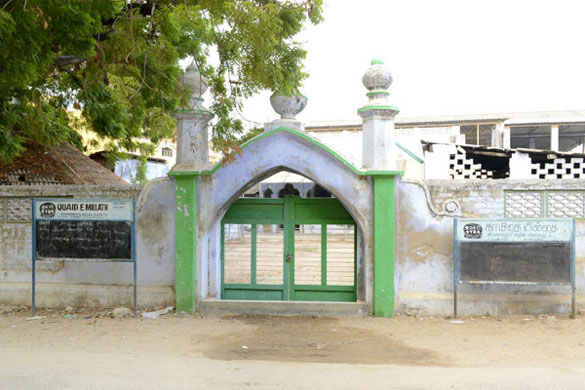
Khutba Periya Palli is a mosque in
Kayalpattinam, Tamil Nadu, India.
-----
Kayalpattinam
is a small city tucked away in the Coromandel coast of South India. Today it
falls within the Thoothukudi district. The city’s ancient name is Kayal. Few
historians argue that this old city is wrecked after Portuguese savage
colonialism and the present city is newly built after the colonial invasion.
Most historians concur that both towns were the same and the present being the
outgrowth after the 16th century when the changing international trade affected
this part of India too, the town mentioned by Greek astrologist Ptolemy as
‘Kolkoi’ and ancient Chinese reference of ‘Ko Kp Lo’ are about this mercantile
city. Ptolemy had visited this port city. Even before the advent of Islam, the
city had mercantile engagements with neighbouring countries like Sri Lanka,
China, Indonesia, Rome and Egypt. Major historians Marco Polo, Abdu Razaq,
Barbosa, Ibn Batuta and Nicolo Conti had visited the city at different times
and their descriptions of the city are still available.
Even though
not visited the town, it was impossible to travel from South East Asia to
Europe due to the city’s proximity to Palk Strait. Due to this fact, it was
called as ‘ma’bar’ (a place to pass). The Portuguese invasion derailed the
city’s position as they opted for other ports in the Coromandel coast. The city
came under vicious Portuguese attacks in 1532, 1552 and 1573 and incurred
severe economic losses and lost its historical prominence.
The
Heritage City Of Islam
The city is
considered to be an ancient Islamic heritage city in South India. Islam came
here in three waves. Its popularly believed that Islam reached her shored
during the lifetime of the Prophet himself. In Hijra 9, five Companions of the
Prophet visited the city. Only one stayed on while others returned to Hijaz.
Remaining Companion Abdulla built the first mosque here popularly called as
‘Masjid Beyond the Shore’. Presently this Masjid is not available.
The second
advent of Islam happened in 227 Hijra, when Sufi Muhammed Khilji settled here
with his 224 relatives. They sailed from Egypt. When he had to incur the wrath
of the ruler due to the philosophical controversy of the creation of the Quran,
he migrated to Kayalpattinam. The city was called ‘Qahira Watan’ (the city of
Cairo). Historians believe Kayalpattinam is the modified name of Cairo in
Arabic. He built the Grand Mosque (Jamiul Kabeer) here.
In Hijra
683 Sayed Jamaludheen migrated to Kayalpattinam. He was appointed as the
minister of the local Hindu ruler Sundara Pandya. He was anointed as ruler
after the demise of the king. He expanded the Grand Masjid adding a thousand
pillared 'madapam' (corridor) as in Hindu architecture. This Masjid has been
mentioned in ‘Rihla’ of Ibn Batuta.
The city is
dotted with innumerable Dargahs, still revered by all people irrespective of
religion. The city was the birthplace of renowned Muslim scholars who made an
immense contribution to Islamic knowledge. Sadaqatullah Qahiri is the one of
the most celebrated scholars of the region. Twelve of his stupendous
compositions have been collated in two anthologies, ‘Nuru-l ‘Aynayn’ and
‘Mukhammas Dhukhru-l Ma’ad’. The most acclaimed of his works is ‘Qasidatu-l
Allafa-l Alif’. The amazing lines of this poem speak of the importance of
loving the holy Prophet (Allah bless him and give him peace), the necessity of
the spiritual path, perils of earthly life, amongst others.
The beauty
of this 31-couplet composition lies in the fact that each of the 29 couplets
between the opening and closing verses begin with a letter from the Arabic
alphabet in order. In every line, the starting letter is repeated between ten
to fifteen times. Another literary feature of this masterpiece is that, sets of
words (two words), identical in form (both having the same letters in the same
order), are skilfully used in the same verse with differing meanings to convey
highly advanced Sufi thoughts.
Several
commentaries have been written on this ode. The most comprehensive being
‘Awarifu-l Ma’arif’ by Shaikh ‘Abdu-r Rahman al-Naqshbandi which was last
published by Ibrahim Kutty of Tanur, Kerala, in 1975. The renowned scholar of
Abiramam, Shaikh ‘Abdu-l Qadir has also written a concise commentary. Another
poem of his that begins with the words, ‘Ilahi kam tubaqqini’ [O my God, for
how long are you going to keep me alive!] is regularly recited in the region
with much fervour and devotion.
Another
renowned personality is Labba Qahiri. He authored the seminal text of Arabic
syntax named ‘Ajnas’ which is still taught in Islamic educational institutions
even to this day. He served as the chief Mufti during Aurangzeb.
Relatives
of Ibrahim Badusha of Ervadi are interred here. His Mazar at Ervadi is one of
the biggest pilgrimage centre of Muslims in South India. According to popular
folklore, Kwaja Ajmir had visited the place. Another famous Sufi sleeping here
is Shahul Hameed Nagori. He studied in Kerala and settled at Kayalpattinam
preaching Islam here.
Many
historical Masjids are situated here. Meekail Masjid is one of them. When
Sadaqatullah Qahiri was teaching people came complaining bout draught.
According to the local narrative he called the angel ‘Meekail’ assigned with
the duty of rain and demanded an immediate downpour. So that this Masjid is
known as Meekail Masjid. A revered sword used against fending off Portuguese
invasion is also preserved here. A stone, which is said to have cried when
Sadaqatulla Qahiri was giving the sermon on piety, could be seen here.
Other major
pilgrimage sites are ‘Saviyatul Shaduliyya’ and ‘Mahlaratul
Qadiriyya’. These were the fountains of Sufism in the region. It was
established by eminent Sufis to perform Sufi rites and later developed as
eminent educational centres.
Unbroken
Tradition
The
residents of the Kayalpattinam are careful to protect the heritage and syncretic
traditions of the place. Still, the old practice of engraving Quranic verses in
front of houses is followed these days. Sufi practices are still celebrated
with great grandeur. While Islamic traditions are being subjected to literalist
and textual interpretations, this place still keeps its spiritual heritage
aloft. Along with the communal harmony is to be praised. Community amity
inherent to Sufi Islam is still guarded. A trip to Kayalpattinam will be surely
an ode to impeccable Islamic Sufi heritage.
-----
A regular columnist for NewAgeIslam.com,
Mubashir V.P is a PhD scholar in Islamic Studies at Jamia Millia Islamia and
freelance journalist.
URL: https://newageislam.com/islam-politics/kayalpattinam-islamic-heritage-mosques-scholars/d/129465
New Age Islam, Islam Online, Islamic
Website, African Muslim News, Arab World News, South Asia News, Indian Muslim News, World Muslim News, Women in Islam, Islamic Feminism, Arab Women, Women In Arab, Islamophobia in America, Muslim Women in West, Islam Women and Feminism