
A World Distracted: Hidden Power, Permanent Tension, And the Moral Crisis of Our Times Part 1
By Amanullah Mohammad, New Age Islam
08 May 2026
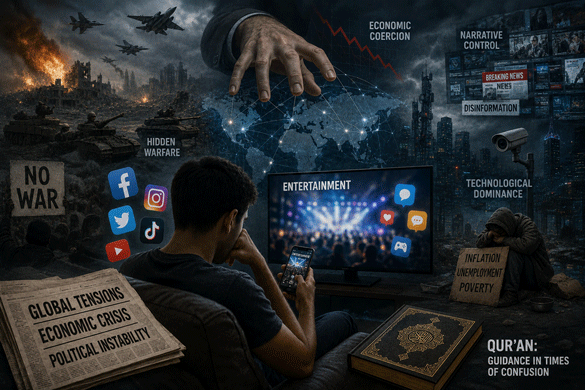
At a time when global attention is absorbed by technology, entertainment, and virtual engagement, the world is experiencing sustained geopolitical tension, economic coercion, and moral exhaustion. This article examines how modern power struggles increasingly operate through invisible systems—finance, narratives, technology, and psychological pressure—rather than open warfare, while ordinary people bear the consequences. Drawing on history and Qur’anic ethics, it reflects on distraction, inequality, and the silent suffering of innocents in an age where dominance is unstable but responsibility remains urgent.
Key Points:
1.Power Is Never Permanent
· History—from ancient empires to the collapse of the USSR—shows that dominance shifts when moral legitimacy erodes. The current global order shows visible stress under economic, political, and ethical contradictions.
2.Hidden Warfare Beyond Battlefields
· Modern conflict increasingly operates through sanctions, financial systems, narrative control, technology, and psychological pressure rather than declared wars—placing civilians at constant risk.
3.AI and Entertainment as Instruments of Distraction
· Artificial intelligence and digital platforms, while technologically impressive, are largely deployed to capture attention, shape behaviour, and divert public focus from deeper structural crises.
4.Economic Survival and Moral Compromise
· Rising inequality, debt, inflation, and exploitative systems push ordinary people into ethical compromises, not by choice but by necessity—revealing systemic injustice rather than individual failure.
5.Innocent People as the Permanent Victims
· Across history, from ancient wars to modern conflicts, civilians suffer the consequences of decisions made by distant power centres, despite bearing no responsibility for them.
Abstract
The contemporary world appears trapped in a state of permanent tension. While wars may not always be formally declared, conflict increasingly manifests through economic coercion, technological dominance, information control, and geopolitical pressure. This article reflects on the moral and human consequences of such an order, where ordinary people struggle for survival while decisions affecting their lives are made far beyond their reach.
Drawing on historical patterns—from the collapse of past empires to present-day power shifts—the article argues that dominance has never been permanent and that moral decay often precedes political decline. Modern forms of warfare are no longer limited to battlefields; they now operate through sanctions, debt systems, narrative manipulation, and digital surveillance. Artificial intelligence and entertainment technologies, while celebrated as progress, often function as instruments of distraction, keeping populations disengaged from deeper structural crises.
The article also examines how economic pressure forces ethical compromise, pushing people toward survival-driven choices within unjust systems. Industrial food production, interest-based finance, and exploitative labour markets disproportionately affect the poor and powerless. Throughout history, innocent civilians have borne the heaviest cost of elite power struggles, a pattern that remains unchanged today.
Grounded in Qur’anic moral principles, this reflection does not predict catastrophe but calls for ethical awareness, restraint, and compassion in an increasingly distracted and unequal world.
Introduction: A World That Feels Permanently Unstable
Across continents, a shared anxiety is quietly growing. Wars may not always be formally declared, but tension has become permanent. Economic insecurity, political polarisation, social fragmentation, and moral confusion now define daily life for billions of people. While ordinary citizens struggle for survival, global power centres appear locked in silent confrontation—through sanctions, proxy conflicts, narrative control, technology, and economic pressure.
This article does not claim secret knowledge, nor does it attempt to predict the future. Instead, it reflects on visible patterns that many people sense but struggle to articulate: a world increasingly shaped by distraction, inequality, hidden power structures, and ethical decay—conditions repeatedly warned about in Islamic moral teachings.
The concern here is not fascination with apocalypse, but compassion for innocent people, who historically pay the highest price when power struggles escalate.
Power Has Never Been Permanent: A Lesson from History
History consistently demonstrates one truth: power never remains in one hand forever.
Empires rise, dominate, and decline—not because of fate alone, but because of moral exhaustion, economic imbalance, and social decay. From ancient civilizations to modern superpowers, the pattern is clear. The Qur’an reminds humanity:
“Such days We alternate among the people…”
(Qur’an 3:140)
The fall of the Soviet Union (USSR) remains a powerful modern example. Once seen as unshakeable, it collapsed not due to invasion, but internal contradictions—economic strain, loss of legitimacy, and systemic rigidity.
Today, many observers perceive similar stress lines in the current global order. The dominance of a single power bloc is increasingly challenged by multipolar alignments, regional coalitions, and alternative economic systems.
The Anxiety of Declining Power and the Language of Threat
When dominance feels threatened, powerful states rarely respond with humility. Instead, history shows a pattern of pre-emptive aggression, coercion, and narrative construction.
Sanctions, economic pressure, regime-change rhetoric, and military posturing often replace diplomacy. Threats toward regions rich in resources—oil, gas, rare minerals—become framed as matters of “security,” “freedom,” or “global order.”
This anxiety is visible today:
• Currency dominance facing slow erosion
• Energy routes being contested
• Strategic minerals restricted by emerging powers
• New trade corridors bypassing old centres
The Qur’an describes this psychological state with precision:
“When power comes to them, they spread corruption on earth.”
(Qur’an 2:205)
Hidden Weapons and Invisible Warfare
Modern warfare no longer relies solely on visible battlefields. Today, power is exercised through:
• Economic warfare (sanctions, debt, currency pressure)
• Information warfare (fake news, selective outrage, narrative dominance)
• Technological warfare (cyber-attacks, surveillance, AI systems)
• Psychological warfare (fear, distraction, polarization)
Discussions about “hidden weapons” should not be understood only as secret machines. The most effective weapons today are systems—financial systems, digital control, data monopolies, and perception management.
The Holy Prophet Muhammad (PBUH) warned of a time when deception would dominate public life:
“Years of deception will come upon people, in which the liar will be believed and the truthful will be rejected…”
(Musnad Ahmad)
This deception does not require conspiracy theories; it functions openly through selective visibility and silence.
Artificial Intelligence: Tool or Distraction?
AI is often presented as humanity’s greatest achievement. Yet many people intuitively feel uneasy—not because technology itself is evil, but because its deployment serves power, not ethics.
AI today is heavily used for:
• Surveillance
• Targeted advertising
• Behavioral manipulation
• Entertainment addiction
• Synthetic images, deepfakes, and misinformation
Meanwhile, existential issues—food security, environmental collapse, moral education, inequality—receive fragmented attention.
The concern is not that AI exists, but that it may function as a grand distraction, keeping populations engaged in virtual worlds while real power decisions occur elsewhere.
The Qur’an cautions against heedlessness:
“They know what is apparent of the worldly life, but of the Hereafter they are unaware.”
(Qur’an 30:7)
Entertainment as a Tool of Disengagement
Never before has humanity had such constant access to stimulation:
• Social media
• Short-form videos
• Celebrity culture
• Hyper-sexualised content
• Endless entertainment cycles
Younger generations are not to be blamed. Systems are designed to capture attention, not cultivate wisdom.
When people are exhausted by survival and saturated by distraction, meaningful engagement with societal problems becomes rare. This benefits those who prefer populations that are busy, divided, and distracted.
Imam Al-Ghazali warned centuries ago:
“The soul is deceived gradually, not suddenly.”
Economic Pressure and Moral Compromise
For billions, daily life is not about ideology but survival. Rising costs, unstable employment, debt, and inflation push people toward compromises they never intended to make.
This includes:
• Interest-based financial dependence
• Doubtful income sources
• Ethical erosion under necessity
• Normalisation of exploitation
The Qur’an repeatedly condemns systems that trap people in injustice:
“Do not consume one another’s wealth unjustly.”
(Qur’an 4:29)
Blame must not fall on the poor or the struggling, but on systems that force moral compromise while protecting elite accumulation.
Industrial Food, Adulteration, and Unknowing Harm
Industrialisation has distanced people from the origins of what they consume. Many unknowingly eat food that violates ethical or religious principles due to:
• Complex supply chains
• Profit-driven shortcuts
• Weak regulation
• Consumer helplessness
Islam places strong emphasis on tayyib (pure and wholesome) consumption, yet modern systems often prioritise scale over integrity.
This condition was foretold:
“A time will come when people will not care whether wealth comes from lawful or unlawful means.”
(Bukhari)
This is not an accusation—it is a tragedy of structure.
Global Tensions and the Geography of Unrest
Civil unrest, internal instability, and social breakdown have occurred across regions:
• South Asia
• Middle East
• Africa
• Latin America
These are rarely isolated events. They are symptoms of:
• Economic stress
• Political exclusion
• External interference
• Identity manipulation
Ordinary people suffer first. History—from Mahabharata to World Wars—confirms this painful truth.
The Qur’an reminds:
“No soul bears the burden of another.”
(Qur’an 6:164)
Yet in war, innocents always bear the burden.
India, Alliances, and Strategic Ambiguity
India’s evolving global position reflects broader shifts:
• Engagement with the West
• Strategic ties with Russia
• Economic cooperation with the Gulf
• Regional leadership ambitions
Multi-alignment brings opportunity—but also tension. History shows that rising powers attract both partners and adversaries.
Islamic ethics caution against arrogance during ascent:
“Do not walk upon the earth exultantly.”
(Qur’an 17:37)
Power without moral restraint invites instability.
Fear, Death, and the Illusion of Control
Death remains the great equaliser. People die peacefully in sleep, on ordinary journeys, during celebrations. War only accelerates what is already inevitable—but unjustly and violently.
Islam does not teach fear of death, but responsibility toward life.
“Whoever saves one life, it is as if he saved all humanity.”
(Qur’an 5:32)
The tragedy is not that death exists—but that systems repeatedly choose paths that multiply it.
Conclusion of Part 1: Warning Without Despair
This reflection is not a declaration of imminent apocalypse. It is a moral warning—one deeply rooted in Islamic tradition—that societies collapse when ethics are sacrificed for dominance, distraction, and denial.
The Holy Prophet Muhammad (PBUH) warned of fitan (periods of confusion), not to terrify believers, but to awaken conscience.
…
Mohammad Amanullah Mohammad is engaged in research and writing on Islamic history, Quranic interpretation, reformist thought, and interfaith harmony.
New Age Islam, Islam Online, Islamic Website, African Muslim News, Arab World News, South Asia News, Indian Muslim News, World Muslim News, Women in Islam, Islamic Feminism, Arab Women, Women In Arab, Islamophobia in America, Muslim Women in West, Islam Women and Feminism