
Tears, Despair And Hope For Justice As These Women Take On Two States Over ‘Unconstitutional’ Cow Protection Acts

By
Aiswarya Raj
July 15,
2023
Two days
after her husband Umar Khan was found dead, allegedly murdered by cow
vigilantes, near a rail track in Alwar district, Khurshidan went into premature
labour and gave birth on November 12, 2017. Though the accused were released on
bail within months after their arrest, Khurshidan, now 40, continued to mourn
Umar’s death for years.
The plea prayed for issuing of an appropriate order holding Sections 12
and 12-A of the Rajasthan Bovine Animal Act as “unconstitutional being
arbitrary, vague, and unreasonable”
------
In Ghatmika
village of Rajasthan’s Bharatpur, a stone’s throw away from Khurshidan’s house
lives 24-year-old Parmina. Thirty-year-old Sajida lives at a slight distance
from their house in the same village. Parmina’s husband Nasir Khan, 32, and
Sajida’s husband Junaid Khan, 35, were killed and their bodies burnt in Nasir’s
car, allegedly by cow vigilantes, in Bhiwani, Haryana, on February 16.
On July 3,
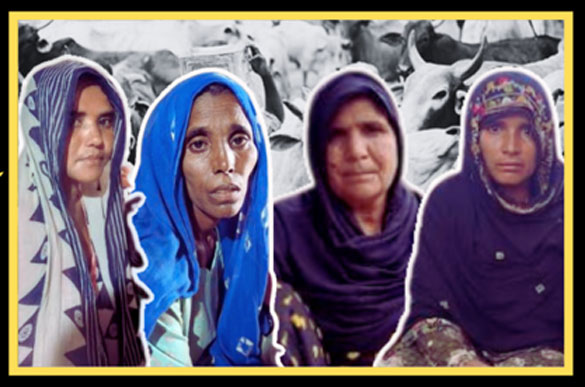
Khurshidan, Parmina, Sajida and 34-year-old Asmeena (her husband Rakbar Khan
was killed, allegedly by cow vigilantes, in Alwar in July 2018) filed a joint
petition against the Haryana and Rajasthan governments, and their respective
Directors General of Police in the Supreme Court. Their plea challenged the
provisions of the Rajasthan Bovine Animal (Prohibition of Slaughter and
Regulation of Temporary Migration or Export) Act, 2015, and the Haryana
Gauvansh Sanrakshan and Gausamvardhan Act, 2015.
The other
petitioners in the case are Irshad, the son of Pehlu Khan, who was killed, allegedly
by cow vigilantes, in Alwar in 2017; Palwal-based Nadir Shah, who was attacked
by a group on February 22; and Palwal-based Salim, who was waylaid while on his
way to buy livestock and beaten up by three people on February 23
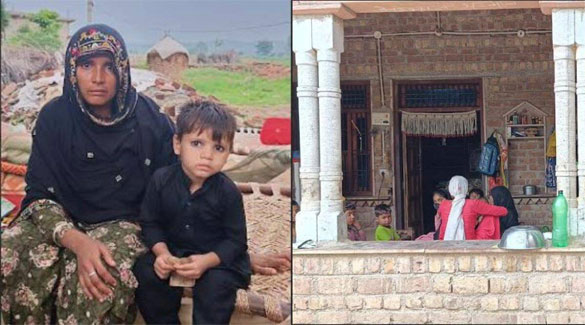
Forty-year-old Khurshidan’s husband Umar Khan, a resident of Ghatmika
village of Rajasthan’s Bharatpur, was found dead, allegedly murdered by cow
vigilantes, near a rail track in Alwar district in November 2017. She said her
son, who was just 15 years old then, took up the reins of the family. (Express
photo by Aiswarya Raj)
------
The Petition
The
petition stated, “All the Petitioners herein are victims of violence by the
vigilante groups of the States of Rajasthan and Haryana claiming to be
‘protectors of cows’. These vigilantes also include those who claim to be
‘person authorised on this behalf by the Government’ for such action under:
Section 12 and Section 12-A of the Rajasthan Bovine Animal (Prohibition of
Slaughter and Regulation of Temporary Migration or Export) Act, 1995 (the
Rajasthan Act) ii. Section 16 and Section 17 of the Haryana Gauvansh Sanrakshan
and Gausamvardhan Act. 2015 (the Haryana Act).”
The plea
prayed for issuing of an appropriate order holding Sections 12 and 12-A of the
Rajasthan Bovine Animal Act as “unconstitutional being arbitrary, vague, and
unreasonable”, as well as Sections 16 and 17 of the Haryana Gauvansh Sanrakshan
Act as “unconstitutional being arbitrary, vague, and unreasonable”. It also
called for setting up a Special Investigation Team (SIT) to probe instances of
violence against Muslims by vigilante groups in Rajasthan and Haryana’s Mewat
region.
In Ghatmika
village, Parmina sobs at the mere mention of Nasir. The family says she has
been like this since the news of his death reached the village in February.
Nasir’s brother Hamid Khan, who had accompanied the women to Delhi, says
Parmina stopped working in the fields after her husband’s death.
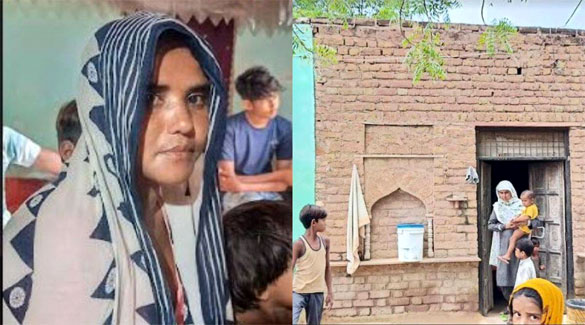
Asmeena’s husband Rakbar Khan was killed, allegedly by cow vigilantes,
in Alwar in July 2018. A resident of Haryana’s Kolgaon village, she met with an
accident just six months after his death. Besides a fractured spine, a catheter
has been inserted into her bladder, making it difficult for her to move around.
Left without any steady income, Asmeena, 34, and her seven children rear three
goats and two cows in their two-room house. (Express photos by Aiswarya Raj)
------
Hamid’s
wife Sabila added, “She keeps crying and has stopped talking. Her hearing too
seems to have been affected.”
Picking
threads off her Kaneez, Parmina stays quiet as Sabila adds, “She has also
stopped taking care of her two children.”
Having
suffered the same fate as Parmina, Khurshidan checks in on the younger woman
occasionally. As she enters the room, Parmina, looking much older than 24,
takes one look at the older woman and bursts into tears. Khurshidan asks her to
stop wailing. Though her cries don’t stop, they subside, seemingly assuaged by
Khurshidan’s consolations.
Syeda
Hameed writes | The deafening silence of those who need to speak about Junaid
and Nasir and the torn pages of a Bible in Pragati Maidan
As she
consoled Parmina, Khurshidan said, “When the Jamiat-Ulama-i-Hind (a
socio-religious organisation of Muslims) said they will fight for justice in
the Supreme Court, they said we would not have to pay the lawyer’s fee or other
expenses. Though our case has already seen a long trial, I was ready for this
new case as well.”
Back in her
house, Khurshidan’s eldest son Maksud Khan, 22, who took up the reins of the
family at the age of 15 years after his father’s death, looked at his mother
and remarked, “She aged quickly after his death. She has been suffering from
ailments, one after another, ever since he died. Two months ago, she was
diagnosed with typhoid. She is yet to recover fully.”
Coincidentally,
her son is married to the daughter of Rakbar Khan, a resident of Kolgaon in
Haryana’s Nuh, who was killed, allegedly by cow vigilantes, in Alwar in July
2018. “Both families went through the same tragedy. It felt right to get our children
married,” said Khurshidan.
junaid
sajida Thirty-year-old Sajida’s husband Junaid Khan, 35, and another resident
of Ghatmika village of Rajasthan’s Bharatpur were killed and their bodies burnt
in a car, allegedly by cow vigilantes, in Haryana’s Bhiwani on February 16.
With Junaid’s death, there is no earning member left in the family of 16,
comprising Junaid’s elder brother (who has learning difficulties), his wife,
their seven children and Sajida’s six children. Sajida said they have been
surviving on the charity of strangers. (Express photos by Aiswarya Raj)
Though
Sajida and Parmina were yet to complete their Iddat, a mandatory period
of seclusion for widows lasting nearly 4.5 months, Sajida said she still “went
to Delhi to file the plea, but wore a burqa and did not speak the whole time”.
With no
breadwinner in a family of 16, comprising Sajida’s six children, Junaid’s elder
brother (who has learning difficulties), his wife and their seven children, she
said they have been surviving on the charity of strangers. The family’s main
source of income was a store run by Junaid, but it was sold after his death.
Sajida’s
13-year-old daughter has started learning Urdu in the hope of getting a job at
a madrasa. In the two-room house shared by 16 people, Sajida spends her days
offering Namaz. “They did not just kill them; they burnt them alive. We could
not even do their death prayers,” she said.
“Sajida
suffers from various diseases and takes medicines for sadness,” Junaid’s cousin
Ismail said.
Unable to
look after her children since her husband’s death, Sajida said her mother and
Junaid’s sisters stay over from time to time to keep the house running. Since
Sajida did not know the details of her husband’s case, Ismail said, “In the
first month, the Rajasthan police were proactive and arrested three persons.
But there has been no progress since.”
To a query
on the absconding accused in the Junaid-Nasir murder case, an officer privy to
the investigation had said in June, “We have other cases to deal with as well.”
M R Shamshad, the advocate for the petitioners, said, “The SC could have exercised the power since two states are involved. However, it asked us to go to the respective High Courts.” He added that the Jamiat-Ulama-i-Hind had approached him after it brought these women together to file the plea.
Niaz
Faruqui, the national secretary of the Jamiat, said they had set up units in
the Mewat region to help the families of alleged victims of cow vigilantism.
“In mid-April, we decided to help the families file a petition together,” he
said.
While
Sajida and Parmina received a sum of Rs 1 lakh in cash and fixed deposits of Rs
4 lakh each from the Rajasthan government, Khurshidan says the compensation
promised to her in 2017 by the then state government is yet to materialise.
No Steady
Source Of Income
Lying on a
charpoy in the verandah of her two-room house in Haryana’s Kolgaon village,
some 20 km away from Ghatmika village, is Asmeena. She has been housebound,
with a catheter inserted into her bladder, after she fractured her spine in an
accident just six months after Rakbar’s murder. Left without a steady source of
income since his death, Asmeena and her seven children rear three goats and two
cows in their courtyard.
As Asmeena
gives instructions to her daughter, she appears hopeful. “I wanted to go to
Delhi with the others, but could not because getting me in and out of a car is
a hassle. I know all the women very well. Sajida is a relative, Khurshidan’s
son is my son-in-law and I have met Parmina too,” she said, adding that
although she had not met Pehlu’s wife Zaibuna, she was aware of her involvement
in the case.
“I don’t
know the details of the case, but I know the men who were killed,” she said,
reeling off their names.
Though the
accused in the Pehlu lynching case were acquitted by a Rajasthan court in 2019,
four persons were awarded a seven-year jail term for Rakbar’s murder in May by
a Rajasthan court. The police have arrested three persons in connection with
the Junaid-Nasir case and named 27 suspects in the chargesheet.
In Nuh’s
Jaisinghpur, Zaibuna said some lawyers had approached her after Junaid and
Nasir were murdered to tell her about the petition. She said she wanted to
pursue the case, especially after the February murders. “When the Jamiat lawyer
spoke about expediting the case hearings, given the number of cases and the
people involved, we decided to become a part of it,” she said
Stating
that they were pinning all their hopes on the judiciary, irrespective of the
long trial in store for them, the women said, “Aaj Nasir-Junaid, kal koi aur
Junaid (Today it’s Nasir-Junaid. Tomorrow, it will be some other Junaid). The
impunity with which these crimes take place needs to stop now.”
-----
URL: https://newageislam.com/islam-politics/justice-women-cow-protection-acts-vigilantes/d/130228