
Pakistan: The Hindu Exodus Is A Fruit of Radicalisation, A Grim Reminder of Horrors of Partition

By
Ayesha Siddiqa
17 August
2012
But what
Malik seems to struggle to hide is the fact that Hindu migration is not a new
phenomenon. It is that Islamabad seems to have noticed it just now. According
to civil society and human rights activists in Sindh, there has been a slow and
gradual move by Hindus to migrate from Pakistan.
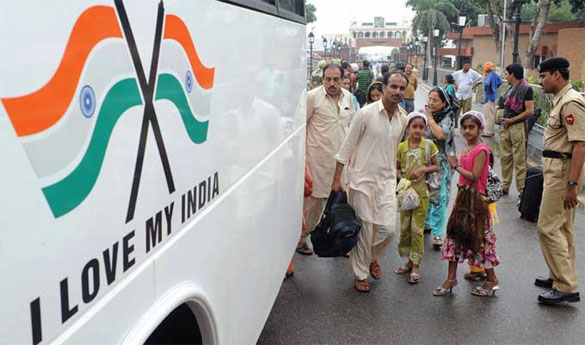
Life is elsewhere: Pakistani Hindu pilgrims arrive in India via the
Wagah border, following reports of intimidation and conversion in the
neighbouring country. Photo: AFP
------
According
to one estimate, there are 4.5 million Hindus in Pakistan, most of whom are
concentrated in Sindh, especially Hyderabad-Karachi, Tharparkat, Mithi, Mirpur
Khas, Shikarpur and Sukkur. The more affluent ones tend to migrate legally.
There is considerable illegal border crossing as well, but in such cases,
people undertake the risk when they have surety of finding help on the other
side. Most of the poor ones try to slip across the border under the pretext of
yatra from which they do not return only if they find hope in staying back in
India.
Sadly,
Malik is loath to not only admit that Hindus are leaving Pakistan but also that
the overall environment has turned unfavourable for religious minorities.
According to a Christian activist, “There are times when people don’t want to
share the same glass of water with us, so what to speak about the Hindus?”
Perhaps, Malik has no option as he cannot admit that a lot of this
discrimination is happening under the PPP government’s watch. The PPP may not
be responsible for the gradual radicalisation of the society, which is spurred
by the presence of the military’s jihadi partners, but the party leadership in
Sindh has done nothing to dissuade its own powerful members from contributing
to this human tragedy.
In Sindh, the PPP and other parties have a
share in creating conditions that led to this migration. The fear of being
forced to convert, abduction of daughters or other women in the family and
their conversion to Islam under duress, or kidnap for ransom are some of the
many reasons that have probably exhausted this group of Hindus to seek asylum
elsewhere. The above-described fear is growing intense due to a combination of
forces at play in Sindh province, which is the mainstay of a majority of the
Hindu population in Pakistan.
In the past
couple of decades, the militant forces in partnership with religious and
non-religious political parties such as the PPP have managed to invade the
Sindh province, which is generally associated with a Sufi culture. Some of the
prominent PPP leaders in Sindh are instrumental in establishing Afghan villages
or radical madrasas.
Then, there
is the partnership between the PPP and the Jamiat-ulema-e-Islam - Fazulr Rehman
group (JUI-F) that expanded the religious party’s influence in the province,
which it used to provide support to a number of Deobandi militant groups such
as the Lashkar-e-Jhangavi and Jaish-e-Mohammad. In any case, JUI-F and JUI-S
(Maulana Samiul Haq group) have a noticeable presence in Sindh. The icing on
the cake was done by the State itself, which encouraged numerous welfare
outfits linked with the militant groups to assist the armed forces in search
and rescue missions during the floods of 2010 and ’11. This means that now the
Lashkar-e-Toiba and its welfare outfit, the Jamaat-ud-Dawa, have expanded and
are operating in areas of Hindu population under the excuse of conducting
welfare activities.
As I sat
down to write this article, I was informed on Twitter that there was yet
another case of a Hindu girl, Maneesha Kumari, who was abducted and later
converted. A similar case had surfaced a few months ago in which Rinkle Kumari
went through a similar experience. But such events are not new. It is
unfortunate that minorities in South Asia have not felt safe as far as their
faith or security is concerned. However, as some of the sources working closely
on the Hindus of Sindh commented, the new development is that this has started
to happen to the affluent Hindu families. This is a group of people who can
afford to migrate to India or elsewhere. undergoing change on two counts.
First, there is the empowerment and consolidation of religious and militant
forces.
Second, there is a new emerging rural and
urban middle-class in the province that does not necessarily share the ethos of
the traditional feudal set-up that at least ensured the protection of the
comparatively affluent members of the religious minorities. This new middle and
upper middle-class is obsessively authoritarian and even fascist. Some like
Mian Mithu use their power to extort greater influence and money. Mithu is
politically aligned with the PPP and has tremendous political influence, a
reason due to which the PPP and its leadership did not intervene to help the
Hindu girls — Lata Kumari and Rinkle Kumari.
Mithu is
one of the of the shrine of Bharchundi sharif, which gives him the social clout
to coordinate abduction activities that are monetarily beneficial. Most
importantly, he doesn’t seem to be under any pressure after the Supreme Court
dispensed justice a few months ago by declaring the conversion of the Hindu
girls as consensual.
It didn’t
matter to the highest court of law that these girls were not allowed to meet
their families and it were the abductors who had regular access to them before
being presented before the court.
This
migration of middle-class Hindus is also a barometer for the state of law and
order in Pakistan. Some of the Hindus are of the opinion that they are being
forced to leave because they can no longer pay to buy their safety and
security. Indeed, cases of abductions for ransom has risen all over the
country. The tragedy is that many cases are not even reported for the fear of
the abductors killing the abductees. It naturally gets worse for the minorities
who have to suffer a double whammy of torture and religious bias. As mentioned
earlier, the departure of minorities is a phenomenal tragedy not just for the
individuals in question but also for the societies that lose a lot of their
life and multi-polarity. The migration of these Hindu families is also a painful
reminder of the fact that South Asia, and certainly the sub-continent, has not
had a closure to the wounds of 1947.
The brutality that happened then can repeat
itself as States have clung to their two-nation theories. The cold-bloodedness
with which some people are declared as “children of a lesser God” in their own
lands may be justified by some theory of political realism, but such behaviour
is indeed condemnable. States must not engage in the brutality of taking away
lives and dreams of individuals.
We, in
South Asia, badly need a closure to the horrors of 1947. Accommodating and
treating with bonhomie the religious and ethnic minorities is perhaps one of
the ways to do so.
URL: