
Women’s Rights and the Continuing Search for Equality
By Kaniz Fatma, New Age Islam
13 May 2026
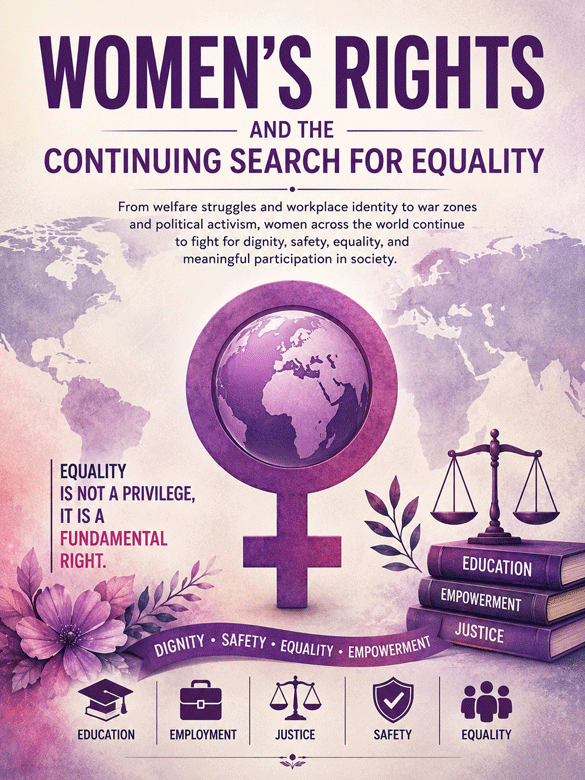
From welfare struggles and workplace identity to war zones and political activism, women across the world continue to fight for dignity, safety, equality, and meaningful participation in society.
Main Points
1. Women’s empowerment requires more than welfare schemes; true equality depends on education, employment, financial independence, and long-term social support.
2. Women continue to face discrimination and identity-based challenges in workplaces and public life, including debates around hijab, inclusion, and personal freedom.
3. Conflict, war, and instability affect women most severely, as seen in Gaza, Afghanistan, and Iran, where women struggle for survival, rights, healthcare, and freedom.
4. Despite hardships, women are emerging as leaders and change makers in policing, healthcare, education, activism, religion, and public service across many societies.
…………
Across the world, women continue to fight for something very basic yet deeply important: the right to live with dignity, safety, opportunity, and respect. Although remarkable progress has been made in education, healthcare, employment, and political participation, the reality is that millions of women still struggle against discrimination, violence, economic insecurity, and social barriers. The global conversation around women’s rights today is no longer limited to slogans or theoretical debates. It is about everyday survival, equal opportunity, freedom of identity, and the ability of women to participate fully in society without fear or exclusion.
Recent developments from different countries remind us that the condition of women often reflects the moral and social health of a nation itself.
In India, the recent verification drive under Maharashtra’s Mukhyamantri Majhi Ladki Bahin Yojana brought attention to the complicated realities surrounding welfare programmes for women. According to government reports, nearly 69 lakh beneficiaries were removed after failing to meet eligibility conditions or complete documentation processes such as e-KYC verification. While transparency and accountability are necessary for any welfare system, the situation also highlights a painful reality: countless women remain financially vulnerable and dependent on government support for survival. Welfare schemes may provide temporary relief, but true empowerment can only come through long-term investment in women’s education, employment opportunities, financial literacy, and skill development.
At the same time, another debate emerged in Uttar Pradesh after a teacher, Samreen Bano, alleged that she faced difficulties in employment because of wearing a hijab. The school administration denied the allegation and offered a different account of events, making it important to approach the matter carefully and fairly. Yet the discussion that followed raised larger questions about women’s identity, workplace inclusion, and the balance between institutional policies and personal freedom. Women should not feel forced to choose between professional participation and personal beliefs. A healthy society is one where women from different backgrounds feel respected, included, and confident in public spaces.
In regions affected by conflict and war, however, women face burdens far greater than workplace discrimination or economic hardship. The stories emerging from Gaza reveal unimaginable suffering carried largely by mothers and women struggling to protect their families amid destruction, displacement, hunger, and fear. Women there are not only caring for children under extremely difficult circumstances but are also coping with trauma, grief, and the collapse of healthcare and legal systems. Reports of mothers searching desperately for food, medicine, and psychological support for their children show how war attacks the most intimate parts of human life. For many women in Gaza, motherhood itself has become an act of courage and endurance.
The reduction in international aid has made these hardships even more severe. Women-led local organizations that once provided healthcare, counselling, legal assistance, and support for widows and displaced families are now struggling to survive with limited resources. These realities reveal an important truth: during humanitarian crises, women often become the backbone of communities, yet they are frequently left without adequate protection or support. In such circumstances, feminism is not merely an ideological discussion; it becomes a demand for survival, healthcare, justice, and human dignity.
Yet amid these struggles, there are also powerful signs of progress and resilience. In Jammu and Kashmir, more than 600 women were selected as part of one of the largest police recruitment drives in the region. Their inclusion reflects the growing role of women in public service, law enforcement, and national security. It also symbolizes changing social attitudes toward women entering professions traditionally dominated by men. Every woman who joins such institutions not only strengthens the system itself but also inspires younger generations to dream beyond social limitations.
Still, progress remains incomplete while violence against women continues across many societies. In Bangladesh, reports of a woman being assaulted over dowry demands once again exposed the cruel persistence of harmful social practices. Despite laws and awareness campaigns, dowry-related abuse continues to destroy lives and rob women of safety and dignity in parts of South Asia. Such incidents remind us that legal reforms alone are not enough. Real change requires education, stronger protection systems, and a transformation in social attitudes toward women.
The condition of women in Afghanistan also continues to raise serious international concern. At a recent meeting in Geneva, activists and United Nations experts discussed justice, reconciliation, and Afghanistan’s political future. Participants expressed alarm over restrictions affecting women’s education, employment, and participation in public life since the Taliban returned to power. Afghan women athletes living in exile have also appealed for international recognition and support. These developments demonstrate how deeply women’s empowerment is connected to access to education, sports, and public participation. No nation can truly progress while half its population is denied the right to contribute openly and equally.
In Iran, ongoing reports concerning female political prisoners and restrictions on activists have again drawn international attention. Human rights organizations continue to raise concerns about prison conditions, healthcare access, and legal protections for detainees. The case of Nobel laureate Narges Mohammadi, who was hospitalized after health concerns, has renewed global discussions on women’s rights, freedom of expression, and humanitarian protections. Women activists in Iran continue to stand at the centre of broader struggles related to civil liberties and social reform.
At the same time, there are also encouraging examples of societies recognizing and celebrating women’s contributions. In Malaysia, Prime Minister Anwar Ibrahim paid tribute to nurses on International Nurses Day, acknowledging the dedication of healthcare workers, many of whom are women. Similarly, community initiatives such as the Mother’s Day Saree Walkathon in Penang celebrated women’s empowerment, health awareness, cultural identity, and social unity. These efforts may appear small compared to global crises, but they help create positive spaces where women’s achievements are recognized and valued.
In Saudi Arabia, the introduction of a women’s section in the King Abdulaziz International Qur’an Competition marks an important step toward expanding opportunities for female participation in religious and educational platforms. Saudi women students participating in international science competitions also reflect the growing visibility of women in academic and scientific fields. These developments show that when societies invest in women’s education and talents, they strengthen their own future.
The global Women Peace and Security Index continues to reveal that countries affected by war, poverty, instability, and weak institutions remain among the least safe places for women. In such environments, women often struggle to access healthcare, education, employment, justice, and personal security. This reality makes one thing clear: women’s safety and equality cannot be separated from peace, stable governance, and social development.
Ultimately, the issue of women’s rights is not only a “women’s issue.” It is a human issue, a social issue, and a moral issue. A society cannot truly call itself progressive while women continue to face barriers to safety, opportunity, and dignity. Feminism, at its core, is not about superiority or division; it is about fairness. It is about ensuring that women are respected equally, treated justly, and given the freedom to participate fully in social, economic, political, cultural, and intellectual life.
The stories emerging from India, Gaza, Afghanistan, Iran, Bangladesh, Malaysia, Saudi Arabia, and many other parts of the world reveal both the achievements women have made and the challenges that still remain. But they also remind us of something deeply important: women are not merely victims of suffering. They are leaders, educators, mothers, activists, officers, professionals, athletes, caregivers, and builders of communities. Even in the face of discrimination, conflict, and hardship, women continue to hold families together, strengthen institutions, and inspire social change.
The future of any nation depends greatly on how it treats its women. Genuine progress can only be achieved when women are given equal access to opportunities, protected from violence and discrimination, and respected as equal members of society. Supporting women’s rights is therefore not simply an act of justice for women alone; it is an investment in stronger, healthier, and more humane societies for everyone.
Sources of reports:
1. 4,000 Youth, 600 Women Join J&K Police; DGP Vows Fight Against Pak-Sponsored Terror
2. Maharashtra Removes 69 Lakh Women From Ladki Bahin Scheme After Verification Drive
----------
Kaniz Fatma is an Islamic scholar (Alimah & Fazilah) and a regular columnist for New Age Islam.
URL: https://newageislam.com/islam-human-rights/women-rights-search-for-equality-/d/140010
New Age Islam, Islam Online, Islamic Website, African Muslim News, Arab World News, South Asia News, Indian Muslim News, World Muslim News, Women in Islam, Islamic Feminism, Arab Women, Women In Arab, Islamophobia in America, Muslim Women in West, Islam Women and Feminism