
The Scio-Moral Implications of the Hilf al- Fudul

By Dr Zafar Darik Qasmi, New Age Islam
8 December 2025
Abstract:
The Hilf al-Fudul was a historic agreement in Mecca that brought major moral and social changes. It focused on justice, teaching that fairness is a human value, not limited to tribe, religion, or wealth. The pledge made sure that anyone who did wrong, whether rich or from an important family, would be held responsible. It also protected the rights of weak people, like slaves or foreign traders. Later, this idea became an important part of Islam’s teachings.
The pledge also introduced the concept of mutual cooperation. People were encouraged to rise above personal interests and work together for collective good. Cooperation created awareness, unity, and moral responsibility, helping to fight oppression and establish peace. Mecca’s tribes learned that true strength comes from unity, not individual power. The Hilf al-Fudul remains a timeless example, showing that justice, solidarity, and compassion are the foundations of a strong, ethical, and peaceful society.
Main Points:
1. Justice must be fair for all, regardless of tribe, wealth, or social position.
2. Standing against oppression is everyone’s moral responsibility, not just the strong or wealthy.
3. Mutual cooperation strengthens society, promoting unity, compassion, and collective awareness.
4. Personal interests should be set aside to achieve fairness and social welfare.
5. True societal strength comes from unity, solidarity, and shared ethical values, not individual power.
-----
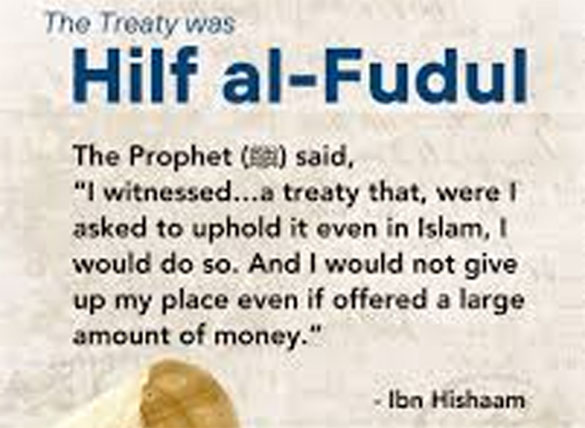
Hilf al-Fudul laid the foundation for many moral and social changes in Arab society. Some important aspects are as follows:
Establishment of Justice
Justice is the foundation for the survival and security of human society. It is the pillar on which civilisation, morality, and peace are built. When justice disappears, oppression, corruption, and chaos arise. The Hilf al-Fudul Al- was the first bright step towards establishing justice in the unjust environment of Arabia.
This agreement was made at a time when power was considered the law, and the cries of the weak went unheard. A few conscientious people vowed that no oppressed person in Mecca would be left alone. The pledge showed that justice is not about a person’s tribe, religion, or family, but about treating all people fairly.
Whether the oppressor belonged to the Quraysh, Banu Hashim, or Banu Zuhrah, they could be held accountable. Likewise, whether the victim was a foreign merchant or a slave, protecting their rights was a shared responsibility. This principle later became part of the core beliefs of Islam. The Quran says:
يَآ اَيُّـهَا الَّـذِيْنَ اٰمَنُـوْا كُـوْنُـوْا قَوَّامِيْنَ بِالْقِسْطِ شُهَدَآءَ لِلّـٰهِ وَلَوْ عَلٰٓى اَنْفُسِكُمْ اَوِ الْوَالِـدَيْنِ وَالْاَقْرَبِيْنَ ۚ اِنْ يَّكُنْ غَنِيًّا اَوْ فَقِيْـرًا فَاللّـٰهُ اَوْلٰى بِـهِمَا ۖ فَلَا تَتَّبِعُوا الْـهَوٰٓى اَنْ تَعْدِلُوْا ۚ وَاِنْ تَلْوُوٓا اَوْ تُعْـرِضُوْا فَاِنَّ اللّـٰهَ كَانَ بِمَا تَعْمَلُوْنَ خَبِيْـرًا.( النساء: 135)
"O you who believe! Stand firmly for justice, as witnesses for Allah, even if it is against yourselves, your parents, or relatives. Whether the person is rich or poor, Allah is more worthy of both. So do not follow your desires to be unjust. And if you distort your testimony or refuse to give it, indeed Allah is aware of what you do."
This verse reflects the spiritual continuity of the Hilf al-Fudul, which was based on the universal concept of justice.
For the first time, the pledge introduced the idea of collective justice in Arab society. Previously, justice depended on the strength of a tribe — the powerful were protected, and the weak were denied justice. The pledge declared that raising a voice against oppression was everyone’s collective duty. Justice became a human value, not a personal privilege.
Justice and unity are not merely legal principles in Islam but also moral and spiritual duties. Hilf al-Fudul teaches that a society can only become civilized when justice is the same for all — the strong and the weak, the rich and the poor, locals and foreigners. Until justice is the foundation of decisions, society cannot achieve true peace. The pledge left a timeless message: justice guarantees peace, and standing against oppression is everyone’s moral responsibility.
The Concept of Mutual Cooperation
The real strength of human society lies in mutual cooperation, unity, and collective awareness. When people or groups rise above personal interests, prejudices, and social divisions to work together for goodness, the society moves towards development, justice, and peace.
The Hilf al-Fudul was the first clear example of this principle in practice. Before that, Meccan society was divided along tribal lines. Each tribe cared only for its own honour and interests. If someone from another tribe was oppressed, people would remain silent, saying, “It’s not our matter.” This selfish attitude caused social injustice to grow.
However, when a foreign merchant was oppressed and no one defended him, the conscience of a few noble individuals woke up. They realised that if people did not share each other’s pain, the city would become a hub of oppression.
The pledge was the first formal declaration of mutual cooperation. It marked the moment when personal interests were set aside for a common human purpose — justice. The pledge stated that society can only be strong when people work together for collective welfare.
Islam later included this principle as part of its moral code. The Quran says:
وَ تَعَاوَنُوْا عَلَى الْبِرِّ وَ التَّقْوٰى ۪-وَ لَا تَعَاوَنُوْا عَلَى الْاِثْمِ وَ الْعُدْوَانِ۪ ( المائدہ: 2)
"And cooperate in righteousness and piety, and do not cooperate in sin and aggression."
This verse captures the spirit of the Hilf al-Fudul in a universal principle. Cooperation is not temporary; it is a requirement of faith — but it must be in good, just, and righteous deeds.
Mutual cooperation brings three major changes to society:
1. It creates collective awareness, encouraging people to share the pain of others instead of being selfish.
2. It promotes unity and harmony, breaking systems of oppression and injustice.
3. It fosters moral consciousness, establishing an environment of justice and compassion.
Hilf al-Fudul taught the divided tribes of Arabia that strength lies not in a single tribe but in unity. When different tribes came together to support the oppressed, it laid the foundation of a new era of justice in Mecca. This lesson remains timeless: if people unite for humanity, they can overcome any system of oppression. Mutual cooperation is not just a social need but a human dignity, and this spirit made the Hilf al-Fudul a comprehensive charter of unity and goodwill in history.
Also Read: Hilf al-Fudul — The First Collective Struggle for Human Rights in Makkah
----
Dr. Zafar Darik Qasmi is an author and a New Age Islam Regular Columnist.
URL: https://www.newageislam.com/islam-human-rights/scio-moral-hilf-al-fudul/d/137929
New Age Islam, Islam Online, Islamic Website, African Muslim News, Arab World News, South Asia News, Indian Muslim News, World Muslim News, Women in Islam, Islamic Feminism, Arab Women, Women In Arab, Islamophobia in America, Muslim Women in West, Islam Women and Feminism