
Hilf al-Fudul — The First Collective Struggle for Human Rights in Makkah

By Dr Zafar Darik Qasmi, New Age Islam
6 December 2025
Abstract:
The agreements made by the Holy Prophet ﷺ show that unity, justice, and peace are the true foundations of a successful society. Before prophethood, Arab society was filled with tribal conflict and oppression, but the Prophet ﷺ supported every effort that protected human rights. Hilf al-Fudul became a turning point, as it provided justice to oppressed people without discrimination. After the migration to Madinah, the Constitution of Madinah united Muslims, Jews, and other tribes through justice, religious freedom, and shared responsibility. Later, the Treaty of Hudaybiyyah proved that long-term unity can be achieved through peace and wisdom instead of war. These agreements reduced conflict and built strong relationships among communities. They teach us that progress and stability are possible only when society follows justice, cooperation, compassion, and mutual respect. If these principles are adopted today, the Muslim world can regain peace, harmony, and global respect.
Main Points:
1. Unity is a practical system based on justice, compassion, and cooperation — not emotional slogans or speeches.
2. Hilf al-Fudul protected every oppressed person in Makkah, regardless of tribe, race, or religion.
3. The Constitution of Madinah united Muslims and non-Muslims under justice, freedom, shared rights, and responsibilities.
4. The Treaty of Hudaybiyyah proved peace, patience, and wisdom are stronger than conflict and war.
5. The Muslim world can resolve internal disputes today by reviving prophetic values of unity and fairness.
-----
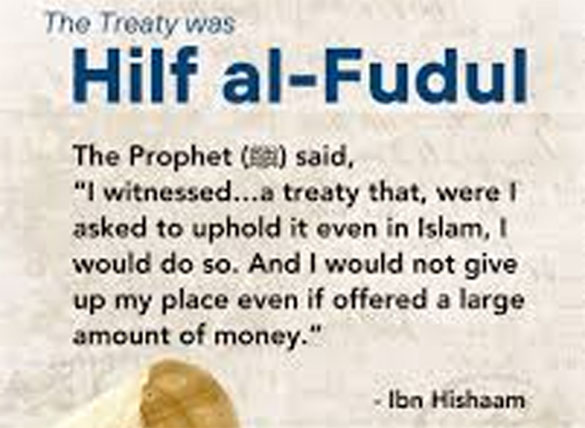
The agreements made by the Holy Prophet ﷺ show that unity and solidarity are not limited to any particular tribe or nation. They aim to promote peace, justice, and respect for all human beings. Before the Prophet ﷺ received prophethood, Arab society suffered from tribal conflicts, class inequality, and oppression. In such a difficult atmosphere, the Prophet ﷺ supported every effort that protected human rights, helped the weak, and brought harmony to society. Among these efforts, the Hilf al-Fudul stood out as an important step, because its purpose was to provide justice to every oppressed person regardless of tribe, race, or religion. The Prophet ﷺ participated in this agreement with great sincerity and later said that even after prophethood, he would be willing to join a similar pact again.
After the migration to Madinah, the Prophet ﷺ established the Constitution of Madinah, which brought Muslims, Jews, and other tribes into one civic system based on justice, religious freedom, mutual defence, and collective responsibility. Later, the Treaty of Hudaybiyyah proved that permanent unity is achieved through peace, wisdom, and tolerance rather than through conflict.
Together, these agreements teach us that unity is not a slogan — it is a practical approach supported by fairness, cooperation, and respect. They reduced conflicts, strengthened relationships between different communities, and ensured social and political stability. They also show that peace and mutual respect should extend beyond Muslims and include non-Muslims as well. If the Muslim world follows these principles today, many internal disputes can be removed, and Islam can once again represent peace and human welfare on a global level.
Early Efforts for Peace and Unity
At the time of the rise of Islam, the world was full of chaos, injustice, and moral decline. The Prophet ﷺ realised that no society can grow or flourish without peace. A peaceful environment leads to good character, progress, and success for the whole community. Therefore, even before prophethood, the Prophet ﷺ took meaningful steps to protect human rights, eliminate injustice, and promote harmony.
Among these actions, the most remarkable was the historical pact of Hilf al-Fudul.
The Agreement of Hilf al-Fudul
Human society can only survive through justice, equality, and cooperation. When these values disappear, oppression and lawlessness take control. This was the condition of Makkah before Islam. There was no central authority or legal system, and powerful tribes exploited the weak. Foreign merchants were cheated, women were denied inheritance, and slaves were treated as property.
During this period, a Yemeni merchant sold goods to a chief of Quraysh, ‘As ibn Wa’il. The chief kept the goods but refused to pay. When the merchant sought support, various tribes stayed silent out of fear or bias. This injustice encouraged several honourable men of Makkah to take action. Five major tribes — Banu Hashim, Banu Zahrah, Banu Taym, Banu Muttalib, and Banu Asad — gathered in the house of Abdullah ibn Jud‘an and formed an agreement to protect every oppressed person.
They pledged:
“We are united to support every oppressed person in Makkah, whether local or foreign. We will stand against every oppressor until justice is served.”
Because of this agreement, the merchant finally received his payment, and a sense of collective justice appeared in Makkah for the first time.
Meaning of the Name “Hilf al-Fudul”
The word Hilf means agreement or pact. Scholars explain al-Fudul in different ways:
1. Some say it refers to three men named Fadl who participated in the pact.
2. Others say it comes from the word meaning virtue and excellence, because the agreement was based on pure goodness.
3. Some linguists say al-Fudul refers to people of noble character and virtue.
Thus, it may be called “The Alliance of Virtues” — an agreement founded for the protection of justice and human dignity.
(Reference: Qasmi, Zafar Darak (Dr.) Muhammad ﷺ ki Siyasi Dastavezaat aur Insani Huqooq, Mishkat Printers, Aligarh, 2017, pp. 32–33.)
Participation of the Prophet ﷺ
At the time, the Prophet ﷺ was about twenty years old. Belonging to the noble tribe of Banu Hashim, he was already known for honesty and high moral character.
When the meeting took place, the Prophet ﷺ participated actively and raised his voice for the oppressed with complete sincerity. This was one of the earliest major moral achievements of his life.
Later in life, the Prophet ﷺ recalled:
“I took part in a pact at the house of ‘Abdullah ibn Jud‘an that is dearer to me than red camels. If I were invited to a similar agreement today, I would surely join it.”
(Seerah Ibn Hisham, Vol. 1, p. 134)
These words prove that Islam is not merely a religion of rituals, but a complete moral system based on justice, unity, and human dignity.
----
Dr. Zafar Darik Qasmi is an author and a New Age Islam Regular Columnist.
URL: https://www.newageislam.com/islam-human-rights/hilf-al-fudul-human-rights-makkah/d/137916
New Age Islam, Islam Online, Islamic Website, African Muslim News, Arab World News, South Asia News, Indian Muslim News, World Muslim News, Women in Islam, Islamic Feminism, Arab Women, Women In Arab, Islamophobia in America, Muslim Women in West, Islam Women and Feminism