
World Media on Israeli Invasion of Gaza - Part 3
Compiled by New Age Islam Edit Bureau
21 July, 2014
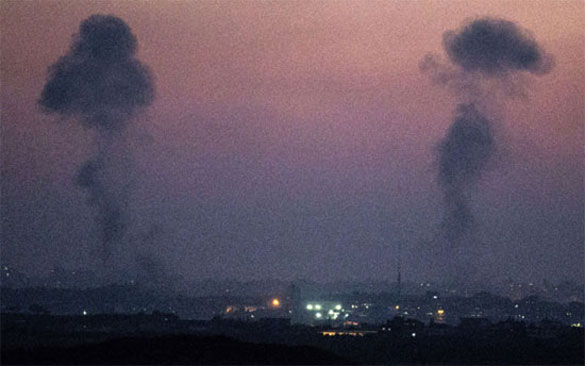
A picture taken from the southern Israeli Gaza border shows smoke billowing from buildings
--------
Articles:
• Gaza Bleeds amid a Fiery Intra–Islamic Civil War
By Eyad Abu Shakra
• Hitting Israel Where It Hurts, With BDS and Protests
By Yara Al-Wazir
• ISRAEL GETS A FREE HAND TO FINISH OFF GAZA
Ilnur Çevik
• Images of Gaza War Shift Perception of Israel
By Daoud Kuttab
• The War on Gaza, Hamas and the Israeli Far Right
By Raghida Dergham
• LEADERS ACROSS THE WORLD DIFFER WITH THEIR PEOPLE ON GAZA
By Meryem Ilayda Atlas
• SAVING GAZA FROM OUR FEARS
By Sadik Ünay
• Gaza Tunnels Take IDF by Surprise
By Shlomi Eldar
----
Gaza Bleeds amid a Fiery Intra–Islamic Civil War
By Eyad Abu Shakra
19 July 2014
The Palestinians have faced many tough situations over the years, but in most cases they have succeeded in winning the sympathy of their Arab brothers and most of the international community. They have a just cause, and the injustice done to them since 1948 is unquestionable. Only sceptics with their own personal agenda would ever seek to deny that injustice.
The same thing must also be said about the injustice done to the Jewish people over the centuries. Unfortunately, today we see two wronged peoples, the Palestinians and the Israelis, locked in an existential conflict. This has happened because the moderate and reasonable voices have died down, and the two sides have become obsessed with victory over the other, if not each other’s complete annihilation.
I dare say that the many setbacks that have befallen the Palestinians are a partial excuse for the way they have lost faith in the international community, which the Palestinian people have found to be firmly biased in favour of their adversary. The people of this troubled land have also been let down by a fractured “Arab nation” that is now threatened with total fragmentation.
From ‘Democracy’ To ‘Militarisation’
I do wonder about the excuses the Israelis have to justify their descent from “democracy” to “militarization.” Since the June 1967 war set their de facto borders, they have had a number of military victories that have enabled them to occupy lands far larger than the entity demarcated in 1967.
The Palestinians have long failed to fully grasp the nature of the Zionist movement. This failure has multiplied since the founding of the Jewish state, but this has not been the fault of the Palestinians alone. The entire Arab world was swept away by the euphoria of “Arabism”—though they never quite succeeded in defining it—and so they were chasing after mere illusions and dreams. In their quest for “one Arab nation with an eternal message” stretching “from the Indian Ocean to the Gulf,” the Arabs were willing to sacrifice principal human values: freedom and dignity.
Thus Arabism, particularly in its revolutionary form, has become associated with two negative traits: demagoguery and political opportunism. The revolutionary tyrants in our part of the world successfully used this to put a glossy veneer on their backwardness, tribalism and sectarianism.
As the Palestinians are part of the Arab world, the Palestinian resistance was directly influenced by Arab interests. In spite of the pledge to support the Palestine Liberation Organization as the sole legitimate representative of the Palestinian people, in the wake of the 1967 defeat, several Arab regimes established their own client organizations under the PLO umbrella. The Palestinians, like many Arabs, were also an active part of the “international liberation movement” against “colonialism” and “imperialism,” towing the line of the Soviet Union and China in the face of the capitalist, imperialist West.
The ‘Arabist’ Mantle
Two influential moments in the Palestinian struggle were the death of Gamal Abdel Nasser, Egypt’s second president, and Anwar Sadat’s decision to draw Egypt closer to the U.S. Other related factors were the competition between the Baathists in Baghdad and Damascus, as well as the positions of Muammar Qaddafi’s Libya and Gaafar Nimeiry’s Sudan, about who was the rightful heir to Nasser’s “Arabist” mantle.
The Palestinian movement was further affected when Sadat, calling himself the “pious president,” began to exploit the forces of political Islam, using them as a weapon in his battle against the remnants of Nasserism and dimming the light of Arabism. The Camp David Accords struck another blow to the Arabist dream, enabling Hamas to rise at the expense of Fatah and the weakened Leftist organizations.
At the time, Israel was not particularly troubled by political Islam. It was fomenting internal battles in the Arab world between Islamists on one side and Arabists and Leftists on the other. The U.S. was also happy to support political Islam—even its jihadist element, as we saw in the Afghanistan war in the 1980s. That is to say, the emergence of Hamas was once seen as a rather positive development by Israeli and American strategic planners, who at that point were in a hurry to settle the Cold War in favour of the West.
The collapse of the Soviet Union and the Warsaw Pact would later become a game changer. The influence of the Left in the Muslim and Arab worlds shrank as a result of the Cold War’s end, and the Arab national identity fell apart in the face of the growing power of political Islam supported by the West. The awakening only came after the Afghan jihadists discovered they had been used as tools in the West’s war of attrition against Soviet communism: as soon as the jihadists were no longer useful, the West’s strategic goal became to put that genie back in its bottle.
Eye of the Storm
In the aftermath of the Cold War, the jihadist response would be worldwide suicide operations, reaching U.S. soil with the attacks on New York and Washington on September 11, 2001. From that point onwards, the game took a drastic turn. In the Middle East, Israel found itself in the eye of the storm.
At one stage, Israel had faced the threat of the Khomeinist revolution in Iran alongside its Western allies. But, seeing itself as part of the conflict between the U.S. and Iran, Israel started gradually to rethink its regional strategy. Rejecting the “land for peace” principle on which the international Arab–Israeli peace process is based, the Israeli right wing is today implicitly encouraging an intra-Islamic civil war between Sunnis and Shi’ites in the region.
The Iranian leadership, which is enviably pragmatic, discovered some time ago that there is an important intersection of interests between it and Israel. The Iran–Contra scandal was an early indication of Tehran’s pragmatism, based on the idea that “the enemy of my enemy is my friend.” Today, the intersection of Israeli and Iranian interests manifests itself in the war on “terrorists,” in Tel Aviv’s discourse, and against “takfirists” in the parlance of Iran.
The price Israel is demanding is, quite simply, enough to end any possibility of a viable Palestinian state. This can only be achieved by weakening an already imperiled moderate power in favor of an unacceptable armed Islamist movement. Regionally it requires, if only on a temporary basis, that Iran use its affiliates in Lebanon, Syria and Iraq for the protection of Israel’s borders. In return, I believe Iran is seeking full control of the Arab Mashreq, from the Gulf to the Mediterranean; it is also claiming leadership of the Muslim world on the principle of “the unity of the Umma.”
For the time being, Israel does not seem to be opposed to Iran’s aspirations and actions because it benefits if Tehran succeeds in protecting its borders, and benefits even more if Tehran’s failure intensifies the intra–Islamic civil war.
The Gaza tragedy can only be understood from this angle.
Eyad Abu Shakra (also written as Ayad Abou-Chakra) began his media career in 1973 with Annahar newspaper in Lebanon. He joined Asharq Al-Awsat newspaper in the UK in 1979, occupying several positions including: Senior Editor, Managing Editor, and Head of Research Unit, as well as being a regular columnist. He has several published works, including books, chapters in edited books, and specialized articles, in addition to frequent regular TV and radio appearances.
Source: http://english.alarabiya.net/en/views/news/middle-east/2014/07/19/Gaza-bleeds-amid-the-intra-Islamic-civil-war.html
-----
Hitting Israel Where It Hurts, With BDS And Protests
By Yara Al-Wazir
19 July 2014
The Israeli ground invasion into Gaza initiated this week has awakened the world to the reality of the situation. Protests and demonstrations have erupted around the globe in solidarity with the Palestinians, and demonstrations against the brutal occupation are underway.
While these protests play a vital role in pressuring both governments and media outlets to cover and react to the situation appropriately, there is no doubt that they will dwindle once the Israeli occupation pulls its troops out of the Gaza Strip. An extended form of silent political protest is needed to ensure that the Israeli government suffers as a consequence of its actions; we need to boycott, divest, and sanction.
The sad truth is that no matter how much we protest the occupation and demonstrate our solidarity with the Palestinian people, the road to war in Palestine was paved by the very countries we protest in. Resolutions can be issued, and they can also be vetoed. The boycott, divestment, and sanction movement (BDS) is not novel, but it is a way of putting on-going pressure on the Israeli economy in order for it to stop committing human rights atrocities.
It is an on-going movement that was started in 2005, and has been growing ever since. Primarily, it was designed to hurt the economic mobility that was brought on by the development of illegal settlements in the West Bank. BDS worked in apartheid South Africa, and with enough support, it can work in Palestine too.
BDS Makes Israel’s Stomach Rumble
Israel is the bully on campus who steals everyone’s possessions. And instead of protesting the theft, the BDS movement stops bringing the possessions in, thus, systematically starving the Israeli economy of illegal theft.
When Israel gets hungry, it gets worried. For years, Israeli government officials have been meeting and discussing methods of tackling the BDS movement, so much so that in 2011, Israel made it illegal to boycott Israeli goods.
There’s nothing controversial about civilians being murdered by Israeli missiles – what is wrong is wrong. However, Western celebrities have recently developed a habit of posting their support for Palestine, then retracting it on social networking sites.
Those who remain neutral in times of oppression are siding with the oppressor, and luckily, the BDS movement calls for public statements from celebrities, politicians, and musicians to voice their support for the Palestinian people. From world-renowned professors such as Stephen Hawking to Pink Floyd musician Roger Walters – support is solid, official, and instrumental in galvanising international attention.
Boycotting companies that profit from illegal settlements, divesting from these companies, and sanctioning their exports and imports is key to the success of the movement.
The ‘Legal’ Right to Protest
Whether the protests are authorized or not, they are dangerous. On health and safety levels as well as on a political level, I will be the first to admit that I am afraid of attending protests in fear of the repercussions that can haunt me in the future.
Not everyone can attend protests either – the time restraints, the length of the protests, and the locations make it difficult for many to take part. This is why BDS is needed now more than ever. It is the 21st century and time is precious.
The movement allows each and every individual, regardless of where they live or how old they are, to participate in a collective silent movement that will truly punish the Israeli government right where it hurts – its economy.
Yara al Wazir is a humanitarian activist. She is the founder of The Green Initiative ME and a developing partner of Sharek Stories
Source: http://english.alarabiya.net/en/views/news/middle-east/2014/07/19/Hitting-Israel-where-it-hurts-with-BDS-and-protests.html
-----
Israel Gets a Free Hand to Finish off Gaza
By Ilnur Çevik
19 July 2014
It is all done in the name of self-defence according to the U.S. and U.K. They are simply trying to justify what Israel is doing to the Palestinian people and the world is swallowing it.
Israel, armed with the aid it receives from Washington and other Western capitals, is not only raining bombs down on Palestinians in the midst of the holy month of Ramadan, but it has now launched a land offensive in the Gaza Strip to massacre people that it could not with its rockets.
The pretext, of course, is to eliminate Palestinian extremists, but once again the victims will be women, children and elderly Palestinians.
For days, even Western media has displayed photos and videos showing bodies of children killed by Israel bombs. Yet no one even feels the slightest remorse in these Western countries that call all this "an act of self-defence."
They all say Israel has a right to finish off Hamas while Israel is actually finishing off an entire nation by ethnic cleansing - and Western powers are an accomplice to this crime. Unlike the Syria, Palestine does not have Russia or China to back them at the useless body called the U.N. Security Council.
If any other country had done one tenth of what Israel is doing today against the Palestinians, Western powers led by the U.S. would make life hell for them. Yet here we see approval of what Israel is doing.
People who cherish democracy, freedom and civilized life have always looked upon the U.S. as a role model. Yet, with the current attitude of Washington, we see that they have clearly steered away from what makes the U.S. great and have turned their backs on the basic principles that the founding father set for them.
Yes, no one in the West dares tell Israel that enough is enough. But what about the Islamic world? What about the silence of Islamic countries? Prime Minister Recep Tayyip Erdogan was right in lambasting the Islamic world for its silence and inactivity as Palestinians continue to be butchered.
Turkish Religious Affairs (President Mehmet Görmez was right in saying that Israel also draws encouragement from the fact that the Islamic world is not only politically divided, but Muslims are killings other Muslims, and this only gives Israel a free hand to exploit this situation to finish off the Palestinians.
Israel does not want a Palestinian state. Israel does not want Palestinians to unite. Thus, as soon as Hamas and Fatah forged an agreement and united, Israel saw the danger of a united Palestine and created an alibi with the killing of three Israel teenagers and then the revenge killing of a Palestinian youngster to launch its operation that the Americans called an act of self-defence.
So first the Islamic world should put its house in order. Thus, the body of Turkish Religious Affairs has taken the bold move to bring together more than 180 leading Islamic scholars from around the world in Istanbul to chart a course to end the chaos in the Islamic world. Turks are doing their share of living up to God's expectations and the expectations of the Prophet Mohammed. Can members of the rest of the Islamic world say the same thing?
Without Muslims united, no one will take notice of the plight of Palestinians. No one should expect anything from the West.
Source: http://www.dailysabah.com/columns/ilnur-cevik/2014/07/19/israel-gets-a-free-hand-to-finish-off-gaza
------
Images of Gaza War Shift Perception of Israel
By Daoud Kuttab
July 18, 2014
War is often remembered by images. Who can forget the photograph of the Vietnamese girl running naked down a road after being exposed to US napalm bombs or the American sailor kissing an anonymous nurse in Times Square following the announcement of the end of World War II? For the current war on Gaza, two images that have gone viral and the stories behind them are reflective of the real price of war in terms of human suffering, unbridled hate and revenge.
The first image is of a young man carrying a dead Palestinian boy on the beach in Gaza and the tweet by NBC reporter Ayman Mohyeldin that he had just been playing soccer with the slain child and the three others killed along with him. The boys, ages 9, 10 and 11, were attacked by the Israeli navy for no reason other than they lived in the overcrowded and besieged Gaza Strip.
The second image was transmitted by a CNN reporter, of Israelis watching gleefully as the Israeli army mercilessly pounded Palestinians in Gaza with missiles. A tweet by the reporter Diana Magnay, which has since been deleted, stated, “Israelis on hill above Sderot cheer as bombs land on #gaza; threaten to ‘destroy our car if I say a word wrong’. Scum.”
More than anything else, these two images shatter two key narratives that Israel has worked so hard to perpetuate: first, that the war on Gaza is a war on terror and against Hamas militants who launch rockets at peace-loving Israelis, and second, that Israel is morally superior, a claim on which Israel has often prided itself. Israeli Prime Minister Benjamin Netanyahu boasted about this moral supremacy in his eulogy of the three Israelis killed near a Jewish settlement in an area under Israeli control in June. In his remarks, Netanyahu said that Palestinians “rejoice over the spilled blood of the innocent” and pronounced that “a deep moral abyss separates between us and our enemies. They sanctify death, we sanctify life. They sanctify cruelty, and we sanctify mercy.”
Pressure on the media and threats against journalists are nothing new. In the last war on Gaza, in November 2012, Israel was criticized by Human Rights Watch for singling out journalists and media buildings, calling these attacks war crimes. In the current war, members of the media continue to be targets. A clearly marked press vehicle belonging to Media24, which Al-Monitor’s Asmaa al-Ghoul had also been using, was struck by a missile on July 8, killing the driver. On July 17, three bombs from Israeli air raids hit a building housing media companies in Gaza City.
Some have argued that Magnay’s tweet was deleted because of a slur made against Israelis collectively. At the end of the tweet, the reporter had referred to those threatening to damage her car as “scum.” CNN later withdrew Magnay from Gaza because of her tweet and reassigned her to Moscow. The fact remains that this is one of the rare instances of the Western media showing a darker side of Israelis that few have ever seen.
Israeli attempts to paint those Israelis and others in Jerusalem chanting “Death to Arabs” as a reckless minority have not been convincing. When a handful of Palestinians pass out candy when Israelis are hurt, Israeli media and politicians have no problem painting all Palestinians as “sanctifying cruelty.”
The burning alive of Palestinian teenager Mohammad Abu Khdeir and the beating (captured on video) of his American cousin while subdued strike at Israel’s hollow claims of moral superiority. Such acts of brutality have marked Israel’s behaviour toward Palestinians and its other neighbours since its inception more than six decades ago. The difference between previous events and today is that there is now irrefutable video documentation exposing the Israelis' behaviour.
NBC’s Mohyeldin, one of Time magazine’s 100 most influential people, has been praised as for his professionalism and courage, but he is now nowhere to be seen on his network’s broadcasts. NBC Nightly News with Brian Williams did not feature Mohyeldin and his harrowing eyewitness testimony of the killing of the four boys he had been playing with on the beach. After the incident, NBC ordered Mohyeldin to leave Gaza, allegedly for security reasons, despite replacing him with another reporter, Richard Engel. Thousands of Mohyeldin supporters around the world have been tweeting the hashtag #letaymanreport and believe that replacing him with Engel was an attempt to control the narrative coming out of Gaza.
War is ugly and criminal by its nature, and the current one in Gaza is completely one-sided. The United Nations, and especially its Security Council, were created with the specific aim of preventing political conflicts from reaching the stage of war. There is no morality in war, and international humanitarian law has dedicated volumes to regulating how war should be conducted to protect the innocent and permit the media to work freely.
The images of this war may have shattered the carefully constructed narratives that Israel had created. Debunking these myths and showing the truth will do little to bring back the lives of the soccer-playing children and heal the hatred and animosity that such violence creates. Reporting the truth, however, goes a long way toward exposing false narratives and identifying the criminals perpetuating such conflicts. Despite attempts to silence professional journalists telling the story as accurately as they can in Gaza, the truth will come out.
Source: http://www.al-monitor.com/pulse/originals/2014/07/gaza-israel-war-ayman-mohyeldin-nbc-diana-magnay-cnn.html#ixzz381w2cTo2
--------
The War on Gaza, Hamas and the Israeli Far Right
By Raghida Dergham
20 July 2014
It is no secret that Qatar and Turkey are very close to Hamas, the de facto ruler of the Gaza Strip, and that this trio's relations with Egypt under President Abdel Fattah al-Sisi are marred by tension, if not outright hostility. Previously, former President Mohammad Mursi, who led the Muslim Brotherhood project in Egypt, was the fourth complement of the trio.
Iran is Hamas's ally, and supplies it with rockets not because it is fond of the Muslim Brotherhood, but because it sees Hamas as an important part of its strategy of "resistance for the sake of one-upmanship" with the Palestinian Authority and its President Mahmoud Abbas, as well as other Arab governments. Iran converges with Qatar and Turkey in the desire to block Egypt's bid to restore its leading regional role and anything that can help it restore the Arab weight in the regional balance of power, particularly since Egypt has the backing of Saudi Arabia and the United Arab Emirates in this endeavour. I believe Israel also converges with Iran and Turkey in their desire to exclude the Arab heavyweights from the regional balance of power, and therefore does not want Egypt to regain the ability to have an exceptional Arab and regional leadership role. Developments related to the Egyptian initiative for ceasefire between Israel and Hamas and for negotiations over Gaza, in light of Hamas and the Islamic Jihad's rejection of the initiative, no doubt have reasons related to Israel and its military machine that has killed more than 300 civilians. But there are also reasons related to their competition over positions not only in the traditional balance of power, but also over influence on militant groups, like the military wings of Hamas and the Islamic Jihad.
The problem in competing over mediation is that it will prolong the conflict, which has come at a heavy price for Palestinian civilians in Gaza because of the Israeli bombardment of civilian sites where Israel accuses Hamas of embedding its rockets. Clearly, there can be no comparison between the limited damage of the rockets fired by the Ezz al-Din al-Qassam brigades - Hamas' military wing - due the advanced Israeli anti-missile system, and the damage inflicted by the Israeli military machine, including killing hundreds and causing widespread devastation.
Caught In a Predicament
Israel and Hamas are caught in a predicament, no matter how much it may seem to them that they can achieve some kind of victory. Even if Israel destroys thousands of rockets and kills hundreds, Hamas would still have thousands of more rockets, and Israel cannot kill the entire population of Gaza. And beyond Hamas' attempt to boast of symbolic if not illusory victories in challenging the might of the Israeli military machine, Israel will remain a major military power capable of destroying Gaza's infrastructure, along with the destruction of half of the missile arsenal in Hamas's possession.
What has Israel achieved during Operation Protective Edge? Of course, Prime Minister Benjamin Netanyahu was able to end his isolation locally and internationally, rallying behind him the U.S. Congress and U.S. public opinion, which shows immediate bias in favor of Israel as soon as a rocket is launched at Israel. I believe the European public opinion sympathizes with the Palestinian victims more than its U.S. counterpart, but European governments stand against Hamas's rocket fire.
Israel Needs Hamas
However, Israel needs Hamas, no matter how much it claims to be its arch-foe. For Israel, Hamas is the security valve that prevents more radical groups from emerging in Gaza. In doing so, Hamas resembles the Palestinian Authority in fulfilling its obligations in accordance with the agreements signed with Israel - i.e. security coordination to prevent extremists from reaching Israel. It is no secret that direct communications between Israel and Hamas have taken place repeatedly.
Israel's dilemma is that it needs Hamas to prevent the arrival of groups like the Islamic State of Iraq and Syria (ISIS) to its doorstep, while at the same time, it insists on destroying Hamas' military capabilities and infrastructure in Gaza, and toppling the national reconciliation government that included members from both Hamas and Fatah in the Palestinian Authority.
Hamas for its part has given ammunition to the Netanyahu government and the Israeli far right, including its political, pro-settler, and military components. On the one hand, Hamas understands that the Israeli right needs it to be very militant, and wants it to become even more militant, to use it as a pretext to justify its demographic schemes, namely, the forcible transfer of Palestinians from Israel, the West Bank, and Gaza to implement the project of Jordan as the Palestinians' alternative homeland. On the other hand, Hamas fulfils the requirements of this project carelessly, while believing or claiming to be challenging it.
Perhaps Hamas can claim to have staged a comeback in the international media arena and in the collective Arab mind, which awakens when it sees the scenes of Israeli brutality against innocent civilians, and perhaps sees rockets launched against Israel as honourable resistance and strength. But the problem is that Hamas' wager on automatic Arab sympathy is misplaced, and the Egyptian public opinion is the best example as it holds Hamas responsible. The problem is that this approach is costly for the Palestinians, as things will go back the way they were before without any achievement of victory to speak of.
Some may say that the third Gaza war should lead Israel to lift the siege on the Strip and end its arbitrary and punitive measures against the coastal enclave. This is something that Israel must indeed do; however, unfortunately, there is no sign that the United States and the international community plan to put pressure on Israel to end these practices. Instead, Hamas's brandishing of its arsenal could increase sympathy with the Israeli blockade of Gaza, and herein lies the dilemma.
There are those who believe that Hamas would like it if Israel invades Gaza by land, as this would force the United Sates to intervene in earnest to find political solutions, and force the Arab countries to seriously revive their interest in Palestine.
Perhaps, what Hamas wants most of all is to force Egypt to open the Rafah crossing to gain access to various kinds of aid, especially those that arrive in the form of bags of cash. But Egypt does not want Israel to throw Gaza into its lap, and does not want Hamas to force its hand to open the Rafah crossing, so that Hamas, Iran, and others can take advantage of the opportunity to embarrass Egypt into adopting measures it does not want.
Hamas and Islamic Jihad have rejected the Egyptian initiative for a ceasefire, ahead of receiving Israeli and Palestinian delegates to discuss broader demands related to a permanent truce, including lifting the siege and the economic blockade on Gaza, as well as the future of the relationship between Gaza and the West Bank. The rejection was part of the strategy of escalation, in a drama that Hamas has found to be beneficial.
But the deeper reason is that Hamas wanted not to put the ball in the Egyptian court that it doesn't trust, and for Abdel Fattah al-Sisi not to be the broker of ceasefires and truces. Hamas wanted to bargain publicly in order to get the Rafah crossing opened. It is possible that Hamas coordinated its steps with Turkey and Qatar before it declared its rejection of the initiative. For one thing, both countries share Hamas's desire to prevent Sisi from benefiting from brokering ceasefire and mediating in the Palestinian-Israeli issue.
Politically, Mahmoud Abbas needs both Saudi Arabia and Egypt. The first was the one to propose the Arab initiative that challenges Israel to choose peace, and the second for its direct influence across the border with Gaza.
Iran, as usual, is subtly present in the drama as well. Some of Hamas's rockets are locally made, but an important part of them were imported from Iran. However, the United States has refrained from holding Iran accountable over this, and preferred, at least in public, to turn a blind eye to the Iranian role in Gaza because the priority for the Obama administration is to conclude a nuclear deal with Iran.
We do not know if U.S. Secretary of State John Kerry had limited the agenda of his bilateral talks with his Iranian counterpart Javad Zarif in Vienna this week to the nuclear issue. However, there are no indications that Kerry raised the issue of the Iranian role in Gaza and Tehran's consistent intervention to block the peace process between the Palestinians and the Israelis, though its one-upmanship practiced in the name of resistance.
Yet Israel does not need Iran to proceed with the destruction of any serious peace process, preferring to engage in a perpetual process because the Israeli government is unwilling to accept a real two-state solution. Israel is unprepared either because it is dominated by extremism or because it does not feel the need to make any concessions to achieve the two-state solution. No one is forcing it to.
Mahmoud Abbas is a victim of Israel, Iran, and other regional and Palestinian players, and is certainly a victim of himself for having gone too far in avoiding deadlines and implementing promises. He now appears weak and marginal in the eyes of the Palestinian and international public opinions equally.
The International Criminal Court card is nearing expiry, having been used then withdrawn and then overstated. Perhaps Israel has now recruited enough international law experts to thwart the momentum and results of Mahmoud Abbas's bid to resort to the ICC to prosecute Israel for war crimes. What matters is that Mahmoud Abbas could still take a step toward the ICC, but most likely, he will not go all the way.
The Question to Examine
Palestinian officials speak today about the right to international protection for the civilians under occupation, and they are correct in believing that this is stipulated in international agreements such as the Fourth Geneva convention. They have appealed to the United Nations, and they are right, because the British mandate had made Palestine the responsibility of the international organization when it left, and the United Nations agreed. However, it will not be wise to just appeal and call for concerted efforts. Before making such an appeal, the Palestinian leadership must think thoroughly about its options, the mechanisms, and the methods of implementation, before asking Ban Ki-moon or the Security Council to intervene haphazardly and without a mechanism for implementation.
Whenever things deteriorate and the conflict escalates, a growing number of people seek to play a role, either to contain the situation or in bringing new ideas. Perhaps there is a chance to think in terms that go beyond ceasefire following the recent escalation in Gaza. However, no one is coming up with major ideas outside the traditional box.
What does Israel ultimately want? This is the most important question that Palestinians must examine profoundly, and develop scenarios and strategies to answer it. The Palestinians want the two-state solution, though this does not apply to their totality, as there are factions among them that also reject the two-state solution, just like the Israelis do. There are also Israelis who are determined to abolish the word "occupation" from the international lexicon, starting with the media and not ending with international resolutions. So what is the purpose behind this? What is the Israeli strategy here?
Gaza is paying the price as usual. It is being subjected to Israeli retribution and an attempt to teach it lessons using the blood of its children, while its leaderships stage a defiant challenge without a clear exit strategy.
Raghida Dergham is Columnist and Senior Diplomatic Correspondent for the London-based Al Hayat, the leading independent Arabic daily, since 1989. She writes a regular weekly strategic column on International Political Affairs. Dergham is also a Political Analyst for NBC, MSNBC and the Arab satellite LBC. She is a Contributing Editor for LA Times Syndicate Global Viewpoint and has contributed to: The New York Times, The Washington Post, The International Herald Tribune and Newsweek Magazine. She serves on the Board of the International Women's Media Foundation, and has served on the Advisory Council of Princeton University's Institute for Transregional Studies of the contemporary Middle East, North Africa and Central Asia. She was also a member of the Women's Foreign Policy Group. She addressed U.N. General Assembly on the World Press Freedom Day when President of The United Nations Correspondents Association for 1997 and was appointed to the Task Force on the Reorientation of Public Information by U.N. Secretary General Kofi Annan. She moderated a roundtable of 8 Presidents and Prime Ministers for U.N.CTAD at Bangkok in 1991. Dergham served as Chairman of the Dag Hammarskjold Fund Board in 2005.
Source: http://english.alarabiya.net/en/views/news/middle-east/2014/07/20/The-war-on-Gaza-Hamas-and-the-Israeli-Far-Right.html
-----
Leaders across the World Differ With Their People on Gaza
By Meryem Ilayda Atlas
21 July 2014,
Yesterday, there were massive protests around the world - even in Israel - in support for the people of Gaza. Thousands took to the streets in London. Even in France, where a ban is in place, people felt the urge to voice their anger. In the capitals of the U.S., Sweden, Norway, Germany and Spain, tens of thousands of people protested the Gaza offensive outside Israeli embassies and at squares. Bloodstained shrouds, posters, slogans and anger stood out during the protests. Since the beginning of Israel's large-scale ground offensive, massive protests have been taking place at the Israeli consulate and residence in Istanbul and Ankara.
The Gaza Strip was being bombarded from both air and sea while these lines were written - Gaza City and Rafah were hit by heavy shelling. Israel has called up 65,000 army reservists since the beginning of July and it is reported that the offensive might be expanded.
Speaking on the ground offensive, Turkish Foreign Minister Ahmet Davutoglu said, "We condemn Israel launching a ground offensive now, which comes after the barbarous murders it has committed through air raids. We will start an initiative for an extraordinary meeting of the U.N. Security Council. In Jeddah and New York, we will also call for the Organization of Islamic Cooperation and the U.N. Human Rights Council to convene an emergency session."
Hamas spokesman Sami Abu Zuhri said Israel's ground invasion will have "dreadful consequences" for Israel. There is significant anger from across the world, but there are serious doubts about what these "dreadful consequences" might be. Humanity's conscience is being tested once again over the Palestinian issue because the same scenes are played out every year, only to be set aside and then forgotten after a while.
Reactions against Israel hardly go beyond rhetoric as European leaders and the U.S. still openly support Israel and public opinion seems to have no influence. The positive remarks and words of support for Palestine are just that … words. However, when it comes to Israel, words of support are followed by tangible action. This being the case, the people follow their conscience and take to the streets while their leaders pay lip service to their constituents and continue with their policies in support of Israel.
Mehmet Görmez, the head of Turkey's Directorate of Religious Affairs, issued a declaration on sectarian divisions and conflicts on Saturday as part of the three-day World Islamic Scholars Initiative for Peace, Moderation and Common Sense Summit. The community of Islam and common ground among Muslims were emphasized in the declaration. A call for joint action regarding Muslims in conflict regions across the world was made. Following the declaration, scholars, representatives and opinion leaders from around the world were asked about their views. The most common response was on Gaza and that there is a need to take concrete steps toward peace. There was palpable anger and a call for action against Israel from the Islamic world. Still, the same lack of principles is dominant in the countries of these scholars. Political leaders from Syria, Lebanon, Egypt and other Muslim countries are just as silent as their Western counterparts.
Merkel's Germany or el-Sissi's Egypt may be largely silent on Gaza, but their people are on the streets, which separates the people from their leaders.
Source: http://www.dailysabah.com/columns/meryem-ilayda-atlas/2014/07/21/leaders-across-the-world-differ-with-their-people-on-gaza
-----
Saving Gaza from Our Fears
By Sadik Ünay
19 July 2014
Following the euphoria of the false dawn triggered by signs of public awakening in the Middle East wrongly dubbed the Arab Spring we are sadly back to the vicious circle of wars, domestic strife and human suffering. The series of backlashes that eliminated any hope for a regional revival started with the civil war in Syria, continued with the bloody military coup in Egypt, expanded with Islamic State of Iraq and al-Sham-led chaos in Iraq and reached its usual destination, Palestine, with the third major bombardment and land occupation of Gaza by Israel in the last six years. Still using the suspicious deaths of three Israeli settler teenagers – which were not concretely attributed to Hamas – as a pretext, Israel launched a major military assault on Gaza falsely codenamed, Operation Protective Edge. The hysterical response of the Netanyahu government to order a vicious and comprehensive campaign against Hamas in the West Bank and East Jerusalem along with the indiscriminate bombardment of Gaza reflects the dominant aggressive public mood in Israel, but there seems to be a wider strategic plan that has long been in the making.
On the surface, the Israeli state blatantly abuses the principle of self-defence in international law by unleashing the whole capacity of its military machinery on 1.7 million helpless Palestinian civilians living under siege and deprivation in Gaza. It is not surprising that the international community including the U.N., U.S. administration and Western governments, as well as mainstream media insist that Hamas stop the (rather amateurish) rocket attacks, while Israel was only politely requested to show "maximum restraint." But the grim humanitarian reality on the ground is that so far, more than 250 Palestinian civilians, most of them women and children, have lost their lives and more than 2,000 are wounded. Should the conflict continue at full pace with the recently launched land operation for a considerable period of time, the number of civilian casualties is destined to rise dramatically.
At a deeper level, Israel's political motives for launching this operation include punishing the Palestinian leadership for achieving a degree of reconciliation between the Palestinian Authority and Hamas, further marginalizing Hamas as a so-called "terrorist organization" and destroying the chances of a two-state solution. Israel is also seeking to bolster its settlements policy during the current period of chaos and shift responsibility for the collapse of direct negotiations to the Palestinian side. Despite strong reactions coming from individual states such a Turkey, Iran, Chile and Venezuela, the muted response of the international community to the latest humanitarian crimes in Gaza confirmed once again that the balance of power and geopolitical alignments determine diplomatic attitudes of major global actors, rather than notions of justice and legitimacy. This is more so when it comes to flashpoints like Gaza, complicated conflicts such as the Israel-Palestinian conflict and regional contexts such as the conflicts across the Middle East.
Therefore, the Palestinian cause for justice, dignity and self-determination can only be advanced through global activism aimed at pressuring governments to penalize Israel with concrete policy instruments including trade boycotts, suspension of aid and embargos against arms exports. On our side, the principled stance of Turkey based on the protection of human dignity and peaceful means for conflict resolution is commendable in the midst of ongoing mayhem in Gaza. This stance may not be sufficient to change the grim regional outlook in the Middle East, but at least provides some degree of hope for a better future. Concerted action against repeated and unlawful aggression on the part of Israel, which behaves like an "anachronic colonial state," should start from demystification of its endless power perception and alleviation of various fears in the Muslim world.
Source: http://www.dailysabah.com/columns/sadik_unay/2014/07/19/saving-gaza-from-our-fears
-------
Gaza Tunnels Take IDF By Surprise
By Shlomi Eldar
July 20, 2014
The ground phase of Operation Protective Edge raises many questions that will require answers once the campaign is over. Was Israel aware of the extent and scope of the Hamas terrorist tunnel project? Was the Israeli military establishment aware of it, and if so, did it provide Israel’s decision-makers with a comprehensive — or even a near comprehensive — account of the dozens of high-quality tunnels being excavated between the Gaza Strip and Israel, which would be put into use once the order arrived? Did the Israeli political echelon know about these tunnels? Were they silent about them? Were they showing restraint? And if so, why?
On the eve of its incursion into the Gaza Strip, Israel agreed to an Egyptian outline for a cease-fire to restore calm. It was only after 13 militants from the Izz ad-Din al-Qassam Brigades penetrated Israel in an attempt to launch a terrorist attack in Kerem Shalom that the Israel Defense Forces (IDF) got the green light to begin a ground assault. And it was only then that soldiers discovered there was an underground Gaza just like there was an aboveground Gaza, and that the Hamas movement had invested an enormous amount of resources into constructing that underground Gaza.
Prime Minister Benjamin Netanyahu was very wary of defining his precise objectives to end Operation Protective Edge. Instead, both he and his government are making do with more general goals, such as “removing the rocket threat” and ''restoring quiet to the citizens of Israel.” It was only following the failed infiltration operation and during the UN-sponsored five-hour humanitarian cease-fire that it became clear how pressing and urgent the tunnel threat really was, and that it could pose an even greater threat to Israel than Hamas’ rockets.
No Iron Dome air defence system has been found as of yet to counter these terrorist tunnels. Furthermore, in the race against time, there can be no doubt that Hamas managed to get a step ahead of Israeli preparedness. In a background briefing for journalists, an IDF source stated on July 19 that it is questionable whether the army will be able to locate all of the tunnels. This only testifies to the degree that the IDF was surprised by the scope and size of the assault tunnels that Hamas created along the border with Israel.
It was suddenly revealed that there are two Gazas: One is the crowded, impoverished and faltering Gaza, but there is also an “underground Gaza,” buried deep below the surface. As of now, the IDF has located 36 tunnels, but even during the current fighting, with the IDF still searching the area, terrorists have been sent to launch attacks deep in Israeli territory through tunnels that have yet to be discovered. According to the security source’s assessment, these are enormous tunnels, the planning and preparation of which probably lasted approximately three years. The cost of excavating, reinforcing and maintaining each tunnel is approximately $1 million, and as far as is now known, dozens of such quality tunnels were dug along the border between Israel and the Gaza Strip, from the northernmost part of the territory all the way to the south.
The Israeli exit of these tunnels is sometimes as far as half a kilometer beyond the Green Line. Over the years, once the tunnels were completed, they all required routine maintenance to ensure that they remained operational and hidden. It was even necessary to protect them from flooding during winter storms, a problem exacerbated by Gaza’s broken and collapsing drainage and runoff system. One can only wonder why Hamas — a movement that advocated the improvement of life quality for Gaza residents and offered them “change and reform” — did not even invest as little as one-hundredth of the cost of the tunnels to renovate Gaza’s sewage system. Instead, it invested in building more tunnels and rockets.
The Hamas Movement Has Developed Three Distinct Types Of Tunnels:
The first consists of the many hundreds of tunnels along the border between Gaza and Egypt, most of which were sealed recently by Abdel Fattah al-Sisi’s new regime. These are "economic tunnels." They are designed to bring merchandise and raw materials into Gaza from Egypt. Over the years, and especially after Israel’s withdrawal from the Philadelphian Corridor (the route running along Gaza’s border with Egypt), these tunnels served as an “underground railroad” of sorts to bring in weapons, including the vast stockpile of rockets that have accumulated in Gaza.
The second network of tunnels is complex and has multiple branches running off it. This network, which was burrowed beneath the cities and refugee camps of Gaza — Khan Yunis, Rafah, Jabaliya, and Shatti — was designed to hide the stockpile of rockets and launchers. At the same time, other tunnels were dug to provide protection to Hamas leaders and allow them mobility. Every single leader of Hamas, from its lowest ranking bureaucrats to its most senior leaders, is intimately familiar with the route to the security tunnel assigned to him and his family. The most senior leadership has its own specific tunnel, which serves as a “war room” in times of emergency, such as the current military campaign in the Gaza Strip.
When there are the tunnels along the border with Israel. These were intended to allow Hamas activists from the Gaza Strip to infiltrate deep into Israeli territory. Israel had already established a security fence along its border with Gaza, which has successfully prevented countless terrorist infiltrations and attacks. So the border tunnels were dug beneath the fence.
Much to the misfortune of the people of Gaza, Hamas has invested far more resources in “underground Gaza” than in “upper Gaza.” The border tunnels and the defensive tunnels intended to ensure the safety of the Hamas command cadre proved that the movement’s priorities were flawed. The movement was founded as a welfare organization, intended to provide for the needy of Gaza, but instead it invested its resources in its own needs, at the expense of the population. Anyone who voted for Hamas in the 2006 elections as a way of protesting Fatah’s corruption received a very different kind of corruption instead. The “change and reform” that Hamas offered its voters was invested in its tunnels at the expense of the people of Gaza.
But the tunnels extending into Israeli territory reveal another old-new aspect of Hamas’ behaviour and methodology. The motif of Shahada, or “martyrdom,” in the person of suicide bombers, has once again taken over the movement. During the second intifada, Hamas used all its force and means to encourage suicide attacks against Israel. To do this, it issued Fatwas (religious rulings) that made recruiting of suicide bombers and sending them on missions to kill Israeli civilians the fulfillment of God’s will. “Martyrdom” became a central motif in Hamas. It was so successful, in fact, that the movement’s leaders boasted that the demand for martyrdom exceeded available opportunities. Hamas was able to recruit “martyrs” to conduct suicide attacks in Israel at any given moment. It even produced a fatwa allowing it to recruit women to die as martyrs.
The entire Hamas system worked to promote and advance the theme of martyrdom. It emerged as its greatest weapon and, unfortunately, the most effective and destructive weapon that the movement had, too. Preachers in mosques used their sermons to speak about the importance of martyrdom (Fi Sabil Allah, “in accordance with Allah’s will”), until many people throughout the West Bank and Gaza sincerely believed that Allah wanted to be sanctified through the sacrifice of believers’ lives, and that only through martyrdom could they prove their loyalty and their faith. At the same time, the movement’s welfare system promised material enticements to the martyrs’ families, providing them with money and aid. Both were especially valuable during the intifada, because the economy had collapsed. Encouraged by Hamas, the motif of suicide was transformed into a heroic act of sacrifice for the sake of the entire Palestinian people and its liberation.
It was only after Israel assassinated the movement’s senior political leadership, starting with its founder Ahmed Yassin in March 2004 and followed by Abdel Aziz Rantisi the following month, that there was a dramatic change in Hamas. The encouragement of Shahada all but disappeared from the Hamas lexicon, and the rocket was sanctified instead. Ten years later, Hamas has returned to its ill roots.
The tunnels along the border with Israel are more than just an extensive engineering project that consumed considerable resources. It is a project that requires the training of hundreds of armed Izz ad-Din al-Qassam Brigades' militants to engage in face-to-face combat in Israeli territory, though the chances of returning alive from it are slim. According to the teachings of Hamas, Ash-Shahada Fi Sabil Allah, “Death upon the order of Allah to sanctify His name,” has become the combat doctrine used to train the movement’s most elite units.
Hamas operated beneath Israel’s radar when it embarked on its extensive project to dug these tunnels, but at the same time, it also had to prepare its people for what these tunnels meant. Without preparing a cadre of martyrs, who agree to sacrifice their lives for the sake of jihad with Israel, the vast network of tunnels is neither effective nor efficient. Indoctrinating hundreds of volunteers with the idea of martyrdom requires no less a long and exhaustive investment as building a tunnel. Operation Protective Edge not only uncovered the terrorist tunnels but also the terrorists who Hamas has been training over the years to operate through its network of tunnels.
The main question that remains is whether the theme of martyrdom will also be adopted anew by the organization’s infrastructure in the West Bank. Will the Hamas leadership encourage the military wing in the West Bank to renew its terrorist attacks against Israel, like it did during the second intifada? There can be no doubt that this time, with Palestinian President Mahmoud Abbas at the helm of the Palestinian Authority instead of Yasser Arafat, and given the effectiveness of the Palestinian security forces, it will be more difficult to send suicide bombers through the security fence to launch attacks against Israel. Yet, though it will be more difficult, it will not be impossible.
There are still many other questions that have yet to be answered. For example, what is the role of the Palestinian media covering the military operation in Gaza? Is it capable of swaying Palestinian public opinion to oppose the corruption of Hamas and the movement’s warped priorities, which include sacrificing the people of Gaza to achieve the movement’s objectives?
As would only be expected, the Palestinian media highlights the killing of Palestinian civilians in the Gaza Strip and the horrible suffering imposed on the residents. And justifiably so. Nevertheless, it is still disappointing that not a single Palestinian journalist has thought to ask one particular question that is critical of the Hamas regime: How is it that Hamas, which seized control of Gaza in a military coup and invested all its resources in creating “underground Gaza,” could leave the people of Gaza aboveground so indigent and exposed?
Source: http://www.al-monitor.com/pulse/originals/2014/07/israel-idf-tunnels-gaza-underground-network-failure-welfare.html#ixzz381v4fbAZ
URL: https://newageislam.com/islam-west/world-media-israeli-invasion-gaza/d/98216