
The Arabian World Cup and Football's Imperial Implications
By
Grace Mubashir, New Age Islam
23 December
2022
Qatar Tactically Used the FIFA World Cup as an
Opportunity to Showcase Its Islamic-Arab Culture, Its Economic Development
Excellence And Its Technological Growth, Thereby Dispelling Colonial Myths
-------
Qatar, the
first Arab country that successfully hosted the FIFA World Cup amid Western
criticism and European scepticism kicked off football and neo-cultural debates
of decolonization on the field. Although critics are welcome, in the case of
Qatar it was imperialist and Islamophobic. Qatar, as a growing nation has its
chunk of problems, especially with migrant labour laws. But, to discredit the
entire efforts of a Muslim nation to grow is purely obsolete and vile.
Ever since
it was announced as the host country of the World Cup, Qatar has been a victim
of the imperialist hunt of the Western media. Violation of human rights and
labour harassment. The butt of berserk was veiled agony at new model of Islamic
modernization.
All such
baseless criticisms were a blatant expression of the colonial mentality of the
classical orientalist approach of Europe. Major media outlets tried to measure
the Western standards by adding coloured news and lies about the qualifications
of a small Arab country called Qatar, which does not have any football
tradition and has no legal sanction to alcohol and homosexuality. On the other
hand, Qatar tactically used the FIFA World Cup as an opportunity to showcase
its Islamic-Arab culture, its economic development excellence and its
technological growth, thereby dispelling colonial myths.
If we look
for the political history of football introduced by the colonialists as part of
the European imperialist cultural project by focusing on their colonies, the
imperialist colonial attitude in the Western criticism directed against Qatar
will be felt quite naturally.
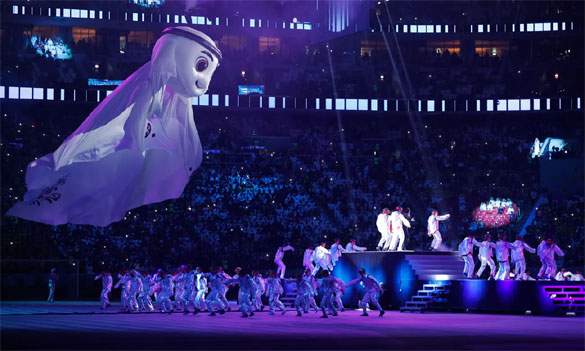
Opening Ceremony: La’eeb, meaning ‘super-skilled
player’, is an ‘adventurous, fun, curious’ sprite based on a Ghutra headdress.
Photograph: Tom Jenkins/The Guardian
-------
Football
Missionaries in Colonial Africa
The West
has willingly imported various social instruments and laws into the colonies
which were necessary to develop the countries that were their colonies into a
progressive society based on Western values. Football was introduced in Middle
East and African countries as part of this project.
The
promotion of football in the colonies was also part of a wider missionary
effort designed to convert the people of the colonies to Western Christian
values as part of a wider European plan of conquest. The ultimate goal of
football's introduction was to inculcate in the colonial subjects the
discipline and order needed to adapt the Third World countries to the Western
social system.
The fact is
that the influence of football missionaries, which was used as part of the
‘culturalization of the blind and ignorant eastern countries’, later became
part of the agenda of the international football organization FIFA. Football is
introduced as part of Catholic missionary activities in North African countries
that were colonies of the French government as part of providing Christian
message and education.
The plan
was to transform the colonists from colonial subjects into full-fledged French
citizens by developing the moral and character traits necessary to maintain the
colonial order. But football grew faster among the locals than the French
government had expected. With constant matches and tournaments, a football fan
base was formed in the crowd. Fears that such gatherings and the growing
influence of football at the local level might trigger wider anti-occupation
national movements against them and thus calls for independence forced the
French government to impose tighter controls on football matches. At the same
time, there was constant pressure to find the best players in the colonies and
tie the boots for France. This was also one of the motives behind the French
government's promotion of football.
The
colonial authorities aims behind the spread of football in African countries
that were colonies of Belgium and Britain, including Congo, Zimbabwe and
Tanzania, was mainly the promotion of European culture. Missionary schools and
military centres were constantly used for this purpose. There was a situation
where the military itself was directly involved in the promotion of European
sports by making football compulsory in the school curriculum and military
recruitment. The colonial regimes dreamed of imposing the colonial Western
cultural projects on the African societies and thus creating a special social
order that would make it easier for them to exercise their power, including
economic exploitation.
Apart from
this, the authorities took special care to silence the people by distracting
them from the dire socio-economic conditions and appease them by popularizing
football among the local elites. The history of football in French, Belgian and
British colonies in Africa reveals the ways in which football functioned as an
instrument of cultural imperialism in addition to African European social
relations during the colonial period. The legacy of colonial totalitarianism in
these places was the complete destruction of local cultures and unique races.
Since the
1920s, football has been deeply rooted in African society. Later in the second
half of the 19th century, football and the fields became the main medium and
platform for expressing anti-occupation sentiments and voicing against
oppression in African society. Early on, the colonial authorities failed to
understand the immense power of football to create unity in society and
organize the people. Football teams and clubs in many African countries, which
were formed by occupying regimes for social control, became arenas for
political struggles and resistance. Football clubs like Al Widad and FNL XI in
African countries like Algeria and Morocco have taken the helm to promote
nationalism and local traditions.
The fact
that the political party Tanganyika African National Union, which was in the forefront
for the independence of Tanzania, formulated its struggle strategies and
political policies in sports meetings at the Yung African Sports Club based in
Dar es Salaam proves the change of football as a weapon of anti-occupation
introduced to fertilize the growth of European occupation in colonial Africa.

FIFA
WC Closing Ceremony: Nora Fatehi, Shakira & Jennifer Lopez set to share
stage for FIFA World Cup Qatar Closing Ceremony on Sunday, Check all
performers, timing, all you need to know
-----
Football
Heritage of the Middle East
One of the
Western criticisms levelled against Qatar's World Cup hosting was the Middle
East's lack of football tradition. But football in the Middle East, like in
Africa, has a broader historical tradition that includes socio-political
fields. As anywhere in the world, breaking through political boundaries and
erasing economic limitations, football, which is rooted in all societies
without spatial differences, has been able to appear at the same time as a
power-political machine and the hope of the oppressed. The Middle East is no
different.
In the book
‘Football in the Middle- East: State, Society, And the Beautiful Game’,
Abdullah Al-Arian explains how football took a place in the political, social
and cultural map of the Middle East long ago. A hundred years ago, when
conquerors introduced the game of football to the Middle East to instil
obedience and order in their colonized territories, no one imagined that it
would become an acquired symbol of a culture and civilization. Football later
became a daily routine on the streets and an art of defence in national
struggles.
New
identities, spheres of power and social classes emerged around it. The accounts
of victories and defeats on the field went beyond the field to affect
diplomatic relations. Egypt, Iran, Morocco, Syria and Palestine all have a rich
tradition of football.
Football
took root in Egypt with the arrival of the Egyptian Football League. A new
culture of excitement and politics was created centred on clubs with a long
tradition, including Al Ahli and Zamalek. Many authorities have willingly used
the influence of football in the anti-dictatorship protests as a tool to secure
the support of the people. Jamal Abdel Nasser's role in the growth of Egyptian
football is also worth mentioning. As president of Al Ahly, he played a major
role in the dissolution of the Egyptian Football Association and the
establishment of the Confederation of African Football. Egypt hosted and won
the first Africa Cup of Nations under Jamal at a time when Egypt was isolated
internationally due to strained relations with the West, including Britain and
France.
Like Egypt,
Iran is known as the football powerhouse in the Middle East. World politics and
diplomacy are on the map of Iran's football. The 1998 FIFA World Cup was locked
in a simmering political climate between Iran and the United States, which had
become enemies with the Iranian Revolution of 1979. The match was won by Iran
with a score margin of 2-1, and the fans of both teams were very emotional. But
on the other hand, the leaders of both countries used this opportunity to
improve diplomatic relations. In any case, the result of the match is not
limited to the field.
The
influence of football in Middle East politics cannot be limited to just
challenging and opposing governments, but it should also be seen as a defensive
art that has been the driving force behind many popular uprisings. During the
2011 Jasmine Revolution, Al Ahli Ultras, the club's fan club, were at the
forefront of mobilizing people to fight against the dictatorial government of
Hosni Mubarak. The recent popular uprising in Algeria to dissuade long-ruling
dictator Abdelaziz Bouteflika from running for a fifth term was accompanied by
football clubs' flag-waving and Shabi folk songs, as is usually seen on match
days.
In short,
the legacy of football in the Middle East is embedded in a wider development
that encompasses cultural, political and social spheres. That tradition and
culture is sprouting new wings with the fact that it has been able to be the
venue for a world spectacle like the World Cup.
Western
Criticism and Qatar's Response
Qatar faced
criticism unlike any other country that has ever hosted the World Cup in its
history. Qatar was attacked with various accusations built on the false notions
of the Western colonial empire that football is the monopoly of Europe and that
only they are qualified to claim football's legacy.
The British
media including the BBC, the Guardian and the Daily Star have been criticizing
Qatar's unfitness to host the World Cup by citing human rights violations. But
when the 2018 FIFA World Cup was hosted by Vladimir Putin's Russia, which has
ruthlessly hunted down government critics and human rights activists, and
trampled on freedom of expression, there was no criticism from the Western
media. The attitude adopted by the media and European countries was that the
game was different from politics. But when it comes to Qatar, the change in
attitude is a direct sign of the Arab Muslim anti-racism based on the
imperialist attitude held in Europe.
Workplace
harassment was another criticism levelled against Qatar by the Western media.
It is true that Qatar has had a labour system that includes strict laws and
regulations, but Qatar has implemented extensive changes in labour laws since
2010, when it received the World Cup hosting duties. As part of Qatar's labour
reforms, including the highly criticized ‘Kafala’ system, which centred
on employers, workers' full rights to work were ensured.
Another
matter that was widely publicized by the British media, including the Guardian,
was the estimate that 6,500 workers were killed during the construction of the
World Cup venues. But according to the official figures of the International
Labour Organization and Qatar, only 39 people have died in this way. The media
here is exaggerating the total number of workers who have died in Qatar since
2010, when it was awarded the World Cup. The fact is that the western media has
adopted an approach that turns its face to the realities.
Redundancies
and criticisms embedded in the Orientalist approach based on completely false
presuppositions are constantly being produced in the Western media. Criticisms
on the LGBTQ issue are based on a purely Eurocentric stance that only their
values are correct. Europe's impudence to not accept even the most basic demand
of Qatar to respect its culture and values is a clear proof of the imperialist
spirit that still exists today. In a way, the criticisms against Qatar are rehashing
classical Orientalist narratives. As FIFA head Gianni Infantino said, Europeans
have the right to teach others morality only after they apologize for the next
three thousand years for what they have done in the last three thousand years.
But on the
other hand, the approaches adopted by Qatar in hosting the FIFA World Cup,
which was watched all over the world despite the constant criticism of the
western centres, were completely revolutionary and capable of breaking colonial
perceptions and myths. Qatar's decision not to allow alcohol products in
stadiums will give spectators a new football experience without the fear of
drunken parties and racist abuse in European football stadiums.
The
conversation between Ghanim Al Miftah, a Qatari boy who suffers from a rare
spinal stunting disease, and Hollywood actor Morgan Freeman at the opening of
the World Cup evoked a message of humanity, unity and mutual respect for
diverse cultures. The Qur'anic verse quoted in the conversation is 'O
mankind, We have created you from male and female. You were made into different
sects and tribes to identify each other. The most honourable among you before
Allah is the more fearful; Of course...! Allah is All-Knowing and
All-Knowing.' The message of the Qur'anic verse to the world in this period of
alienation is not small.
But, at the
same time, Qatar’s efforts to invite tele-preacher Zakir Naik is to be
criticised. In an attempt to oppose Saudi hegemony in the region, Qatar is
appropriating the legacy of Islamism, which is not to be appreciated at all.
Qatar is
developing a new concept of modernity through the decolonization of Western
colonial modernity in multiculturalism. Qatar's new modernist conception of a
tolerant embrace of diverse values and cultures breaks down the total
intolerance of an Arab Muslim state wrapped in a broad democracy of white
supremacy.
-----
A
regular columnist for NewAgeIslam.com, Mubashir V.P is a PhD scholar in Islamic
Studies at Jamia Millia Islamia and freelance journalist.
URL: https://newageislam.com/islam-west/arabian-world-cup-football-imperial/d/128690
New Age Islam, Islam Online, Islamic
Website, African
Muslim News, Arab World
News, South Asia
News, Indian Muslim
News, World Muslim
News, Women in
Islam, Islamic
Feminism, Arab Women, Women In Arab, Islamophobia
in America, Muslim Women
in West, Islam Women
and Feminism