
Sunni Pakistanis Using Blasphemy Laws to Target and Murder Shias, They Call ‘Heretics’
Shah Meer
Baloch
By
Shah Meer Baloch and Hannah Ellis-Petersen
21 Oct 2020
Syed
Kareem* has been in hiding for weeks. He fears if he is seen on the streets of
Karachi, the Pakistan city he calls home, he will be a dead man walking.
His ordeal
began with a Facebook post in early September, where he condemned the killers
of a Shia Muslim martyred centuries ago. Though Kareem had meant it as a post
of religious devotion, it caught the attention of an extremist Sunni Muslim
group, who called him a traitor to Muslims.
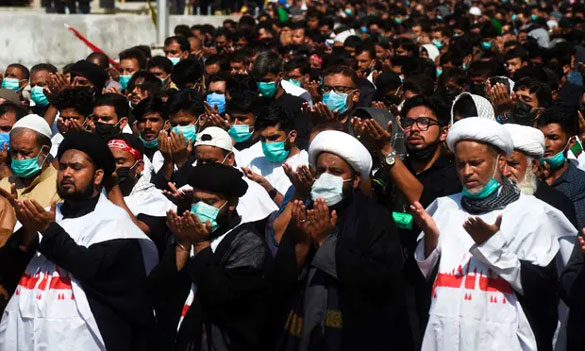
Shia Muslims mourning the death anniversary of Imam Hussain, the
grandson of the Prophet Mohammed, in Karachi on 8 October. Photograph: Asif
Hassan/AFP/Getty Images
------
Two days
later, the 21-year-old student found himself the subject of a police report,
accused of violating Pakistan’s draconian laws on blasphemy. He is one of over
50 Shia Muslims in Sunni-majority Pakistan, who have been booked under
blasphemy and antiterrorist charges over the last month. The youngest was three
years old.
“I fear
they will kill me,” said Kareem, his voice shaking as he spoke from his place
of hiding. “I am being targeted because I am from a Shia religious minority. I
fear for myself and my family.” With the police on their way to interrogate
him, and fearing the violent fate that extremist Sunni groups in Pakistan
inflict on those accused of blasphemy, last month Kareem and his family chose
to disappear.
Over the
past month, Pakistan has seen an unprecedented rise in attacks and arrests of
its Shia population, who make up between 15% and 20% of the Sunni-majority
country, the largest Shia community outside Iran.
As well as
the 50 who have been charged in the blasphemy crackdown, five have been killed
since September and many more Shia families and well-known figures have gone
into hiding. Last week, in Punjab, police beat up and arrested 22 Shia Muslims,
including seven women, who were taking part in a ceremony to mark a Shia
martyr.
Blasphemy
is a capital offence in Pakistan and even unsubstantiated allegations can lead
to mob violence and lynchings against the accused.
Bakhtawar
Jaffri, a Shia rights activist in Punjab, said he had recently filed a police
report for anti-Shia hate speech but it had been ignored. “In contrast, even
the baseless and fake cases from the other side are being entertained by
police,” she said.
The
situation worsened further last week when an influential Sunni religious
scholar, Maulana Dr Adil Khan, was killed in an attack. Hardcore Sunni groups
publicly accused Shia Muslims of orchestrating the attack.
The
anti-Shia Muslim campaign first began gathering pace on social media in
September, demanding that Shia Muslims were declared heretics. The hashtag
“infidel, infidel, Shias are infidel” began trending.
Then, in
mid-September, a march of more than 30,000 people, organised by extremist Sunni
Muslim groups, gathered in Karachi over two days to call Shia Muslims
“unbelievers” and “blasphemers” and called for their beheading. It was the
largest anti-Shia march seen in decades in Pakistan, and was copied in other
cities including the capital Islamabad.
Shia
Muslims also fear their religious freedom is being legislated away. In July,
Tahaffuz-e-Bunyad-e-Islam [protection of foundation of Islam bill] was passed
by the Punjab assembly, which supported only the Sunni interpretation of Islam,
provoking a huge backlash from the Shia community.
“Persecution
seems to be waiting for the Shia minority,” said Hamza Baloch, a founding
member of Secular Shia Voices, an advocacy group. “At first, they used
hashtags, then killed us and rallied against us. Now they’re coming up with
legislation to eliminate the Shia minority.”
At the
forefront of anti-Shia campaign in Pakistan are two hardline Sunni Muslim
groups, Ahl-e-Sunnat-Wal-Jamaat (ASWJ) and Tehreek-e-Labbaik Pakistan (TLP).
ASWJ had previously been banned in Pakistan under the Anti-Terrorism Act before
it was lifted in 2018 but is still globally considered a terrorist
organisation.
Sectarian
persecution of Shia Muslims has been a long-running fracture in Pakistan,
exacerbated by the proxy wars fought on Pakistan soil by Sunni-majority Saudi
Arabia and Shia-majority Iran, as well as the US ‘“war on terror”. As one
senior security official speaking on condition of anonymity, alleged: “We can’t
ignore the role of regional and international powers in sectarianism in
Pakistan … Iran supports the Shia militia here.”
However,
the vehement sectarian resurgence began in 2017 when the Pakistani government
began making concessions to the extremist Sunni Muslim groups. In 2017, TLP was
responsible for forcing a law minister to quit over a perceived softening in
the blasphemy laws. Then, in the 2018 election, ASWJ and TLP were allowed to
run in the election, winning seats in parliament.
In the same
election, ASWJ also threw its influential backing behind 70 candidates from
Imran Khan’s Pakistan Tehreek-e-Insaf (PTI) party, which won and formed the
government.
Despite
their well-documented extremist positions, over the past two years TLP and ASWJ
have been allowed to assemble, make public anti-Shia speeches, carry out
rallies, run for political office and mobilise against the Shia community,
ensuring their power and influence in Pakistan has gone from strength to
strength.
The Khan
government, meanwhile, has been accused of both turning a blind eye to rising
sectarianism from hardline Sunni groups, which reportedly enjoy patronage from
state and military officials, and also using their support for political gain
at a time when the government is weak and the economy is collapsing.
Dr Nauman
Naqvi, an associate professor at Habib University in Karachi, said: “Since
Pakistan’s economic and political outlook appears increasingly troubled, the
ruling power see Sunni majoritarian populism as the only option to secure
stability, undercut democratic forces and distract from the grave political and
economic crises that hover over Pakistan.
“The
large-scale presence of these constitution-phobic groups is a clear and present
threat to civil and constitutional rule in Pakistan,” added Naqvi. “It
threatens to plunge the country into anarchy.”
Even Fawad
Chaudhry, currently serving as the minister for science and technology in Khan’s
government, conceded that sectarianism was an issue that was getting “out of
hand”.
“Unfortunately,
due to the history that Pakistan has had, especially with regards to security,
this remains a huge problem,” said Chaudhry.
* Name
has been changed to protect identity
-----
Original
Headline: Pakistani Shias Live In Terror As Sectarian Violence Increases
Source: The Guardian
URL: https://newageislam.com/islam-sectarianism/sunni-pakistanis-using-blasphemy-laws/d/124514
New Age Islam, Islam Online, Islamic Website, African Muslim News, Arab World News, South Asia News, Indian Muslim News, World Muslim News, Women in Islam, Islamic Feminism, Arab Women, Women In Arab, Islamophobia in America, Muslim Women in West, Islam Women and Feminism