
Why Did NSA Ajit Doval Seek An End To Takfiri Terrorism During His Recent Visit To Iran?

By
Shah Faesal
4 May 2023
During his
recent visit to Tehran, India's National Security Adviser Ajit Doval stressed
the importance of Iran and India working together to promote stability in
Afghanistan and end Takfiri terrorism in the country. The
delegation-level talks took place ahead of the upcoming meeting of the Foreign
Ministers of the SCO in Goa and encompassed a broad range of topics, including
economic, political, and security ties, as well as key regional and global
developments. Doval also met with Iranian President Ebrahim Raisi and Foreign
Minister Hossein Amirabdollahian.

NSA Ajit Doval holding talks with his Iranian counterpart Rear Admiral
Ali Shamkhani, Secretary of Iran's Supreme National Security Council in Tehran
-----
What Is Takfiri
Ideology?
Takfir is an accusation of unbelief or a
declaration of apostasy which leads to the ex-communication of another Muslim.
It is the practice of one Muslim declaring another Muslim as an infidel, which
some extremist groups use to prescribe the death penalty for apostates. In the
past Takfiri fatwahs have led to the assassination of the Egyptian
President Anwar Saadat, Governor of Punjab Pakistan Salman Taseer, and death
threats against authors Salman Rushdie and Taslima Nasreen. A Tamil Nadu-based
radical Muslim group declared India’s former President APJ Abdul Kalam as an
apostate and fatwas are regularly given in India to expel Muslims from the
‘Islamic community’ on the charges of blasphemy and apostasy.
The book
Issues in the Jurisprudence of Jihad (Mas’ail Fi Fiqh al-Jihad) by Abu 'Abdullah
al-Muhajir, one of the leading ideologues of ISIS, was one of the most
important treatises in recent times to deploy Takfir as a theological
and legal argument for justifying violence against Muslims and non-Muslims
alike. Muhajir notably was a jihadi-Salafi from Egypt who influenced the former
leader of al Qaeda Abu Musab al-Zarqawi.
The concept
of Takfir, which led to the treatment of apostasy and blasphemy as
serious offenses, originated with the Khawarij sect in the 7th century CE. The
Khawarij were the first to declare Takfir against fellow Muslims,
appropriating the right to do so and introducing extrajudicial killings of
fellow Muslims. This marked the beginning of Islamic extremism. Over time, the
notion of Takfir was further developed by multiple scholars and
theologians. In the 13th century, Islamic scholar Ibn Taymiyya distinguished
between man-made and divine law, calling on Muslims living under the former to
migrate to lands governed by Shari'a. He classified unbelievers into different
groups, including apostates and those who failed to perform their religious
duties. Ibn Taymiyya expanded on the notion of Takfir by arguing that
any failure of religious obligation was an offense and that Muslims who failed
in their religious obligations were worse than unbelievers or members of other
religious groups.
In the 18th
century, the concept of Takfir was further developed by Muhammad Ibn
'Abd al-Wahhab, the founder of the Wahhabi doctrine. He aimed to purify the
Islamic community by asking Muslims to return to the ways of the Prophet and
his Companions, rejecting the decisions of the four Sunni schools and any
consensus issued after the death of the Prophet's Companions. He deemed Muslims
who followed traditions that emerged after the first generation of Islam as
polytheists.'
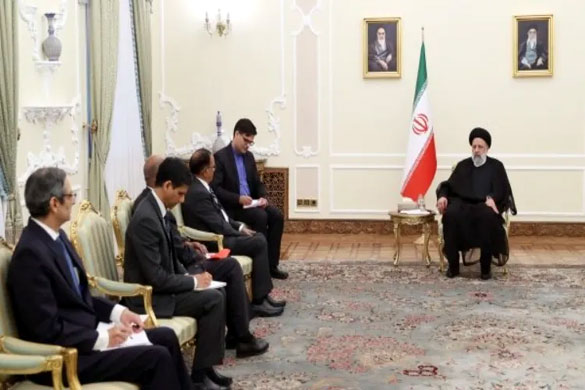
National Security Advisor Ajit Doval calls on Iran President Ebrahim Raisi
-----
The 20th
century saw a further evolution of Takfir as Muslim-majority states
began to adopt Western models of law. Sayyid Qutb, a leading member of the
Muslim Brotherhood in Egypt, used the notion of contemporary Jahiliyya to
denounce Muslim societies and governments that followed the Western model.
Similarly, Abul A‘la Maududi, founder of the political organization
Jamaat-e-Islami, condemned Muslim majority states for borrowing constitutions,
laws, and principles from nonbelievers.
Maududi's
ideas have been cited by militant leaders, such as ISIS leader Abu Bakr
al-Baghdadi, who appointed himself a Caliph and referred to Maududi's notion of
a pan-Islamic state. ISIS has repeatedly drawn on Maududi's claims that
sovereignty is for God only and that full citizenship of an Islamic state is
only available to Muslims. Terror groups like Ansar Ghazwatul Hind also
espoused the same cause. This has led to the persecution of religious
minorities and attempts to crush any Islamic theology deviating from the ISIS
model. This extremist use of Takfir is also exemplified in ISIS's
campaign against the Sunni Awakening in Iraq.
Driven by
this ideology, Daesh has been targeting Muslims as its primary victims since
2014 in countries like Afghanistan, Iraq, and Syria. Its definition of Kufr (unbelief,
infidelity) goes beyond non-Muslims to include Muslims, who are considered
incidental disbelievers.
Daesh has a
strong presence in Eastern and Northern Afghanistan, particularly in Nangarhar,
which is regarded as its base in the war-torn country. Since the Taliban
takeover of Kabul in 2021, there have been frequent clashes between the Emirate
and the IS-Khorasan with ISKP launching multiple terror attacks against Taliban
forces, journalists, civil society members, and the Shia Hazara community
across Afghanistan. The Hazaras, a historically persecuted Shia sect, share a
commonality of faith with Iran's clerical establishment and many Hazaras have
fled to Iran due to their persecution by the Taliban in the past. However, in
their second coming Taliban assured the Hazara community of their safety during
Shia religious festivities.
Movement
against Takfir
The
fundamental question at the core of thought is ‘Who is a true Muslim’? The takfiri
answer to this is dictated by an extremely literal and rigid interpretation of
Islam.
However,
there have also been voices from across the Muslim world that have condemned
the practice of Takfir. In July 2005 King Abdullah II of Jordan led an
international Islamic conference of the world’s top most Islamic scholars to
deliberate on the issue of Takfir. The outcome of this conference became
known as Three Points of the Amman Message which included recognizing the
validity of all 8 Maktabs (legal schools) of Sunni, Shia, and Ibadhi
Islam; of traditional Islamic Theology (Ash’arism); of Islamic Mysticism
(Sufism), and true Salafi thought. It was also decided that ignorant and
extreme fatwas issued on such contentious subjects should be stopped.
While many
Qur'anic verses mention unbelievers, the Qur'an itself does not define
apostasy. The definition of apostasy in Islam is always provided by humans.
According to several Qur'anic verses, only God holds the right to declare Takfir,
as only He can determine a believer's status, and this judgment will occur in
the hereafter. Consequently, takfir declarations by humans constitute a
religious sin under Shari'a law.
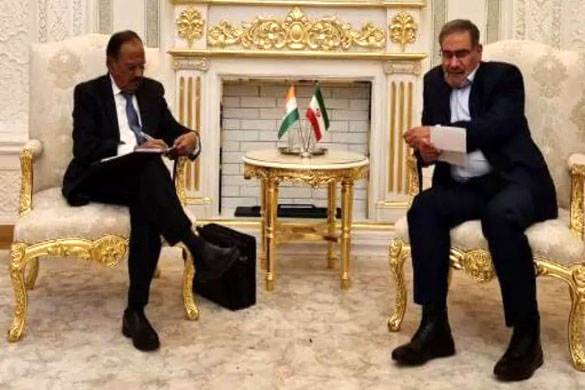
NSA Ajit Doval meeting Secretary of Iran's Supreme National Security
Council, Rear Admiral Ali Shamkhani
------
Indirect
prohibition of Takfir can be found in various Qur'anic verses, such as
6:108 and 4:94. These verses emphasize the importance of not insulting other
religions, as it could lead to retaliation, and caution believers against
hastily judging others' faith. Thus, the use of takfir by extremist
groups like ISIS contradicts the teachings of the Prophet and the Qur'an.
There is a
wide body of Islamic scholarship that suggests that Prophet Mohammad (PBUH)
warned Muslims against declaring someone a disbeliever for committing a sin or
expelling them from Islam due to their actions. These teachings, found in
various hadiths, such as Sahih Bukhari, Sahih Muslim, and Sunan An-Nasa'i, show
that the Prophet not only prohibited takfir but also regarded such
declarations as sinful. ―When a person calls his brother (in Islam) a
disbeliever, one of them will certainly deserve the title. If the addressee is
so as he has asserted, the disbelief of the man is confirmed, but if it is
untrue, then it will revert to him (narrated by Al-Bukhari and Muslim). Noted
Islamic scholar Javed Ahmed Ghamdi views takfir against the spirit of
the Quran and suggest that no one has a right to call a Muslim an unbeliever
unless that Muslim makes a wilful public announcement about abandoning the
faith. After the attack on Salman Rushdie in New York last year,
Secretary-General of the Muslim World League Muhammad bin Abdul Karim al-Issa
said that the violence was “a crime that Islam does not accept”
Takfir in India: Brian Didier in his
chapter in the edited volume Accusations of Unbelief in Islam: A Diachronic
Perspective on Takfir explores the wedge between Wahhabi groups and the
Shamsiya Sufis in Lakshadweep Island. Shamsiya Sufis have been condemned as
heretics and vilified. The majority of Indian Muslims belong to the Sunni sect
which is further divided into Wahhabi and Barelvi factions. In the past, there
have been frequent instances of Wahhabi preachers declaring Barelvis as
apostates for grave worship and other intercessionary practices. Rashid Ahmad
Gangohi, a Deobandi jurist had declared that the views held by Ahmad Raza Khan
made him a Kafir (disbelievers).
Likewise,
Barelvis have branded Wahabis as Kafirs for disrespecting Prophet Mohammad
(PBUH). The founder of the Barelvi sect Ahmad Raza Khan is reported to have
said in his famous words that the category of ‘Murtad Munafiq (apostate and
hypocrite) includes Wahhabis, Rafidis (Shias), Qadianis, and Naturi
(Rationalists). Both Wahhabis and Barelvis in turn declare Shias, Bahai’i, and Ahmadiya
as apostates, refusing to offer prayers in their mosques and prohibiting
marital relations with them. These statements are a common practice even today
and the social media in India is rife with Takfiri hate speeches given
during Friday sermons by Maulvis of one sect while claiming supremacy over
another.
It is
against this backdrop that Ajit Doval’s flagging the issue of Takfiri
terrorism during the recent Iran visit becomes important. India and Iran share
common security interests in Afghanistan. Both India and Iran are concerned
about the threat of terrorism emanating from Afghanistan, particularly from
groups such as ISIS, which have targeted both countries in the past. India has
the second largest population of Muslims in the world and around 13% of Indian
Muslims identify with the Shia sect. In the past, there have been constant
attempts to radicalize and recruit gullible Muslim youngsters into global
terrorist organizations with many landing in the frontrunner takfiri
group ISIS. Pakistan has witnessed extremely high levels of violence including
suicide bombings against minority Muslim sects that have been declared to be
heretical, Shias being the main victims of such violence. This cannot be
allowed to happen in India.
India’s
leadership in fighting Takfiri extremism in Afghanistan in partnership
with Iran will thus not only ensure sectarian bonhomie within our borders but
is also bound to generate a lot of goodwill across the Islamic world that has
been devastated by Takfiri jihad in recent years.
-----
Shah Faesal is an IAS Officer from AGMUT Cadre, a
Fulbright Scholar, and an Edward S Mason Fellow from Harvard University. Views
are personal.
URL: https://newageislam.com/islam-politics/nsa-doval-takfiri-terrorism-iran/d/129694