
Western Media Triggered Turkey’s Neo-Ottoman Ambitions
By Sevgi Akarçeşme
July 16, 2015
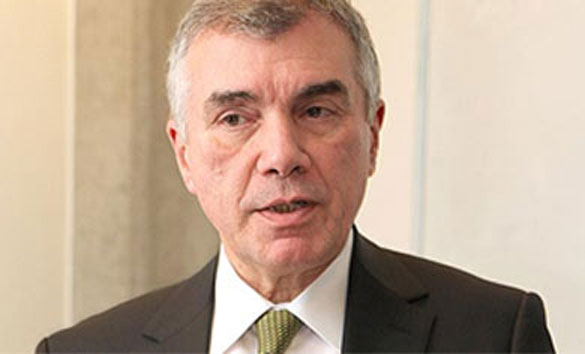 Ünal Çeviköz (Photo: Cihan, Mustafa Köker)
-----------
Recently retired diplomat Ünal Çeviköz, who last served as Turkey's ambassador to London until 2014, told Today's Zaman in an extended interview that Turkey's policy toward Syria will hopefully change once a new government is in place, adding that the Western media's coverage of the Justice and Development Party's (AK Party) foreign policy could have triggered neo-Ottoman ambitions among policy makers, leading to overconfidence in the Turkish government.
A veteran ambassador who now serves on the board of trustees of İstanbul Kadir Has University and writes about foreign policy for the now-web-based news portal Radikal, Çeviköz vocally criticizes Turkey's policy toward Syria, considering the country's complete severing of diplomatic ties with its neighbors to be a mistake, as do several of his retired colleagues.
In agreement with a widely-held opinion that Turkey has taken sides in conflicts in the Middle East, Çeviköz stresses that for the resolution of any conflict, the recognition of all parties is a requirement. In the face of increasing debate over a possible incursion into Syria, Çeviköz unequivocally states that such a move has no international legitimacy.
Emphasizing the importance of cooperation with the international community, Çeviköz hopes for a return to rationalism in Turkish foreign policy, noting that the president and the prime minister have become the most influential foreign policy makers in Turkey, the result of a frequent passing over of the ministry of foreign affairs.
The following are highlights from Today's Zaman's interview with Çeviköz, which covered a range of issues, from emergence of the Islamic State of Iraq and the Levant (ISIL) to mistakes made by international powers in Iraq.
Turkey Acted Emotionally In Syria
Though critical of current foreign policy, the ambassador appreciated policies that were in place during the AK Party's initial terms, presenting then-Prime Minister Recep Tayyip Erdoğan's 2009 speech in Egypt as exemplary. “The real breaking point was the policy toward Syria,” Çeviköz remarked, in response to a question about when things began to go wrong in Turkey's foreign policy. “The downward trend that started with Syria became more visible after the coup in Egypt,” the former ambassador to London said.
“Turkey acted emotionally, particularly in Syria,” Çeviköz surmised, explaining that Syrian President Bashar al-Assad had failed to keep promises made to Turkey regarding certain politician reforms, including the promise to form a transitional government until democratic elections were held in Syria.
“In diplomacy, when the other party listens to you, it does not necessarily mean that the other party accepts your propositions,” Çeviköz remarked. “We might have acted with assumptions in Syria,” he added.
Turkey once had close ties with Syria, holding joint cabinet meetings before relations completely disintegrated, Çeviköz explained. In his opinion, one of Turkey's mistakes was to depart from its conventional approach of maintaining relations regardless of changes in government.
Çeviköz stressed that cutting ties with Syria and Egypt completely has been a mistake, and that interfering in the domestic affairs of other countries such as Syria, Egypt and Libya is a move that has traditionally been avoided in Turkish foreign policy. However, he maintains that the real problem for Turkey in these cases has been “taking sides,” which has eliminated the possibility of making an impact on foreign policy.
Who Will Turkey Fight Against In Syria?
As Turkey struggles to form a coalition government after 13 years of single-party rule, Çeviköz urges the new government to revise the current policy toward Syria. “The fight against ISIL should be negotiated with the Assad regime,” Çeviköz suggested, after strongly denouncing an incursion into Syria and asking, “Who is Turkey's enemy in Syria?” Çeviköz stressed that such an intervention has no legitimacy under international laws and conventions.
In response to international reactions, Çeviköz said that the international media already considers the coverage in the Turkish press of the possible intervention to be an outcome of domestic political attempts to revitalize nationalist feelings and gain support for the AK Party in the event of a snap election.
When asked whether Turkish foreign policy has the potential to return to realism, Çeviköz responded, “I hope so,” adding that the new government has to change many aspects of foreign policy, starting with that toward Syria. “The policy that Turkey will not hold talks with Assad under any conditions should change,” Çeviköz stated.
He explained that the regime comprises more than just Assad, and that his influence on it is limited. “Assad is the result of an establishment, which he would not want to challenge, for his own survival,” Çeviköz stated, adding that in such regimes the state apparatus and the political elite overlap, comparing the Baath regime to Soviet-style totalitarian systems.
“In Libya, the structure in place was easy to dissolve because it was established around a one-man rule, but the Baath regime in Syria is different,” Çeviköz pointed out, adding that in the wake of a negative experience in Iraq, the West has remained cautious about engaging in an “adventure in Syria.”
Çeviköz, who also served as an ambassador in Baghdad from 2004 to 2006, observed that, “In Iraq, the US could not replace what it toppled,” leading to its distancing itself from the conflict in Syria.
According to Çeviköz, the Baath regime successfully managed a sustainable relationship between the ruling elite and the people, whether one likes it or not. In his opinion, the failure of the US in Iraq is not the result of a lack of foresight, but of overconfidence. Çeviköz argued that, when the US saw that “bullying” did not produce the desired results in Iraq, the attitude of the Obama administration in Syria was different.
Turkey Should Go Back To Its Impartial Mediator Role
Retired ambassador and new columnist Çeviköz does not only call for a change in Turkey's Syria policy, but also a complete revisit of its Middle East strategy. Calling for normalization with Egypt and Israel, since these countries are very important for Turkey, Çeviköz says that animosity with Egypt in the eastern Mediterranean harms Turkey's interests even in Africa.
As far as relations with Israel are concerned, Çeviköz says that Turkey followed the right path when it assumed the role of a “mediator” between Israel and Syria and pursued a solution-based, multidimensional policy while also making economic investments in Palestine. However, he argues that from the perspective of Israel there is a trust issue following its apology and ease of the siege of Gaza. “Israel wonders what next will come from Turkey even when it meets Turkey's conditions,” Çeviköz states.
Western Media Triggered Neo-Ottoman Feelings Of Turkey
When it comes to the widespread belief that Turkey aimed higher than its capabilities in the Middle East, Çeviköz brings an unheard perspective and places responsibility on the Western media.
According to Çeviköz, stories and comments with a “neo-Ottomanism” theme appeared in the Western media extensively following Turkey's regional policy of 2002-2009 due to Turkey's successful foreign policy that resulted in temporary membership in the UN Security Council. Such coverage contributed to “a boost in confidence” among Turkish leaders, argues Çeviköz.
“The idea of neo-Ottomanism was imposed on Turkey,” Çeviköz points out. He states that some people in Turkey believed in those stories and adopted neo-Ottomanism.
For him, in order to strike a balance between its ambitions and capability, Turkey should have acted together with the international community. “The partnership capacity with the West is still utilized,” Çeviköz comments in reference to relations ranging from NATO to the EU and bilateral ties with the US.
As far as the larger Syria policy is concerned, Çeviköz believes that the priorities of the US have changed even though Assad has never been approved. “ISIL is now considered a bigger threat,” the ambassador points out.
In reference to Joseph Nye's debate on the end of the American century, Çeviköz states that following the failures in Iraq and Afghanistan, the US has resorted to “soft power” instead of hard power. He directs attention to the rise in anti-American sentiment in the Middle East following these failures and says that the US has been transforming its use of power in the region.
When it comes to relations with Iran, Çeviköz refers to the fundamental problem of trust between the West and Iran, saying that “a grace period” is necessary. For him, what Iran wants is “recognition.”
Born in İstanbul, Ünal Çeviköz is a graduate of Boğaziçi University with a double major in English literature and political science. He joined the Foreign Ministry in 1978. After serving as second secretary of the embassy in Moscow, consul in Bregenz and counsellor of the embassy in Sofia, he was transferred from the ministry in 1989 to the NATO international secretariat and worked in the Economics and Political Directorates till 1997. During this period, in 1994 he accomplished his post-graduate study at the University of Brussels with an MA degree in international relations. In 1994 he was assigned to open the NATO Information Office in Moscow. Then, he prepared the NATO-Russia Founding Act which was signed in Paris in 1997. Going back to Ankara the same year, he continued to work in the Foreign Ministry first as the head of Balkan Department, then later as the deputy director general for the Caucasus and Central Asia. He served as Turkey's ambassador to Azerbaijan (2001-2004), Iraq (2004-2007) and the UK (2010-2014). From 2007 to 2010 he was the deputy undersecretary of the MFA for bilateral political affairs. During that period he prepared the Turkish-Armenian protocols signed in 2009 in Zürich. He retired from the Foreign Service in 2014. Currently he is the president of the 28th Assembly of the International Maritime Organisation, a member of board of trustees of the Kadir Has University and the president of the Ankara Policy Centre. Çeviköz speaks English, French, Russian, Italian and German.
Source: http://www.todayszaman.com/interviews_cevikoz-western-media-triggered-turkeys-neo-ottoman-ambitions_393884.html
URL: https://newageislam.com/interview/western-media-triggered-turkey’s-neo/d/103936