
How an Illinois Mom Converted To Islam and Found Peace and Joy during Her Very First Hajj
Huffington Post
10/12/2014
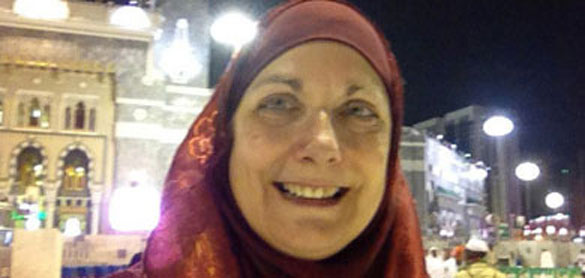 Kristin Szremski
is a 53-year-old mom from Palo Hills, Illinois. Born into a Missouri-Synod Lutheran family,
she first converted to Catholicism before finding her place in Islam. This
year, Szremski was one of the hundreds of thousands of Muslims who were drawn
to Mecca between October 2 - 7 to complete the fifth pillar of Islam, the Hajj.
Kristin Szremski
is a 53-year-old mom from Palo Hills, Illinois. Born into a Missouri-Synod Lutheran family,
she first converted to Catholicism before finding her place in Islam. This
year, Szremski was one of the hundreds of thousands of Muslims who were drawn
to Mecca between October 2 - 7 to complete the fifth pillar of Islam, the Hajj.
She tells Huffington
Post about her experience below. Some answers have been edited for length
and clarity.
1. How did you come
to Islam and what was it about the religion that moved you?
I was a special
assignment reporter for the Star Newspapers in suburban Chicago in 2000. I was
assigned to cover the Arab community. At that time, I didn't know anything
about Islam -- I was raised as a Missouri-Synod Lutheran and we had been taught
that all religions and prophets that came after Jesus were false.
During the six weeks I
had for research, I interviewed many, many Arab Muslims. My conversion was not
something that happened overnight; it probably took more than 18 months. I was
fascinated to learn that Islam had all the same stories as the Bible as well as
the same characters.
To back up a bit -- I
was raised Lutheran, but converted to Catholicism when I was about 40. I always
wanted to belong to a large community and I was intrigued by the Catholic
Church. Since my husband at the time was Catholic, I decided to join the
church. That had a huge impact on my later conversion to Islam because where
the Lutheran church believed in the Bible literally; the Catholic Church
encouraged knowledge, questions and also gave us the historical context for the
books contained in the Christian canon. This allowed me to open my mind to the
possibility that the Quran was truly the revealed word of God.
Once I came to believe
this, it was an easy step to believe Muhammad (peace be upon him) was the
messenger and prophet. The harder part was letting go of my belief that Jesus
was the Son of God. Ultimately, it was the passages in the Quran where God
tells us that He was not begotten nor has He begotten and similar ones that
finally helped me. Also, Jesus figures prominently in Islam so I wasn’t letting
go of him, but just the idea that he is God.
In the end, my
conversion came while I was praying. The date was July 21, 2001. I was in a
hotel room in Washington DC, where I'd gone to cover a meeting for a magazine I
was writing for. I had the Quran open on the bed before me and I was actually
on my knees praying, asking God to lead me to the truth when suddenly I declared
the Shahadah –- that there is no God but Allah and that Muhammad is His
messenger. I later made a public declaration in Arabic but for all purposes it
was at that moment that I became a Muslim.
I love Islam because
of its purity, its simplicity and its truth. The Muslims I had met were truly
pleasant, patient and well-mannered people.
2. We understand
this is your first hajj. Were you nervous at all?
I was very nervous
about this trip because it is a heavy spiritual journey, which means there's a
lot of personal reflection. It is also a very physical experience, with many
different components taking place over several days. I’ve had two surgeries on
my neck and lower back because of the degenerative arthritis and it has left me
with some slight neurological deficiencies. One of the biggest of these is
weakness in my legs, which things like overuse, fatigue, lack of sleep, extreme
conditions can exacerbate.
3. Was there
someone who showed you around? How did you know what to do?
I was traveling with a
tour group, called Noor Travel, out of Milwaukee. The tour guide was extremely
helpful. Plus, my lovely roommates are Arab American women who can help with
the language as need be. There are also people in the group who have done this
before who can offer advice. When all is said and done, though, 3 million
people in one small place is pretty overwhelming and daunting so I pretty much
learned as I went along.
4. Are there any
parts of the hajj that you were particularly looking forward to?
Muslims pray in the direction
of the Kaa’bah from wherever they are in the world. Being in the presence of
God in Mecca, at the very center of the Earth, where Adam and Eve came to earth
from the Garden of Eden, where Abraham and Ishmael rebuilt the Kaa’bah, and
where Muhammad (peace be upon him) lived and received his first revelations
from God is a tremendously invigorating and rejuvenating experience. To be able
to see the Kaa’bah right in front of me after all these years was powerful and
something I don’t believe I will ever forget.
5. How did it go?
I did much better
physically than I expected. I’m actually feeling better now than before I left
for the trip, mainly due to an improved state of mind that this trip brought
about. In addition, Islam is always about moderation and the religion is not
meant to be difficult. Therefore, certain accommodations are possible during
the rites of Hajj.
There are three types
of Tawafs, or circumambulations of the Kaa’bah. During each Tawaf, Muslims
circle the Kaa’bah seven times.
I was able to use a
wheelchair to circumambulate the Kaa’bah the first time.
During the second
Tawaf, called Tawaf Al-Ifadah, I wanted to walk by myself so I could really
concentrate on ‘talking to God,’ in my supplications and in worship. I also
wanted to make the physical effort for God, as so much of Islam is about taking
action with the help of God. This was an extremely beautiful experience for me,
extremely spiritual. I finished the entire rite in just under three hours. Then
it took me about one hour to make the usual 10 minute trip back to the hotel
because I had overdone it a bit.
I was not able to
finish the third Tawaf, called Tawaf Al-Wada or the Farewell Tawaf, because I
was unprepared for the millions of people who were there at the same time as
me. I was getting hurt and not strong enough to withstand the crush of people.
So, sadly, I had to leave without completing it. To expiate for missing that
rite, I paid to have a sheep slaughtered and its meat given to the poor.
Throwing stones at
pillars that symbolize the spots where Satan tempted Abraham, who was preparing
to sacrifice his son, is another rite of Hajj. Because of the sheer physicality
it takes to walk up a steep hill to the throwing area and the danger of being
in a crowd of a few million people throwing what are supposed to be pebbles but
sometimes turn out larger, women, the elderly and people with health conditions
can ask someone to throw the stones for them. I took advantage of this and
asked some other group member to throw for me.
An integral part of
the Hajj is the visit to Mount Arafah, where the Prophet Muhammad (peace be
upon him) prayed on the ninth of Dhul Hijjah when he made Hajj. The Day of
Arafah is a day of atonement, when we stand in prayer from just after the sun
reaches its zenith during midday until sunset. This year, it was about six
hours. We were at Arafah long before that, though. We stayed in sweltering
tents. It was 108 degrees outside and hotter inside because the air
conditioning did not work.
If one stands in
Arafah in sincere devotion and sincerely repents of his sins, all his sins will
be forgiven. And we also believe that supplications on this day made sincerely
will be answered. Standing is key, although allowances are made for older
people or people, like me, with health conditions. I stood a great deal of the
time but had to sit from time to time.
It was probably the
most difficult physically and spiritually of the entire trip. But it was also
extremely beautiful and cleansing. The most beautiful time came when it was
close to sunset and hundreds of people gathered on a hillside, facing the
Kaa’bah in the West, to make supplications while the sun was setting. All this
was done while one imam made the supplications, called Duas, out loud. It was
extremely powerful and many people, including me, were crying.
I think there's a
recurring point here. Hajj requires extreme effort but then offers extreme
beauty, peace and joy in return.
6. What were you
searching for during this pilgrimage? Did you find it?
What I wanted most out
of this journey is to find a deeper relationship with my Creator, to get to the
place where I have the confidence of my conviction that God is all I need or
will ever need. I was praying for this absolute, intuitive trust because who
have attained this level of faith are never worried or discouraged.
I believe I absolutely
found what I was looking for, although I also realize that this is something I
have to work on every day. In Mecca, in the presence of the Kaa’bah, I felt
God’s presence in a way that I never have before at any time in my life. There
was an overwhelming feeling of love that inspired trust and confidence. I could
pour my heart out, ask for anything and worship God.
Now that I have
experienced this pure connection to God, I want to maintain and grow it. The
onus is on me to make the changes necessary to help this happen. For instance,
I plan on attending congregational Fajr (dawn) prayers at the mosque every day,
God-willing.
7. What did you
hope would change about you after hajj, on the inside? Did this happen?
The last 10 years have
been difficult ones for me - I got divorced, moved, had two major surgeries
related to the degenerative arthritis, lost my house in economic crisis, and am
beginning to feel worn down by the rampant Islamophobia in this country. Islam
is the perfect religion, but I am not living it perfectly. Instead of
complaining, I should be thanking God for what I’ve experienced in the past few
years.
I think the biggest
thing that happened to me was that I realized how spoiled I am as a privileged
American, how ungrateful I’ve been for my conversion to Islam and for the life
that I have.
People from all
corners of the world come to Hajj and many of them do not have the means to
stay in hotels, let alone tents. People leave their villages with not much more
than a small sack of possessions, knowing they will be sleeping without shelter
on a plaza, hillside, or on the street. Would I have that kind of devotion? I
would hope so, but somehow I rather doubt it. It was these people, who inspired
me to walk the second Tawaf, described above.
A person’s Hajj can be
invalidated for complaining, arguing, or gossiping so it is extremely important
to avoid all this. Dealing with crowds of millions requires massive doses of
patience, which can only happen when you start looking at individuals in the
crowd as just that – individual human beings deserving of respect and gentle
treatment. Exercising this kind of patience for two weeks brought about a
deeper sense of humility, which I hope to remember as I go about my daily life.
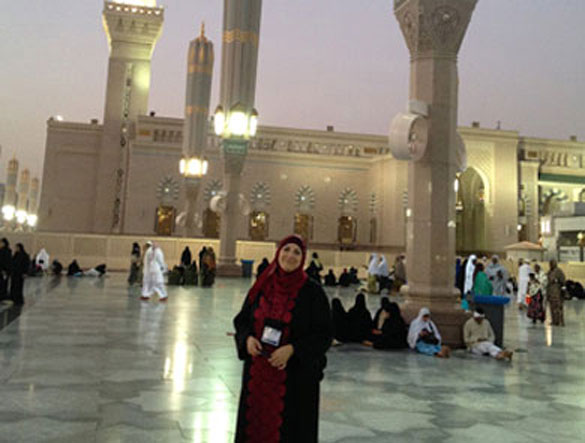
Finally, God says in the Quran that He guides whom He wills to Islam. As I mentioned, I’d been struggling lately because of things like Islamophobia. Instead of cherishing the fact that God called me to the religion, I’ve been focusing on superficial things that distract me from the real beauty of what it means to be Muslim. This experience showed me that I have been taking the great gift of this faith for granted.
Source:
http://www.huffingtonpost.com/2014/10/12/hajj-muslim-convert_n_5959514.html
URL: