
The Universal Promise Of Salvation: Interpreting Surah Al-Baqarah (2:62) In The Contemporary World
BY New Age Islam special correspondent
13 may 2026
Surah Al-Baqarah 2:62 remains one of the Qur’an’s most powerful statements about faith, morality, and human coexistence. Across centuries, scholars have debated its theological implications, yet its ethical force remains undeniable. The verse shifts attention away from empty identity toward sincere belief and righteous conduct. It challenges religious arrogance and opens the possibility of recognizing goodness across communities. In an age marked by communal violence, sectarianism, and ideological hatred, its message is more relevant than ever.
Major points:
· The Qur’an consistently teaches that diversity is part of human existence and that justice, mercy, and compassion are higher moral values. The Prophet Muhammad ﷺ embodied these principles through coexistence with Jews, Christians, and others in Medina.
· Today, Muslims and non-Muslims alike can draw wisdom from this verse. Religious harmony does not require abandoning faith. Rather, it requires recognising that true faith must produce humility, mercy, and ethical responsibility.
· Surah Al-Baqarah 2:62, therefore, stands not merely as a theological statement but as a moral challenge to humanity. It asks believers to move beyond hatred and self-righteousness and toward a world rooted in dignity, justice, and peace.
· Among the most discussed verses in the Qur’an regarding religious diversity, coexistence, and salvation is the verse from the Qur'an known as Surah Al-Baqarah 2:62. The verse has occupied an important place in Islamic theology, interfaith relations, and modern debates about pluralism. In a world increasingly divided by religious nationalism, communal hatred, and ideological extremism, this verse continues to offer an ethical and spiritual framework for coexistence. Muslim scholars across centuries have interpreted it differently, yet almost all agree that it carries a powerful moral message about faith, righteousness, and accountability before God.
The verse reads:
إِنَّ الَّذِينَ آمَنُوا وَالَّذِينَ هَادُوا وَالنَّصَارَىٰ وَالصَّابِئِينَ مَنْ آمَنَ بِاللَّهِ وَالْيَوْمِ الْآخِرِ وَعَمِلَ صَالِحًا فَلَهُمْ أَجْرُهُمْ عِندَ رَبِّهِمْ وَلَا خَوْفٌ عَلَيْهِمْ وَلَا هُمْ يَحْزَنُونَ
Translation:
“Indeed, those who believed, and those who were Jews, Christians, and Sabians — whoever believed in Allah and the Last Day and did righteous deeds — shall have their reward with their Lord. No fear shall come upon them, nor shall they grieve.”
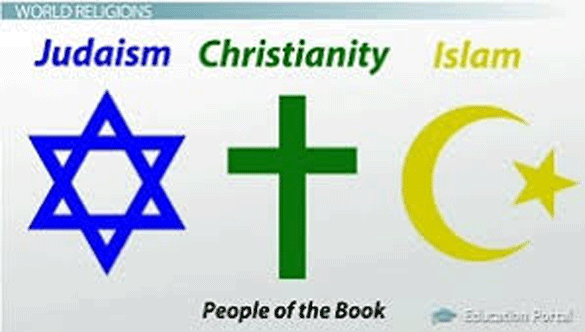
This verse appears in the early portion of Surah Al-Baqarah, a chapter deeply concerned with moral guidance, the Children of Israel, the formation of the Muslim community, and humanity’s covenant with God. At first glance, the verse appears remarkably inclusive. It mentions Muslims, Jews, Christians, and Sabians together and promises divine reward to all who believe in God and the Last Day and perform righteous deeds. This inclusive language has fascinated theologians, reformers, and ordinary believers for centuries.
Historical Context of the Verse
To understand this verse properly, one must examine the historical environment in which it was revealed. Early Islam emerged in a religiously diverse Arabia where Jews, Christians, polytheists, and other religious groups coexisted. The Qur’an frequently interacted with these communities, correcting certain beliefs while also acknowledging their spiritual heritage.
The Jewish tribes of Medina held strong theological traditions and considered themselves heirs to prophetic revelation. Christians in Arabia, especially in regions like Najran, also possessed rich theological cultures. The Sabians, although historically debated, were likely a monotheistic or semi-monotheistic group known in the region. The Qur’an recognised the existence of these communities and addressed them repeatedly.
Surah Al-Baqarah 2:62 appeared in a context where religious exclusivism was common. Many communities believed salvation belonged only to them. The Qur’an challenged this mentality by shifting emphasis from communal labels to moral and spiritual qualities. According to the verse, salvation is not simply inherited through identity. Instead, it is connected to belief in God, accountability in the Hereafter, and righteous action.
This was a radical moral intervention. It challenged tribal superiority, religious arrogance, and inherited privilege. The Qur’an repeatedly criticises communities that believe they are automatically chosen without moral responsibility.
Another related verse states:
وَقَالُوا لَن يَدْخُلَ الْجَنَّةَ إِلَّا مَن كَانَ هُودًا أَوْ نَصَارَىٰ ۗ تِلْكَ أَمَانِيُّهُمْ
“They say none shall enter Paradise unless he be a Jew or a Christian. These are their wishful claims.”
The Qur’an therefore introduced a moral criterion that transcended narrow communal boundaries.
Classical Interpretations of the Verse
Classical Muslim scholars interpreted this verse in different ways. Some viewed it inclusively, while others limited its meaning through later theological developments.
تفسير الطبري (Tafsir Tabari)
Al-Tabari explained that the verse referred to people from earlier religious communities who sincerely followed their prophets before the arrival of Prophet Muhammad ﷺ. According to this interpretation, Jews who followed Prophet Moses faithfully before the coming of Jesus, and Christians who followed Jesus sincerely before Islam, could attain salvation.
Al-Tabari emphasised continuity between prophetic traditions. For him, the verse demonstrated that God rewards sincere faith and righteous action across prophetic histories.
تفسير الرازي (Tafsir Razi)
Fakhr al-Din al-Razi explored philosophical dimensions of the verse. He asked whether salvation depends entirely on formal religious identity or whether ethical sincerity matters more. Razi discussed different opinions and highlighted the mercy and justice of God. His interpretation reflected a deeper theological concern about divine fairness.
تفسير ابن كثير (Tafsir ibn Kathir)
Ibn Kathir interpreted the verse through the lens of Islamic orthodoxy. He argued that after the coming of Prophet Muhammad ﷺ, acceptance of Islam became necessary. According to this view, the verse applied primarily to communities before Islam’s final revelation.
This interpretation became influential in many orthodox circles and was often connected with another Qur’anic verse:
وَمَن يَبْتَغِ غَيْرَ الْإِسْلَامِ دِينًا فَلَن يُقْبَلَ مِنْهُ
“And whoever seeks a religion other than Islam, it shall never be accepted from him.”
Classical scholars, therefore, differed on whether Surah Al-Baqarah 2:62 carried a universal timeless message or whether it was historically limited.
Modern Reformist Readings
Modern Muslim thinkers revisited this verse in response to globalisation, interfaith tensions, colonialism, and religious violence. Many reformists emphasised its universal ethical dimension.
Muhammad Abduh and Rational Interpretation
Muhammad Abduh argued that Islam fundamentally teaches justice, reason, and ethical universalism. He believed the Qur’an consistently values sincere faith and moral conduct over inherited communal identity. Abduh saw Surah Al-Baqarah 2:62 as evidence that God’s mercy is wider than sectarian boundaries.
For Abduh, the Qur’an did not encourage hatred toward other religious communities. Instead, it invited ethical competition in goodness.
Fazlur Rahman and Moral Universalism
Fazlur Rahman viewed the Qur’an as a moral project aimed at building an ethical society. He argued that the essence of religion lies in moral transformation rather than sectarian labelling.
Rahman interpreted Surah Al-Baqarah 2:62 as emphasising universal accountability before God. According to him, righteousness and sincere belief are central, while communal identity is secondary.
Asma Barlas and Inclusive Readings
Asma Barlas highlighted the anti-patriarchal and anti-authoritarian spirit of the Qur’an. She argued that exclusionary interpretations often emerge from political interests rather than the text itself.
Barlas considered verses like 2:62 important for creating inclusive societies where religious minorities are treated with dignity.
Theological Debates Around Salvation
One of the most sensitive questions raised by this verse concerns salvation outside Islam. Muslim theologians historically debated whether non-Muslims could attain divine mercy.
Some scholars insisted that formal acceptance of Islam is mandatory after the Prophet Muhammad ﷺ. Others argued that God judges individuals according to their circumstances, sincerity, and moral awareness.
The Qur’an itself repeatedly emphasises divine justice and mercy:
إِنَّ اللَّهَ لَا يَظْلِمُ النَّاسَ شَيْئًا
“Indeed, Allah does not wrong people at all.”
Another verse states:
وَرَحْمَتِي وَسِعَتْ كُلَّ شَيْءٍ
“My mercy encompasses all things.”
These verses led many modern scholars to caution against declaring entire communities condemned. They argue that ultimate judgement belongs only to God.
The famous hadith also reflects divine mercy.
عَنْ أَبِي هُرَيْرَةَ، أَنَّ رَسُولَ اللَّهِ ﷺ قَالَ:
لَمَّا خَلَقَ اللَّهُ الْخَلْقَ كَتَبَ فِي كِتَابِهِ فَهُوَ عِنْدَهُ فَوْقَ الْعَرْشِ: إِنَّ رَحْمَتِي غَلَبَتْ غَضَبِي
Translation:
Abu Hurairah reported that the Messenger of Allah ﷺ said, "When Allah created creation, He wrote in His Book above the Throne: My mercy prevails over My wrath.”
This theological emphasis on mercy shaped many inclusive Muslim interpretations.
Religious Harmony in the Qur’anic Vision
Surah Al-Baqarah 2:62 cannot be understood in isolation. The Qur’an repeatedly recognizes diversity as part of divine wisdom.
Another famous verse states:
يَا أَيُّهَا النَّاسُ إِنَّا خَلَقْنَاكُم مِّن ذَكَرٍ وَأُنثَىٰ وَجَعَلْنَاكُمْ شُعُوبًا وَقَبَائِلَ لِتَعَارَفُوا
“O humankind, We created you from male and female and made you into nations and tribes so that you may know one another.”
Similarly, the Qur’an says:
لَا إِكْرَاهَ فِي الدِّينِ
“There is no compulsion in religion.”
These verses collectively build a framework for coexistence. The Qur’an does not erase theological differences, but it demands ethical engagement despite those differences.
The Prophet Muhammad ﷺ himself entered agreements with Jewish tribes and Christian communities. One famous example is the Constitution of Medina, which recognised multiple religious communities as part of one political society.
Another important historical example is the Prophet’s treatment of Christians from Najran. When they visited Medina, he allowed them to pray according to their own tradition inside the mosque. This prophetic behaviour reflected practical coexistence rather than forced assimilation.
The Misuse of Religion in Contemporary Politics
In today’s world, religion is frequently weaponised for political mobilisation. Across many societies, religious identity has become tied to nationalism, exclusion, and hatred. This is true not only among Muslims but also across many religious traditions.
Communal violence in places like India, sectarian conflicts in the Middle East, Islamophobia in the West, and anti-minority rhetoric globally demonstrate how religion can become a political tool.
In such a climate, Surah Al-Baqarah 2:62 offers a corrective moral vision. The verse reminds believers that righteousness matters more than slogans. Faith is not meant to produce arrogance or hatred.
The Qur’an strongly condemns mockery and hostility toward others:
وَلَا تَنَابَزُوا بِالْأَلْقَابِ
“Do not insult one another with offensive nicknames.
Another verse says:
ادْفَعْ بِالَّتِي هِيَ أَحْسَنُ
“Repel evil with what is better.”
These teachings are deeply relevant today.
Relevance in the Indian Context
The message of Surah Al-Baqarah 2:62 is especially important in India, a country marked by immense religious diversity. Muslims, Hindus, Christians, Sikhs, Buddhists, Jains, and others have coexisted for centuries. Indian civilisation historically produced traditions of syncretism, shared spirituality, and interreligious dialogue.
Figures like Kabir, Dara Shikoh, and Khwaja Moinuddin Chishti emphasised spiritual unity and compassion.
Indian Islam itself was deeply shaped by Sufi ethics, vernacular cultures, and coexistence. Many Sufi traditions focused more on service and love than rigid sectarianism.
However, contemporary India also faces communal polarisation. Religious identity is increasingly politicised. Hate speeches, misinformation, and social media propaganda deepen mistrust between communities.
In this atmosphere, verses like Surah Al-Baqarah 2:62 can help Muslims articulate a theology of coexistence rooted in the Qur’an itself. Rather than seeing pluralism as a Western import, Muslims can derive ethical coexistence directly from Islamic scripture.
The verse encourages Muslims to focus on righteousness, justice, and moral conduct instead of religious superiority.
The Ethical Meaning of “Righteous Deeds”
An important aspect of the verse is its emphasis on righteous action:
وَعَمِلَ صَالِحًا
“And performed righteous deeds.”
The Qur’an repeatedly combines faith with ethical conduct. Belief alone is insufficient without justice, compassion, honesty, and service.
The Prophet Muhammad ﷺ said:
خَيْرُ النَّاسِ أَنْفَعُهُمْ لِلنَّاسِ
“The best of people are those most beneficial to people.”
This hadith shifts religious focus toward public ethics. A truly religious person benefits humanity.
In contemporary society, righteous deeds may include defending minority rights, feeding the poor, protecting women from violence, fighting corruption, preserving the environment, and promoting peace.
The Qur’an consistently links spirituality with social responsibility.
Interfaith Dialogue and Shared Humanity
Surah Al-Baqarah 2:62 also provides a theological foundation for interfaith dialogue. Dialogue does not mean erasing differences or creating artificial sameness. Instead, it means recognising shared moral concerns while respecting theological distinctions.
The Qur’an instructs Muslims:
وَجَادِلْهُم بِالَّتِي هِيَ أَحْسَنُ
“Debate with them in the best manner.”
This ethical principle is urgently needed in the age of digital hatred. Social media often rewards outrage, humiliation, and division. Religious discussions become hostile rather than thoughtful.
The Qur’anic approach is different. It calls for wisdom, patience, and respectful engagement.
Modern interfaith movements can draw inspiration from such verses. Religious harmony is not merely a political necessity; it is also a spiritual obligation.
Criticism and Conservative Concerns
Some conservative scholars worry that inclusive interpretations of Surah Al-Baqarah 2:62 may weaken Islamic identity or blur doctrinal boundaries. They argue that Islam maintains theological truth claims that cannot simply be relativised.
This concern deserves serious consideration. The Qur’an clearly presents Islam as divine guidance. It does not promote theological indifference.
However, affirming one’s faith does not require hatred toward others. The Qur’an simultaneously maintains religious conviction and ethical coexistence.
A Muslim can believe Islam is true while still respecting the dignity of non-Muslims and recognising moral goodness in other communities. This balance is crucial.
One of the deepest lessons of Surah Al-Baqarah 2:62 is humility. Human beings do not possess ultimate authority over salvation.
The Qur’an repeatedly reminds believers that God alone judges hearts.
إِنَّ اللَّهَ عَلِيمٌ بِذَاتِ الصُّدُور
“Indeed, Allah knows what is within the hearts.”
This awareness should reduce arrogance. Religious communities often fall into the temptation of imagining themselves exclusively saved while condemning everyone else.
The Qur’an challenges such certainty.
The Prophet Muhammad ﷺ also warned against self-righteousness. A famous hadith states the following:
لَا يَدْخُلُ الْجَنَّةَ مَنْ كَانَ فِي قَلْبِهِ مِثْقَالُ ذَرَّةٍ مِنْ كِبْرٍ
“He will not enter Paradise who has even a particle of arrogance in his heart.”
Humility therefore becomes central to authentic religiosity.
A Qur’anic Vision for the Future
The contemporary world desperately needs moral frameworks that can sustain coexistence without erasing difference. Surah Al-Baqarah 2:62 contributes to such a framework.
The verse teaches several enduring lessons. It rejects inherited superiority. It values sincere faith and ethical action. It reminds believers that God’s mercy is vast. It encourages humility about salvation. It creates space for coexistence among religious communities.
At a time when many people use religion to divide humanity, the verse calls believers back to moral responsibility. The Qur’an does not imagine religion as a tool for domination. It imagines religion as a path toward justice, compassion, and accountability before God. For Muslims living in plural societies, this verse offers both confidence and openness. One can remain deeply committed to Islam while building peaceful relations with others. The future of religious harmony may depend on rediscovering such ethical teachings within our own traditions rather than importing them artificially from outside.
Conclusion
Surah Al-Baqarah 2:62 remains one of the Qur’an’s most powerful statements about faith, morality, and human coexistence. Across centuries, scholars have debated its theological implications, yet its ethical force remains undeniable.
The verse shifts attention away from empty identity toward sincere belief and righteous conduct. It challenges religious arrogance and opens the possibility of recognising goodness across communities. In an age marked by communal violence, sectarianism, and ideological hatred, its message is more relevant than ever.
The Qur’an consistently teaches that diversity is part of human existence and that justice, mercy, and compassion are higher moral values. The Prophet Muhammad ﷺ embodied these principles through coexistence with Jews, Christians, and others in Medina.
Today, Muslims and non-Muslims alike can draw wisdom from this verse. Religious harmony does not require abandoning faith. Rather, it requires recognising that true faith must produce humility, mercy, and ethical responsibility.
Surah Al-Baqarah 2:62, therefore, stands not merely as a theological statement but as a moral challenge to humanity. It asks believers to move beyond hatred and self-righteousness and toward a world rooted in dignity, justice, and peace.
…
URL: https://newageislam.com/interfaith-dialogue/universal-promise-salvation-surah-al-baqarah-/d/140006
New Age Islam, Islam Online, Islamic Website, African Muslim News, Arab World News, South Asia News, Indian Muslim News, World Muslim News, Women in Islam, Islamic Feminism, Arab Women, Women In Arab, Islamophobia in America, Muslim Women in West, Islam Women and Feminism