
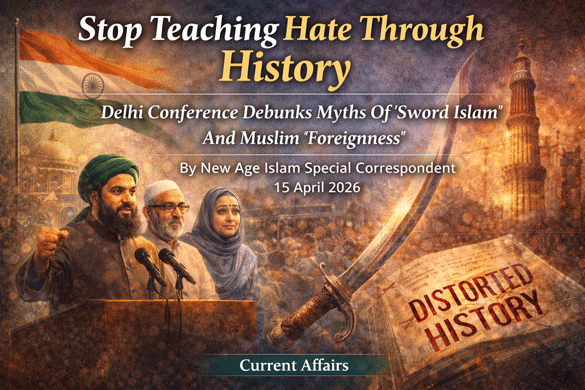
Stop Teaching Hate Through History: Delhi Conference Debunks Myths Of ‘Sword Islam’ And Muslim ‘Foreignness’
By New Age Islam Special Correspondent
15 April 2026
Main Points:
· Delhi’s National History Conference challenged the communal myths that Islam spread in India “by the sword” and that temple destruction was purely religious, calling for evidence-based historical reading.
· Scholars stressed that most medieval conflicts were driven by power, territory and political legitimacy—not by religion alone.
· The conference firmly rejected the narrative of Indian Muslims as “foreigners,” asserting that the vast majority are indigenous communities shaped by centuries of spiritual, social and cultural transformation.
· Speakers highlighted the decisive Muslim contribution to India’s civilisational growth—from science, philosophy and literature to modern nation-building and constitutional democracy.
· A major warning emerged on distorted textbooks and ideological history writing, with experts urging scientific, plural and non-sectarian historiography to protect India’s democratic future.
In an era when history is increasingly being rewritten to serve ideological agendas, the two-day National History Conference held in New Delhi came as a much-needed scholarly intervention. Organised by the India History Forum at the India Islamic Cultural Centre, the conference challenged some of the most politically weaponised myths of our times: that Islam spread in India solely through the sword, that temple destruction was an exclusively religious enterprise, and that Indian Muslims are somehow descendants of “outsiders.”
The significance of this conference lies not merely in its academic depth, but in its moral courage. At a time when selective readings of medieval history are routinely used to manufacture suspicion and hatred in the present, historians and public intellectuals gathered in Delhi to insist on a simple but radical proposition: history must be understood through evidence, context and complexity—not through propaganda.
Among the most powerful interventions was that of Dr Ram Puniyani, who observed that over the last three to four decades, history in India has increasingly been reduced to a communal morality play. Isolated episodes are extracted from their political and economic contexts and repackaged as proof of civilisational enmity.
This is particularly visible in the persistent trope that Islam spread only by military conquest. Such a claim, repeated often enough in popular discourse, has acquired the aura of common sense. Yet serious historians know that this narrative collapses the vast diversity of India’s Islamisation into a single communal cliché.
As the conference rightly highlighted, medieval wars were overwhelmingly fought for power, revenue, strategic control and dynastic legitimacy, not religious conversion. Kings, whether Hindu or Muslim, fought to expand territory and consolidate authority. To reinterpret every conflict through the lens of faith is to fundamentally misunderstand premodern statecraft.
Equally misleading is the politically convenient obsession with temple destruction as a purely religious phenomenon. Historical evidence shows that attacks on temples, where they occurred, were often directed at centres of royal legitimacy, wealth and political symbolism. Temples in many kingdoms functioned not merely as sacred sites but as repositories of treasure and markers of sovereignty. To erase this political dimension is to deliberately communalise the past.
The Delhi conference’s rejection of these myths was therefore not an exercise in apologetics—it was a defence of historical method itself.
Another deeply consequential theme of the conference was the assertion that Indian Muslims are not foreigners but an inseparable part of the subcontinent’s civilisational evolution.
Abdus Salam Potage directly challenged the rhetoric that casts Muslims as alien to India’s soil. His point deserves emphasis. The overwhelming majority of Indian Muslims are descendants of local communities who embraced Islam across centuries through processes far more complex than conquest narratives allow. The appeal of Tawhid, social equality, Sufi spirituality, moral universalism and resistance to caste hierarchies all played important roles in shaping conversion histories.
To call Indian Muslims “foreign” is therefore not only historically false; it is an ideological act designed to delegitimise their belonging.
Salman Khurshid—Former External Affairs Minister—added another crucial layer by reminding the audience that Muslims were central not only to India’s medieval and early modern past, but also to the making of modern India. From the anti-colonial struggle to constitutional democracy, from legal thought to diplomacy and public education, Muslim contributions are embedded in the republic’s very foundations.
In today’s polarised climate, this reminder is essential. The erasure of Muslim contributions from national memory is not merely an academic distortion; it weakens the plural imagination on which India’s democracy depends. The conference also broadened the discussion beyond politics into the realms of knowledge and culture.
Prof. S. M. Azizuddin Husaini highlighted the extraordinary Muslim contributions to science, philosophy, literature, aesthetics and urban culture, reminding participants that civilisations are built as much through ideas as through institutions.
This intellectual dimension was enriched further by Dr Ishtiaq Husain, whose reflections on medieval India’s multilingual world were especially relevant. He noted that the Mughal period saw substantial exchanges between Persian, Sanskrit and regional languages, including the translation of important Sanskrit texts.
This directly contests the simplistic claim that Persian’s status as an official language led to the suppression of indigenous traditions. In reality, languages often coexisted, interacted and enriched one another. India’s civilisational strength has always lain in such synthesis, not exclusion.
Perhaps the most urgent contemporary relevance came through Prof. Anita Rampal’s remarks on textbooks and curriculum. If distorted history is institutionalised through school education, it shapes generations not merely to misunderstand the past, but to mistrust one another in the present. This is why the battle over history is also a battle over India’s democratic future.
The participation of young scholars—who presented over 20 research papers on the historical role of Islam and Muslims in India—was particularly encouraging. It signals that despite ideological pressures, a new generation remains committed to critical scholarship and archival seriousness.
What emerged from the Delhi conference was a clear warning: when history is turned into a tool of grievance politics, society itself becomes vulnerable to division.
India urgently needs a historiography that resists communal simplification and recovers the layered truths of coexistence, conflict, exchange and synthesis. The medieval past cannot be reduced to slogans of victimhood or conquest. Nor can Indian Muslim identity be held hostage to fabricated genealogies of foreignness.
The real lesson of history is not hate. It is complexity. And in today’s India, defending that complexity may be one of the most important acts of democratic responsibility.
…
URL: https://newageislam.com/interfaith-dialogue/delhi-conference-sword-islam-muslim-foreignness/d/139683
New Age Islam, Islam Online, Islamic Website, African Muslim News, Arab World News, South Asia News, Indian Muslim News, World Muslim News, Women in Islam, Islamic Feminism, Arab Women, Women In Arab, Islamophobia in America, Muslim Women in West, Islam Women and Feminism