
Enlightenment Across Faith Traditions: Engaging with Cross-Scriptural Values for Religious, Spiritual and Social Harmony in India
By New Age Islam Special Correspondent
02 April 2026
The Round Table emphasized the importance of applying enlightenment in everyday life, urging individuals to move beyond the narrow confines of religion in order to truly practice its essence. It clearly stated: Religion is made for man. Man is not made for Religion; Religion exists for human beings and is only one aspect of life—not its entirety. The conference cautioned against giving religion absolute importance and advocated for a balanced, moderate approach free from rigidity and extremism. It concluded that refining and elevating our understanding of religion is itself a form of enlightenment and further reminded the audience that nothing in this world is perfect, and therefore, we must embrace the good within religions while rejecting what causes harm…….
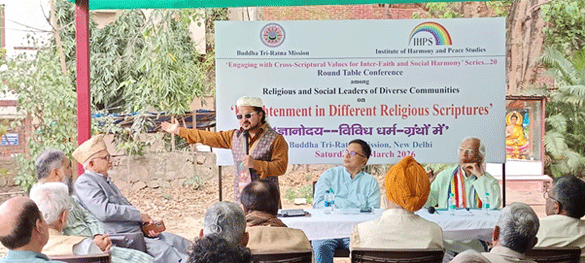

In an age marked by polarization and misunderstanding, a remarkable inter-religious gathering in the national capital offered a refreshing vision of unity grounded in shared spiritual values.
The Institute of Harmony and Peace Studies (IHPS), in collaboration with the Buddha Tri-Ratna Mission (BTM), convened a round table conference on the theme “Enlightenment in Different Religious Scriptures” (ज्ञानोदय—विविध धर्म-ग्रंथों में). The event brought together religious scholars, social leaders, and interfaith practitioners from diverse traditions to reflect on one of humanity’s most profound aspirations: enlightenment.
Chaired and moderated by Fr. Dr. M. D. Thomas, Founder Director of IHPS, the conference was part of an ongoing initiative titled “Engaging with Cross-Scriptural Values for Interfaith and Social Harmony.” This initiative seeks to explore shared ethical and spiritual principles across religious traditions, fostering dialogue that transcends doctrinal boundaries. The central premise of the gathering was simple yet powerful: while religious paths may differ, the quest for enlightenment is universal.
In his opening remarks, Dr. Thomas emphasized that enlightenment—often associated with Buddhist philosophy—is not confined to any single religion but represents a shared human heritage. He described it as a state of higher awareness, wisdom, and moral clarity that can guide individuals and societies toward harmony. He encouraged participants to identify parallel concepts within their own traditions and engage in a comparative dialogue rooted in mutual respect.
The Buddhist perspective, presented by Bhikku Dr. Nanda, defined enlightenment (Bodhi) as liberation from suffering and the cycle of rebirth. Rooted in the “Four Noble Truths” or Char Ashtang (चार अष्टांग), this understanding highlights the impermanent nature of existence and the absence of a fixed self. The Four Noble Truths are the foundation of the teachings of Gautama Buddha. They explain the nature of suffering and the path to liberation and enlightenment. Enlightenment, he explained, is attained through disciplined practice—ethical living, meditation, and the cultivation of wisdom. It is marked by freedom from craving and the flowering of compassion, offering a path not only for personal liberation but for universal well-being.
From the Jain tradition, Dr. Ajay Jain elaborated on the concept of Keval Gyan, or absolute knowledge. According to Jain philosophy, the soul is inherently pure and omniscient, but is obscured by layers of karmic accumulation. Enlightenment occurs when these obstructions are removed through strict ethical discipline and adherence to the five great vows. He outlined the five categories of knowledge in Jain thought, culminating in Keval Gyan, which represents complete and perfect awareness.
Islamic perspectives on enlightenment were articulated by Prof. Junaid Haris of Jamia Millia Islamia University and Prof. Salim Engineer of Jama’at-e-Islami Hind. Prof. Haris highlighted three foundational principles derived from the Qur’an: the unity of religion, the unity of God, and the unity of humanity. These principles suggest that all authentic religious teachings ultimately converge toward a single truth. Enlightenment, in this framework, is achieved through akhlaq—moral and ethical conduct that reflects divine guidance. Prof. Engineer further distinguished between acquired knowledge gained through reason and experience, and revealed knowledge transmitted through prophets. He stressed that knowledge becomes meaningful only when it serves the greater good, reinforcing the idea that enlightenment is inseparable from social responsibility.
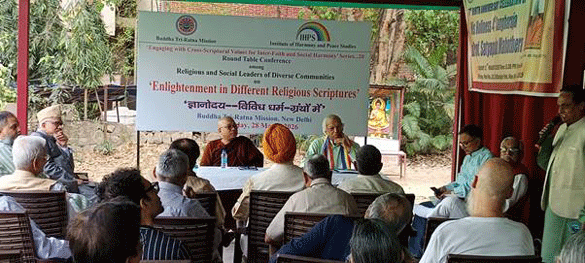
Hindu philosophical traditions offered multiple pathways to enlightenment, often described as moksha, or liberation from the cycle of birth and death. Hindu speakers thus highlighted the importance of purity in thought, intention, and action as prerequisites for spiritual realization. Concepts such as Neti-Neti—the process of negating the transient to realize the eternal—illustrate the inward journey toward truth. Knowledge was also categorized into Nitya Gyan (eternal knowledge) and Naimittik Gyan (contextual knowledge), both of which contribute to spiritual growth when rightly understood and applied, the scholars of Hinduism stressed.
Sikh teachings, as discussed by Sardar Harvinder Singh Lamba and Sardar Surjit Singh Azad, emphasized the principle of Ik Onkar—the oneness of God and the unity of all creation. Enlightenment, in this tradition, involves internalizing the Guru’s teachings, overcoming ego, and recognizing the inherent dignity of all beings. A key insight shared during the discussion was the importance of self-reflection: rather than judging others, one must cultivate humility and the ability to see goodness in all.
Other contributors expanded the conversation beyond traditional frameworks. Dr. Vic Gaffiney, a polymathic omnologist, educationist and consultant based in the Australian Capital Territory, Australia spoke of enlightenment as a universal journey toward unity with the divine, describing all religions as pathways leading to the same ultimate reality. Dr. Chand Bharadwaj of Delhi-based Gyanam Suvigyanam introduced a philosophical lens, framing enlightenment as a fundamental human right linked to the evolution of consciousness. Using metaphors drawn from cosmology, he suggested that humanity is part of a scientific cosmic movement toward freedom and self-realization.
Interfaith activists and scholars also underscored the importance of lived experience in the pursuit of enlightenment. Mr. Aniruddh Kumar emphasized the need to transcend ego and recognize the interconnectedness of all beings. Janab Firoz Bakht Ahmed described such dialogues as essential in a world increasingly defined by conflict, advocating for wisdom and compassion over division.
Janab Ghulam Rasool Dehlvi, New Age Islam regular columnist and Sufi author and poet drew attention to the beauty of diversity, likening it to the colours of a rainbow, and cautioned against straying from the ethical teachings of scriptural traditions. Citing from various scriptures, Mr Dehlvi emphasized the importance of diversity in contemporary society, comparing it to the harmonious coexistence of colours in a rainbow. A recurring theme throughout his speech was the centrality of truth and moral integrity across faith traditions. He observed that although humanity shares a common divine origin, it has strayed from the values taught by the prophets, contributing to present global challenges. He highlighted truthfulness as the foundation of all values that lead to enlightenment, describing it as a unifying ethical principle essential for both individual growth and collective harmony.
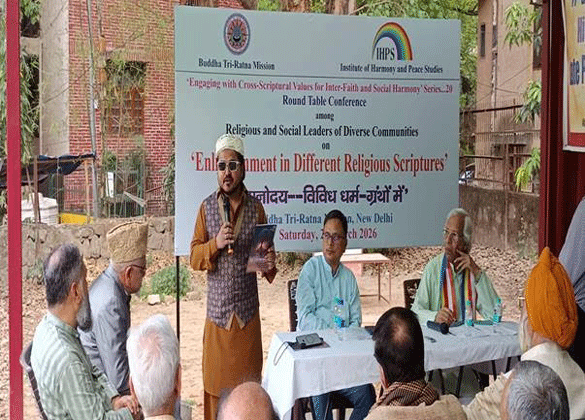
Ms. Nilakshi Rajakhowa of the Bahá’í House of Worship (New Delhi) highlighted truthfulness as the foundation of all spiritual values, while others echoed the importance of service, compassion, and ethical conduct. Dr. Gopal Jee pointed to the role of yoga in harmonizing the body, mind, and soul, offering a practical pathway to enlightenment that transcends religious boundaries.
Importantly, the conference did not remain confined to abstract philosophical discussions. Several speakers addressed contemporary challenges, particularly the mental and emotional struggles faced by youth. Prof. T. K. Mishra emphasized the need to cultivate spiritual awareness as a means of addressing inner turmoil and fostering resilience. He argued that promoting shared values across religions can help build a more tolerant and compassionate society.
The concluding remarks by Dr. Thomas brought the discussion full circle. He urged participants to move beyond rigid interpretations of religion and focus on its essence—values that uplift and unite. Religion, he noted, is only one aspect of human life and should not be absolutized at the expense of reason and empathy. He called for a balanced approach that embraces the good within all traditions while rejecting elements that cause harm or division.
Perhaps the most striking takeaway from the conference was the shared recognition that enlightenment is not merely a distant spiritual ideal but a practical guide for everyday living. It is reflected in how individuals treat one another, how societies uphold justice and compassion, and how humanity navigates its collective challenges. In this sense, enlightenment becomes both a personal journey and a social responsibility.
The round table conference stands as a testament to the power of dialogue in bridging divides. By bringing together voices from different faiths and perspectives, it demonstrated that common ground is not only possible but abundant. At a time when religious differences are often exploited to fuel conflict, such initiatives offer a hopeful alternative—one rooted in understanding, respect, and shared humanity.
As the participants dispersed, the message that lingered was clear: enlightenment is not the monopoly of any one tradition. It is a universal aspiration, a guiding light that can lead humanity toward greater harmony and peace. The challenge lies not in defining it, but in living it.
In a world searching for direction, this gathering in New Delhi offered a simple yet profound reminder: the path to enlightenment begins with openness, humility, and the willingness to see oneself in the other. Thus, the conference encouraged an open-minded acceptance of cross-cultural ethical and spiritual universal values wherever they are found and emphasized that the true essence of faith lies in living its deepest principles.
…
New Age Islam, Islam Online, Islamic Website, African Muslim News, Arab World News, South Asia News, Indian Muslim News, World Muslim News, Women in Islam, Islamic Feminism, Arab Women, Women In Arab, Islamophobia in America, Muslim Women in West, Islam Women and Feminism