
Beyond the Battlefields: Shri Krishna, Prophet Muhammad and the Moral Trajectories of War for Peace and Justice
By New Age Islam Special Correspondent
20 February 2026
Revisiting Shri Krishna’s Mahabharata, Dharma, Karma and Moksha with Prophet Muhammad’s Islamic Battles (Jihad), Migration (Hijrah) for the establishment of his Deen of Peace…...
At the launch of the book “From Death to Immortality: The Great War of Mahabharata”, New Age Islam columnist, Ghulam Rasool Dehlvi weighed in with an elaborate and thought-provoking intervention. Drawing a comparative reflection, he highlighted certain historical and moral parallels between Prophet Muhammad (peace be upon him) and Shri Krishna, particularly in relation to the wars they were compelled to face and the circumstances that led to them. “While the Mahabharata war, in narrative scope, far exceeds the scale of the Arabian battles during the Prophet’s lifetime, both traditions situate these conflicts within moral and theological frameworks that seek to restrain violence and uphold justice. War is portrayed not as an intrinsic virtue but as a tragic necessity when all avenues of reconciliation fail”, he averred.
The hall was quiet, attentive — not merely because a book was being launched, but because a civilisational question was being reopened.
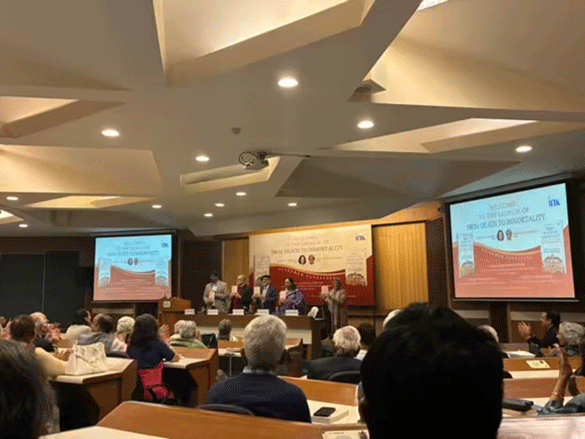
At the launch of the book “From Death to Immortality: The Great War of Mahabharata”, noted scientist and thinker Prof. Anand Kumar (MD, FAMS) rose to speak. What followed was not a formal academic address nor a ceremonial tribute to the authors. It was a meditation on life, death and the moral structure of the universe.
The Mahabharata, he reminded the audience, is not merely a battlefield narrative. Kurukshetra is also a theatre of conscience. Warriors fight, sages interpret, priests console the dying, and amidst the carnage emerges the luminous teaching of the Bhagavad Gita. Action must align with dharma. Duty must be performed without attachment to reward. “You have a right to action alone, not to its fruits” (Gita 2:47).
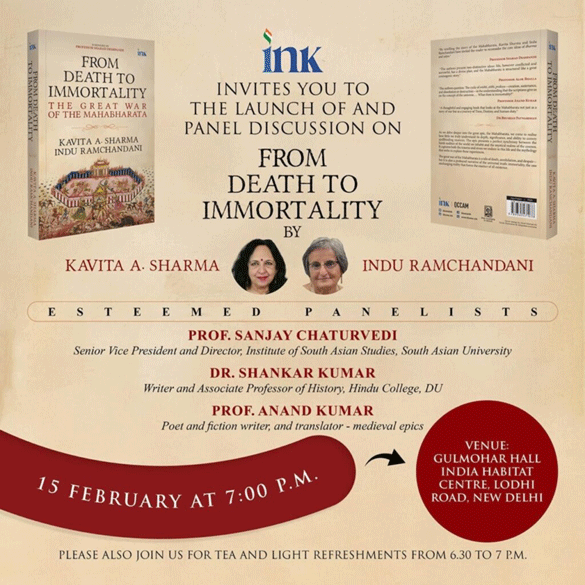
The book, authored by Prof. Kavita Sharma and Madam Indu Ramchandani, reintroduces the Mahabharata as more than an epic of war. It presents it as a philosophical mirror — reflecting humanity’s deepest anxieties: Why do the righteous suffer? Why does injustice seem to flourish? Does death conclude our moral story, or merely interrupt it? Prof. Kumar spoke of karma not as fatalism but as moral continuity. He spoke of rebirth not as mythology but as an ethical grammar through which suffering and justice are interpreted. And he described moksha — liberation — as the transcendence of fear itself: freedom from attachment, ego and the terror of mortality. War, in this framework, is never glorified. It is a tragic necessity when moral order collapses.
As the formal speech concluded and the session opened for questions, the discussion took an interesting turn. New Age Islam columnist and Indo-Islamic scholar Ghulam Rasool Dehlvi rose to respond — not to debate theology, but to explore ethical resonances. Carefully, and with clear acknowledgment of doctrinal boundaries, he drew a comparative reflection between Shri Krishna and Prophet Muhammad (peace be upon him).
Both figures, he observed, faced persecution before confrontation. Shri Krishna left Mathura under sustained hostility, preserving life and strategic space before the eventual conflict of Kurukshetra. Prophet Muhammad (pbuh) was expelled from Makkah, undertaking the historic Hijrah to Madinah — an event the Qur’an recalls poignantly: “They drove him out” (9:40).
In both traditions, migration was not surrender. It was moral repositioning. The Hijrah marked the establishment of a community built on justice and covenant. The Constitution of Madinah stands as one of the earliest plural civic compacts. Similarly, Krishna’s political and moral role in the Mahabharata was oriented toward restoring dharma within a fractured polity.
Dehlvi emphasized that in Islam, armed struggle was permitted only under ethical restraint and defensive necessity. The Qur’an grants permission to fight only when wronged: “Permission [to fight] has been given to those who are being fought, because they have been wronged” (22:39). Even then, limits are imposed: “Fight in the way of God those who fight you, but do not transgress” (2:190).
The battles of Badr, Khandaq and Hunain were not expansionist campaigns but existential struggles of a vulnerable community seeking survival with dignity. Likewise, the Mahabharata does not romanticize war. The Gita’s exhortation to Arjuna — “For a warrior, nothing is higher than a righteous war” (2:31) — is embedded within a deeper spiritual discipline of detachment and selflessness. Action must be free from ego. Violence without dharma is adharma.
On this terrain of thought, Indo-Islamic scholar and author of “Ishq Sufiyana: Untold Stories of Divine Love”, Ghulam Rasool Dehlvi weighed in with an elaborate and thought-provoking intervention. Drawing a comparative reflection, he highlighted certain historical and moral parallels between Prophet Muhammad (peace be upon him) and Shri Krishna, particularly in relation to the wars they were compelled to face and the circumstances that led to them.
He noted that just as Shri Krishna was forced to leave Mathura in the face of persistent hostility, Prophet Muhammad (pbuh) too was driven out of Makkah and undertook the historic Hijrah to Madinah. In both cases, migration was not an act of retreat but a strategic and moral turning point — a transition from persecution to the establishment of a just social order.
Dehlvi further observed that both figures, within their respective traditions, were compelled to confront armed conflict in defence of truth and moral order — Dharma in the Hindu framework and Deen in the Islamic and Qur’anic framework. Prophet Muhammad (pbuh) fought several defensive battles, including Badr, Khandaq and Hunain, under circumstances of existential threat to the nascent Muslim community. Similarly, Shri Krishna played a central role in the Mahabharata war, a vast and devastating conflict rooted in questions of justice, legitimacy and righteousness.
While the scale and historical contexts of these wars differed, Dehlvi emphasized that both traditions present them as morally conditioned struggles rather than aggressive enterprises. In each case, war emerged as a last resort within a larger ethical framework. The legitimacy of these struggles, he argued, must be understood within their specific historical and theological contexts rather than through anachronistic comparison. By drawing these parallels, however, Dehlvi sought not to equate the two traditions simplistically, but to underscore a shared moral pattern: persecution, migration, principled resistance, and the establishment of justice. Such reflections, he suggested, can deepen interfaith understanding by focusing on ethical commonalities rather than doctrinal divides.
By offering a carefully framed comparative reflection between Prophet Muhammad (pbuh) and Shri Krishna within their respective theological and historical contexts, he said, his intention was not to conflate doctrines or equate the two traditions in matters of creed, but to draw attention to certain ethical and historical parallels that illuminate shared moral themes. He noted that both figures experienced persecution that led to decisive moments of migration. In Islamic history, the Prophet Muhammad’s Hijrah from Makkah to Madinah marks a foundational transition — from oppression to the establishment of a just and covenant-based community. The Qur’an alludes to this expulsion: “They drove him out” (Qur’an 9:40), and affirms the moral legitimacy of resistance when injustice becomes intolerable: “Permission [to fight] has been given to those who are being fought, because they have been wronged” (Qur’an 22:39).
Similarly, in the Hindu narrative tradition, Shri Krishna’s departure from Mathura in the face of persistent aggression is presented not as defeat, but as strategic withdrawal and preservation of dharma. Later, in the Mahabharata, Krishna assumes the role of moral guide in the Kurukshetra war — a conflict framed not as conquest, but as the restoration of righteousness (dharma) against injustice.
Dehlvi pointed out that both traditions articulate the ethical conditions under which war becomes permissible. In Islam, warfare during the Prophet’s lifetime — including Badr (Qur’an 8:5–19), Khandaq (33:9–27), and Hunain (9:25–27) — is consistently framed in the Qur’an as defensive and conditional, with clear ethical restraints: “Fight in the way of God those who fight you, but do not transgress; indeed, God does not love transgressors” (2:190).
Likewise, in the Bhagavad Gita, revealed in the midst of the Kurukshetra battlefield, Krishna instructs Arjuna that action must be aligned with dharma and undertaken without egoistic attachment: “Considering your duty as a warrior, you should not waver… for a warrior, nothing is higher than a righteous war” (Gita 2:31). Yet this call to battle is embedded within a larger spiritual framework of selflessness and moral responsibility, culminating in the doctrine of nishkama karma — action without attachment to its fruits (Gita 2:47).
Dehlvi emphasized that understanding these parallels requires theological sensitivity. In Islam, Prophet Muhammad (pbuh) is the Seal of the Prophets (Qur’an 33:40), and Islamic theology does not make doctrinal claims about Krishna in prophetic terms. Similarly, within Hindu theology, Krishna is understood in diverse ways — as an avatar of Vishnu, a divine teacher, and a central figure in the unfolding of dharma. Therefore, comparative reflections must remain respectful of doctrinal boundaries while engaging ethical common ground.
In drawing these parallels, Dehlvi sought to highlight a shared moral pattern: persecution, migration, principled resistance, and the pursuit of justice within divinely guided frameworks. Such careful comparative reflection, he suggested, can foster deeper interfaith understanding — not by dissolving theological distinctions, but by appreciating how different traditions wrestle with similar moral dilemmas in their sacred histories.
As the evening drew to a close, the title of the book — From Death to Immortality — seemed less metaphorical. Immortality, as Prof. Kumar had implied, is not merely survival after death. It is moral endurance. It is living in such a way that one transcends fear of death because one has aligned with truth.
The Mahabharata and the Qur’an emerge from different revelatory and theological universes. Yet both wrestle with the same human dilemma: how to uphold justice in a world where power often overrules principle.
In times marked by communal suspicion and politicised religiosity, such conversations matter. They remind us that sacred history is not a call to perpetual battle, but a call to moral courage and spiritual discipline.
The battlefield of Kurukshetra and the trials of early Madinah are not invitations to triumphalism. They are reminders that the real struggle — the greater jihad, in Islamic language — is against ego, injustice and moral blindness.
…
New Age Islam, Islam Online, Islamic Website, African Muslim News, Arab World News, South Asia News, Indian Muslim News, World Muslim News, Women in Islam, Islamic Feminism, Arab Women, Women In Arab, Islamophobia in America, Muslim Women in West, Islam Women and Feminism