
Islam And The Ethics Of Tolerance

By Moin Qazi, New Age Islam
29 May 2026
I. Faith, Diversity, and the Human Condition
The Indian subcontinent has, for centuries, been one of the world's richest examples of civilisational coexistence. Diverse religious communities, languages, philosophies, and cultural traditions evolved here not in isolation but through continuous interaction. Yet the persistence of communal tension since Partition has shown with painful clarity that harmony cannot survive merely through nostalgic invocations of a composite past. Distrust, historical memory, political mobilisation, and social insecurity continue to shape relations between communities in deeply unsettling ways.
Human beings are emotional creatures, vulnerable to fear, prejudice, and manipulation. A rumour, a distorted narrative, or a symbolic provocation can ignite violence with terrifying speed. Modern societies are therefore confronted with a challenge far deeper than political administration: the cultivation of a moral culture rooted in mutual respect and ethical restraint.
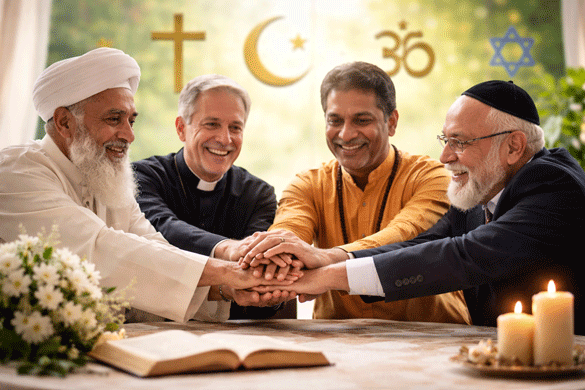
Tolerance is not passive indifference toward others, nor merely a legal arrangement for coexistence. It is a moral virtue grounded in spiritual maturity and intellectual humility. Genuine tolerance emerges when individuals recognise that human dignity transcends divisions based on religion, race, caste, language, and ideology. Without this ethical foundation, pluralism becomes fragile and vulnerable to collapse under social or political pressure.
The survival of diverse societies depends upon nurturing habits of empathy, openness, and moral responsibility. Exposure to different traditions, scriptures, and cultures broadens the moral imagination and weakens the instinct to fear the unfamiliar. A confident faith does not perceive diversity as a threat; it understands plurality as part of the divine order of human existence.
Islamic civilisation historically developed within profoundly diverse societies that stretched from Spain to India, from Africa to Central Asia. Muslims interacted continuously with Christians, Jews, Hindus, Buddhists, and numerous other communities. This interaction produced not merely political coexistence but intellectual and cultural synthesis. Islamic civilisation flourished most when it possessed confidence rather than fear, curiosity rather than hostility.
The Qur'an repeatedly reminds humanity that diversity is neither accidental nor undesirable:
"O mankind, We created you from a male and a female and made you into nations and tribes so that you may know one another." (Qur'an 49:13)
This verse establishes one of the foundational principles of Islamic ethics: human difference exists for recognition, understanding, and cooperation, not domination or exclusion.
The Prophet Muhammad reinforced this moral vision in his Farewell Sermon, dismantling the hierarchies of race, tribe, and lineage that had fractured human societies for centuries. He declared that no Arab possessed superiority over a non-Arab, nor a white person over a black person, except through righteousness and moral conduct. This was not merely spiritual counsel but an ethical proclamation aimed at reshaping social consciousness itself.
Religion ultimately reveals itself not through slogans or polemics but through conduct. Communities are judged less by their doctrines than by the moral character they embody in public life. Compassion, justice, honesty, humility, and dignity communicate faith more powerfully than rhetoric ever can. The credibility of religion rests not merely in what believers preach, but in how they live among others.
At its deepest level, tolerance reflects spiritual confidence — the confidence to uphold one's convictions without hatred toward those who differ. A faith grounded in moral certainty does not need coercion or hostility. It persuades through wisdom, example, and ethical integrity.
The Qur'an and the Moral Vision of Peace
Islam, in its essential moral orientation, is a religion directed toward peace, justice, and human dignity. The very word Islam derives from the same linguistic root as salaam — peace, harmony, and wholeness. Far from endorsing indiscriminate violence, the Qur'an consistently links faith with mercy, restraint, and moral accountability.
One of the Qur'an's most profound ethical declarations states:
"Whoever kills a human being — unless for murder or corruption in the land — it is as though he has killed all mankind; and whoever saves a life, it is as though he has saved all mankind." (Qur'an 5:32)
This verse establishes the sanctity of human life as a universal moral principle. The Qur'anic worldview does not restrict compassion to one tribe, nation, or religious community. Human dignity itself is sacred because every human being is a creation of God.
The central ethical thrust of the Qur'an revolves around justice, mercy, compassion, honesty, forgiveness, and care for the vulnerable. Yet despite this ethical core, Islam is frequently portrayed through the lens of violence and extremism. Much of this distortion arises from selective reading, ideological manipulation, and decontextualised interpretation.
The Qur'an is not a collection of isolated commandments detached from historical and textual context. Its verses must be read holistically, each illuminating and qualifying the other. Detached interpretation often produces meanings that reflect the interpreter's prejudices rather than the text's moral intent. The same scripture can yield profoundly different readings depending on the reader's moral disposition. Those inclined toward compassion discover mercy within it; those seeking domination may weaponise certain passages while ignoring the broader ethical framework.
The Qur'an warns against precisely this abuse of scripture:
"As for those in whose hearts is perversity, they follow the ambiguous parts seeking discord and false interpretation." (Qur'an 3:7)
The problem, therefore, is not merely textual but interpretive. Religious violence often emerges not from faith itself but from ideological readings stripped of ethical balance, historical awareness, and spiritual humility.
This becomes especially clear in discussions surrounding jihad. In modern discourse, the term is routinely reduced to militant violence despite its far broader linguistic and spiritual meaning. Derived from the Arabic root meaning "to strive" or "to exert effort," jihad fundamentally signifies struggle in the path of moral truth. The highest form of jihad in Islamic spirituality has traditionally been understood as the struggle against ego, injustice, greed, and moral corruption within oneself.
The Qur'an permits fighting only under strictly defined conditions of self-defence and protection against persecution:
"Fight in the way of God those who fight you, but do not transgress. Indeed, God does not love transgressors." (Qur'an 2:190)
Even in conflict, reconciliation and peace remain morally superior:
"If they incline toward peace, then incline toward it also." (Qur'an 8:61)
These ethical limitations fundamentally distinguish defensive struggle from aggression or terror. Yet extremist groups routinely isolate verses from their textual and historical context to legitimise violence. Equally, anti-Muslim polemicists reproduce the same distortions to portray Islam itself as inherently violent. In both cases, the Qur'an becomes a hostage to ideological agendas.
The true moral spirit of Islam cannot be understood through isolated quotations or sensational narratives. It emerges only through a holistic engagement with the Qur'an's ethical universe — a universe grounded in mercy, restraint, justice, and reverence for life.
Freedom, Pluralism, and Religious Coexistence
One of the most profound principles within Islam is the recognition of freedom of conscience. Faith possesses moral value only when sincerely and voluntarily embraced. Coerced belief is spiritually meaningless because genuine faith arises from conviction of the heart rather than external pressure.
The Qur'an declares with remarkable clarity:
"There is no compulsion in religion." (Qur'an 2:256)
This principle established a moral foundation for coexistence within religiously plural societies. Islamic civilisation historically developed in continuous interaction with other faith communities, and despite undeniable historical shortcomings, Muslim societies often accommodated religious diversity to a degree rare in many premodern civilisations.
The Prophet Muhammad's conduct reflected this ethic of coexistence. The Constitution of Medina recognised Jews as equal members of the civic community entitled to protection and participation within a shared political order. This early model demonstrated that religious diversity could coexist with social unity.
Equally revealing was the Prophet's conduct during the peaceful conquest of Mecca. After years of persecution and exile, he entered the city not as a vengeful conqueror but as a leader committed to reconciliation. He declared a broad amnesty for his former enemies and rejected collective revenge. His triumph became not merely a political victory but a moral one — a demonstration that forgiveness possesses greater transformative power than retaliation.
Modern Muslim thinkers continue to draw upon this tradition of coexistence in responding to the contemporary world. Across many societies, scholars and reformers are revisiting foundational Islamic texts to recover ethical principles that can support constitutionalism, pluralism, equal citizenship, and peaceful coexistence.
This effort is especially important in an era marked simultaneously by rising Islamophobia and religious extremism. Muslims today often find themselves trapped between two distorted narratives: one portraying Islam as inherently intolerant and another reducing religion to rigid ideological absolutism. Both narratives impoverish the ethical richness of the Islamic tradition.
The rise of anti-Muslim prejudice across parts of the world has intensified feelings of alienation among many Muslim communities. Simplistic portrayals of Muslims as uniformly violent or anti-modern ignore the immense diversity within the global Muslim experience. Such stereotypes are not grounded in rigorous understanding but are shaped by selective media representation, political opportunism, and fear-driven rhetoric.
Yet Muslims themselves must also confront uncomfortable realities. Religious minorities within Muslim-majority societies are entitled not merely to symbolic tolerance but to full dignity, legal protection, and equal citizenship. The ethical credibility of Muslim societies depends upon their treatment of vulnerable communities and dissenting voices.
Tolerance cannot remain a rhetorical ideal reserved for moments of political convenience. It must become an institutional and moral commitment embedded within educational culture, legal systems, and religious discourse. Philosophically, tolerance reflects recognition of shared human dignity despite deep disagreement. A society grounded in tolerance acknowledges that truth cannot flourish through coercion and that moral communities are strengthened, not weakened, by freedom of conscience.
Religion becomes dangerous not when it inspires conviction, but when it merges with fanaticism and political absolutism. Once individuals become convinced that divine legitimacy belongs exclusively to them, compromise appears as betrayal and cruelty becomes morally rationalised. Preventing this degeneration requires ethical education, intellectual humility, and spiritual restraint.
Islam, Modernity, and Ethical Renewal
The contemporary Muslim world stands at a profound intellectual and moral crossroads. On one side lies the temptation of rigid literalism, sectarianism, and nostalgic fantasies of a frozen past. On the other hand lies the challenge of renewing Islamic thought while remaining faithful to its ethical and spiritual foundations.
The crisis facing Muslims today is not fundamentally a crisis of faith, but a crisis of interpretation, confidence, and moral imagination.
Islamic civilisation once nurtured extraordinary achievements in philosophy, science, medicine, law, literature, spirituality, and ethics because it possessed intellectual openness and civilisational confidence. Inquiry was not viewed as a threat to faith but as an expression of it. The decline began when critical reasoning weakened and dogmatism gradually displaced intellectual vitality.
Contemporary reformers increasingly argue that Muslims must recover the ethical objectives underlying Islamic teachings rather than remain imprisoned within rigid formalism. The higher purposes of Islamic law — justice, mercy, human welfare, dignity, and social balance — provide a moral framework capable of addressing changing realities without abandoning religious integrity.
This renewal does not require abandoning tradition, nor does it require wholesale imitation of Western secularism. Rather, it demands a dynamic engagement with Islamic sources guided by ethical reasoning, historical awareness, and spiritual sincerity.
The modern world presents unprecedented challenges: technological disruption, artificial intelligence, environmental degradation, authoritarian politics, economic inequality, migration, and social fragmentation. These issues cannot be addressed through isolated medieval formulations detached from contemporary realities. They require fresh ethical reflection grounded in enduring principles.
Muslim scholars and reformers worldwide are therefore attempting to reconcile Islamic ethics with constitutional democracy, gender justice, pluralism, and human rights. This effort represents not a betrayal of Islam but a continuation of its historic adaptability.
At the same time, Muslims must resist the temptation to define themselves solely through reactions to hostility or prejudice. Victimhood consciousness, though understandable in climates of discrimination, cannot become the basis of civilisational renewal. A confident community responds to misunderstanding not through bitterness or isolation but through ethical excellence, intellectual contribution, and moral clarity.
Islam's enduring strength has historically rested upon its capacity for synthesis — its ability to preserve spiritual coherence while engaging diverse cultures and civilisations. From Andalusia to India, from Baghdad to Istanbul, Islamic civilisation flourished most when it embraced plurality, scholarship, and creativity.
The future of Islam will therefore not be determined primarily by extremists or polemicists. It will be shaped by ordinary believers — scholars, teachers, women, students, jurists, artists, and moral leaders — who seek to recover the humane and ethical spirit of their faith.
Recovering the Ethical Soul of Islam
The future of Islam will not be secured through anger, triumphalism, or ideological rigidity. Nor will it be protected through defensive isolation from the modern world. Civilisations endure not because they retreat into fear, but because they retain the moral confidence to renew themselves while remaining faithful to their deepest principles.
The tragedy of contemporary discourse on Islam is that the faith is too often represented either by extremists who weaponise religion for political power or by hostile voices determined to reduce a vast spiritual civilisation into crude stereotypes of violence and intolerance. Between these distortions stands the silent majority of Muslims whose lives are shaped not by fanaticism but by ordinary acts of devotion, compassion, family responsibility, and moral striving.
Islam cannot be understood merely through the conduct of those who betray its ethical spirit.
The Qur'an repeatedly calls on believers to reflect, maintain balance, show mercy, and uphold justice. Its message is directed not toward the creation of a society ruled by fear, but toward the cultivation of moral responsibility and spiritual consciousness. The essence of Islam lies not in coercion but in ethical transformation. Laws without compassion become tyranny; religiosity without humility becomes arrogance; identity without morality becomes dangerous.
Much of the contemporary crisis within Muslim societies stems from the widening gulf between the ethical ideals of Islam and the conduct of many who invoke its name. Sectarian hostility, authoritarianism, intolerance, corruption, and intellectual stagnation cannot be cured merely through louder proclamations of religious identity. Moral decline cannot be reversed through symbolism alone. It requires a return to the spiritual and ethical foundations that once animated Islamic civilisation.
The Qur'an consistently links faith with moral excellence:
"Indeed, God commands justice, excellence, and generosity." (Qur'an 16:90)
Justice in Islam is not confined to courts or punishments; it encompasses fairness in social relations, honesty in public life, compassion toward the weak, and dignity toward all human beings. Likewise, mercy is not sentimental idealism but a governing principle of civilisation itself.
The modern Muslim world, therefore, faces a dual challenge. It must resist external demonisation while also confronting internal failures with honesty and courage. A community secure in its faith does not fear introspection. Self-criticism is not weakness; it is the beginning of renewal.
Equally important is the revival of intellectual culture within Muslim societies. The Qur'an repeatedly invites human beings to think, observe, reason, and seek knowledge. Early Muslim civilisation became a beacon of scholarship precisely because it cultivated inquiry rather than suppressing it. The decline began when intellectual openness gave way to imitation and fear of dissent.
The path forward lies neither in abandoning tradition nor in mindlessly idolising inherited interpretations. It lies in recovering Islam's ethical universality: justice over domination, compassion over hatred, wisdom over fanaticism, and conscience over coercion. Muslims must rediscover that the strength of their civilisation historically rested not merely in military power or political rule, but in moral vision, intellectual vitality, and spiritual depth.
At a time when the world is increasingly fractured by nationalism, polarisation, prejudice, and ideological extremism, Islam's deepest values remain profoundly relevant. Its insistence on human dignity, social justice, mercy, moderation, and moral accountability speaks not only to Muslims but to humanity at large.
The ultimate struggle today is therefore not between Islam and the modern world, nor between religion and secularism. It is between ethical civilisation and moral decay, between compassion and cruelty, between wisdom and fanaticism.
If Muslims can recover the spiritual and ethical essence of their tradition, Islam will continue to remain not merely a religion of rituals and inherited identities, but a living moral force capable of enriching both individual lives and human civilisation itself.
…
URL:
New Age Islam, Islam Online, Islamic Website, African Muslim News, Arab World News, South Asia News, Indian Muslim News, World Muslim News, Women in Islam, Islamic Feminism, Arab Women, Women In Arab, Islamophobia in America, Muslim Women in West, Islam Women and Feminism