
When Every Leaf Becomes a Book: Reason, Ecstasy, and A Higher Reality

By Ghulam Rasool Dehlvi, New Age Islam
13 February 2026
From the Bodhi Tree to the “Sufi Tree”:
When we speak of the “Sufi Tree” — rooted in divine remembrance (Zikr or Dhikr) and bearing fruits of unconditional love and compassion (Rahmah)— we find a powerful parallel in the Bodhi Tree, under which spiritual awakening for eternal salvation itself became history in India….
My Sufi-Master Murshid Sheikh Esref Effendi often says: “A tree is known for its fruits”. In the Sufi imagination, the tree represents an insaan-e-kamil or the perfected human being — rooted in Divine remembrance, nourished by revelation, strengthened through discipline, and bearing fruit for humanity. A tree does not consume its own fruit. It exists in service. It absorbs harsh sunlight and transforms it into sweetness. It stands exposed to storms yet remains grounded. It grows silently.
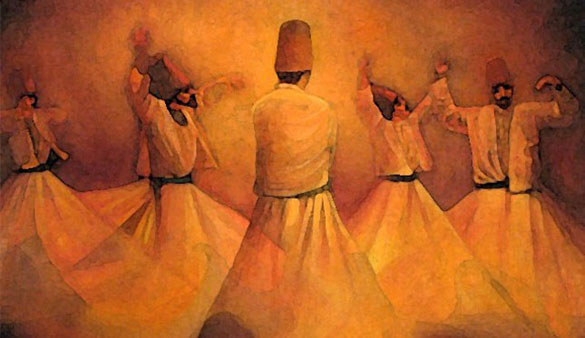
When we speak of the Sufi tree — rooted in divine remembrance (Zikr or Dhikr) and bearing fruits of unconditional love and compassion — we find a powerful parallel in the Bodhi Tree, under which awakening itself became history.
In essence, the Bodhi Tree actually and organically offers the beautiful seed for revitalising the “Sufi Tree”. It stands for deep divine wisdom, unconditional love, compassionate care and generosity of the spirit planted by the immortal spiritual intellect of Muslim mystics who activated the Divine Names of Allah making them into a reality in their lives. This metaphor of the “Sufi Tree” is not ornamental poetry; it is a spiritual map.
You may understand it more deeply as you see the famous Bodhi Tree in Bodh Gaya, India, which is revered as the tree beneath which an Indian Prophet of God Gautama Buddha attained enlightenment over 2,500 years ago. The original tree was a sacred fig (Ficus religiosa), and its descendants continue to be venerated as living symbols of spiritual realization. The word Bodhi means “awakening” or “enlightenment.” Thus, the Bodhi Tree is not sacred merely as a botanical entity, but as a witness to inner transformation. It represents the still point where striving ends and seeing begins.
The Qur’anic image of the “good tree” whose roots are firm and whose branches reach the sky echoes deeply within Sufi consciousness. The roots symbolize tawhid — the oneness of God — anchoring the seeker in unity. The trunk represents character, integrity, and moral steadfastness. The branches stretch toward transcendence, while the fruits manifest as compassion, justice, wisdom, and mercy. The celebrated Persian Sufi sage Sheikh Saadi writes:
“Before the Lord of Awareness, every green leaf of the trees,
Is a notebook of the knowledge of the Creator.”
Each leaf is a lesson. Each vein in the leaf is like a script of divine artistry. To contemplate the tree is to contemplate order, patience, and surrender. The leaf does not question the sun; it turns toward it instinctively. Likewise, the awakened heart inclines toward the Divine without coercion.
The “Sufi Tree” of unconditional love that my Murshid describes is not a mystical abstraction. It is a living practice. It asks: Do we give shade to those who disagree with us? Do we offer fruit even when unrecognized? Do we remain rooted when criticized? Such a Sufi tree teaches humility. No matter how tall it grows, its nourishment remains hidden underground. The Sufi too hides his spiritual states, allowing actions — not claims — to speak. Thus, it tells us that true spirituality is not loud; it is fruitful. Yet fruitfulness requires inner transformation, and here the tension between reason and ecstasy becomes crucial.
The profound metaphysical poet Mirza Abdul Qadir Bedil Dehlvi reminds us:
چہلازمباخِردہمخانہبودن
دوروزےمیتواںدیوانہبودن
What necessity is there to dwell always in the company of reason?
For a day or two, one may also live as a madman.
The “madness” of which Bedil-e-Dehlvi speaks is the overflowing sap of the tree — the energy of love that defies strict containment. Reason prunes; love makes grow. Reason calculates seasons; love trusts them. Without reason, growth may become chaotic. Without love, growth becomes sterile.
This delicate balance was beautifully articulated with remarkable clarity by the Poet of the East Allama Iqbal in his famous Urdu couplet:
لازمہےدلکےپاسرہےپاسبانِعقل
لیکنکبھیکبھیاسےتنہابھیچھوڑدے
It is necessary that reason remain as the guardian of the heart,
But once in a while, let it be left alone.
However, Iqbal’s vision is not anti-intellectual; it is integrative. The tree must be structured, but it must also be alive. Intellect provides form; love provides life. When intellect dominates entirely, the tree becomes dry wood. When emotion dominates without guidance, it becomes wild and unrooted.
The Sufi tree also embodies what may be called the Divine Feminine principle — mercy (rahmah), receptivity, nurturing presence, and relational wisdom. Just as the earth receives the seed and allows it to unfold, the Divine Feminine within the human soul creates space for growth. It is not weakness; it is generative power.
To activate this principle is to shift from domination to service, from competition to compassion, from ego-centred ambition to collective flourishing. The tree does not compete with the forest; it contributes to it. Its existence enriches the ecosystem.
Civilizationally, this symbolism offers a corrective to modern fragmentation. Today’s world is marked by uprootedness — ecological destruction, spiritual alienation, ideological extremism. The Sufi tree invites re-rooting. It calls for depth in an age of speed, silence in an age of noise, generosity in an age of accumulation.
A tree also grows slowly. It cannot be forced. The Sufi path is gradual cultivation. The roots deepen through divine remembrance (Dhikr). The trunk strengthens through ethical discipline. The branches extend through knowledge. The blossoms appear through sincerity. The fruits ripen through service. And more importantly, trees shed their leaves. They accept cycles. The seeker too must accept spiritual winters — periods of dryness, doubt, or fatigue. Yet the root remains alive. Patience sustains renewal.
When we internalize this metaphor, spirituality ceases to be a private escape and becomes public nourishment. We begin to measure our faith not by arguments won, but by hearts healed. Not by how high we appear, but by how deeply we are rooted.
As Sheikh Saadi suggests, every leaf is a book
As Mirza Abdul Qadir Bedil hints, love must occasionally transcend calculation. As Allama Iqbal advises, intellect must guard — but not suffocate — the heart. And as my Murshid reminds me: a tree is known by its fruits.
May we all become speaking trees — rooted in unity, rising in awareness, flowering in compassion, and bearing fruits of unconditional love for all creation.
…
Contributing author at New Age Islam, Ghulam Rasool Dehlvi is writer and scholar of Indian Sufism, interfaith ethics, and the spiritual history of Islam in South Asia. His latest book is "Ishq Sufiyana: Untold Stories of Divine Love".
New Age Islam, Islam Online, Islamic Website, African Muslim News, Arab World News, South Asia News, Indian Muslim News, World Muslim News, Women in Islam, Islamic Feminism, Arab Women, Women In Arab, Islamophobia in America, Muslim Women in West, Islam Women and Feminism