
VC of Jamia Millia Islamia Mazhar Asif's Controversial Remarks on all Indians sharing the D N A of Mahadeva: Is he calling for inclusivity or erasure of religious identity?

By Ghulam Rasool Dehlvi, New Age Islam
02 May 2026
Main Points:
· The Students' Federation of India (SFI) unit at Jamia Millia Islamia issued a strong condemnation of the Vice-Chancellor’s recent remarks. They argued that his statements are inappropriate for the head of a premier central university and risk undermining the secular and pluralistic ethos of the 'minority institution'.
· According to the SFI, the Vice-Chancellor’s assertion appeared to blur the distinction between cultural symbolism and constitutional secularism, thereby generating unnecessary religious and ideological controversy within an academic space that is meant to uphold inclusivity and intellectual neutrality.
· The controversy has since evolved into a broader debate on the role of public intellectuals and educational administrators in invoking religious or civilizational narratives in contemporary India.
· While supporters of the VC defend the statement as a metaphorical expression of shared ancestry and cultural interconnectedness, critics maintain that universities must remain cautious in articulating ideas that may be interpreted as privileging one religious idiom over others.
· The episode has therefore become emblematic of the larger national discourse surrounding identity, secularism, heritage, and the evolving language of inclusivity in India’s public sphere.
…
In his recent speech, which has gone viral on social media, the Vice-Chancellor of Jamia Millia Islamia, Mazhar Asif, is heard emphasizing India’s immense diversity by stating that “all Indians share the DNA of Mahadeva” (“Hamare DNA mein Mahadev ka DNA hai”).
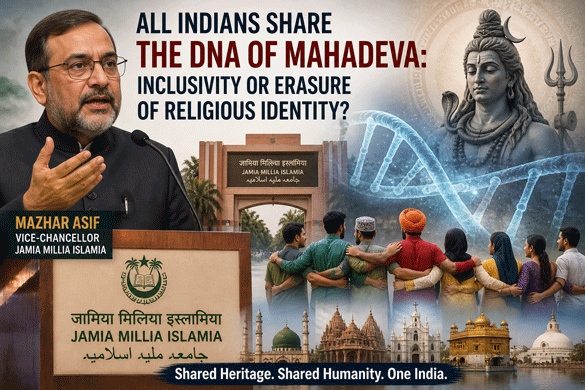
This remark by the Jamia V-C has sparked a sharp political and academic debate. He stated that people may differ in language, upbringing, culture, geography, and even religion, yet continue to share a common national identity as Indians. Thus, he reportedly remarked:
“Looking at everyone seated here, I do not believe that everyone shares the same mother tongue, upbringing, or culture. Geographically speaking, and I am stating this in a geographical context, they may not even hail from the same region. Their religions, too, may differ.”
He then added:
“Yet, despite all this, we remain Indians. We are Indians because the DNA of Mahadev resides within our own DNA.”
The statement appears to have been intended as a symbolic and civilizational metaphor aimed at expressing cultural interconnectedness and a shared heritage transcending religious and regional divisions. Supporters interpret the remark as an appeal for unity rooted in India’s composite civilization, while critics argue that invoking a specifically Hindu religious symbol in defining national identity may raise concerns in a constitutionally secular and religiously plural society.
The debate surrounding the statement reflects a wider intellectual and political conversation in contemporary India over how concepts such as ancestry, culture, spirituality, and nationalism should be articulated within an inclusive democratic framework. While critics interpreted the statement through a political or ideological lens, others viewed it as a symbolic affirmation of India’s shared civilizational heritage and cultural interconnectedness.
It has also revived discussions around the idea that India’s diverse religious communities, despite doctrinal differences, emerge from a common civilizational matrix shaped by centuries of coexistence, cultural exchange, and shared ancestry. Critics argue that such formulations risk blurring theological boundaries and may invite differing interpretations in a plural religious society. Nonetheless, the statement has undeniably reopened a wider conversation on identity, ancestry, inclusivity, and the relationship between faith and national belonging in contemporary India.
In the context of Indian society, the assertion that “all Indians share a single DNA” should not be perceived merely as an emotional, political, or ideological slogan. It is, in fact, grounded in substantial genetic and anthropological research. Contemporary studies in population genetics have consistently demonstrated that the people of India, irrespective of religion, caste, language, or region, are deeply interconnected through a shared and overlapping genetic heritage. While India’s demographic history reflects multiple waves of migration, assimilation, and social evolution over millennia, these processes ultimately produced a population that is biologically intertwined rather than sharply divided.
The scientific evidence thus reinforces the broader civilizational reality that India’s diversity exists within an underlying framework of common ancestry and shared human continuity.
In the charged atmosphere of contemporary identity politics, such statements are often reduced to controversy. Yet, beyond the noise lies a deeper and more enduring truth about the Indian subcontinent: despite differences of religion, language, caste, sect, or ideology, the people of India remain historically, culturally, and ancestrally intertwined.
The Vice-Chancellor’s statement, read carefully, was less a theological declaration than a reflection on common heritage. The metaphor of “DNA” was not about religion in the doctrinal sense; rather, it pointed toward the civilizational continuity and shared ancestry that connect millions across communities. One may change religion, ideology, or cultural affiliation over generations, but historical and biological connections often remain deeply intertwined.
Modern genetic and historical studies have repeatedly shown that most communities in South Asia possess overlapping ancestral roots shaped by centuries of coexistence, migration, intermingling, and cultural exchange. India’s Muslims, Hindus, Sikhs, Christians, Buddhists, Jains, and others are not isolated civilizations living side by side; they are, in many ways, branches of the same civilizational family tree.
Early Indians, the remarkable book by Tony Joseph, clearly argues that the people of the Indian subcontinent emerged through a long and complex process of migration, interaction, and cultural assimilation over thousands of years. According to his analysis, all communities living in India today are descendants of diverse groups of migrants who arrived at different historical periods and intermixed with populations already inhabiting the land. This understanding reinforces an important civilizational truth: no section of Indian society can claim complete racial, cultural, or biological exclusivity. Rather, all Indians are interconnected through a shared historical and ancestral continuum, shaped collectively through centuries of coexistence, exchange, and synthesis.
This idea is neither radical nor unprecedented. India’s spiritual and intellectual traditions have long emphasized the unity of humankind beneath outward differences. The Islamic tradition itself carries a profound message of human equality and shared origin. Muhammad clearly stated in his final sermon:
“All of you are from Adam, and Adam is from dust.”
Adam had a noble son named Seth (Shees or Sheth), who was born after the tragic episode in which Qabeel (Cain) killed Habeel (Abel), the first sons of Adam. In Islamic, Biblical, and other Abrahamic narratives, Shees is regarded as a righteous and spiritually elevated figure who succeeded Adam in guiding humanity after the loss of Habeel. Many traditional accounts describe him as a prophet endowed with wisdom and divine guidance, through whom the lineage of prophetic spirituality continued.
According to certain mystical and syncretic Sufi interpretations found within segments of Indian Islamic thought, Nabi Shees (a.s.) is believed to have journeyed to or preached in the Indian subcontinent. During my visits to shrines associated with Nabi Shees (a.s.), I learned that some Sufi masters, particularly within strands of the Naqshbandi mystical tradition, have drawn symbolic parallels between Shees and Shiva or Mahadeva. The syncretic Sufi traditions connected with Ayodhya hold Mahadeva in high spiritual esteem and consider all Indians as his progeny.
Such interpretations do not represent mainstream Islamic or Hindu theology, nor are they established through historical consensus. Rather, they belong to India’s broader tradition of mystical and interfaith engagement, where spiritual commonalities were often emphasized to cultivate harmony among communities. In this mystical view, the reverence for Mahadeva as exhibited by the Jamia V-C should not be understood in a polemical sense, but as part of an effort to foster interfaith respect and recognize the spiritual interconnectedness of India’s diverse sacred traditions.
The timeless teaching of the Qur’an dismantles all notions of religious exclusivism and racial, tribal, or inherited supremacism. If all humanity descends from Adam, then every human being shares a common spiritual ancestry and equal dignity before the Creator. The Qur’an declares:
“O mankind! We created you from a single male and female and made you into nations and tribes so that you may know one another.” (49:13)
The mystics and sages of Indian traditions echoed similar truths. Sufi saints, Bhakti poets, Vedantic thinkers, Buddhist teachers, and Sikh Gurus all equally emphasized the deeper unity of existence beyond superficial distinctions. Their message was simple yet transformative: beneath the labels of religion and identity lies a shared spiritual essence connecting all human beings.
We, the people of India, may be understood as reflections of the same ultimate human and spiritual truth. When we forget this, conflict becomes inevitable. Much of history’s violence has emerged not from diversity itself, but from claims of exclusivism and superiority — the belief that one community, sect, or religion alone possesses absolute entitlement over truth, dignity, or salvation. Such attitudes create division, fear, and alienation.
India’s civilizational strength, however, has historically rested on coexistence rather than exclusion. The Indian ethos evolved not through uniformity but through accommodation, synthesis, and dialogue. Spiritual traditions influenced each other. Sufi shrines welcomed all communities. Bhakti and Sikh traditions challenged rigid social hierarchies. Shared festivals, customs, music, poetry, and architecture became part of a composite culture that still shapes Indian life today.
It is within this broader context that the Jamia Vice-Chancellor’s remarks may be understood. His statement can be seen as an appeal toward inclusivity and shared belonging rather than the erasure of religious identity. Recognizing common ancestry or cultural interconnectedness does not weaken faith; rather, it can deepen mutual respect and strengthen national cohesion.
A confident nation does not fear diversity. It embraces it while acknowledging the deeper bonds that unite its people.
At a time when polarization threatens to reduce every conversation into competing ideological camps, India urgently needs voices that remind citizens of their shared humanity. Religious identity may differ, political views may diverge, and cultural practices may vary, but the larger human and civilizational connection remains undeniable.
The real challenge before India is not diversity itself, but whether diversity will be guided by empathy or by hostility. Inclusivity, mutual respect, and shared cultural values are not signs of weakness. They are the foundations of a mature civilization and the hallmarks of a strong republic. India’s future will not be protected by the politics of separation, but by the civilizational wisdom that teaches us that beneath our many identities, we remain part of one shared human story.
---
Contributing author at New Age Islam, Ghulam Rasool Dehlvi is a writer and scholar of Indian Sufism, interfaith ethics, and the spiritual history of Islam in South Asia. His latest book is Ishq Sufiyana: Untold Stories of Divine Love. He is also an alumnus of Jamia Millia Islamia.
New Age Islam, Islam Online, Islamic Website, African Muslim News, Arab World News, South Asia News, Indian Muslim News, World Muslim News, Women in Islam, Islamic Feminism, Arab Women, Women In Arab, Islamophobia in America, Muslim Women in West, Islam Women and Feminism