
Reimagining, Redefining and Reforming Hinduism in a Polarised Age: Why Shashi Tharoor's Book on Sree Narayana Guru Matters to Us Indians, Hindus and Muslims Alike

By Ghulam Rasool Dehlvi, New Age Islam
21 February 2026
At a time when religious identities are often mobilised for exclusion — whether through majoritarian nationalism or extremist interpretations of Islam — returning to these deeper currents of Advaita and Wahdat al-Wujud offers a corrective. Both traditions, in their highest articulation, dissolve superiority complexes and affirm interconnectedness. At this crucial juncture, Narayana Guru’s message emerges as a shared moral horizon between Islam and Hinduism — a call for equality, dignity, and universal brotherhood grounded in the very heart of their metaphysical visions, and not a dilution of distinct faiths….
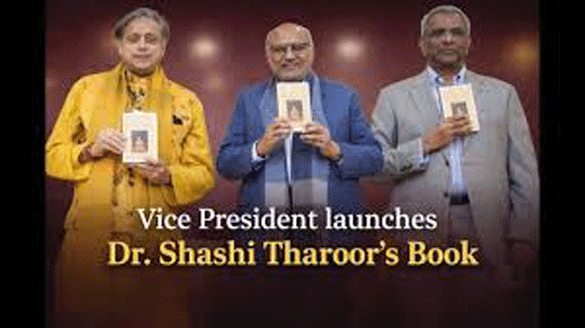
This writer attended the book launch of The Sage Who Reimagined Hinduism: The Life, Lessons and Legacy of Sree Narayana Guru, released by Vice-President C. P. Radhakrishnan and authored by Shashi Tharoor at Delhi’s India International Centre. The book release held on 19th February was more than an evening of literary gathering. It was, in many ways, an attempt to restore a forgotten moral clarity to voice India’s national and civilisational consciousness. This writer came away with a deeper reflection on some of the key takeaways from the book and its remarkable release which would tell the readers why this was not merely a literary occasion, but a civilisational intervention.
First things first! In his remarks, the Vice-President rightly lamented that the contributions of Indian philosophers and social reformers have not been adequately documented in international languages. This gap has limited their presence in global academic discourse. Among those insufficiently recognised outside regional contexts is Sree Narayana Guru, whose life and message carry universal resonance.
Reminder — all who can make it are ...Narayana Guru emerged in 19th-century Kerala at a time when caste discrimination was not only widespread but sanctified. Social hierarchies were so rigid that Swami Vivekananda once described Kerala as a “lunatic asylum.” Into this deeply unequal order, Narayana Guru introduced a spiritual revolution. What makes Narayana Guru historically significant is that he did not attack religion in order to reform society. Instead, he reinterpreted religion to liberate society. By consecrating temples open to all castes, promoting education, and instilling self-respect among the oppressed, he demonstrated that faith could be reclaimed from the grip of hierarchy. His declaration — “One Caste, One Religion, One God for humankind” — was not theological abstraction; it was a moral uprising against humiliation and exclusion.
From an Indian Muslim perspective, this dimension is profoundly important.
India today faces twin ideological distortions: majoritarian exclusivism on one side and religious extremism and radical Islamism on the other. The politicised interpretation of Hindu identity associated with Hindutva often reduces a vast, plural, philosophical civilisation to a narrow cultural nationalism. At the same time, radical strands within sections of Muslim discourse attempt to weaponise religion as a marker of separation rather than coexistence. Both tendencies feed off each other.
In such a climate, reimagining Hinduism in the inclusive, ethical spirit of Narayana Guru becomes not merely an internal Hindu reform project, but a national necessity. His universalism directly contradicts any attempt to define Hindu identity in exclusionary or supremacist terms. A Hinduism rooted in spiritual equality and human dignity leaves little room for majoritarian domination.
Equally, Narayana Guru’s method carries lessons for Muslims confronting internal challenges. He showed that reform is strongest when it arises from within tradition, not through reactionary defensiveness or rigid literalism. Just as caste injustice was challenged through reinterpretation of sacred ‘scriptural authority’, so too must Muslims address sectarianism, patriarchy, supremacism, exclusivism and intolerance through principled engagement with their own primary ethical and scriptural sources.
Just as Adi Shankaracharya’s non-dualistic Advaita Vedanta laid the philosophical bedrock of classical Hindu thought, Muhyiddin Ibn Arabi — revered in the Sufi tradition as Sheikh al-Akbar — deepened and internalised the Islamic creed of Tawhid (Oneness of God) through the metaphysical doctrine of Wahdat al-Wujud (Unity of Being). If Shankaracharya affirmed that ultimate reality is non-dual — that the apparent multiplicity of existence rests upon a single, indivisible Brahman — Ibn al-Arabi articulated that all existence is a manifestation of the One Divine Reality. In both traditions, plurality does not negate unity; it expresses it.
It is precisely at this philosophical intersection that Sree Narayana Guru’s immortal message — “One Caste, One Religion, One God for humankind” — acquires profound civilisational significance. His declaration was not an erasure of religious diversity, but a spiritual affirmation that beneath social divisions and sectarian identities lies a deeper ontological unity.
From an Indian Muslim perspective, this common ground is neither artificial nor politically constructed. It flows naturally from the metaphysics of Tawhid when understood in its ethical fullness. The Qur’anic assertion of divine unity demands moral unity — the equal dignity of all human beings before God. Similarly, Advaita’s non-dual vision undermines rigid hierarchies by affirming a shared spiritual essence.
In this light, Narayana Guru’s proclamation becomes more than devotional poetry. It becomes a revolutionary ethical bridge. By declaring the oneness of humanity under one divine reality, he challenged caste supremacy just as Sufi metaphysics historically challenged legalistic rigidity and spiritual arrogance.
For Indian Muslims committed to pluralism, Narayana Guru’s life offers reassurance that the subcontinent’s spiritual traditions contain resources for self-correction. He represents a Hindu reformist voice that affirms human unity rather than religious rivalry. In doing so, he weakens the ideological foundation upon which both Islamophobia and Islamist radicalism thrive.
There is also a strategic dimension. Extremist narratives — whether majoritarian or minority-based — depend on portraying religious identities as monolithic and perpetually in conflict. By highlighting reformers like Narayana Guru, India reminds itself and the world that its religious traditions have long histories of internal critique, inclusivity, and moral evolution. Shashi Tharoor’s book therefore performs a dual function. It restores Narayana Guru to the national conversation and introduces him to a global audience. More importantly, it re-centres an understanding of Hinduism that is philosophical rather than political, ethical rather than ethnic. In a time when religious identity is frequently mobilised for polarisation, the reclamation of spiritually grounded reformers is urgent. Narayana Guru’s insistence on human unity undermines caste arrogance, communal hostility, and sectarian absolutism alike.
For Muslims who believe in India’s constitutional pluralism, supporting such reimagining of Hinduism is not an act of concession — it is an affirmation of shared civilisational space. A confident, inclusive Hinduism and a self-critical, reform-minded Islam can together resist the pull of extremism on both sides.
To this writer, the evening of the book launch thus felt symbolically significant. It suggested that India’s future may depend less on ideological confrontation and more on moral retrieval — retrieving voices like Sree Narayana Guru who remind us that the deepest religious truths are those that dissolve hierarchy and affirm human dignity. If India is to defeat both majoritarian chauvinism and radical religious exclusivism, it will not do so through slogans. It will do so by recovering and amplifying its reformist sages — those who reimagined faith as a bridge, not a weapon. Thus, the book release function’s message is clear: safeguarding India’s civilisational memory is not an exercise in nostalgia. It is a commitment to ensuring that voices of ethical courage — such as that of Sree Narayana Guru — continue to inform the moral direction of the present.
Shashi Tharoor’s central achievement lies in repositioning Sree Narayana Guru not merely as a mystic withdrawn from the world, but as a quiet revolutionary who challenged caste hierarchy through education, temple reform, and a radically inclusive vision of faith. Structured into The Life, The Lessons, and The Legacy, the book moves seamlessly from biography to philosophy to social impact. Tharoor’s prose remains characteristically clear and measured, translating complex spiritual ideas into accessible language. The Guru’s emphasis on equality, self-respect, and human dignity is presented in a way that general readers can readily grasp without feeling overwhelmed by theological abstraction. Particularly compelling are the chapters addressing caste oppression and social reform, where spirituality is firmly rooted in lived social realities rather than romantic idealism.
Yet the book is not without limitations!
The book’s most noticeable deficiency is its largely uncritical tone. Tharoor’s admiration for Narayana Guru is evident throughout — sometimes to the extent that analytical distance gives way to endorsement. Readers seeking deeper academic debate, comparative philosophical tension, or a more rigorous interrogation of the Guru’s theological positions may find the narrative somewhat softened. Complex historical contradictions and internal disagreements within reform movements are touched upon, but not fully explored.
At moments, the writing also feels stylistically familiar — eloquent, persuasive, and polished, yet rarely surprising. Tharoor’s signature cadence lends dignity to the subject, but those expecting bold reinterpretations or sharply revisionist arguments may find the treatment more celebratory than interrogative.
That said, the book succeeds in its primary mission: restoring Narayana Guru to broader national and international attention. If it does not exhaust the subject academically, it opens the door for future scholarship. In that sense, its greatest contribution may not lie in critical deconstruction, but in making a compelling case for why deeper engagement with the Guru’s legacy is urgently needed today.
…
Contributing author at New Age Islam, Ghulam Rasool Dehlvi is writer and scholar of Indian Sufism, interfaith ethics, and the spiritual history of Islam in South Asia. His latest book is "Ishq Sufiyana: Untold Stories of Divine Love".
New Age Islam, Islam Online, Islamic Website, African Muslim News, Arab World News, South Asia News, Indian Muslim News, World Muslim News, Women in Islam, Islamic Feminism, Arab Women, Women In Arab, Islamophobia in America, Muslim Women in West, Islam Women and Feminism