
Is the Israel-Iran War Apocalyptic? A Comparative Study of Jewish, Christian and Islamic Eschatology

By Ghulam Rasool Dehlvi, New Age Islam
10 March 2026
Jewish Rabbis, Biblical commentators, Christian evangelists and Islamic eschatologists interpret the current war as a clear sign of approaching the prophecy of “end time”.….
Main Points:
· In the midst of war, scriptural prophecies and eschatological references return to public imagination. The current Israel-Iran confrontation has not only intensified geopolitical tensions in the Middle East but has also revived powerful apocalyptic narratives about the “end times”.
· For many believers across the Abrahamic traditions, the ongoing war in this region is not seen merely as a geopolitical conflict; it is rather interpreted as a great sign of a cosmic drama foretold in sacred scriptures.
· The Middle East occupies a unique place in the religious imagination of Christian Eschatology, Jewish Eschatology, and Islamic Eschatology. From the biblical visions of Armageddon to the Jewish conception of the War of Gog and Magog, and the Islamic tradition of Al-Malhama al-Kubra, the same geographical landscape—Jerusalem, the Levant, and the broader Middle East—appears repeatedly as the stage where history is believed to reach its final climax.
· These apocalyptic narratives have gained momentum and renewed attention. Jewish preachers, Biblical commentators, Christian evangelists and Islamic Youtubers interpret the current war as a clear sign of approaching prophecy.
· Yet mature scholars of religion must caution that sacred texts describing the end of time were meant primarily to inspire moral vigilance and spiritual reflection, not to serve as literal roadmaps for modern geopolitical conflicts.
In a recent article published at New Age Islam titled “War Against Iran: Is It a Religious War?”, the author has correctly pinpointed an eschatological worldview behind the ongoing Israel-Iran war. He observes that in the United States, some Evangelical Christians and Christian Zionists interpret conflicts in the Middle East not only in political terms but also through a biblical narrative of “End Times”. According to this belief, events in the region may fulfil prophecies described in the Bible about the final phase of human history.
Eschatological ideas such as Armageddon (the final great battle), the return of Jesus Christ, and the “pre-tribulation rapture” are central to Evangelical Protestant theology. The “rapture” is understood as the moment when true believers will be taken up to heaven before a period of global suffering and chaos known as the Tribulation. These beliefs are part of a theological system called “Dispensational Premillennialism”, which divides history into different divine eras or dispensations and teaches that major conflicts—particularly in the Middle East—will precede the second coming of Christ.
Because of this interpretation, some Evangelical and Christian Zionist groups strongly support the state of Israel, believing that events involving Israel are closely connected to the fulfilment of biblical prophecy and the unfolding of the End Times.
The ongoing confrontation between Israel and Iran is widely analysed through geopolitical, military and strategic lenses. Yet beneath the language of missiles, alliances and deterrence lies another powerful layer: an apocalyptic and eschatological imagination. For many religionists across the Abrahamic traditions, the Middle East is not merely a battlefield of states but also the stage of sacred history. In times of crisis, wars in this region often revive ancient narratives about the end of time.
When viewed comparatively, the striking fact is not the differences but the shared symbolic geography. All three traditions situate their apocalyptic imagination in the same sacred landscape: Jerusalem, the Levant and the broader Middle East. This overlapping sacred map means that every major conflict in the region—from medieval crusades to modern wars—tends to acquire cosmic meaning for believers. The Israel–Iran confrontation is therefore not only a political struggle but also a narrative battlefield where ancient prophecies are invoked, interpreted and sometimes misused.
However, history offers a sobering lesson. For centuries, every generation facing war in the Middle East has believed it might be witnessing the final chapter of history. Yet the world has continued. Responsible scholarship across Islam, Judaism and Christianity therefore stresses a critical distinction: apocalyptic texts are meant to inspire ethical vigilance, not political fatalism. When prophecy is used to justify violence or to frame war as inevitable, it risks turning faith into a lethal ideology.
Christian Eschatology
This phenomenon is most visible in Christian Eschatology, especially among some Evangelical movements in the United States. Certain groups interpret turmoil in the Middle East as a prelude to biblical prophecy. They link modern conflicts involving Israel to the apocalyptic battle of Armageddon, described in the Book of Revelation. According to this worldview, the return of Jesus Christ will follow a period of catastrophic wars and global upheaval. Such beliefs have helped shape the ideology of Christian Zionism, which sees the security and expansion of Israel as part of a divine plan leading toward the culmination of history.
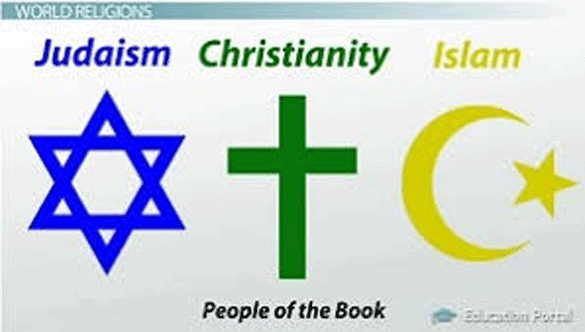
This interpretation is largely shaped by a theological construction known as “Dispensational Premillennialism”, a doctrine popularised in the 19th century by the Anglo-Irish theologian John Nelson Darby and later spread widely through evangelical churches and prophecy literature.
In the 20th century, these ideas became popular among American evangelicals through influential prophecy writings such as The Late Great Planet Earth by Hal Lindsey, which interpreted modern Middle Eastern conflicts as signs of the approaching biblical apocalypse. According to this doctrine, human history unfolds in distinct divine “dispensations,” culminating in a dramatic sequence of end-time events. Central to this narrative is the belief that the modern state of Israel plays a providential role in God’s plan. Many adherents interpret the establishment of Israel in 1948 and subsequent conflicts in the region as signs that biblical prophecy is entering its final stage.
Within this worldview, global turmoil—especially wars involving Israel and its neighbours—is often interpreted as a prelude to the apocalyptic battle of “Armageddon”, described in the Book of Revelation. In this narrative, world powers will gather for a climactic confrontation in the Middle East before the triumphant return of Jesus Christ. They also expect an event called the “Rapture”, in which “true believers” are taken up to heaven before a period of catastrophic tribulation unfolds on earth.
These theological expectations have played an important role in shaping the ideology known as Christian Zionism. Christian Zionists argue that supporting Israel is not simply a matter of foreign policy but a religious duty rooted in scripture. As a result, influential Evangelical leaders and organizations have often advocated strong political and diplomatic backing for Israel, believing that the security and territorial integrity of the Jewish state are essential steps in the divine timeline leading to the culmination of history.
Thus, Christian eschatology does not merely remain within the realm of theology. It shapes how certain communities understand international events, transforming political crises into signs of a cosmic drama that they believe will ultimately culminate in the return of Christ and the establishment of divine justice on earth.
However, Christian critics—including many theologians and historians—argue that this interpretation represents a modern reading of biblical texts rather than a universally accepted Christian doctrine. Nevertheless, its influence in American religious and political circles has been significant. In moments of the heightened conflict involving Israel and regional powers like Iran—apocalyptic language frequently resurfaces in Christian sermons, media commentary, and religious discourses.
Jewish Eschatology
In Jewish Eschatology, the end-time narrative centres on the arrival of a redeemer known as the Mashiach. Unlike some Christian interpretations, the Jewish Messiah is not divine but a human descendant of King David who will restore justice, bring the Jewish people back to their land, and inaugurate an era of peace and spiritual renewal.
Jewish philosopher Maimonides describes in his legal code, the Mishneh Torah, the Messiah as a king from the house of David who will restore Israel’s sovereignty and rebuild its spiritual life:
“The King Messiah will arise and restore the kingdom of David to its former glory… He will rebuild the Temple and gather the dispersed of Israel.”
— Mishneh Torah, Laws of Kings 11:1
This passage highlights three essential messianic expectations in Judaism: (1) restoration of Davidic leadership, (2) rebuilding of the Temple, and (3) ingathering of the Jewish diaspora.
Jewish eschatology also includes references to a dramatic final confrontation known as the “War of Gog and Magog”. This concept originates in the Hebrew Bible, particularly the Book of Ezekiel. In chapters 38–39, the prophet describes a future coalition of hostile nations led by a mysterious figure named Gog attacking the land of Israel. The prophecy declares:
“You will come up against My people Israel like a cloud covering the land… but I will magnify Myself and sanctify Myself before many nations.”
— Ezekiel 38:16
In this narrative, the attack ultimately fails because God intervenes to defend Israel and demonstrate divine sovereignty before the nations. Later rabbinic literature also discusses the Gog-Magog conflict. The Talmud contains passages suggesting that the turmoil preceding the Messianic age may include great suffering and global instability.
However, because the messianic narrative revolves around Jerusalem, the restoration of Israel, and conflicts involving the Jewish people, the ongoing war in the Middle East often revives public discussion of these ancient texts. As the tension escalates around Israel, references to Gog and Magog or the Messianic age reappear in religious discourses—though mainstream Jewish scholarship generally maintains a cautious and non-apocalyptic interpretation. In this way, Jewish eschatology combines hope for redemption with restraint in prediction, emphasizing that the ultimate transformation of history depends not on human speculation but on divine timing and justice.
Islamic Eschatology
While Jewish and Christian apocalyptic traditions focus heavily on the destiny of Israel and Jerusalem, Islamic Eschatology frames the end of time more broadly as a moral and spiritual trial for humanity.
Within Islamic Eschatology, the end of time is described through a sequence of moral, political and cosmic events. It speaks of the appearance of Imam Mahdi, the rise of the deceiver Dajjal, and the return of Jesus Christ—known as Isa in Qur’an—who will ultimately defeat the forces of deception. Hadith narrations also mention a massive conflict known as Al-Malhama al-Kubra, expected to occur in the region historically called Al-Sham (the Levant).
Islamic tradition describes the end times as beginning with a period of widespread moral and social upheaval. Numerous hadiths mention that injustice, corruption, and loss of ethical values will become widespread before the appearance of the major eschatological figures. In this moral climate of disorder and injustice, Islamic tradition says a righteous leader known as Imam Mahdi will emerge. While the Qur’an does not explicitly mention the Mahdi, numerous hadiths describe him as a descendant of the Prophet who will restore justice and guide the Muslim community during a time of global turmoil. According to a famous narration reported in Sunan Abu Dawud, Prophet Muhammad (pbuh) said:
“The Mahdi will be from my family, from the descendants of Fatimah.”
However, the Mahdi’s appearance does not end the trials of humanity. Islamic eschatology describes a powerful deceiver known as Dajjal, whose name literally means “the great deceiver.” He is often compared to the Antichrist in Christian tradition. Widely cited hadiths emphasize the gravity of this trial such as this: “There will be no trial on earth greater than the trial of the Dajjal” (Sahih Muslim).
The hadith literature also mentions a massive end-time conflict called Al-Malhama al-Kubra, sometimes translated as “the Great Battle.” Narrations in Sahih Muslim describe a large confrontation between Muslim forces and opposing armies in the region historically known as Al-Sham. One narration says: “The Hour will not come until the Romans land at al-A‘maq or Dabiq…” (Sahih Muslim).
Despite the dramatic imagery of these narrations, classical Muslim scholars have consistently warned against linking specific modern conflicts to these prophetic events. The renowned scholar Ibn Khaldun, for example, urged caution when interpreting apocalyptic traditions, noting that many such reports were misunderstood or misapplied in political contexts.
More importantly, the Qur’anic worldview places far greater emphasis on ethical accountability than on speculative predictions about geopolitics. The Qur’an repeatedly reminds believers that the exact timing of the end of the world remains unknown: “They ask you about the Hour: when will it occur? Say: its knowledge is only with my Lord.” (Qur’an 7:187).
Thus, Islamic eschatology ultimately directs attention not toward predicting wars or identifying contemporary events with prophecy, but toward moral responsibility, justice, and spiritual preparedness. The central message is that the end of history belongs to divine knowledge alone, while human beings are accountable for their actions in the present world.
To conclude, the real challenge posed by the Israel–Iran conflict is thus not theological but moral. If religious traditions share the hope of a future age of justice and peace, then the task of believers is not to hasten apocalyptic wars but to prevent them. The sacred narratives of the Abrahamic faiths ultimately point toward divine justice, reconciliation and accountability—values that should guide human action long before any imagined end of the world arrives. This is what is enjoined upon and reinforced in the Qur’an (20:15):
“Indeed, the Hour is coming, but I keep it hidden so that every soul may be rewarded for what it strives for.”
…
Contributing author at New Age Islam, Ghulam Rasool Dehlvi is writer and scholar of Indian Sufism, interfaith ethics, and the spiritual history of Islam in South Asia. His latest book is "Ishq Sufiyana: Untold Stories of Divine Love".
…
New Age Islam, Islam Online, Islamic Website, African Muslim News, Arab World News, South Asia News, Indian Muslim News, World Muslim News, Women in Islam, Islamic Feminism, Arab Women, Women In Arab, Islamophobia in America, Muslim Women in West, Islam Women and Feminism