
Indian Muslims Must Continue to Celebrate ‘Eid-e-Gulabi’ as their Festival of Colours. Here’s Why!

By
Ghulam Rasool Dehlvi, New Age Islam
24 March
2024
Indian Muslims Must Consider The Continuation
Of ‘Eid-E-Gulabi’ As The Sufi Celebration Of Colours To Promote A Peaceful And
Pluralistic Tradition With A Greater Emphasis On The Message Of Sufi Mystics—Wahdat
Or Unity Of The Being. The Sufi Celebration Of Colours Would Greatly Contribute
Towards Protecting Indian Composite Culture, National Integration And
Preservation Of The Pluralistic Culture Of The Country And The Values Of A
Multicultural Indian Society
.......
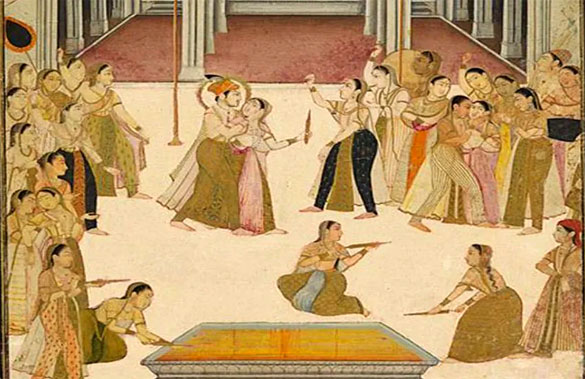
Holi was celebrated with great pomp even during the Mughal rule.
Holi was called ‘Eid-e-Gulabi’ (Eid-e-Hulabi) and ‘Aab-e-Pashi’.
------
Holi—a
festival full of colours—has no particular ‘religious colours’, and of course,
colours should have no religion. There are different ways to celebrate colours
in India, and one of them is “Eid-e-Gulabi”. Today when this festival is being
celebrated everywhere in its own style, Sufi lovers and shrine visitors also
enjoy the festivity of Holi in a joyous manner. While pilgrims and tourists
come from abroad to see Holi in Mathura, Vrindavan and Barsana, Indian Muslim
mystics and their followers today also consider Holi as a festival of mutual
brotherhood. On this day, they believe, Hindus and Muslims of the country must
end mutual hatred by hugging and congratulating each other. Be it city or
village, people everywhere celebrate Holi in their own special way. The famous
Holi of Barsana is a common knowledge today. But not many know that in multicultural
and colourful country, there has been an amazingly unique style of Holi
celebration—The Sufi celebration of colours—popularly known as “Eid-e-Gulabi”.
That is a Holi played at Dargahs like the holy shrine of the famous Sufi saint
Haji Waris Ali Shah located in Barabanki, UP.
Hori Khelungi, Keh Bismillah.
Nam Nabi Ki Ratn Chadi,
Boond Padi Allah Allah.
Rang Rangeeli Ohi Khilave,
Jis Seekhi Ho Fanaa Fi Allah.
“Alastu Bi Rabbikum” Pritam Bole,
Sab Sakhiyan Ne Ghunghat Khole.
Qaloo Bala,Yunhi Kar Bole, “La Ilaha Illallah”
Translation: In the name of Allah, I begin to
play Holi reciting Bismillah. Cast like a gem in the name of the holy Prophet
(pbuh). Each drop falls with the beat of Allah, Allah. Only he may play with
these colourful dyes, who has learnt to lose himself in Allah. “Am I not your
lord?” asked the lover. And all maids lifted their veils. Everyone said, “Yes!”
and repeated: “There’s only one God”.
These
beautiful couplets were composed by the prominent Punjabi Sufi mystic, poet and
a revolutionary philosopher Sayyid Abdullah Shah Qadri, more popularly known as
Bulleh Shah. He rendered these mystically nuanced poetic exhortations of divine
love and ultimate union in his celebration of Holi during his times (1680-1757)
in an undivided India. But his words are more relevant today in the
conflict-ridden communally sensitive society in the Indian subcontinent.
-------------------------------------------------------------------------
-------------------------------------------------------------------------
Munshi
Zakaullah in his book “Tareekh-e-Hindustani” has rightly asked: “Who says Holi
is just a Hindu festival?” The last Mughal Emperor who was also a Sufi
follower, Bahudar Shah Zafar, would rejoice in the celebration of Holi. He
believed that his religion would not be affected by this cultural celebration
and even encouraged his Hindu ministers to smear his forehead with gulal on
Holi. He also adored the festival in his poetry:
Kyun Mope Maari Rang Ki Pichkaari Dekh Kunwarji
Dungi Main Gaari
Bhaag Sakun Main Kaise Moso Bhaago Nahin Jaat
Thaande Ab Dekhun Main Baako Kaun Jo Sun Mukh
Aat
Bahut Dinan Mein Haath Lage Ho Kaise Jaane
Deoon
Aaj Main Phagwa Ta Sau Kanha Faita Pakad Kar
Leoon.
Translation:
Why have you squirted me with colour? O Kunwarji, I will swear at you. I can’t
run. I am unable to run. I am now standing here and want to see who can drench
me. After many days have I got my hands on you, how can I let you go? I will
catch you by your cummerbund and play Holi with you.
At the
Indian Sufi shrines like Dewa Sharif, the Dargah of Haji Waris Ali Shah in
Uttar Pradesh, Holi has been celebrated with as much enthusiasm as Eid ul Fitr.
Therefore, it is popularly known as Eid-e-Gulabi or “Pink Eid” in the age-old
Sufi tradition. Waris Ali Shah, more popularly known as Sarkar Waris Piya of
Dewa Sharif, was an inclusivist Indian Muslim mystic from Barabanki. Besides an
array of beautiful spiritual traits, Dewa Sharif is India’s most notable Dargah
today where Holi is celebrated as “Eid-e-Gulabi” with a similar fervour as in
Hindu faith traditions. Every year when the colourful festival of Holi comes,
the shrine visitors at Dewa Sharif start invoking the divine blessings through
the Sufi celebration of colours. In fact, the crucial significance of such Sufi
festivities is vital to our collective spiritual consciousness in India.
Born into
the 26th generation of Imam Hussain, Waris Piya was not an ordinary saint, but
a successor to the prominent Sufi order — Qadriyya-Razzakiyya, and thus the
founder of Warsi Silsila in modern Indian Sufism. With a profound knowledge in
classical Islamic sciences, Waris Piya was a widely travelled Murshid
(master) of people from across the country, irrespective of faith and creed.
For decades, they all come together to celebrate the Sufi Holi as Eid-e-Gulabi
at the sanctum of Dewa Sharif. A custodian of this Dargah, Ghani Shah, asserts
that Waris Piya exhorted his Mureeds (disciples) to venerate every
religion as a spiritual foundation based on the mutual feelings of love and
devotion. Ghafur Shah, a scholar of the Waris spiritual lineage, notes in his
book: “The Blessed Lord Haji Hafiz Syed Waris Ali Shah,” that Waris Piya
undertook the Hajj pilgrimage several times, and held extensive visits to the
West, especially the European countries, including Germany, England and Turkey.
During his travels to Europe, Waris Piya also met and blessed the Sultan of
Turkey and Bismarck of Berlin, and had an audience with Queen Victoria in
England.
A close
relative in Waris Pak’s family lineage Prof. Wahajuddin Alwi, who is wedded to
his great granddaughter, Asma Parween, told this writer: “Since Waris Piya
wanted people in India to transcend religious/sectarian divides, he
participated in Hindu festivals like Holi. His non-Muslim mureeds and regular
disciples included Raja Udyat Narayan Sing, raja of Oudh, Thakur Pancham Singh Talukdar
of Eta, Pundit Deendaar Shah of Indore, Sahaj Ram Dixit, Thakur Grur Mohan
Singh, a zamindar of Bhagalpur. They were spiritually in parallel with his
Muslim bureaucrat Mureeds such as governor general Ghulam Mohammad and
Justice Sharfuddin.”
As a matter
of fact, the syncretic Sufi celebration of colours in India was actually
inspired by the holiest Chishti Sufi saint of Delhi, Hazrat Khwaja Nizamuddin
Aulia R.A and his disciple, Hazrat Amir Khusro. They revered colours,
especially “pink” and “yellow”, as divine expressions in their highly
imaginative mysticism expressed through deeply moving Sufi discourses and
beautiful Persian and Hindavi poetry. Therefore, Holi and Basant became an
integral part of the Dargah celebrations. Hazrat Amir Khusro wrote the
following couplet on the divine connotations of colours in his Hindavi Kalam:
Kheluungii
Holi, Khaaja Ghar Aaye,
Dhan Dha
Bhaaghamare Sajni, Khaaja Aaye Aangan Mere
(I shall
play Holi as Khwaja has come home, blessed is my fortune, o friend, as Khwaja
has come to my courtyard).
More to the
point, Holi was celebrated as Eid ul Alwan (The Colourful Eid) and
Eid-e-Gulabi during the reign of the Mughal emperors especially Shahjahan and
Jalaluddin Akbar. In Mughal India, it was also called “Aab-e-Pashi”
(shower of colourful flowers) as it is mentioned in Tuzk-e-Jahangiri,
the autobiography of Mughal Emperor Nuruddin Muhammad Jahangir. Emperor
Jahangir also used to hold Mahfil-e-Holi.
Indian
Muslims must consider the continuation of Eid-e-Gulabi as the Sufi celebration
of colours to promote the peaceful and pluralistic tradition of Sufism with a greater emphasis on the
message of Sufi Mystics—Wahdat or Unity of the Being. The Sufi Celebration of
Colours would greatly contribute towards protecting Indian composite culture,
national integration and preservation of the pluralistic culture of the country
and the values of a multicultural Indian society.
-----
A Regular Columnist with Newageislam.com, Ghulam Rasool Dehlvi is an
Indo-Islamic scholar and English-Arabic-Urdu writer with a background in a
leading Sufi Islamic seminary in India.
URL: https://newageislam.com/interfaith-dialogue/indian-muslims-eid-e-gulabi-colours-holi/d/131989