
India Arises for the Prophet's Family: Delhi’s Jannatul Baqi Conference Was A Quiet Show of Unity and Sectarian Solidarity

By Ghulam Rasool Dehlvi, New Age Islam
25 April 2026
Main Points:
· While sections of Muslim discourse are busy manufacturing outrage over sectarian differences, a quiet but powerful reality unfolded in Delhi—one that exposes just how disconnected these divisive narratives are from the ground.
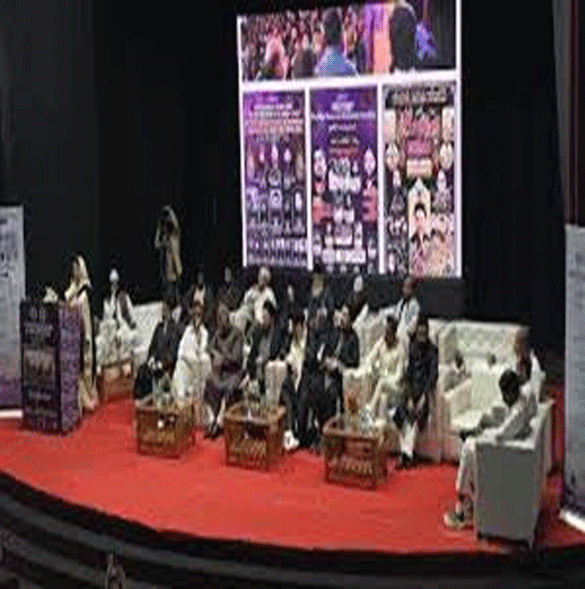
At a recent gathering in the capital, held in solidarity with the legacy of Jannat al-Baqi—the sacred cemetery in Madinah—Sunni and Shia scholars stood together. Community leaders spoke in one unison. Even non-Muslim figures joined in support. Hussaini Brahmins like Dr. Sufi Raj Jain of Khwaja Mandir, Hoshiarpur Punjab and his wife Divia ji revered as Kaneez-e-Sakina and “Guru Maa” emphasized that this awareness must go beyond annual events and reach every home.
An international conference calling for the reconstruction of Jannat-ul-Baqi was held on April 19, 2026, at the Aiwan-e-Ghalib Auditorium in New Delhi, drawing an unusually broad spectrum of voices. Organised by the Sufi Islamic Board and the Al-Baqee Organization, the gathering was not merely a protest against the historic demolition of the sacred cemetery in Madinah, but a powerful assertion of shared Islamic heritage. What stood out was the cross-sect participation—scholars and leaders from both Sunni Islam and Shia Islam traditions, alongside non-Muslim public figures, united in demanding the rebuilding of the shrines associated with the Ahl al-Bayt. In doing so, the event quietly but firmly challenged the sectarian framing of the issue, recasting it instead as a collective moral and civilisational concern of the wider Ummah.
In a notable gesture of solidarity, they underscored that preserving the legacy of the Ahl al-Bayt is not a sectarian demand but a universal moral responsibility. This collective call for rebuilding the shrines of the Prophet’s family members in Makka and Madina thus emerged as a civilisational concern that transcends religious boundaries. It’s not a narrow doctrinal issue.
“This is not a Shia issue alone—it is part of our shared Indo-Islamic heritage,” said Maulana Kalbe Jawad Naqvi, a prominent Shia cleric from Lucknow. “When we speak of Jannatul Baqi, we speak of a history that belongs to the entire Ummah.”
That sentiment was echoed by Sunni voices. “At a time when differences between Sunni Islam and Shia Islam are routinely weaponised, this is not just an event. It is a rebuttal of sectarianism in India, said Maulana Ubaidullah Khan Azmi, former MP and a noted Sunni scholar.
“Differences in fiqh or theology should never blind us to our mushtarka aqdaar (shared values),” said Maulana Khalid Rasheed Firangi Mahali. “Our tradition teaches us to respect difference and diversity without turning it into division.”
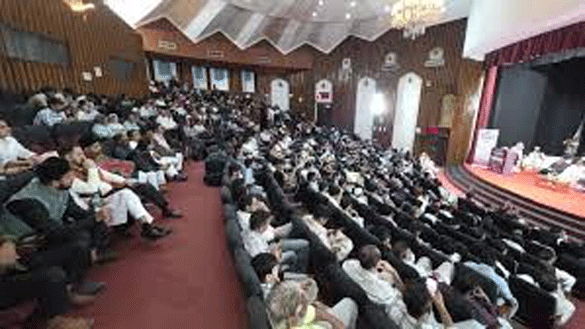
A Ground Reality That Defies Digital Narratives
Scroll through social media, and you would think the Muslim community is irreparably divided. Sectarian preachers dominate timelines, peddling outrage and reducing centuries of scholarship into soundbites.
But the Delhi gathering told a different story.
Here were scholars and citizens refusing to be boxed into sectarian binaries. Here was unity—not imposed, but consciously chosen.
“This is India’s shared Islamic tradition,” noted Agha Syed Ruhullah Mehdi. “We have always had differences, but we also had the wisdom to manage them.” Addressing the gathering, the political leader and a Shia cleric from Jammu & Kashmir struck a broader political and moral chord: “The legacy of Jannatul Baqi is not about sectarian claims—it is about preserving a shared historical and spiritual memory. When we stand for it, we stand for dignity, heritage, and unity.”
The Real Crisis: Not Theology, But Scholarship
What we are witnessing today is not a doctrinal crisis—it is a crisis of authority. Self-styled preachers, often lacking serious scholarly grounding, have turned sectarian identity into a tool of influence. Their formula is simple: provoke, polarise, and profit from attention. This is not a scholarship. It is sectarian populism.
The classical tradition offers a stark contrast. Scholars like Imam Abu Hanifa and Imam Ja'far al-Sadiq engaged across traditions with intellectual humility. Their differences enriched the Ummah—it did not divide it.
“Today, we have confused Ikhtelaf (difference) with Ifteraq (divisiveness),” observed a social media influencer and a Kota-based medical educationist, Umar Farooq Ashrafi. “Difference is natural. Division is a choice”, he said.
Why This Moment Matters!
For Indian Muslims, this distinction is not academic—it is existential. As a diverse minority, internal cohesion is essential for social, educational, and political progress. Sectarian fragmentation weakens institutions and distracts from urgent challenges.
The Jannatul Baqi mobilisation, though modest, points to a different future—one where shared concerns override sectarian labels. It shows that sectarian unity is not only possible; it is already being practiced at the grassroots in Indian polity.
But such moments must be amplified, not overshadowed by louder, more divisive voices.
What unfolded in Delhi was more than a protest. It was a quiet assertion of that principle. A reminder that beyond the manufactured divisions lies a deeper truth: the nation’s strength lies not in erasing differences, but in rising above them. A community that follows sectarian preachers will fragment; one that follows true scholars will rise. In the end, it is not our differences that will define us—but how we rise above them. If unity is abandoned, no external challenge will need to defeat us—we will have done it ourselves.
…
Contributing author at New Age Islam, Ghulam Rasool Dehlvi is writer and scholar of Indian Sufism, interfaith ethics, and the spiritual history of Islam in South Asia. His latest book is "Ishq Sufiyana: Untold Stories of Divine Love".
New Age Islam, Islam Online, Islamic Website, African Muslim News, Arab World News, South Asia News, Indian Muslim News, World Muslim News, Women in Islam, Islamic Feminism, Arab Women, Women In Arab, Islamophobia in America, Muslim Women in West, Islam Women and Feminism